
Registered behavior technician RBT training is the starting point for many people exploring the RBT pathway, but a course is not the same thing as certification. A useful review asks whether the training follows the current BACB outline, provides active learning and a qualified responsible trainer, documents completion correctly, and leaves you prepared to handle the competency assessment, application, examination, and supervision steps that come next.
Table of Contents
- Registered behavior technician RBT training: what the course should cover
- Registered behavior technician RBT training: how to verify 2026 alignment
- How to compare online, live, in-person, and employer-provided formats
- Registered behavior technician RBT training: what completion does not mean
- Registered behavior technician RBT training: how to review course quality
- Questions to ask before paying or enrolling
- Frequently asked questions
- Official sources and scope
RBT training course review framework
Registered Behavior Technician RBT Training: How to Choose a 2026-Ready Course
Compare a course against the current BACB training requirements without confusing 40-hour training with the entire RBT credential pathway.
If you are comparing registered behavior technician RBT training, start by separating the course from the credential. The training is a required part of the path for many applicants, but it does not by itself make someone an RBT. A strong course should teach the current content, create opportunities to practice, document completion, and explain what the learner must still do next.
This distinction matters because course pages often use phrases such as “RBT certification course” or “become an RBT online.” Those phrases may describe a training product, a bundled pathway, or a marketing package. The current BACB requirements and Handbook—not a headline—determine whether a learner has completed the applicable steps.
Registered behavior technician RBT training: what the course should cover
BACB’s current 2026 training document says the training must cover the 2026 curriculum outline in the context of behavior-technician service delivery. That means a useful course should connect concepts to the kinds of decisions, observations, documentation, teaching procedures, behavior-reduction procedures, and professional conduct expected in the role.
Do not judge a course only by the number of videos or by whether it says “40 hours.” Review the outline. Look for a clear mapping to the current BACB content, plain explanations, examples and nonexamples, practice opportunities, feedback, and a way to check understanding. A long playlist can still be passive if the learner only watches and clicks “next.”
The course should also be honest about role boundaries. An RBT implements services under direction and close supervision. Training should not imply that a learner will independently diagnose, design an assessment, rewrite a behavior plan, or make clinical decisions simply because those topics appear in a lesson.
Registered behavior technician RBT training: how to verify 2026 alignment
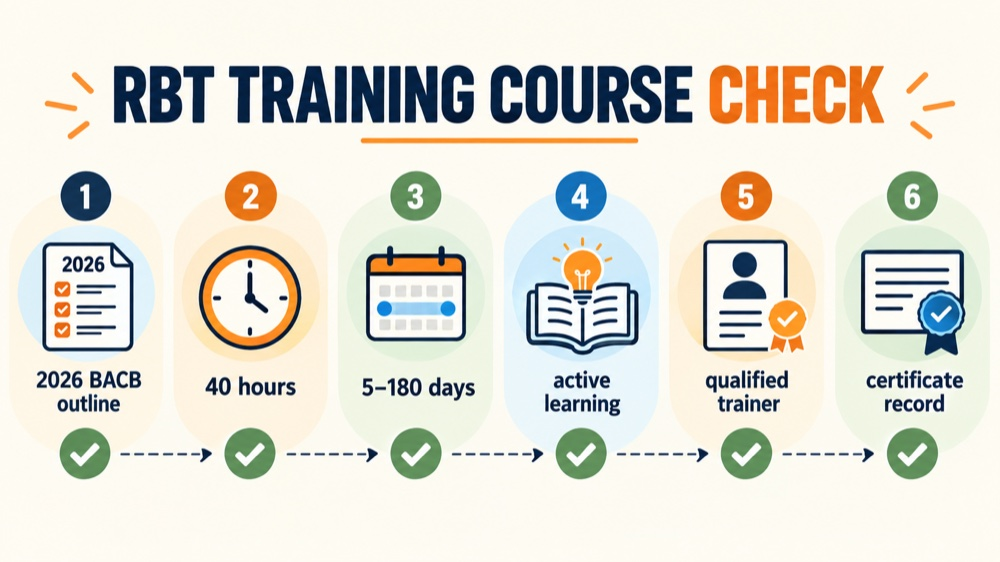
For applicants applying on or after January 1, 2026, BACB’s 2026 40-hour training requirements specify a minimum of 40 hours, completed in no fewer than 5 days and no more than 180 days. The course page should state which requirement version it is designed to meet. If a page still describes an older outline without explaining the transition, ask the provider for a current syllabus before enrolling.
Delivery format is flexible, but the learning design is not just “hours on a clock.” BACB lists possible behavioral-skills-training components such as video-based or didactic instruction, modeling with exemplars and nonexemplars, in-vivo role-play with feedback, quizzes, interactive activities, and instructor-led discussion. Assigned reading alone may not count toward the overall training duration.
- Version: Does the provider clearly identify the 2026 training requirements and curriculum outline?
- Time: Can you see how the course reaches at least 40 hours within the 5-to-180-day window?
- Learning activities: Does the course include active practice, modeling, feedback, quizzes, or discussion rather than only reading?
- Trainer: Is the responsible trainer identified, and does the provider explain the trainer’s oversight role?
- Records: Will you receive documentation that identifies the learner, training dates, responsible trainer, and required completion information?
How to compare online, live, in-person, and employer-provided formats
Online, live, in-person, and employer-provided courses can all look different while still being useful. The format is not a quality verdict by itself. Compare what the learner actually receives.
| Format | Potential benefit | What to verify |
|---|---|---|
| Self-paced online | Flexible scheduling and repeat access | Completion tracking, practice, feedback, technical support, and the deadline window |
| Live online | Real-time questions and discussion | Attendance rules, interaction, make-up policy, and access to the responsible trainer |
| In person | Immediate modeling and in-room rehearsal | Travel, accessibility, schedule, class size, and how practice is documented |
| Employer provided | May connect training to a real workplace and next steps | Who provides the course, who is responsible for training, and whether the course meets your applicable pathway |
A provider may offer more than one format. Ask whether the same curriculum, trainer oversight, documentation, and learner support apply to each version. A low price may be helpful, but price alone cannot confirm compliance or learning quality.
Registered behavior technician RBT training: what completion does not mean
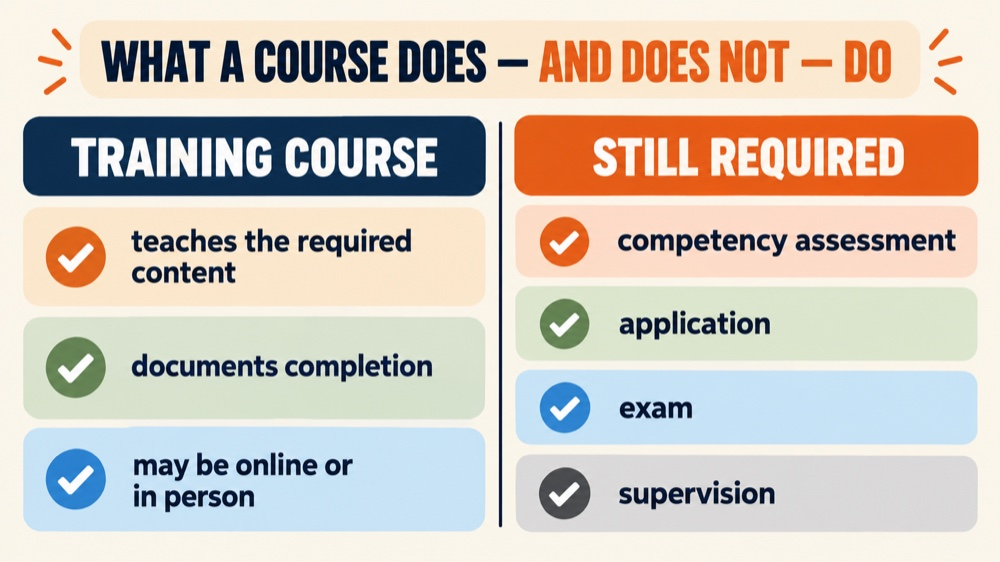
Completing a training course is not the same as holding the RBT credential. BACB’s public RBT materials describe additional steps in the pathway, including the initial competency assessment, application, examination, and ongoing supervision requirements. The exact process and documents can change, so use the current Handbook and BACB resource pages when planning your next step.
A course certificate can show that the training provider recorded completion. It does not independently prove that an applicant has passed a competency assessment, submitted an accepted application, passed the examination, or met supervision requirements. Be cautious when a sales page compresses all of those steps into one phrase such as “full certification.” Ask for a step-by-step explanation.
Registered behavior technician RBT training: how to review course quality
Once a course appears aligned on paper, review the learner experience. You are looking for evidence that the training helps you understand and apply the material, not merely accumulate screen time.
- Read a real lesson sample. Does it define terms, show examples, explain common errors, and connect the concept to service delivery?
- Check the practice loop. Can you rehearse a skill, receive feedback, and try again? If a course advertises quizzes, find out whether the quizzes explain why an answer is correct.
- Confirm support. Know how you ask content questions, report technical problems, request accessibility support, and obtain missing records.
- Review trainer accountability. Identify the responsible trainer and ask how the provider maintains the training records and monitors assistant trainers.
- Look for accurate boundaries. Good training prepares you to work within competence and supervision; it does not sell independence beyond the RBT role.
- Check the update policy. Ask what happens if BACB changes the outline while you are enrolled and whether the provider will explain which version your record reflects.
Testimonials can help you understand how learners experienced a course, but they are not proof that every learner will receive the same result. Treat pass-rate claims, badges, and phrases such as “BACB approved” as prompts to verify—not as substitutes for the official requirements.
Questions to ask before paying or enrolling
Before you purchase or accept a course, ask the provider these questions in writing:
- Which current BACB training requirements and curriculum outline does this course follow?
- What are the exact start and completion dates, and how is the 40-hour duration documented?
- Who is the responsible trainer, and how can learners contact the training team?
- Which parts involve modeling, rehearsal, feedback, quizzes, interactive activities, or discussion?
- What will the completion record include, and how can a correction be requested?
- Does the price cover only training, or does it include any separate assessment, application support, or exam-preparation resources?
- What happens if the course is updated or if I need accessibility or technical support?
If a provider avoids the questions, promises certification from course completion alone, or cannot explain its responsible-trainer and recordkeeping process, pause before paying. You can compare another course without treating a marketing countdown as a deadline.
Frequently asked questions
Is registered behavior technician RBT training the same as RBT certification?
No. Training is one part of the pathway. Depending on the current BACB requirements that apply to you, additional assessment, application, examination, and supervision steps remain.
Can RBT training be completed online?
BACB’s 2026 training requirements allow online, in-person, or combined delivery when the program meets the applicable requirements. Verify the provider’s current outline, active-learning components, timing, trainer oversight, and documentation.
How long should the 40-hour training take?
For the 2026 requirements, the training must be completed in no fewer than 5 days and no more than 180 days, with at least 40 hours of training. Confirm the version that applies to your application date.
Does the BACB approve a specific RBT training company?
Do not assume that a provider’s use of BACB terminology means BACB endorses that provider. Compare the provider’s claims with the official BACB requirements and ask the provider to explain its documentation and responsible-trainer process.
What should I do after finishing the course?
Review the current BACB RBT Handbook and pathway resources, confirm your documentation, and determine the next applicable competency-assessment, application, examination, and supervision steps. The course provider may offer help, but the live BACB requirements control.
Official sources and scope
This guide was checked against BACB’s RBT resource page, the 2026 RBT 40-Hour Training Requirements and Curriculum Outline, the Supervision, Assessment, Training, and Oversight page, and the current RBT Handbook resource. Requirements and documents can change, so use the live BACB sources for current decisions.
Ready to practice the RBT concepts you just reviewed?
Try an independent, original RBT practice resource with exam-style questions, scoring, and answer explanations.
References
- Behavior Analyst Certification Board. RBT Test Content Outline, 3rd edition.
- Behavior Analyst Certification Board. RBT Handbook.
- Behavior Analyst Certification Board. RBT Ethics Code.