
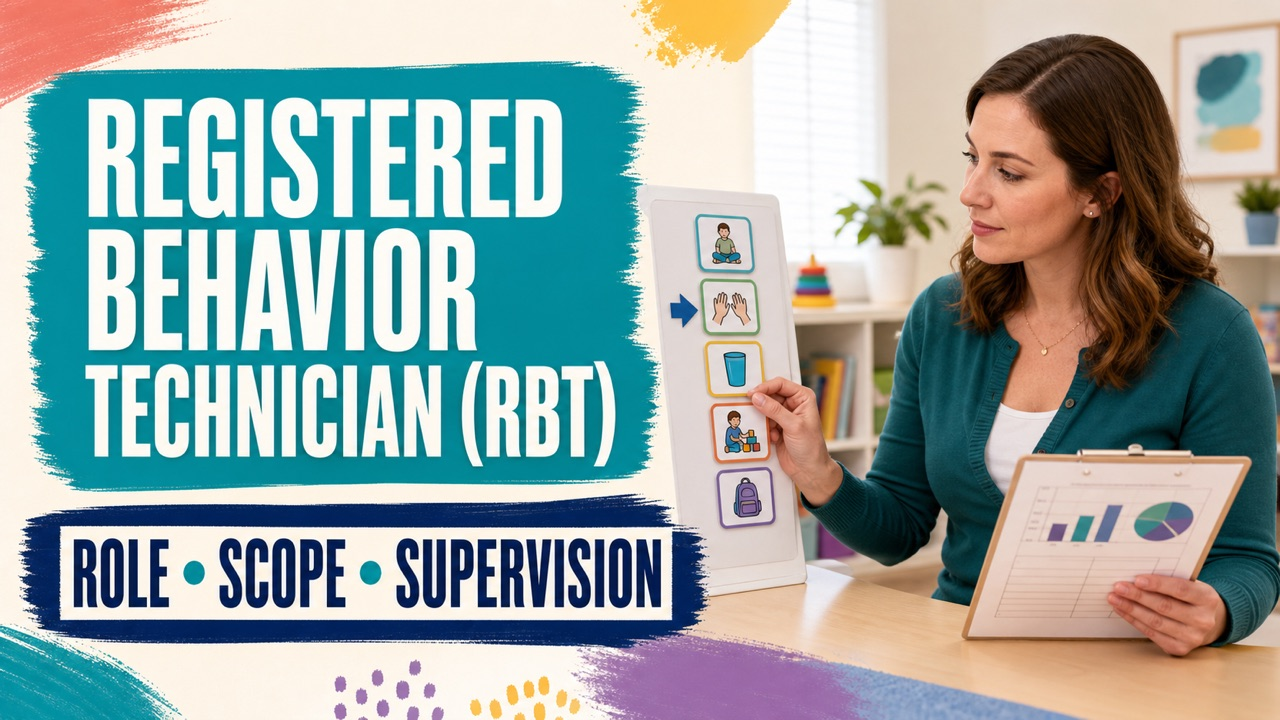
The phrase registered behavior technician RBT refers to a credentialed paraprofessional who assists with behavior-analytic services under the direction and close supervision of an RBT Supervisor and/or RBT Requirements Coordinator. The RBT role is hands-on and important, but it is not independent clinical practice and it is not the same credential as a BCBA or BCaBA.
Table of Contents
- Registered behavior technician RBT: what the credential means
- What does an RBT do in a typical service session?
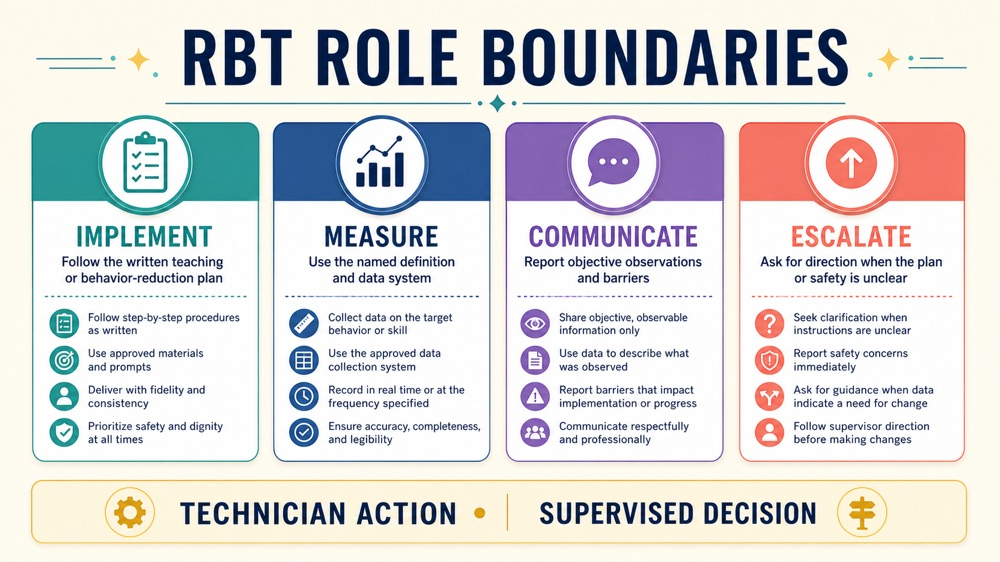
- RBT scope: implement, record, communicate, escalate
- How to become an RBT under the current path
- How RBT supervision works
- Skills to build before and after RBT certification
- Connect RBT work to the six-domain exam map
- Common misconceptions about the registered behavior technician RBT role
- Frequently Asked Questions
- References
In everyday work, an RBT may implement written teaching and behavior-reduction procedures, collect data, support skill acquisition, document sessions, communicate objective observations, and follow safety procedures. The RBT should not independently diagnose, determine behavioral function, design a treatment plan, change reinforcement or extinction schedules, or promise an outcome outside the assigned scope and supervision structure.
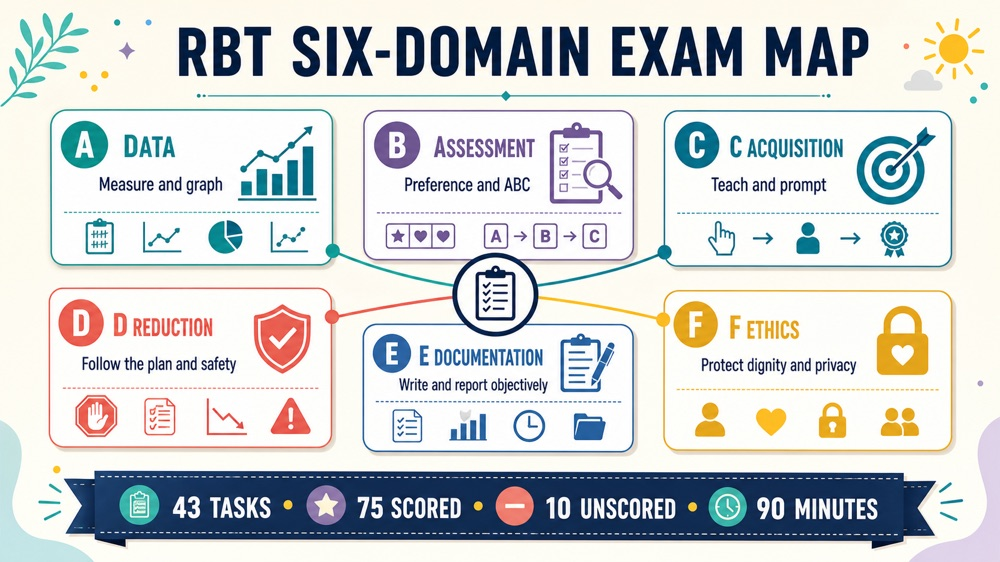
The current RBT certification path includes eligibility, qualifying 40-hour training, the Initial Competency Assessment, a BACB application, and the written RBT examination. The current RBT Test Content Outline, 3rd edition, describes 43 tasks across six domains; the exam context includes 75 scored questions and 10 unscored pilot questions. These facts are for study orientation, not official exam questions.
This is independent educational content. RBT Training is not the BACB, is not a certification program, and is not affiliated with or endorsed by the BACB. Examples below are newly written and are not official, recalled, leaked, or BACB-endorsed questions. No course, practice score, or article can guarantee certification or a passing result.
Registered behavior technician RBT: what the credential means
The RBT credential identifies a technician who provides behavior-analytic services under close supervision. The word “technician” is important: the RBT applies procedures and records what happened; the supervising professional is responsible for clinical direction, program decisions, and oversight according to the current BACB requirements.
| Role feature | What it means in practice | What it does not mean |
|---|---|---|
| Paraprofessional credential | The RBT is trained to carry out defined technician tasks. | It is not a graduate-level independent-practice credential. |
| Direct service | The RBT may work directly with a client while implementing the written program. | Direct contact does not transfer clinical authority to the RBT. |
| Close supervision | An RBT Supervisor or RBT Requirements Coordinator oversees the work and supervision record. | “I have experience” is not a substitute for qualified supervision. |
| Objective reporting | The RBT records observable events, data, barriers, and questions. | The RBT should not turn an observation into an unsupported diagnosis or function claim. |
Job titles vary. A person may be hired as a behavior technician or behavior therapist before becoming an RBT, while an employer may use “RBT” in a job posting as shorthand for the position. When comparing a registered behavior technician RBT role with a general technician job, check whether the person actually holds the current BACB credential and whether the role’s supervision and service requirements are in place.
What does an RBT do in a typical service session?
Actual duties depend on the client, setting, written plan, and supervisor. A useful session map has six parts:
| Session phase | RBT action | Evidence to protect |
|---|---|---|
| Prepare | Review the current program, materials, schedule, communication system, and safety directions. | Use the current version and ask about an unclear or conflicting instruction. |
| Teach | Deliver the planned instruction, prompt, reinforcement, and error-correction procedure. | Follow the stated prompt hierarchy and record prompt level when required. |
| Measure | Collect the measurement named by the program and enter data accurately. | Use operational definitions and the correct start, stop, count, or interval rule. |
| Support behavior reduction | Implement the approved response and environmental steps when a target behavior occurs. | Follow safety and crisis procedures; do not improvise a new intervention. |
| Communicate | Report objective observations, caregiver information, barriers, and safety events. | Protect privacy and separate observation from interpretation. |
| Close | Complete session documentation, secure materials, and identify questions for supervision. | Make the record accurate, timely, and limited to necessary information. |
For example: the program says to teach a learner to request a break with a card when a difficult task is presented. In a registered behavior technician RBT study scenario, the RBT prepares the card, presents the task as written, follows the prompt plan, records independent versus prompted requests, and delivers the planned consequence. The RBT does not decide that every instance of leaving the table “means escape,” remove the task permanently, or change the delay without direction.
RBT scope: implement, record, communicate, escalate
Many exam questions are really boundary questions. Use this table as a quick decision filter:
| RBT may do under the current plan | RBT should ask the supervisor or responsible person |
|---|---|
| Implement the named teaching procedure and prompt level. | Choose a new teaching procedure because progress is slow. |
| Collect frequency, duration, latency, interval, trial, or other specified data. | Change the operational definition or select a different measure. |
| Use the communication response and reinforcement arrangement written in the plan. | Choose a new reinforcer, delay, extinction component, or schedule. |
| Describe what was observed and report a caregiver concern. | Diagnose a condition, interpret motivation, or promise a clinical result. |
| Follow the crisis, emergency, and mandated reporting procedures. | Continue an unclear or unsafe procedure because a session target is unfinished. |
| Protect client information and use approved communication channels. | Post client details, photos, or stories on personal social media. |
When the written plan, safety information, caregiver report, or observed response does not fit together, pause at the appropriate point and seek direction. “The client is doing something new” is a reason to report and document, not a license to invent a function or treatment change.
How to become an RBT under the current path
The current BACB Handbook is the authority for the live route. At a high level, a new applicant should:
- Review eligibility: confirm the current age, education, background and abuse-registry, and jurisdiction requirements.
- Complete the 40-hour training: use the current RBT 2026 training requirements and curriculum outline. The current Handbook states the training is completed in no less than 5 days and no more than 180 days, with both start and end dates counted.
- Complete the Initial Competency Assessment: use the current 2026 packet after training and within its application timing window.
- Submit the application: create or use the BACB account, upload required documents, and pay the current application processing fee.
- Schedule and take the exam: after approval, use the Pearson VUE process and follow the current authorization deadline.
- Maintain the credential: follow ongoing supervision, ethics, reporting, recertification, and professional-development requirements that apply to your status.
A course certificate is one document in the path. It is not the application, the competency assessment, the exam result, or the credential record. Save documents in a secure place and compare every step with the current Handbook rather than an old checklist.
How RBT supervision works
The BACB describes two common organization structures: an RBT Supervisor structure and an RBT Requirements Coordinator structure. In the first, one or more supervisors at the organization may collaborate to meet the RBT’s requirements, while each supervisor is responsible for the services they oversee. In the coordinator model, one Requirements Coordinator organizes the supervision record and multiple RBT Supervisors may provide portions of supervision.
| Supervision question | What an RBT should know | What to verify |
|---|---|---|
| Who is responsible? | The RBT Supervisor and/or RBT Requirements Coordinator has the role defined by the current structure. | The person is listed correctly in the BACB portal when required. |
| Who can supervise? | The current BACB guidance identifies qualified BCBA and BCaBA roles, with required supervision training. | Credential status, supervision training, organization relationship, and client-specific knowledge. |
| How much supervision? | The current Handbook and BACB guidance control the monthly minimum; the current public guidance references a 5% minimum requirement. | How hours are counted, how meetings are recorded, and what happens if services or supervisors change. |
| What if supervision stops? | An RBT must not assume that a job title alone keeps the credential active. | Who to contact, how to update the portal, and whether inactive or maintenance rules apply. |
Supervision is not merely a monthly signature. It should include observation, feedback, review of data and documentation, modeling, problem-solving, and ethical decision-making. If your supervisor is not available, if the plan changes, or if a safety concern emerges, follow the organization’s escalation pathway and preserve an objective record.
Skills to build before and after RBT certification
- Measurement precision: choose the measurement system named by the question and apply it consistently.
- Instructional fidelity: follow prompting, reinforcement, chaining, shaping, discrimination, and generalization procedures as written.
- Behavior-reduction boundaries: recognize when to implement, when to pause, and when to contact the supervisor.
- Communication: write objective notes and report changes without adding unsupported explanations.
- Ethics: protect dignity, privacy, consent, professional boundaries, and competence.
- Self-monitoring: identify a skill you cannot perform safely or accurately and request training before continuing.
Do not measure readiness only by vocabulary recall. A strong RBT can explain what the learner, environment, procedure, data, and supervision record require in a short scenario. Practice with original cases that make you choose the next safe action, not only a definition.
Connect RBT work to the six-domain exam map
The current RBT Test Content Outline, 3rd edition, describes 43 tasks across six domains. The role and the exam reinforce each other, but an exam concept is not permission to practice outside scope:
| Domain | RBT work connection | Boundary question |
|---|---|---|
| A. Data Collection and Graphing | Record the measure named by the plan and recognize what the graph shows. | Am I following the operational definition rather than inventing a new one? |
| B. Behavior Assessment | Assist with preference or ABC procedures when assigned. | Am I collecting the observation or independently deciding function? |
| C. Behavior Acquisition | Implement teaching, prompting, reinforcement, chaining, shaping, and generalization. | Am I following the procedure or redesigning it? |
| D. Behavior Reduction | Implement the written reduction and safety procedures. | Is the situation safe and clear enough to continue, or should I escalate? |
| E. Documentation and Reporting | Write objective notes and communicate barriers or events. | Does my note separate observable fact from interpretation? |
| F. Ethics | Protect dignity, privacy, boundaries, competence, and supervision. | Would this action protect the client and stay within my role? |
The examination has 85 multiple-choice questions, including 75 scored questions and 10 unscored questions, with four possible answers and 90 minutes. These facts can shape study pacing. They do not change the RBT’s real-world duty to follow the current plan and supervision structure.
Common misconceptions about the registered behavior technician RBT role
| Misconception | Better interpretation |
|---|---|
| “RBT means I can independently choose ABA treatment.” | RBT work is performed under the direction and close supervision of the responsible professional. |
| “A behavior technician and an RBT are always the same thing.” | Employers use titles differently; verify whether the BACB credential is active and current. |
| “More experience means I can skip the written plan.” | Experience helps implementation, but the current plan and supervision remain the decision source. |
| “A practice score predicts my exact exam result.” | Practice identifies review needs; it is not an official result or personal prediction. |
| “A supervisor’s quick signature proves every skill.” | Competency and supervision records must be based on the current official requirements and observed evidence. |
Bottom line: a registered behavior technician is a trained, credentialed technician who helps deliver behavior-analytic services under close supervision. Learn the procedures, collect accurate data, communicate objectively, protect the client, and escalate decisions that belong to the supervisor.
Practice the RBT decision, not just the term.
Use original scenarios to connect current six-domain concepts with measurement, implementation, documentation, and supervision boundaries.
Try Free RBT Practice Questions →
Frequently Asked Questions
What is a registered behavior technician (RBT)?
An RBT is a paraprofessional credential in behavior analysis who assists with behavior-analytic services under the direction and close supervision of an RBT Supervisor and/or RBT Requirements Coordinator.
What does an RBT do?
Depending on the plan and setting, an RBT may implement teaching and behavior-reduction procedures, collect data, support skill acquisition, write objective notes, communicate observations, and follow safety procedures.
Can an RBT design a treatment plan?
An RBT should not independently design a treatment plan, determine behavioral function, change a clinical procedure, or promise an outcome. Those decisions require the responsible professional and current supervision structure.
What are the current RBT exam facts?
The current RBT Test Content Outline, 3rd edition, describes 43 tasks across six domains. The exam context includes 75 scored questions and 10 unscored questions within an 85-question, 90-minute multiple-choice examination.
How does RBT supervision work?
The organization may use an RBT Supervisor structure or an RBT Requirements Coordinator structure. Review the current BACB Handbook for qualified roles, portal records, monthly supervision, documentation, and maintenance requirements.
Is RBT the same as BCBA?
No. RBT is a paraprofessional technician credential. A BCBA is a different professional credential with different education, examination, scope, and supervision responsibilities.
References
- Behavior Analyst Certification Board. Registered Behavior Technician resources.
- Behavior Analyst Certification Board. Registered Behavior Technician Handbook. Updated 06/2026.
- Behavior Analyst Certification Board. Supervision, assessment, training, and oversight.
- Behavior Analyst Certification Board. RBT Requirements Coordinator structures.
- Behavior Analyst Certification Board. RBT Test Content Outline, 3rd edition.
- Independent RBT career guide. Reviewed for competitor research; not an official BACB source.
- Behavior technician job explainer. Reviewed for competitor research; job titles and estimates were not treated as official requirements.