

A registered behavior technician study guide should be more than a glossary or a long list of practice questions. It should show you where the current content comes from, how the six domains connect to entry-level work, how to read a scenario, and how to repair an error without memorizing one website’s wording.
Table of Contents
- Registered behavior technician study guide: what complete means
- Build the official source stack
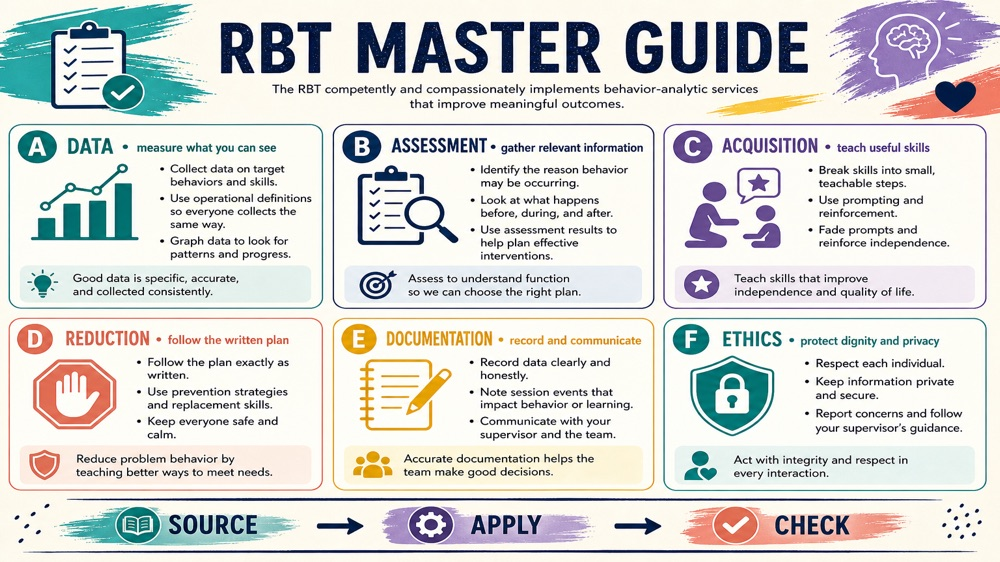
- Use the six-domain master map
- Study Domains A and B
- Study Domains C and D
- Study Domains E and F
- Practice with a study-and-error loop
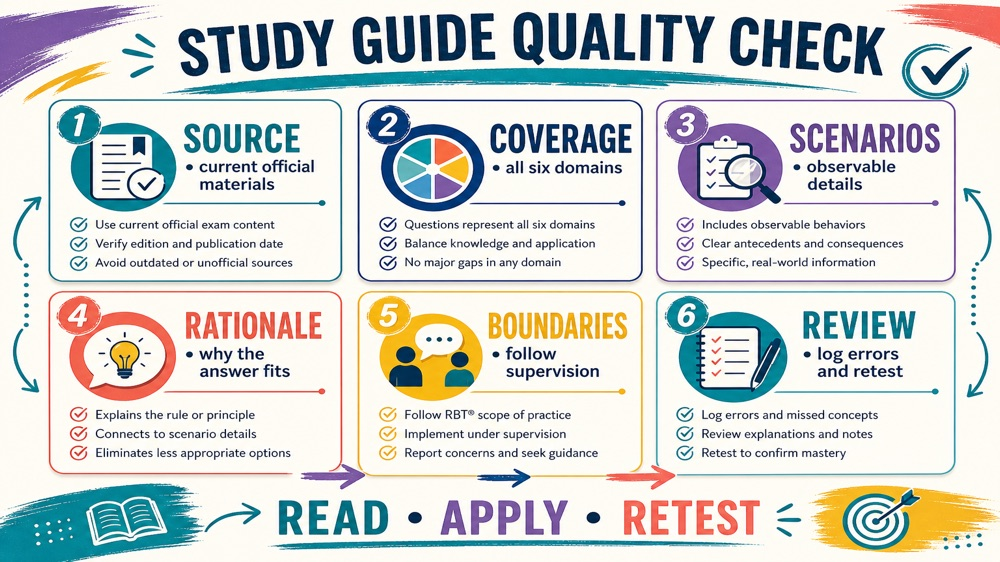
- Audit a study guide before using it
- Original registered behavior technician study guide scenarios
- Use a seven-day master plan
- Frequently Asked Questions
- References
Use the BACB RBT Test Content Outline, 3rd edition, and current RBT Handbook as the source layer. The TCO describes 43 tasks across six domains. The exam includes 75 scored questions and 10 unscored questions; the current Handbook describes 85 multiple-choice questions, four possible answers per item, and 90 minutes.
This article is an independent study resource. It is not the BACB, a certification application, an RBT training program, or a source of secure examination questions. All examples are newly written and are not official, recalled, leaked, or BACB-endorsed. No study guide, course, practice score, or employer can guarantee certification or a passing result.
Registered behavior technician study guide: what complete means
“Complete” should describe coverage and usability, not a page count. A reliable guide includes:
| Layer | What it should answer |
|---|---|
| Source | Which current BACB document controls the claim? |
| Blueprint | Which domain and task does the concept belong to? |
| Concept | What does the term mean in plain language? |
| Application | What would an entry-level RBT do in a new scenario? |
| Boundary | When should the RBT follow the plan, document, or ask the supervisor? |
| Review | What error did the learner make, and how will a new item test transfer? |
A guide that covers every domain but only supplies one-line definitions is broad, not necessarily complete. A guide with fewer pages but precise examples, answer rationales, and a current source trail may be more useful.
Build the official source stack
- TCO: use the current RBT Test Content Outline, 3rd edition, to map 43 tasks, six domains, and scored-question distribution.
- Handbook: use the current RBT Handbook for eligibility, preparation, examination rules, certification status, security, and maintenance.
- Training: revisit the materials from your eligible 40-hour training for demonstrations and service-delivery examples.
- Ethics: use current BACB ethics resources for confidentiality, competence, supervision, public statements, gifts, relationships, and cultural responsiveness.
- Independent practice: use original questions to apply the concepts, but never treat them as official examination items.
Save the source URLs and update dates in your notes. Search results can mix current pages with old PDFs, and a study guide can silently preserve older names or counts. If a page says approximately 42 items, compare it with the official TCO before repeating that number.
Use the six-domain master map
| Domain | Official questions | Master-study focus |
|---|---|---|
| A. Data Collection and Graphing | 13 (17%) | Measurement, calculations, graphs, observable definitions, reliability, and fidelity. |
| B. Behavior Assessment | 8 (11%) | Preference, skill, and functional-assessment participation under direction. |
| C. Behavior Acquisition | 19 (25%) | Reinforcement, teaching, prompts, chaining, discrimination, generalization, shaping, and token economies. |
| D. Behavior Reduction | 14 (19%) | Functions, antecedent interventions, differential reinforcement, extinction, punishment effects, and crisis procedures. |
| E. Documentation and Reporting | 10 (13%) | Objective communication, variables affecting progress, clinical direction, and timely reporting. |
| F. Ethics | 11 (15%) | Competence, supervision, confidentiality, public statements, relationships, gifts, and cultural responsiveness. |
The percentages help you allocate time; they do not justify abandoning a smaller domain. A complete registered behavior technician study guide should let you move from every domain to a scenario and back to the source.
Study Domains A and B
Domain A: connect behavior definitions to measurement. Frequency counts occurrences, rate adds time, duration measures how long, latency measures time from an event to a response, and IRT measures time between responses. Discontinuous systems answer different questions, and permanent-product recording relies on a lasting outcome. Practice choosing the measure from the stem, calculating it, and checking the graph for trends or data-quality problems.
Domain B: distinguish preference, skill, and functional assessments. An RBT may prepare, implement a component, collect data, or summarize information as directed. The RBT does not independently diagnose, determine treatment, or announce function from one observation. Record objective information and seek clinical direction when the procedure or interpretation is unclear.
For example: if a question says a response occurred 12 times in 30 minutes and asks for rate per hour, the time unit controls the calculation. If another question asks what an RBT should do when a graph suddenly changes after staff stopped measuring one setting, examine data collection and procedural fidelity before declaring client improvement.
Study Domains C and D
Domain C: read teaching questions as sequences. Identify the instruction or discriminative stimulus, response, prompt, consequence, prompt-fading plan, and generalization condition. Distinguish acquisition from maintenance, and forward, backward, and total-task chaining from the order of teaching. Reinforcement describes what is added or removed and whether the response becomes more likely; it is not a synonym for “reward.”
Domain D: match behavior-reduction procedures to the function, written plan, and safety direction. Differential reinforcement, extinction, antecedent interventions, punishment, and crisis procedures are not interchangeable labels. A stem may test secondary effects such as extinction burst, resurgence, response variation, emotional responding, or escape and avoidance.
Keep the role boundary visible: implement trained procedures as written, collect data, and report concerns. Do not change a prompt, reinforcer, schedule, extinction component, or crisis response because a different option feels faster.
Study Domains E and F
Domain E: write and communicate what happened in observable, timely, complete, and private language. Report illness, medication, schedule changes, data irregularities, caregiver concerns, and suggestions according to the workplace and supervisor direction. A session note should not hide a missed trial or turn an inference into a fact.
Domain F: apply ethics when the socially easy answer is not the professional answer. Ask whether an action stays within competence and supervision, protects confidentiality and dignity, avoids misleading public statements, handles gifts and multiple relationships appropriately, and responds to feedback or cultural differences with humility.
Use a three-part decision routine: pause when the request exceeds your role, protect the client and information, and communicate through the correct supervisor or reporting channel.
Practice with a study-and-error loop
After every practice item, complete this loop:
- Identify the task: write the domain and the skill the item is testing.
- Find the signal: underline the words that control the decision.
- State the rule: explain the answer without relying on the answer letter.
- Reject the nearest distractor: identify the specific assumption that makes it less appropriate.
- Create transfer: write a new setting, person, or behavior that tests the same rule.
- Recheck later: answer the transfer item after a delay and then mix it with another domain.
Log the reason for the miss: definition, calculation, plan fidelity, prompt sequence, function, documentation, ethics boundary, reading, or time. A correct guess belongs in the review log too. The purpose of a registered behavior technician study guide is durable decision-making, not familiarity with a fixed question bank.
Use timed sets only after the explanation loop is working. The current exam’s 90-minute, 85-question context can be practiced, but a mock score is not an official score and does not disclose a passing standard.
Audit a study guide before using it
| Check | Pass evidence | Red flag |
|---|---|---|
| Version | Names the current 3rd-edition TCO and links to an official source. | Uses “3.0” or “3rd edition” without a source or uses approximate counts as fact. |
| Coverage | Includes A through F with task-level or concept-level navigation. | Promises “complete” but skips documentation or ethics. |
| Examples | Shows different settings, behaviors, and decision points. | Repeats one definition with no applied context. |
| Answers | Explains the best answer and nearest distractor. | Shows a letter or percentage only. |
| Independence | States that questions are original and not official or endorsed. | Claims real, recalled, leaked, or guaranteed questions. |
| Role | Includes supervision, scope, confidentiality, and escalation. | Encourages independent treatment changes. |
| Access | Explains price, trial, privacy, accessibility, and update terms. | Calls a short sample a complete free course. |
Use this audit on free pages, paid PDFs, videos, apps, and employer packets. The resource can still be helpful when one field is missing, but mark the missing evidence and verify important claims elsewhere.
Original registered behavior technician study guide scenarios
These examples are newly written for learning. They are not official, recalled, leaked, or BACB-endorsed questions.
- Measurement: A learner engages in 20 responses during a 40-minute session, and the question asks for rate per hour. Best reasoning: convert to the requested time unit rather than reporting 20 as the rate.
- Assessment: An RBT sees that a behavior often follows a difficult task and says the function is proven. Best reasoning: record the descriptive pattern and consult the supervisor; one observation does not establish function independently.
- Acquisition: A teaching plan specifies least-to-most prompting and prompt fading, but the technician uses a full verbal prompt immediately on every trial. Best reasoning: follow the programmed prompt sequence and report prompt dependence.
- Reduction: A learner engages in a target behavior during extinction and the response temporarily increases. Best reasoning: recognize a possible extinction burst, follow the written plan and safety procedure, and do not improvise.
- Documentation: A caregiver reports a medication change before session. Best reasoning: communicate and document the variable according to direction; do not omit it because the session looked typical.
- Ethics: A neighbor asks whether a child seen at a store is an ABA client. Best reasoning: do not confirm or deny client status because confidentiality applies to the relationship itself.
- Guide audit: A study guide has 900 questions but no edition, author, source links, or rationales. Best reasoning: treat the volume claim as insufficient evidence and verify the resource before using it as a master guide.
- Exam boundary: A website offers “recalled BACB items” for a fee. Best reasoning: do not obtain or distribute protected content; use original independent practice.
Use a seven-day master plan
- Day 1: download or bookmark the official TCO and Handbook; record update dates and make the six-domain map.
- Day 2: study Domain A with measurement contrasts, calculations, graphs, and data-fidelity examples.
- Day 3: study Domains B and C with assessment participation, reinforcement, prompting, teaching, chaining, and generalization.
- Day 4: study Domain D with functions, antecedents, differential reinforcement, extinction, punishment effects, and safety.
- Day 5: study Domains E and F with objective notes, supervision, privacy, competence, boundaries, and cultural responsiveness.
- Day 6: complete an original mixed set and write a nearest-distractor explanation for every miss or guess.
- Day 7: complete a timed set, review the error log, and revisit every domain with a new transfer item.
If you are using a registered behavior technician study guide for a retake, do not study only the task names listed in a prior report. Use the report to target review, then study the complete current content because a small number of items may not predict your overall understanding.
Bottom line: the strongest guide combines current official sources, exact six-domain coverage, original scenario practice, answer rationales, ethical and supervision boundaries, and an error-to-transfer loop. That is the standard to use whether the guide is free, paid, online, printable, or part of an employer program.
Build a stronger RBT review routine
Use original scenarios, clear rationales, and six-domain review to turn weak areas into a next study step.
Compare RBT Exam Prep Materials →
Frequently Asked Questions
What should a registered behavior technician study guide cover?
It should cover all six current TCO domains, connect concepts to entry-level scenarios, explain answer choices, include data and ethics boundaries, and link changing facts to official BACB sources.
Is the RBT Handbook a study guide?
The Handbook is an official source for certification, examination, security, and maintenance information. Use it with the TCO, training materials, and original practice rather than treating it as a complete question bank.
How many tasks are in the current RBT TCO?
The current TCO describes 43 tasks organized in six domains. Verify task counts and names in the official document because third-party pages may use approximate or older terminology.
How should I divide study time across the domains?
Use the official question distribution as a starting point, give more time to larger domains, and still review every domain. Your study log should also reflect the errors you actually make.
Are paid RBT study guides official?
Paid or free study guides are generally independent resources. The BACB publishes the official TCO and Handbook and does not endorse a particular study guide. Check authorship, sources, update date, and independent-content disclosure.
Can a complete study guide guarantee a passing result?
No. A guide can organize learning and practice, but no guide, course, mock score, or provider can guarantee certification or a passing result.
References
- Behavior Analyst Certification Board. RBT Test Content Outline (3rd ed.).
- Behavior Analyst Certification Board. RBT Handbook.
- Behavior Analyst Certification Board. Examination Information.
- Behavior Analyst Certification Board. RBT resources.
- RBT Practice Exam study guide. Reviewed for competitor research; not an endorsement.
- RBT Mock Exam study guide. Reviewed for competitor research; not an endorsement.
- StudyBee ABA guide. Reviewed for competitor research; not an endorsement.
- RBT Exam Practice sampler. Reviewed for competitor research; not an endorsement.