
A registered behavior technician training program should be evaluated by more than a low price or a completion badge. Check the current BACB requirements, curriculum coverage, trainer qualifications, opportunities to practice, feedback and competency steps, documentation, privacy, and support after class before enrolling.
Table of Contents
- Registered behavior technician training program: the short answer
- Check the current content
- Evaluate the trainer and teaching format
- Look for practice and feedback
- Ask what happens after class
- Recognize misleading promises
- Enrollment checklist
- Frequently asked questions
RBT training programs, curriculum, practice, assessment, and support
Registered Behavior Technician Training Program: How to Evaluate It
Compare a training program by what it teaches, how it supports practice, and what it does not promise.
A registered behavior technician training program should be evaluated by more than a low price, a short calendar, or a completion badge. A useful comparison checks the current BACB requirements, curriculum coverage, trainer qualifications, opportunities to practice, feedback and competency steps, documentation, privacy, and support after class.
Training is one part of the RBT pathway. Application, eligibility, competency assessment, examination, supervision, and ongoing maintenance are separate steps. No provider should imply that one purchase or certificate guarantees certification, exam success, employment, or approval. Verify the current official requirements before enrolling.
Registered behavior technician training program: the short answer
Before paying, ask five questions:
- Does the curriculum match the current official requirement and content outline?
- Who teaches it, and can the provider explain the trainer’s role and qualifications?
- How will I practice the skills and receive feedback?
- What records, completion evidence, and next-step instructions will I receive?
- What support exists after class if I need clarification or a competency assessment?
Clear answers matter more than marketing language. If a provider avoids the details or pressures you to pay before showing the curriculum, treat that as a reason to pause.
Check the current content
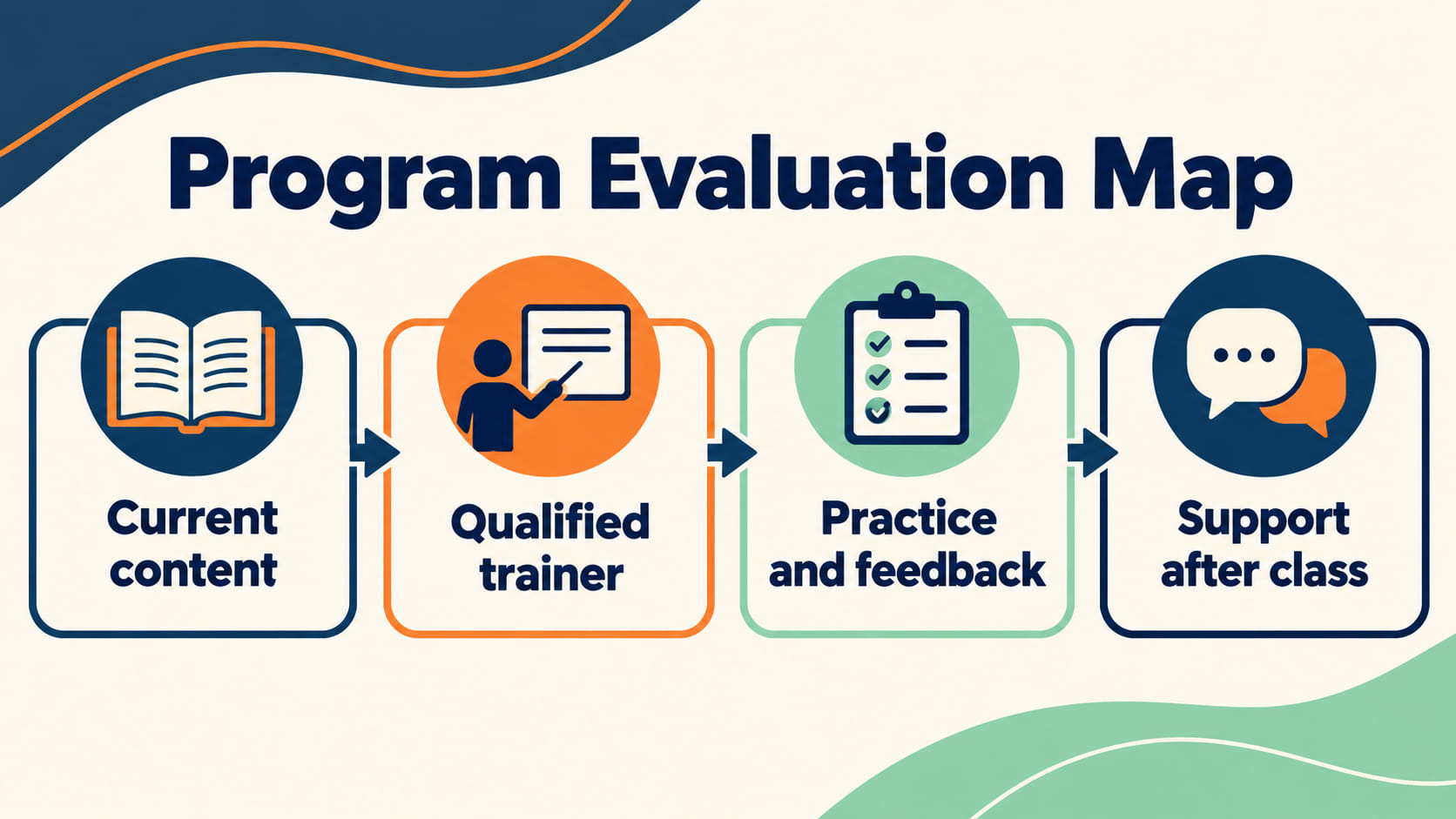
Start with the current BACB RBT page, Handbook, and applicable training materials. Compare the provider’s outline with the current content areas rather than relying on a screenshot from an old course. The program should explain what it covers in measurement, assessment, skill acquisition, behavior reduction, documentation and reporting, ethics, and scope as applicable to the current requirements.
Look for observable learning objectives, not only broad labels. “Learn ABA” is vague. “Describe observable and measurable behavior, implement the assigned measurement procedure, and identify risks of unreliable data” gives you a clearer way to judge the lessons and practice.
Ask how the program handles updates. BACB requirements, handbooks, exams, portal procedures, and transition materials can change. A provider should tell students which version the program uses and how changes are communicated. Do not assume a course is current because its webpage has a recent design.
Evaluate the trainer and teaching format
Ask who is responsible for instruction, what experience they bring, and how students can ask questions. A good trainer can explain technical terms in plain language, demonstrate objective measurement, connect examples to role boundaries, and correct misunderstandings without turning the class into a promise of clinical independence.
Format affects learning. A live class may provide immediate questions and practice. A self-paced course may offer flexibility but require you to check whether feedback, interaction, and completion evidence are included. An online format is not automatically weak or strong; examine the actual teaching and support.
Check whether the program protects privacy. Training examples should be fictional or appropriately authorized. A provider that asks students to upload real client notes, videos, or identifying information into an ordinary chat or personal drive is creating a serious concern.
Look for practice and feedback
Behavior technician work is performance-based. A training program should create opportunities to practice measurement, prompting, reinforcement, objective description, data entry, professional communication, and safety or escalation decisions at the level the course promises.
Practice is more useful when a trainer or supervisor can observe it and give specific feedback. “Correct” or “incorrect” may not explain what to fix. Ask whether you will learn why a response meets an operational definition, how to record a missed opportunity, and how to ask for direction when the plan is unclear.
Do not confuse a quiz score with demonstrated competence in every service context. A course can teach concepts and provide practice, while a separate competency assessment and supervision process determine the next steps. The provider should explain that boundary clearly.
Ask what happens after class
After training, you may still need application guidance, a competency assessment, examination preparation, a supervisor, employer onboarding, and access to the current program. Ask what the provider does and does not provide. A training course that offers no individualized clinical direction should say so; a course that advertises “job guaranteed” should explain the terms rather than implying certification.
Check the completion record. Ask what name appears on the certificate, what dates and hours are documented, how records are corrected, and how long access to the materials lasts. Keep your own copies only in a way that does not create an unauthorized client-data archive.
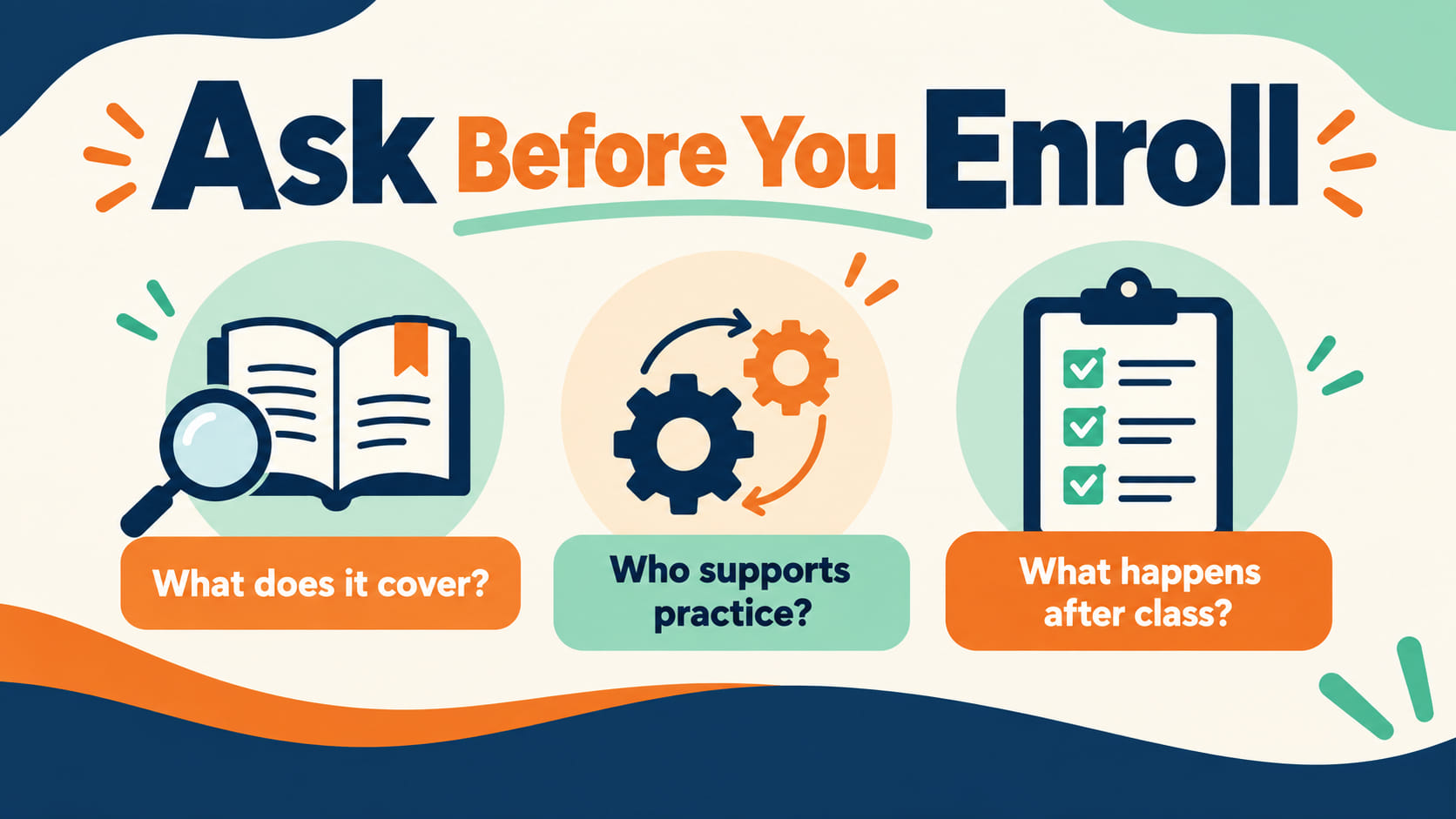
Support can include office hours, technical help, a clear refund policy, a route for correcting a completion record, and transparent instructions for contacting the organization. It should not require students to share private client information to get ordinary course help.
Recognize misleading promises
- Guaranteed certification: no course can replace every eligibility, assessment, application, examination, supervision, or maintenance step.
- Guaranteed job: employment depends on employer decisions, qualifications, location, and other facts outside a course.
- Outdated urgency: pressure to enroll immediately without showing the current curriculum or version.
- Unclear instructor: no meaningful information about who teaches or answers questions.
- No practice: a completion badge is offered without explaining feedback or performance expectations.
- Privacy shortcuts: students are asked to upload real client records or videos for ordinary homework.
Enrollment checklist
- I checked the current BACB RBT page and Handbook before comparing providers.
- The program states its curriculum version, learning objectives, schedule, and completion evidence.
- I know who teaches, who answers questions, and whether feedback is included.
- The format supports practice without requiring unauthorized client information.
- The provider explains what the course does not replace: application, competency assessment, examination, supervision, or maintenance.
- Prices, refund terms, access period, and record-correction process are clear.
- No promise of certification, exam success, employment, or approval is being treated as a guarantee.
Frequently asked questions
How do I choose a registered behavior technician training program?
Compare current content, trainer information, practice and feedback, completion records, privacy controls, support, price, and what the program does not replace. Verify details against current official BACB materials.
Does the cheapest program provide the same preparation?
Price alone does not show curriculum quality, feedback, practice, trainer access, or record support. Compare the actual learning and service model.
Can an online program be useful?
It can be, if its format meets the applicable current requirements and provides clear content, learning support, practice or assessment steps as appropriate, and accurate completion records. Check the details instead of assuming format is the deciding factor.
Does a training certificate make me an RBT?
No. Training is one part of the pathway. Follow the current BACB requirements for application, competency assessment, examination, supervision, and maintenance.
Role reminder: This is educational information, not provider endorsement, certification advice, legal advice, or a promise of exam or employment outcomes. Verify the current BACB requirements before enrolling.
Official starting points: the BACB RBT page, the RBT Handbook, and BACB supervision and training resources.
Ready to practice the RBT concepts you just reviewed?
Try an independent, original RBT practice resource with exam-style questions, scoring, and answer explanations.
References
- Behavior Analyst Certification Board. RBT Test Content Outline, 3rd edition.
- Behavior Analyst Certification Board. RBT Handbook.
- Behavior Analyst Certification Board. RBT Ethics Code.