

The behavior technician study guide PDF is a convenient format for review, but a PDF is only as reliable as its source date and content. Use the current BACB RBT Test Content Outline for exam coverage, the Handbook for pathway details, and original scenarios for application. This page explains how to use a study PDF without confusing an independent guide with an official BACB document or certification service.
Table of Contents
- The behavior technician study guide PDF: check it against official sources
- Map the six domains in a usable layout
- Use measurement examples
- Study assessment and teaching actions
- Study reduction, safety, and reporting
- Add documentation and ethics
- Turn the PDF into active recall
- Current exam context and PDF limits
- The behavior technician study guide PDF checklist
- Frequently Asked Questions
- References
Then reinforce the concepts with free RBT mock exams and review the explanations.
Continue your RBT study with RBT exam study materials and original practice resources.
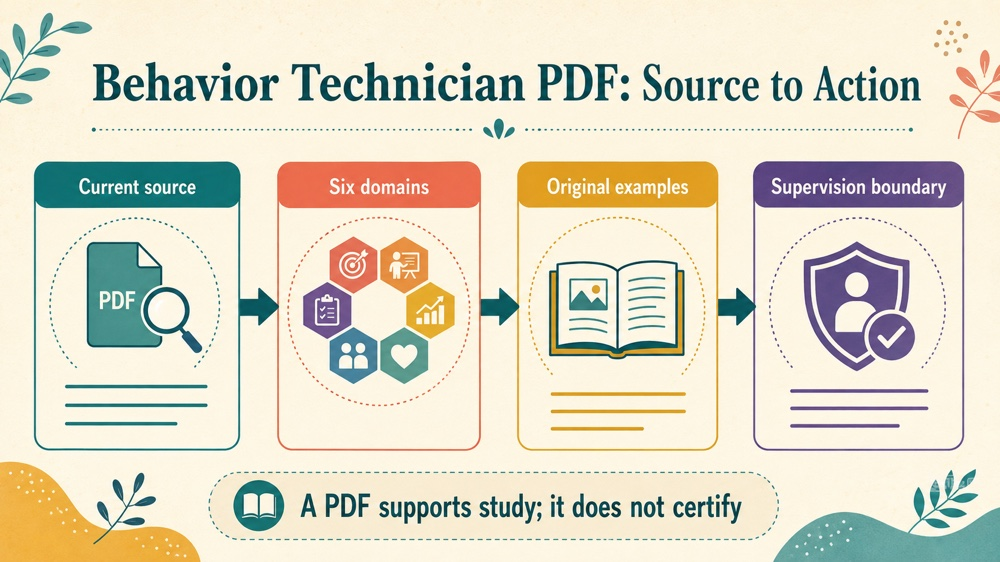
Quick answer: Treat the behavior technician study guide pdf as a current-source RBT study topic. Define the concept, connect it to an observable action, use original examples, and keep the supervision boundary visible.
Study boundary: This independent guide is educational content. It is not a BACB policy, certification decision, legal opinion, answer key, or guarantee of examination success. It does not promise a passing score or certification outcome. Examples are original and are not official, recalled, leaked, or BACB-endorsed questions.
Current exam context: The current BACB RBT Test Content Outline describes 43 tasks across six domains; the examination includes 75 scored questions and 10 unscored pilot questions in a 90-minute testing period. Verify the current handbook and outline before relying on a time-sensitive detail.
The behavior technician study guide PDF: check it against official sources
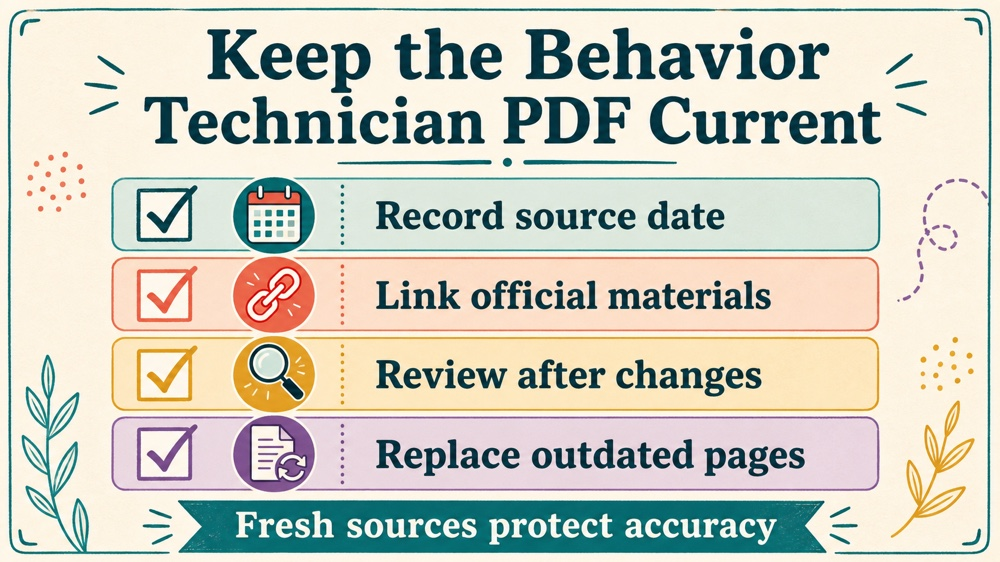
Record the publication date, source URLs, and outline version before studying. The current RBT Test Content Outline (3rd ed.) anchors task coverage, while the Handbook controls changing application, authorization, supervision, and maintenance information. A well-designed PDF can still be outdated if it does not show when it was checked.
Put a review date on the file. When an official number or rule changes, update or replace the affected page. Do not place an attractive but unverified correction over an older claim without recording its provenance.
Map the six domains in a usable layout
The current outline describes 43 tasks across Data Collection and Graphing, Behavior Assessment, Behavior Acquisition, Behavior Reduction, Documentation and Reporting, and Ethics. Use one section per domain and add a condition, an observable action, a data rule, and a boundary note to each concept.
- State the task in plain language.
- Give an original scenario.
- Name what the RBT observes, implements, records, or reports.
- State what is controlled by the written plan or supervision.
- Link the concept to the current source and check date.
Use measurement examples
Include frequency, rate, duration, latency, interval recording, permanent product, percentage, and graphing with short timelines or count examples. The definition should make clear what starts and stops the measure. The actual operational definition and recording system remain program-specific.
Add a barrier example: what happens if the timer or data sheet is unavailable? A competent response preserves data integrity, documents the problem, and seeks direction. It does not fill in a value from memory or choose an easier measure.
Study assessment and teaching actions
Assessment participation should be described as implementing assigned procedures, recording responses, and communicating observations. Acquisition topics may include prompting, fading, reinforcement, shaping, chaining, discrimination, generalization, and maintenance. The PDF should show the RBT action, not imply independent diagnosis or program design.
Write ‘check the plan’ beside concepts that can vary by learner or setting. The study guide becomes more useful when it shows where the technician’s decision ends and the supervising team’s decision begins.
Study reduction, safety, and reporting
Reduction topics can include antecedent strategies, differential reinforcement, extinction, safety procedures, and reporting. Emphasize consistent implementation, objective notes, and prompt communication about barriers or risks. The RBT should not invent a new consequence or promise that a procedure will work.
Use fictional examples that do not identify clients. Include who receives the concern and what facts are recorded. A PDF should support professional behavior, not merely recite terms.
Add documentation and ethics
Documentation and Reporting and Ethics should have their own visible pages. Include confidentiality, competence, supervision, accurate records, disclosure of limits, and reporting routes. Link these points to the current RBT Ethics Code and the relevant official resources.
A note is not objective merely because it is long. Teach the learner to record observable facts, preserve privacy, distinguish observation from interpretation, and ask for direction when competence or authority is unclear.
Turn the PDF into active recall
Cover the answer, explain the concept aloud, identify the reason for a miss, check the source, and write a new scenario. Change one variable in the new scenario so the learner must retrieve the rule under a different condition. This avoids mistaking page familiarity for competence.
Interleave domains and keep a short error log. A session that moves from graphing to prompting to ethics provides better diagnostic information than a long passive reread of one section.
Current exam context and PDF limits
The current examination includes 75 scored questions and 10 unscored pilot questions in a 90-minute testing period. Use the official source for current details. An independent PDF should not claim to reproduce, predict, or contain official, recalled, leaked, or protected questions.
Keep the file public-facing only where appropriate and avoid including private client information. A source-linked PDF can be clear and citable while remaining honest about what it is and is not.
The behavior technician study guide PDF checklist
- Is the publication date and outline version visible?
- Are the six domains mapped to observable actions and data rules?
- Does each concept include an original scenario and role boundary?
- Are privacy, documentation, competence, supervision, and ethics included?
- Do I review the source when a number or requirement may change?
- Do I use active recall and write new scenarios after misses?
- Does the PDF avoid official, recalled, leaked, or BACB-endorsed claims?
Use the behavior technician study guide PDF as a maintained learning tool. It should point back to current BACB sources and forward to an accurate supervised action. It is not a certification decision, official handbook, or substitute for the applicable process.
Practice the concept
Review the behavior technician study guide pdf with original RBT scenarios, current-source reminders, and clear role boundaries.
Review the RBT study resource →
Frequently Asked Questions
Is this PDF an official BACB handbook?
No. It is independent study content. Use the current BACB Handbook and RBT Test Content Outline for official information.
What should a behavior technician study PDF include?
Include current source notes, the six domains, original scenarios, observable actions, data rules, documentation, ethics, and role boundaries.
How do I keep a PDF current?
Record the source check date, compare it with current BACB documents, and revise or replace pages when official materials change.
Can a PDF contain recalled exam questions?
Do not use recalled or protected questions. Use original examples that are clearly educational and not BACB-endorsed.
References
- Behavior Analyst Certification Board: Registered Behavior Technician Handbook, updated June 2026.
- Behavior Analyst Certification Board: RBT Test Content Outline (3rd ed.).
- Behavior Analyst Certification Board: RBT resources.
- Behavior Analyst Certification Board: ethics resources.
- Behavior Analyst Certification Board: RBT Ethics Code (2.0).