

Use this RBT glossary as a retrieval tool, not as a wall of vocabulary. For each term, ask four questions: What does it mean? What does it not mean? What clue would appear in a scenario? What should an RBT do with the concept under supervision?
Table of Contents
- RBT glossary: define, contrast, apply, and retrieve
- Foundations and observation terms
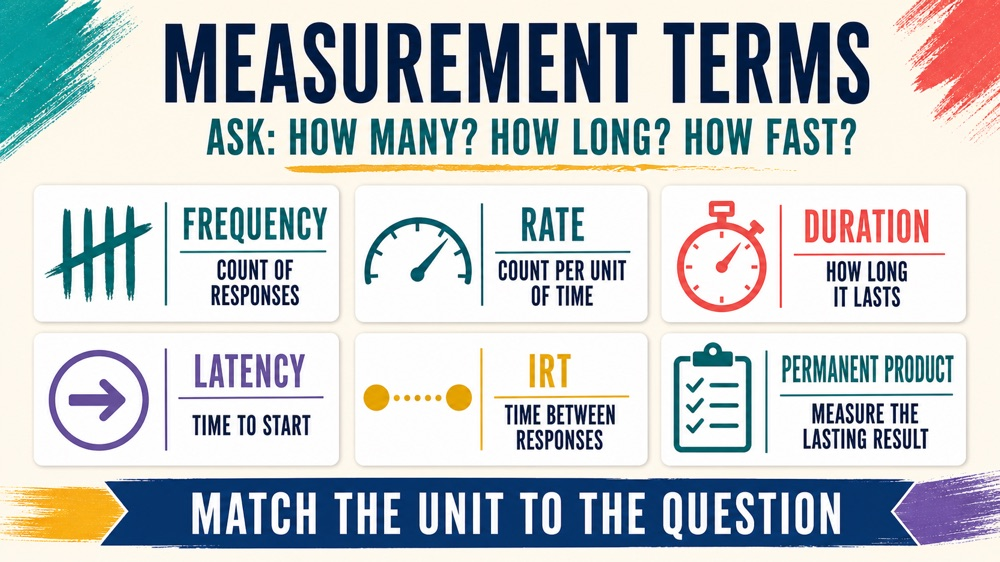
- Measurement terms in an RBT glossary
- Assessment and function terms
- Teaching and reinforcement terms
- Behavior-reduction and differential-reinforcement terms
- Documentation, reporting, and ethics terms
- RBT glossary high-confusion pairs
- Map this RBT glossary to the six current TCO domains
- Frequently Asked Questions
- References
The current RBT Test Content Outline, 3rd edition, organizes the exam into six domains and 43 tasks. The current exam presents 85 multiple-choice questions: 75 scored questions and 10 unscored pilot questions, with four answer choices and 90 minutes. A definition alone is rarely enough; the exam often tests whether you can distinguish two similar terms in a short workplace situation.
This guide groups high-value terms by the current TCO rather than attempting to reproduce every word used in behavior analysis. The definitions and examples are newly written for independent study. RBT Training is not the BACB, is not affiliated with or endorsed by the BACB, and does not provide official exam questions. No course or glossary can guarantee certification or a passing result.
RBT glossary: define, contrast, apply, and retrieve
A useful glossary entry has a definition plus a boundary. For example, reinforcement is not simply “a reward,” and negative reinforcement is not punishment. The effect on future behavior and the operation of adding or removing a stimulus determine the term.
- Define: say what the term means in observable, exam-ready language.
- Contrast: compare it with the closest distractor.
- Apply: write a one-sentence session example.
- Retrieve: close the notes and identify the term from a new scenario.
When a definition is too broad to tell two answer choices apart, it is not finished. Add the feature that changes the choice: time, effect, function, prompt level, response criterion, or professional role.
Foundations and observation terms
| Term | Plain-language definition | Exam clue or boundary |
|---|---|---|
| Applied Behavior Analysis (ABA) | A science and professional practice that applies principles of behavior to socially important behavior and evaluates change with data. | Look for observable behavior, socially meaningful goals, and measurement—not a promise that every intervention is automatically ABA. |
| Behavior | An observable and measurable activity of an organism. | “Frustrated” is a private or interpretive label; “pushed the worksheet away” is an observable response. |
| Operational definition | A clear description of what counts as the target response and what does not count. | Another trained observer should be able to use the definition and make a similar decision. |
| Topography | The physical form or shape of a response. | Two responses can look different but serve the same function; topography is not function. |
| Antecedent | An event or condition that occurs immediately before a behavior in a specified sequence. | It is not automatically the cause; identify what happened before the response. |
| Behavior | The response that follows the antecedent in the sequence. | Use the operational definition rather than an inferred feeling or intention. |
| Consequence | An event or condition that follows a behavior. | Consequence does not mean punishment; reinforcement and punishment are defined by their future effect. |
| ABC data | A record of antecedent, behavior, and consequence in a defined episode. | ABC notes describe an episode; they do not by themselves prove a behavioral function. |
| Socially significant behavior | Behavior selected because improving it matters to the learner, family, community, or daily functioning. | Ask who benefits and whether the target is meaningful, safe, and respectful. |
Micro-example: “The teacher presented a writing task” is an antecedent; “the learner tore the paper” is the behavior; “the task was removed” is the consequence. Do not label the function from one ABC row without the assessment process and supervisor’s interpretation.
Measurement terms in an RBT glossary
| Term | Definition | Common confusion |
|---|---|---|
| Frequency | The count of how many times a response occurs. | Frequency is a count; it is not automatically comparable across sessions of different lengths. |
| Rate | A count divided by a unit of time, such as responses per minute. | Rate adjusts for observation time; it is not the same as a raw count. |
| Duration | How long a behavior lasts from onset to offset. | Duration measures time engaged in the response, not the number of episodes. |
| Latency | The time between a specified stimulus or instruction and the start of the response. | Latency ends when the response begins; it is not the total time needed to finish. |
| Interresponse time (IRT) | The time between two consecutive occurrences of the same response. | IRT is between responses; latency is from a stimulus to response onset. |
| Partial interval | Score the interval if the behavior occurs at any point during it. | A brief occurrence can score “+”; do not count every event inside the interval. |
| Whole interval | Score the interval only if the behavior occurs for the entire interval. | A brief break produces “−” under the whole-interval rule. |
| Momentary time sampling | Score whether the behavior is occurring at a specified sample moment. | Behavior earlier in the interval may not count if it is absent at the sample moment. |
| Permanent product | A lasting result of behavior that can be measured after the behavior occurs. | Count the product only when the plan identifies it as a valid indicator of the response. |
| Trend | The overall direction of data across time. | One high point is not automatically a trend; inspect the series and graph. |
| Variability | The amount of fluctuation or inconsistency in data across observations. | Variable data may require context and fidelity review, not an instant treatment change by the RBT. |
Read the unit and time words before choosing a measure. “How many,” “how long,” “how quickly,” and “how far apart” are different questions. A data point is only meaningful when the definition and recording system are known.
Assessment and function terms
| Term | Plain-language definition | Do not confuse it with… |
|---|---|---|
| Preference assessment | A procedure that identifies relative selection or engagement among stimuli. | A preference is not automatically proof that the item will function as a reinforcer in every situation. |
| Reinforcer | A consequence that increases the future likelihood of the behavior it follows. | A preferred item may not increase the target response; effect matters. |
| Skill assessment | A structured assessment of relevant strengths, deficits, or performance under defined conditions. | It is not the RBT’s Initial Competency Assessment, which evaluates technician skills. |
| Functional behavior assessment (FBA) | A process for gathering information about behavior and relevant variables to guide support. | It is broader than one ABC note and does not mean the RBT independently diagnoses function. |
| Functional analysis | An experimental assessment that systematically tests environmental conditions to evaluate behavioral function. | Do not assume an RBT can independently design or alter analysis conditions. |
| Function | The consequence or outcome that has historically affected the future probability of behavior, often described with categories such as attention, escape, tangible, or automatic. | Function is not the same as topography or the person’s stated intention. |
| Motivating operation (MO) | An event that changes the value of a consequence and momentarily changes behavior related to that consequence. | It changes value and evoking/abolishing effects; it is not simply any antecedent. |
| Antecedent intervention | A planned change before the behavior that alters the likelihood of the response or makes the desired response easier. | It is not a consequence delivered after behavior. |
High-confusion pair: preference tells you what a learner selects under the assessment conditions; reinforcement is demonstrated by an increase in the future behavior after the consequence. The terms can be related, but they are not interchangeable.
Teaching and reinforcement terms
| Term | Definition | Example or boundary |
|---|---|---|
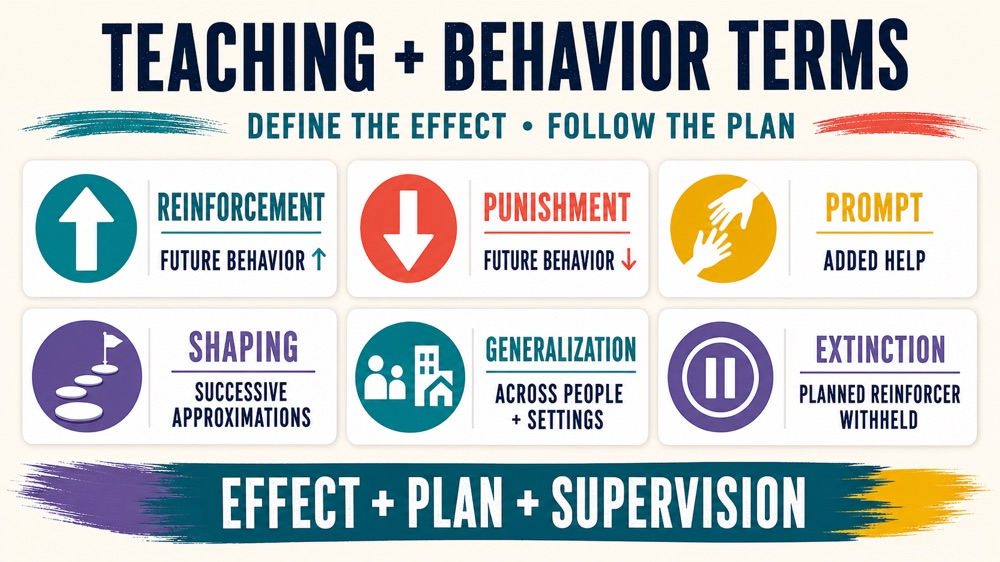
| Reinforcement | A procedure or consequence arrangement that increases future behavior. | “Positive” means a stimulus is added; “negative” means a stimulus is removed. Neither word means good or bad. |
| Positive reinforcement | After a behavior, a stimulus is added and the behavior becomes more likely. | A learner requests help and receives praise; check future responding before calling it reinforcement. |
| Negative reinforcement | After a behavior, an aversive or effortful stimulus is removed and the behavior becomes more likely. | Removal is not punishment; the behavior’s future increase defines reinforcement. |
| Punishment | A consequence arrangement that decreases future behavior. | “Positive” adds a stimulus; “negative” removes a stimulus. The future decrease is essential. |
| Prompt | An added cue or assistance that increases the likelihood of a correct response. | Follow the assigned prompt hierarchy and do not provide more help than the plan specifies. |
| Prompt fading | Systematically reducing assistance so the learner responds with less prompt dependence. | Fading is planned reduction of prompts, not simply waiting longer. |
| Discriminative stimulus (SD) | A stimulus in whose presence a behavior has a history of reinforcement available. | An SD is not a command merely because it is spoken; the relevant reinforcement history matters. |
| Shaping | Reinforcing successive approximations toward a target behavior. | Choose closer forms gradually; do not require the final form on the first trial. |
| Task analysis | A sequence of steps that describes how to perform a larger skill. | It breaks a skill into teachable responses; it is not the same as a behavior definition. |
| Chaining | Teaching a task-analysis sequence by linking steps through forward, backward, or total-task procedures. | The direction describes which step is emphasized first, not whether prompts are allowed. |
| Discrete-trial training (DTT) | A structured teaching format with a clear antecedent, response opportunity, consequence, and repeated trials. | It is one teaching arrangement, not a synonym for all ABA. |
| Natural environment teaching (NET) | Teaching arranged within naturally occurring activities, interests, and contexts. | Natural does not mean unplanned; data and teaching targets still matter. |
| Generalization | Using a learned response across people, materials, settings, or examples beyond the teaching condition. | Generalization is not the same as mastery in one room. |
| Maintenance | Continued performance of a learned behavior after teaching intensity or support changes. | Maintenance is performance over time; generalization is performance across relevant changes. |
Behavior-reduction and differential-reinforcement terms
| Term | Definition | Exam distinction |
|---|---|---|
| Extinction | Withholding the consequence that previously reinforced a behavior, according to the plan. | It is not ignoring every behavior and should not be started independently by an RBT. |
| Extinction burst | A temporary increase or change in behavior that can occur when reinforcement is first withheld. | It is a possible pattern, not proof that the plan is working or failing by itself. |
| Differential reinforcement | Reinforcing one response pattern while withholding or reducing reinforcement for another according to the plan. | Identify which behavior is reinforced and which criterion is used. |
| DRA | Differential reinforcement of alternative behavior: reinforce a specified alternative response. | The alternative replaces or competes with the target response. |
| DRI | Differential reinforcement of incompatible behavior: reinforce a response that cannot occur at the same time as the target. | Incompatible means simultaneous performance is physically impossible or functionally incompatible under the definition. |
| DRO | Differential reinforcement of other behavior: reinforce the absence of the target behavior for a specified period or criterion. | It does not teach a specific alternative unless the plan adds one. |
| Replacement behavior | A socially appropriate response taught to meet the relevant need or compete with the target response. | It should be feasible, effective, and taught within the written plan. |
| Response cost | A negative-punishment procedure that removes a specified amount of a reinforcer after behavior. | It requires a documented plan and verified competence; “cost” is not a fee for service. |
When a question uses the word “function,” do not jump straight to a consequence label. Identify the assessment information, the written intervention, the replacement response, and the supervisor’s direction. RBTs implement assigned behavior-reduction procedures and report safety or fidelity concerns.
Documentation, reporting, and ethics terms
| Term | Definition | Practice cue |
|---|---|---|
| Objective note | A record that describes observable events, procedures, responses, and relevant context without unsupported judgments. | Separate “looked away for 10 seconds” from “was unmotivated.” |
| Confidentiality | Protecting private client, stakeholder, and workplace information according to BACB, employer, and legal requirements. | Use approved channels and share only necessary information. |
| Competence | The ability to accurately carry out assigned behavior-technician services. | If the task is unfamiliar or outside competence, contact the supervisor and seek training. |
| Supervision | Direction, observation, feedback, and oversight required for RBT practice under the current rules. | Supervision is not a reason to hide uncertainty; it is the route for support and correction. |
| Assent | Observable willingness to participate when assent is relevant to the person and setting. | Follow the plan and supervisor guidance; do not treat assent as a one-time verbal permission for everything. |
| Scope of competence | The behavior-technician services and activities an RBT can accurately carry out. | A job title or past exposure does not automatically expand scope. |
| Self-report | Providing required information about specified events to the BACB or other required entities within the applicable time frame. | Check the current Code and Handbook for the event and deadline; do not guess from an old study card. |
| Exam integrity | Following BACB and testing-center rules, including not cheating or distributing unauthorized exam content. | Recalled or leaked questions are not a legitimate study source. |
These terms connect Domain E and Domain F to every technical skill. Accurate data without privacy is incomplete; a correct procedure without competence is unsafe; a good teaching plan without objective reporting cannot be evaluated.
RBT glossary high-confusion pairs
- Frequency vs. rate: count versus count per time.
- Duration vs. latency: how long the response lasts versus how long it takes to start.
- Preference vs. reinforcer: selected item versus consequence that increases future behavior.
- Topography vs. function: what a response looks like versus what consequence maintains it.
- Prompt vs. reinforcement: assistance that evokes a response versus a consequence that changes future probability.
- Generalization vs. maintenance: across relevant people/settings/examples versus over time.
- Extinction vs. ignoring: a planned change to a reinforcement contingency versus a vague everyday instruction.
- FBA vs. functional analysis: broader information-gathering process versus experimental testing of conditions.
Write one contrast sentence for each pair. If the sentence still allows both terms to fit, add the missing feature: time, effect, experimental control, response form, or context.
Map this RBT glossary to the six current TCO domains
| Domain | Terms to retrieve | One study question |
|---|---|---|
| A. Data Collection and Graphing | Frequency, rate, duration, latency, IRT, interval recording, permanent product, trend. | What is the unit and what does one data point represent? |
| B. Behavior Assessment | Preference assessment, skill assessment, FBA, functional analysis, function, MO. | What is being assessed, and what may the RBT do? |
| C. Behavior Acquisition | Reinforcement, prompt, fading, SD, shaping, task analysis, chaining, DTT, NET. | What is the teaching step and what changes future behavior? |
| D. Behavior Reduction | Extinction, burst, differential reinforcement, DRA, DRI, DRO, replacement, response cost. | Which behavior is reinforced or reduced, and what does the plan say? |
| E. Documentation and Reporting | Objective note, ABC data, privacy, trend, variability, reporting. | Could a supervisor verify what happened? |
| F. Ethics | Competence, supervision, assent, scope, confidentiality, exam integrity. | Does the answer protect dignity and stay within role? |
Bottom line: use this RBT glossary to practice retrieval, not just rereading. Define the term, contrast it with the nearest distractor, apply it to a fresh example, and connect it to the current plan and supervision boundary.
Turn glossary terms into exam decisions.
Use original RBT practice questions to test definitions, high-confusion pairs, and six-domain transfer.
Try free RBT practice questions →
Frequently Asked Questions
What should an RBT glossary include?
A useful glossary includes exam-relevant definitions, high-confusion contrasts, short examples, current TCO mapping, and scope or supervision boundaries.
Is this RBT glossary an official BACB vocabulary list?
No. It is an independent study aid organized around the current RBT Test Content Outline. Use the BACB TCO, Handbook, Ethics Code, and supervisor guidance as primary authorities.
What is the difference between reinforcement and punishment?
Reinforcement increases future behavior; punishment decreases future behavior. Positive means a stimulus is added and negative means a stimulus is removed.
What is the difference between frequency and rate?
Frequency is a count of responses. Rate is a count divided by a time unit, such as responses per minute.
What is the difference between preference and reinforcement?
Preference is selection or engagement under an assessment; reinforcement is demonstrated when a consequence increases future behavior.
Are these glossary entries official exam answers?
No. The definitions and examples are newly written for study and are not official, recalled, leaked, or BACB-endorsed questions.
References
- Behavior Analyst Certification Board. RBT Test Content Outline, 3rd edition.
- Behavior Analyst Certification Board. Registered Behavior Technician Handbook.
- RBT Exam Practice glossary. Reviewed for competitor research; not an official BACB source.
- RBT Practice Exam ABA terms glossary. Reviewed for competitor research.
- RBT Hub glossary. Reviewed for competitor research.
- RBT Practice Exam terminology glossary. Reviewed for competitor research.