
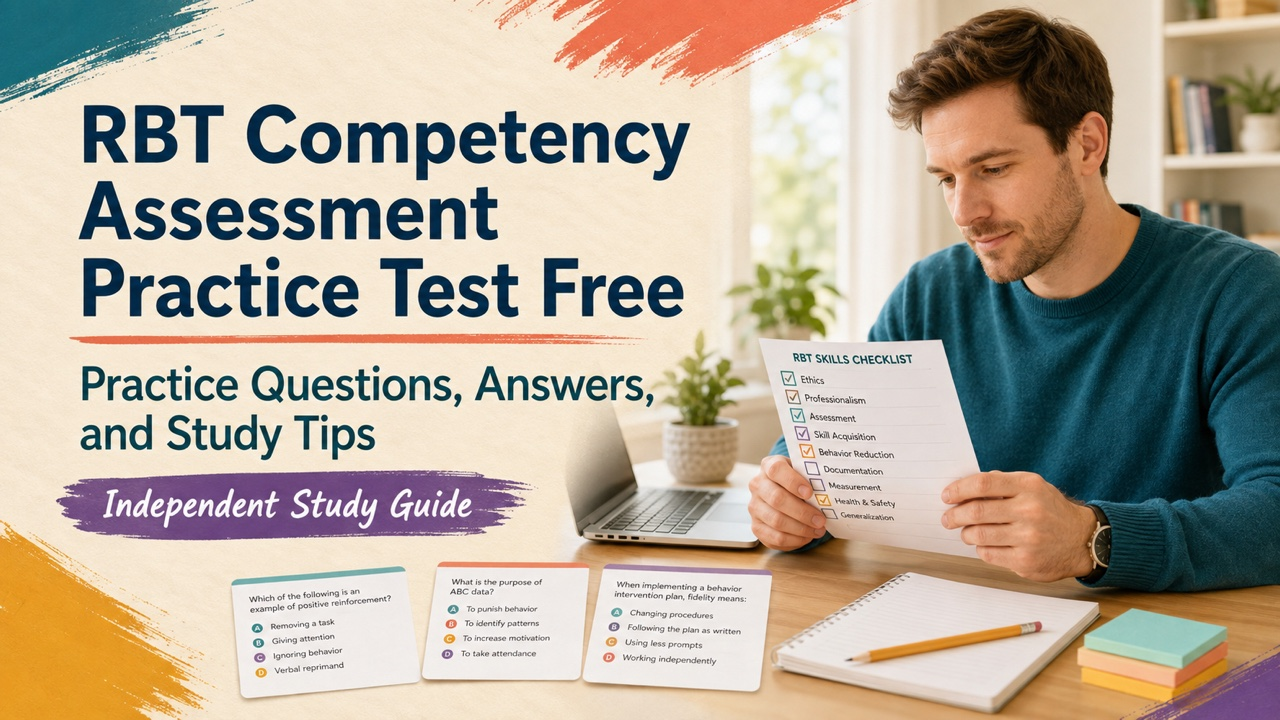
RBT competency assessment practice test free describes a search for no-cost preparation, but a practice test is not the BACB initial competency assessment and cannot certify a candidate. Use free practice to rehearse observable technician actions, then complete the official or applicable competency process with an eligible assessor. The examples on this page are original and are not official, real, recalled, leaked, or BACB-endorsed questions.
Table of Contents
- RBT competency assessment practice test free: practice versus assessment
- What a useful free practice set should contain
- Original scenarios for data collection
- Original scenarios for acquisition and reduction
- A practice-test example
- Use a free practice test without studying shortcuts
- Current RBT exam context
- Mistakes to avoid with free assessment practice
- RBT competency assessment practice test free checklist
- Frequently Asked Questions
- References
Quick answer: Treat rbt competency assessment practice test free as a current-source RBT study topic. Define the concept, connect it to an observable action, use original examples, and keep the supervision boundary visible.
Study boundary: This independent guide is educational content. It is not a BACB policy, certification decision, legal opinion, answer key, or guarantee of examination success. Examples are original and are not official, recalled, leaked, or BACB-endorsed questions.
Current exam context: The current BACB RBT Test Content Outline describes 43 tasks across six domains; the examination includes 75 scored questions and 10 unscored pilot questions in a 90-minute testing period. Verify the current handbook and outline before relying on a time-sensitive detail.
RBT competency assessment practice test free: practice versus assessment
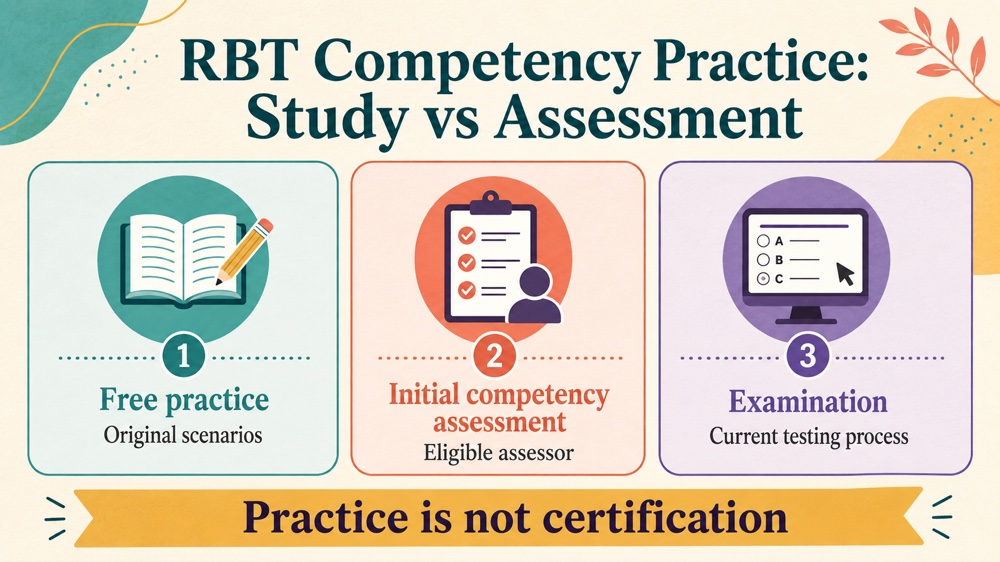
A practice test is a study tool. An initial competency assessment is an eligibility component in the RBT pathway completed according to the current BACB requirements and assessment process. A free quiz can help reveal a knowledge gap, but it cannot replace an eligible assessor’s observation, attestation, or documentation.
Keep three labels separate in your notes: practice, competency assessment, and examination. Practice asks whether you can explain or rehearse a skill. The assessment evaluates performance under the applicable process. The examination measures knowledge and skills through the current testing format. Confusing the labels can lead to a candidate believing that a free score has administrative effect.
What a useful free practice set should contain
Good practice items give a condition, an observable response, and enough information to choose an RBT action. They should cover data collection, assessment participation, behavior acquisition, behavior reduction, documentation, and ethics. Each answer should explain why the correct action fits the written plan and why tempting alternatives exceed the RBT role.
- Read the condition and identify the actor.
- Name the observable response or data rule.
- Choose the action the RBT is trained and assigned to perform.
- Check whether the consequence or reporting route is specified.
- Explain why an unapproved change, guess, or privacy breach is incorrect.
Original scenarios for data collection
A practice item might give an operational definition of property destruction and ask how the RBT records two qualifying events. Another might ask what to do when a timer is missing during an interval procedure. The answer should follow the defined measurement system, document the barrier, and seek direction when needed. It should not substitute a favorite measure or reconstruct data later.
After answering, write the rule in your own words. If you missed because you confused frequency and duration, draw a small timeline. If you missed because the definition was vague, identify which clarification belongs to the supervisor. This turns a score into a targeted study action.
Original scenarios for acquisition and reduction
An acquisition item may describe a prompt hierarchy, a programmed delay, and a reinforcement criterion. The RBT should implement those steps and record the prompt level. A reduction item may describe an antecedent strategy or differential reinforcement procedure. The RBT should follow the plan and report safety or effectiveness concerns rather than invent a new consequence.
Do not make an answer more clinical than the role allows. A practice question is not asking you to diagnose a function from one event, design a new treatment, or promise a family that a procedure will work. It is asking whether you can implement, document, and communicate within competence.
A practice-test example
The program says: present the instruction, wait three seconds, deliver a gestural prompt if there is no response, and record independent or prompted responding. The learner responds correctly after one second. A strong answer records an independent response and delivers the programmed consequence. It does not add a prompt or label the learner’s motivation.
A second item says the caregiver asks the RBT to skip the planned procedure for the rest of the week. The RBT should listen, document the concern, and contact the supervising team through the approved route. The RBT should not agree to a clinical change merely because the request sounds reasonable.
Use a free practice test without studying shortcuts
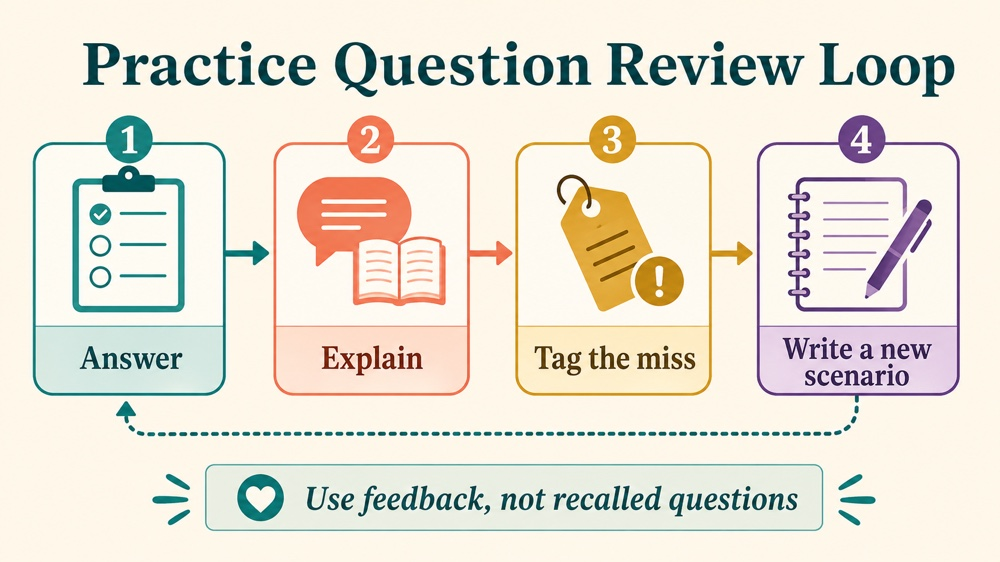
Set a small time limit, answer without looking at notes, and then review the explanation. Tag each miss as vocabulary, measurement, discrimination, calculation, reading the condition, or role boundary. Write a new scenario for the tag. Repeating the same items can create familiarity without improving transfer.
Do not search for recalled or leaked items. The goal is not to predict a protected question; it is to demonstrate a reliable decision process. Original practice is more useful when it changes the setting, material, prompt, consequence, or reporting route while preserving the underlying concept.
Current RBT exam context
The current RBT Test Content Outline describes 43 tasks across six domains, and the examination includes 75 scored questions and 10 unscored pilot questions in a 90-minute period. Use the outline to balance practice across domains. A free competency practice test should not claim to reproduce the official assessment or examination, and a score should not be presented as a certification result.
Pair each practice block with one source check and one implementation explanation. Ask, ‘What would I record?’ and ‘Who decides what changes?’ These questions keep administrative claims, clinical procedures, and study feedback in their proper lanes.
Mistakes to avoid with free assessment practice
- Calling a free quiz the official competency assessment.
- Presenting original questions as real, recalled, leaked, or BACB-endorsed.
- Treating a percentage score as proof of eligibility or certification.
- Choosing an answer that independently changes the program.
- Ignoring safety, privacy, data integrity, or supervision in favor of a quick answer.
- Studying only one domain because it feels familiar.
- Using a practice page as a substitute for the current handbook or assessor.
RBT competency assessment practice test free checklist
- Can I explain what practice can and cannot prove?
- Can I identify the six domains and practice each with original scenarios?
- Can I distinguish independent, prompted, incorrect, and no-response data?
- Can I implement a written procedure without redesigning it?
- Can I document and report a barrier or safety concern?
- Can I explain why a free score is not an official assessment result?
- Can I return to the current BACB sources for eligibility and assessment decisions?
Use free practice as a feedback loop: answer, explain, tag the miss, study the rule, and try a new scenario. That is a useful study process without pretending that a practice page is the official assessment.
Practice the concept
Review rbt competency assessment practice test free with original RBT scenarios, current-source reminders, and clear role boundaries.
Review the RBT study resource →
Frequently Asked Questions
Is a free RBT competency assessment practice test official?
No. Free practice is an independent study tool. It is not the BACB initial competency assessment and does not create eligibility or certification.
What should free practice questions cover?
They should cover the six current RBT domains with original scenarios, observable actions, data rules, supervision boundaries, and explanations.
Can a practice score prove I am ready?
A score can show topics to review, but it cannot replace the applicable competency assessment, application process, or examination.
Are the examples recalled BACB questions?
No. They are original study scenarios and are not official, recalled, leaked, or BACB-endorsed questions.
References
- Behavior Analyst Certification Board: Registered Behavior Technician Handbook, updated June 2026.
- Behavior Analyst Certification Board: RBT Test Content Outline (3rd ed.).
- Behavior Analyst Certification Board: RBT resources.
- Behavior Analyst Certification Board: ethics resources.
- Behavior Analyst Certification Board: RBT Ethics Code (2.0).