
RBT task list flashcards can make review portable, but a card set is only useful when it reflects the current RBT Test Content Outline and asks for an observable decision. The phrase task list is often used informally; candidates should check the current BACB outline, version date, and handbook rather than assuming that an old download is current.
Table of Contents
- Task list flashcards versus a current outline
- Build one card for one decision
- Flashcard examples for data and assessment
- Flashcard examples for acquisition and reduction
- A task-list flashcard review session
- Current exam context for RBT task list flashcards
- Mistakes to avoid with flashcards
- RBT task list flashcards checklist
- Frequently Asked Questions
- References
Quick answer: Treat rbt task list flashcards as a current-source RBT study topic. Define the concept, connect it to an observable action, use original examples, and keep the supervision boundary visible.
Study boundary: This independent guide is educational content. It is not a BACB policy, certification decision, legal opinion, answer key, or guarantee of examination success. Examples are original and are not official, recalled, leaked, or BACB-endorsed questions.
Current exam context: The current BACB RBT Test Content Outline describes 43 tasks across six domains; the examination includes 75 scored questions and 10 unscored pilot questions in a 90-minute testing period. Verify the current handbook and outline before relying on a time-sensitive detail.
Task list flashcards versus a current outline
Flashcards are a memory format, not an official blueprint. The current BACB examination document is the RBT Test Content Outline (3rd ed.), which organizes 43 tasks into six domains. A flashcard may translate a task into plain language, but the official outline remains the source for wording and examination coverage.
Write the version date on the first card and keep a change log. If a card says only ‘know measurement,’ it is too vague. A better card names the condition, the measurement rule, the RBT action, and the reason a tempting alternative is wrong. This makes recall useful for transfer.
Build one card for one decision
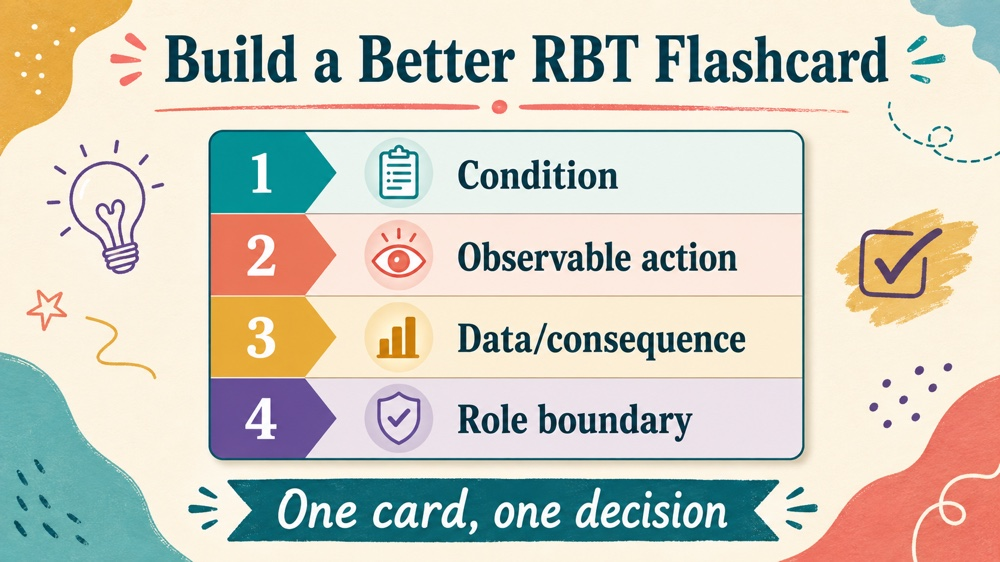
A strong card has a short front and a self-contained back. The front can ask, ‘Given a duration definition, what should the RBT record?’ The back should state the answer, the key condition, and the role boundary. Avoid putting an entire textbook paragraph on one card; the goal is retrieval followed by explanation.
- Choose one task or decision.
- Write an original condition or scenario.
- Name the observable response or data rule.
- State the RBT action and programmed consequence.
- Add a supervisor or ethics note when a change is not independent.
Flashcard examples for data and assessment
A data card might ask the difference between frequency, rate, duration, latency, and interval recording. The answer should include what is measured and when the clock or count begins and ends. An assessment card might ask what an RBT does when implementing a preference assessment: follow the materials and trial rules, record the response, and refer interpretation or procedure changes to the supervising team.
Do not turn a card into a universal rule. The program’s operational definition and measurement system control. Add a note such as ‘check the written plan’ when a procedure can vary by learner or setting. That note protects accuracy instead of weakening the card.
Flashcard examples for acquisition and reduction
For acquisition, make cards about reinforcement, prompting, shaping, chaining, discrimination, generalization, and maintenance. For reduction, make cards about antecedent strategies, differential reinforcement, extinction, safety, and reporting. Each card should ask what the RBT implements and records, not what the technician independently designs.
A useful reverse card starts with an event and asks which concept is present. For example, ‘The technician waits three seconds before the programmed prompt’ points to time delay. ‘The learner uses the skill with a new person after programmed practice’ points to generalization. Explain the cue and consequence rather than relying on the vocabulary label alone.
A task-list flashcard review session
Sort cards into new, learning, review, and source-check piles. Answer the front aloud before turning it over. For a missed card, write why you missed it: definition, discrimination, calculation, reading the condition, or authority boundary. Then change one variable and create a second card. This makes the session diagnostic rather than repetitive.
Use spaced retrieval and interleaving. Mix a measurement card with a prompting card, an ethics card, and a documentation card. The exam and the workplace rarely announce the domain in advance. Practicing the switch helps you notice which rule actually controls the scenario.
Current exam context for RBT task list flashcards
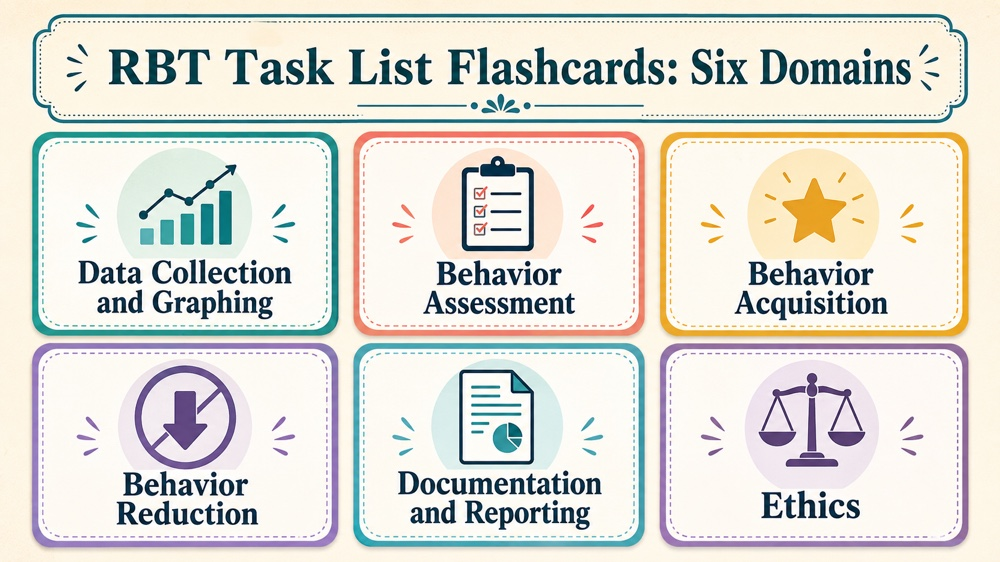
The current outline describes 43 tasks across six domains: Data Collection and Graphing, Behavior Assessment, Behavior Acquisition, Behavior Reduction, Documentation and Reporting, and Ethics. The examination includes 75 scored questions and 10 unscored pilot questions in a 90-minute period. Use the numbers for planning, not as a reason to treat an old flashcard deck as official.
A complete card set should also include role boundaries, privacy, supervision, accurate documentation, and source-checking. A definition-only deck can leave a candidate unprepared for a scenario that asks what to do next.
Mistakes to avoid with flashcards
- Using an unlabeled or outdated task-list version.
- Writing a keyword on the front without a condition or action.
- Memorizing a definition without practicing discrimination.
- Calling an original card official or claiming it predicts the exam.
- Leaving out prompt level, measurement rule, or data consequence.
- Turning a card into permission for independent clinical changes.
- Studying only cards that feel easy and ignoring source-check cards.
RBT task list flashcards checklist
- Does each card identify one task, condition, action, and explanation?
- Is the current outline version recorded on my deck?
- Can I connect cards to all six domains?
- Do the cards distinguish independent, prompted, incorrect, and no-response outcomes?
- Do I include supervision, privacy, documentation, and ethics decisions?
- Can I explain why a tempting alternative is outside the RBT role?
- Do I create new scenarios instead of memorizing protected or recalled questions?
Flashcards work best as active recall tied to accurate sources. Keep the cards short, the scenarios original, and the role boundary visible. When the official outline or handbook changes, update the deck rather than adding another unverified layer.
Practice the concept
Review rbt task list flashcards with original RBT scenarios, current-source reminders, and clear role boundaries.
Review the RBT study resource →
Frequently Asked Questions
Are RBT task list flashcards official?
Flashcards are study tools. Check the current BACB RBT Test Content Outline for the official examination structure and tasks.
What should go on an RBT flashcard?
Use one decision, a clear condition, an observable action, the data or consequence rule, and a role-boundary explanation.
Do flashcards replace practice scenarios?
No. Flashcards support active recall, but original scenarios help candidates transfer concepts to changing conditions.
Can flashcards contain recalled exam questions?
Do not use recalled or protected questions. Use original study scenarios that are not official, recalled, leaked, or BACB-endorsed.
References
- Behavior Analyst Certification Board: Registered Behavior Technician Handbook, updated June 2026.
- Behavior Analyst Certification Board: RBT Test Content Outline (3rd ed.).
- Behavior Analyst Certification Board: RBT resources.
- Behavior Analyst Certification Board: ethics resources.
- Behavior Analyst Certification Board: RBT Ethics Code (2.0).