

The statement RBTs are not allowed to administer standardized assessments is a common RBT exam shortcut. It points to an important scope boundary, but it needs careful wording. The current official RBT Test Content Outline, 3rd edition, says RBTs participate in assessments of relevant skill strengths and deficits; it does not give an RBT an unrestricted task to independently select, administer, score, or interpret every standardized assessment instrument.
Table of Contents
- Rbts are not allowed to administer standardized assessments: what the shortcut means
- What makes an assessment standardized?
- What the current TCO actually assigns to RBTs
- Compare standardized, skill, preference, functional, and competency assessments
- Rbts are not allowed to administer standardized assessments: the RBT scope boundary
- A five-step scope verification workflow
- Rbts are not allowed to administer standardized assessments: how the exam tests the boundary
- Rbts are not allowed to administer standardized assessments: final scope checklist
- Original exam-style standardized-assessment scenarios
- Map standardized-assessment boundaries to the six current TCO domains
- Frequently Asked Questions
- References
For exam purposes, choose the answer that keeps the RBT in an assigned, supervised participation role and sends instrument selection, interpretation, diagnosis, and report-level decisions to the qualified professional or responsible team. In actual work, whether an RBT may assist with a particular instrument can depend on the instrument manual, training, supervisor direction, employer, payer, state law, and licensure rules. Do not turn a study card into universal legal advice.
The current TCO contains 43 tasks across six domains. The current exam presents 85 multiple-choice questions: 75 scored questions and 10 unscored pilot questions, with four answer choices and 90 minutes. This article uses original scenarios and is not an official question bank. RBT Training provides independent exam-preparation content and is not affiliated with or endorsed by the BACB. No course can guarantee certification or a passing result.
Rbts are not allowed to administer standardized assessments: what the shortcut means
When a practice question uses this statement as a true/false item, it is usually testing whether the RBT recognizes a limit on independent assessment authority. The safest exam interpretation is:
An RBT should not independently choose, administer, score, or interpret a standardized assessment as if the technician were the qualified evaluator. The RBT may participate in assigned assessment components when the current plan, instrument requirements, supervisor, and applicable rules authorize that participation.
This answer is more precise than either extreme. “RBTs can administer anything if a supervisor is nearby” ignores instrument and role requirements. “An RBT can never touch any standardized assessment materials under any circumstances” goes beyond the TCO wording and may conflict with a particular instrument’s authorized procedures. The exam wants the role boundary: participate as assigned; do not claim independent assessment authority.
What makes an assessment standardized?
A standardized assessment uses prescribed materials, instructions, administration conditions, scoring rules, and interpretation procedures intended to be applied consistently. It may produce norm-referenced scores, criterion scores, or another formal result. The manual or publisher requirements matter. A person cannot make an assessment standardized simply by putting a timer and a score sheet in the room.
| Feature | Question to ask | Why an RBT should pause |
|---|---|---|
| Fixed instructions | Must the wording be delivered exactly? | Changing prompts, examples, wait time, or materials can invalidate the administration. |
| Standardized materials | Does the tool require a specific kit, stimulus set, or response format? | Substituting materials may change what the instrument measures. |
| Scoring rules | Who is authorized to calculate or interpret the score? | Raw response recording is not the same as clinical interpretation. |
| Qualification | Does the manual, employer, state, or payer require a particular credential or training? | RBT certification alone does not override a separate requirement. |
| Report use | Will the result be used for diagnosis, eligibility, treatment planning, or a formal decision? | Report-level conclusions belong to the responsible qualified professional. |
Example: a supervisor asks an RBT to sit beside a learner while the supervisor delivers an instrument’s exact items. The RBT may be assigned to prepare materials or record defined responses, but should not change item wording, add unauthorized prompts, calculate an interpretation, or sign the evaluator’s report without explicit authorization and qualification.
What the current TCO actually assigns to RBTs
The current TCO separates three behavior-assessment tasks:
| TCO task | Plain-language meaning | RBT boundary |
|---|---|---|
| B.1 Preference assessments | Conduct assigned procedures such as multiple-stimulus, paired-stimulus, or free-operant preference assessment. | Follow the stated procedure and record selections; do not call every selected item a reinforcer without evidence. |
| B.2 Skill strengths and deficits | Participate in assessments of relevant skills, such as curriculum-based, developmental, or social skills assessments. | Participation can include assigned probes or response recording; instrument authority and interpretation must be verified. |
| B.3 Functional-assessment components | Participate in components of descriptive assessment or functional analysis as assigned. | Do not independently design conditions, change consequences, or announce a behavioral function. |
Notice the verbs. “Conduct” in B.1 refers to assigned preference-assessment procedures. “Participate” in B.2 and B.3 does not automatically mean independent administration of a standardized instrument or independent interpretation of results. A high-quality answer follows the verb, the plan, the training, and the supervisor.
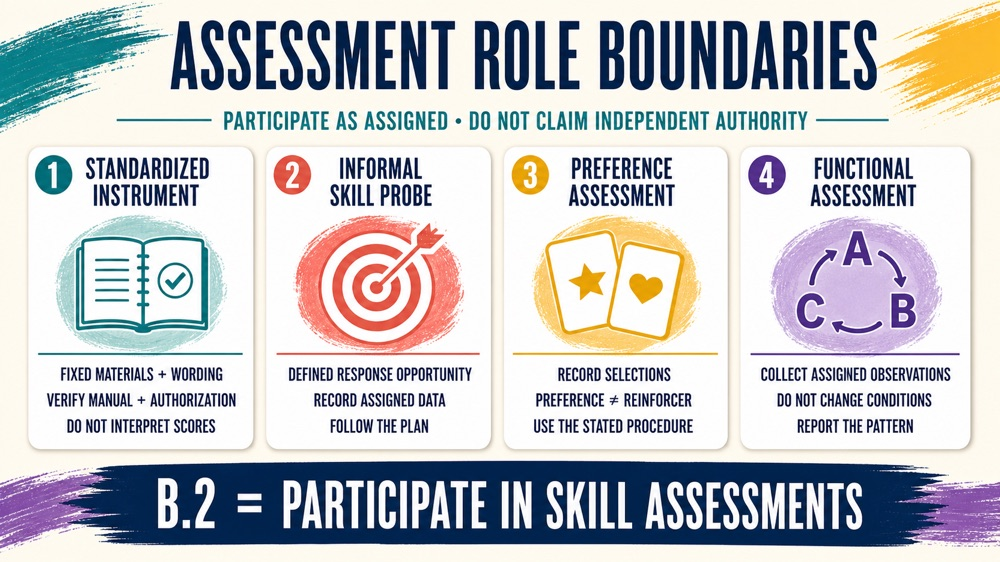
Compare standardized, skill, preference, functional, and competency assessments
| Situation | What is being assessed? | What an RBT should remember |
|---|---|---|
| Standardized assessment | Performance under fixed materials, instructions, and scoring conditions. | Do not independently select, alter, score, or interpret it by title alone; check manual and authorization. |
| Informal skill probe | A defined response under a teaching or assessment condition created by the clinical team. | May be an assigned participation task; follow the procedure and record the response. |
| Preference assessment | Selection or engagement among stimuli under a specified procedure. | Record choices; preference does not automatically equal reinforcement. |
| Functional-assessment component | Information about antecedents, behavior, consequences, or systematically arranged conditions. | Participate only as assigned; do not independently infer or change the function analysis. |
| RBT Initial Competency Assessment | The candidate’s ability to perform technician skills. | It evaluates the technician, not a client’s standardized skill score or diagnosis. |
These categories can appear in one workplace but they are not interchangeable. A question may describe a child completing a task and ask what the RBT is doing. Look for whether the response is a preference choice, a skill probe, a standardized item, a functional-assessment observation, or a technician competency demonstration.
Rbts are not allowed to administer standardized assessments: the RBT scope boundary
Use “administer” carefully. In everyday conversation, someone may use it to mean “handed the materials to the learner” or “read one assigned item.” In an exam or professional document, administer can imply responsibility for following the instrument, scoring it, and producing an interpretable result. An RBT should not accept that responsibility without the required authorization, training, and qualification.
- May be assigned: prepare materials, arrange the environment, present a response opportunity exactly as directed, record raw responses, or report observable behavior.
- Must verify: the instrument manual, supervisor direction, employer policy, training, payer rules, and applicable state or licensure requirements.
- Should not assume: that an RBT credential authorizes every standardized tool, every setting, or every formal report.
- Should not independently: select the assessment, change administration conditions, interpret scores, diagnose, determine eligibility, or rewrite a treatment plan from one score.
For example: if a caregiver asks an RBT to “run the school readiness test and tell me whether my child qualifies,” the RBT should not promise to do that. The RBT should explain that the request must go through the responsible supervisor or qualified evaluator, then follow any assigned participation procedure and document the communication.
A five-step scope verification workflow
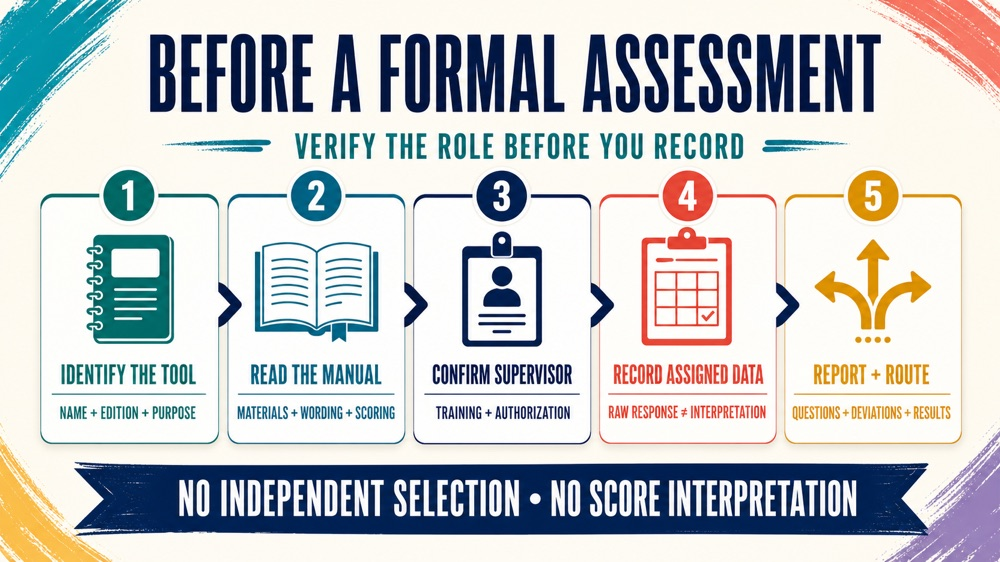
Before touching a formal assessment, use this workflow:
- Identify the tool: obtain the exact name, edition, manual, and intended use. “Assessment” is too vague.
- Identify the role: ask whether the RBT is preparing, presenting, recording raw responses, scoring, interpreting, or writing a report.
- Check authorization: confirm the supervisor, employer, instrument requirements, state rules, payer conditions, and required training.
- Follow the procedure: do not alter instructions, prompts, timing, materials, or scoring rules. Ask before proceeding if anything is unclear.
- Report accurately: separate raw observation from interpretation, document interruptions or deviations, and route results to the responsible professional.
If any step is unanswered, pause and ask the supervisor. “I was told to do it” is not enough if the task conflicts with the instrument manual, competence, law, or client protection. The RBT’s ethical obligation is to work within competence and seek guidance.
Rbts are not allowed to administer standardized assessments: how the exam tests the boundary
In a multiple-choice stem, underline the verb and the responsibility attached to it. “Participate,” “record,” or “assist” usually describes a narrower role than “select,” “administer independently,” “interpret,” or “diagnose.” Then ask whether the scenario supplies a current plan, qualified supervisor, instrument training, and a defined task. If those details are missing, the safest answer is to pause and seek direction rather than assume authority.
Also separate an assessment result from a treatment decision. A raw response can be accurate while the interpretation is still outside the RBT’s assignment. The exam may include a tempting answer such as “tell the parent the score means…”; that answer confuses observation with professional interpretation.
Rbts are not allowed to administer standardized assessments: final scope checklist
- Do I know the exact tool, edition, purpose, and manual?
- What role was assigned: prepare, present, record, score, interpret, or report?
- Has the supervisor confirmed authorization, training, and competence?
- Am I preserving the required wording, materials, timing, and scoring rules?
- Where will I route questions, deviations, raw data, and formal results?
If the answer to any question is unclear, contact the supervisor before proceeding. This checklist supports safe study reasoning; it does not replace the instrument manual, employer policy, or applicable law.
Original exam-style standardized-assessment scenarios
Scenario 1—fixed wording: an RBT is asked to deliver an assessment item but the learner does not respond. The RBT wants to rephrase the item to make it easier. What is the best action?
Answer: do not rephrase independently. Follow the manual and assigned instructions, record the response or nonresponse, and ask the supervisor how to proceed.
Scenario 2—raw response recording: a supervisor who is qualified to administer the instrument asks the RBT to mark whether the learner touched the correct item. Is this automatically the same as independently administering the assessment?
Answer: not necessarily. It may be an assigned recording component, but the RBT must verify authorization, training, the manual, and the supervisor’s direction. The RBT should not interpret or sign the formal result just because they recorded responses.
Scenario 3—score interpretation: a parent asks the RBT whether the child’s score means an autism diagnosis.
Answer: do not interpret or diagnose. Route the question to the qualified professional and protect confidential information.
Scenario 4—assessment selection: a technician finds a free online standardized checklist and wants to use it because the written plan does not name a tool.
Answer: do not choose a new instrument independently. Ask the supervisor to clarify the assessment plan, intended use, qualifications, and documentation requirements.
Scenario 5—functional assessment: a supervisor asks the RBT to collect ABC observations during assigned conditions. The RBT notices a pattern and wants to change the consequence to “test” a function.
Answer: collect the assigned observations, report the pattern, and do not change conditions or announce a function without the responsible professional’s direction.
These examples are newly written for study and are not official, recalled, leaked, or BACB-endorsed questions. The recurring answer pattern is: identify the exact role, follow the authorized procedure, do not alter or interpret beyond competence, and communicate uncertainty.
Map standardized-assessment boundaries to the six current TCO domains
| Domain | Connection | Review prompt |
|---|---|---|
| A. Data Collection and Graphing | Record observable responses and preserve measurement fidelity. | Am I recording what the procedure defines? |
| B. Behavior Assessment | Distinguish preference, skill, functional, and standardized-assessment participation. | What is the assessment type and assigned role? |
| C. Behavior Acquisition | Run assigned teaching probes without turning a probe into an unauthorized test or treatment decision. | What does the written teaching plan require? |
| D. Behavior Reduction | Collect assessment information safely and do not change consequences to test a hypothesis. | What safety or supervisor step controls the situation? |
| E. Documentation and Reporting | Document raw responses, deviations, questions, and communication accurately. | Could the qualified evaluator reconstruct the session? |
| F. Ethics | Stay within competence, protect privacy, follow supervision, and avoid misrepresenting authority. | Does the answer protect client rights and role boundaries? |
Bottom line: the phrase RBTs are not allowed to administer standardized assessments is best understood as an exam reminder against independent administration and interpretation. The official TCO permits assigned participation in relevant assessments; the exact task must be checked against the instrument, supervisor, training, employer, payer, and applicable rules.
Practice the assessment boundary before a full mock.
Use original RBT questions to distinguish preference, skill, functional, standardized, and competency assessments.
Try free RBT practice questions →
Frequently Asked Questions
Are RBTs allowed to administer standardized assessments?
The safest RBT exam answer is that an RBT should not independently select, administer, score, or interpret a standardized assessment by title alone. The current TCO says RBTs participate in assessments of relevant skill strengths and deficits. Specific assistance must be authorized by the supervisor and consistent with the instrument, training, employer, payer, and applicable rules.
What does B.2 of the current RBT TCO say?
B.2 says to participate in assessments of relevant skill strengths and deficits, including examples such as curriculum-based, developmental, and social-skills assessments. The word participate is important for scope reasoning.
Can an RBT collect raw responses?
An RBT may be assigned to record observable responses when the supervisor, instrument requirements, training, and applicable rules authorize it. Raw recording is not the same as independent score interpretation or report writing.
Can an RBT choose an assessment tool?
An RBT should not independently select a formal assessment tool. Ask the responsible supervisor or qualified evaluator to identify the tool, purpose, administration rules, and role assignments.
Is an RBT competency assessment the same as a client standardized assessment?
No. The Initial Competency Assessment evaluates the RBT candidate’s technician skills. It is not a standardized assessment of a client’s development, achievement, diagnosis, or treatment eligibility.
Are these assessment scenarios official questions?
No. They are newly written educational examples and are not official, recalled, leaked, or BACB-endorsed questions.
References
- Behavior Analyst Certification Board. RBT Test Content Outline (3rd ed.).
- Behavior Analyst Certification Board. RBT Test Content Outline, 3rd edition PDF.
- Behavior Analyst Certification Board. Registered Behavior Technician Handbook.
- Behavior Analyst Certification Board. Supervision, Assessment, Training, and Oversight.
- Behavior Analyst Certification Board. RBT Initial Competency Assessment Packet, effective January 1, 2026.
- Quizlet behavioral-skills flashcards. Reviewed because it matches the search wording; not an official BACB source.
- RBT Hub practice questions. Reviewed for competitor assessment-question patterns.