
If you are looking for an rbt test review, the most useful review is not a list of remembered letters. It is a repeatable process that shows what the question tested, why the best answer fits the scenario, why the distractors fail, and what you will do differently next time.
Table of Contents
- What a useful RBT test review should measure
- RBT test review: the four-step answer-review loop
- How to complete a missed-question review card
- The error types behind an RBT practice miss
- RBT test review by the six TCO domains
- How to interpret an RBT practice result safely
- A repeatable one-week RBT test review schedule
- How to choose a high-quality practice review resource
- Frequently Asked Questions
- References
The current RBT examination presents 85 multiple-choice questions in 90 minutes. It includes 75 scored questions and 10 unscored questions, and each item has four answer choices. The current RBT Test Content Outline (3rd ed.) contains 43 tasks across six domains. Use those official facts to design practice, but do not call independent questions official, recalled, leaked, or BACB-endorsed.
A score can tell you where to look. It cannot, by itself, tell you whether the problem was a measurement mismatch, a reading error, an unfamiliar procedure, a scope boundary, or a timing decision. This guide builds a review loop that turns each practice set into a targeted study plan.
This is independent exam-prep guidance. It does not reproduce official exam content, predict your score, guarantee certification, or promise that a particular practice percentage equals a BACB result.
What a useful RBT test review should measure
A practice set is useful when it measures applied decision-making, not just vocabulary recognition. The current TCO is organized around tasks that an entry-level behavior technician should understand and implement under supervision. A good review therefore asks whether you matched the scenario to the right procedure and professional boundary.
| Review question | What you are checking |
|---|---|
| What is directly observable? | Whether you separated an operational description from an interpretation or mentalistic label. |
| What measurement fits? | Whether you distinguished frequency, rate, duration, latency, interresponse time, continuous, discontinuous, or permanent-product choices. |
| What procedure is written? | Whether you followed the stated teaching, reinforcement, prompting, or behavior-reduction plan. |
| What is the RBT’s role? | Whether you implemented the plan, documented objectively, protected dignity, and contacted the supervisor instead of improvising clinical decisions. |
| What evidence supports the answer? | Whether your choice came from the stem rather than from a familiar word that appeared in a distractor. |
For example: a question may describe a behavior that occurs 12 times in a 30-minute session and ask which measurement best represents the result. A review that only records “B was correct” is weak. A stronger review says that the scenario gives count and time, so rate may be the useful representation, then explains why duration or latency would not answer the same question.
RBT test review: the four-step answer-review loop
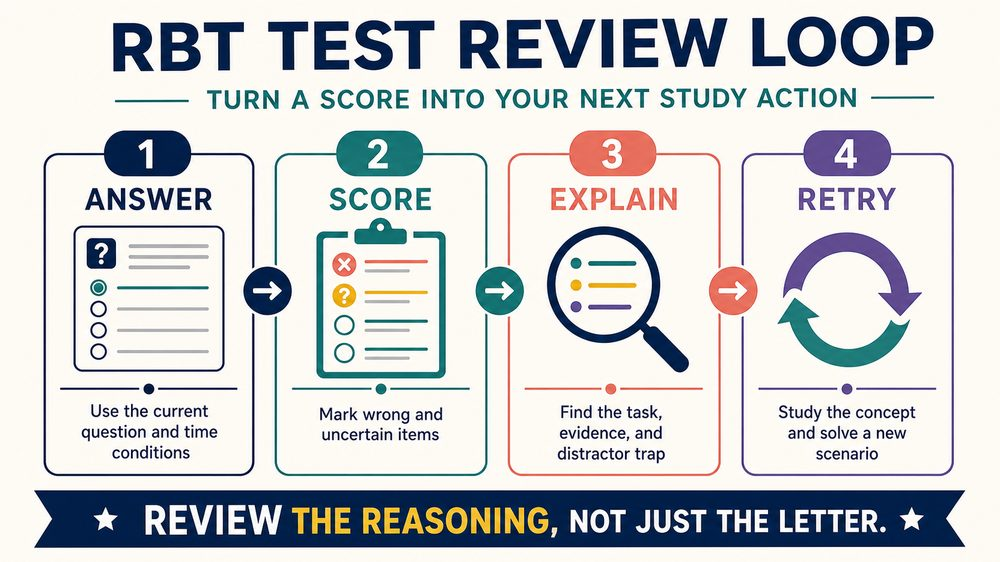
Use the same loop after a full-length mock exam, a domain quiz, or a short set of original scenarios. Consistency makes it easier to see whether your performance is improving because you understand the task rather than because you remember an item.
- Answer under conditions: use the question count, four-choice format, and time pressure appropriate to the practice goal. For a full simulation, use 85 original questions and a 90-minute clock.
- Mark uncertainty: record wrong answers and answers you guessed or changed. An answer can be correct for the wrong reason and still needs review.
- Explain the decision: identify the tested task, the evidence in the stem, the best answer, and why each tempting distractor fails.
- Retry with transfer: study the underlying concept, then answer a new scenario with different names, settings, and surface details.
The fourth step is important. Repeating the same question until you remember its letter measures memory of the question. A new scenario tests whether the concept transfers.
How to complete a missed-question review card
Create one short review card for every wrong or uncertain answer. The card can be a spreadsheet row, a notebook entry, or a template in your study system. Keep it concise enough to use repeatedly.
| Field | What to write |
|---|---|
| Domain and task | Use the current TCO domain and task that the scenario targets. |
| Decision cue | Write the one or two facts in the stem that should control the answer. |
| My answer | Record the selected option and the reason you actually used. |
| Best answer | State the answer in your own words, without copying a practice-site explanation. |
| Distractor audit | Explain why each alternative is less appropriate for this scenario. |
| Error type | Choose concept gap, measurement mismatch, reading error, scope or ethics error, distractor trap, or pacing error. |
| Next action | Choose a source review, a worked example, a domain quiz, a supervisor question, or a new transfer item. |
Do not write private client information into a study log. Use fictional examples and remove identifying details from any training notes. Practice content should teach the reasoning pattern while respecting client dignity and confidentiality.
The error types behind an RBT practice miss
Two candidates can miss the same item for different reasons. Classifying the error helps you choose the next study action.
- Concept gap: you did not know the distinction, definition, or procedure.
- Measurement mismatch: you knew the terms but selected a system that did not match the behavior or question.
- Reading error: you missed “most appropriate,” “not,” “first,” “best,” or another decision word.
- Distractor trap: you chose a familiar phrase that ignored a more important scenario fact.
- Scope or ethics error: you selected an answer that changed a plan, made a clinical judgment, or crossed a professional boundary.
- Pacing error: you ran out of time, rushed the last items, or spent too long on one ambiguous stem.
If most misses are concept gaps, return to the relevant study section. If most are reading errors, practice slower stem parsing. If most are scope errors, review the written plan, supervision, documentation, and ethics boundaries. More question volume is not the right fix for every category.
RBT test review by the six TCO domains
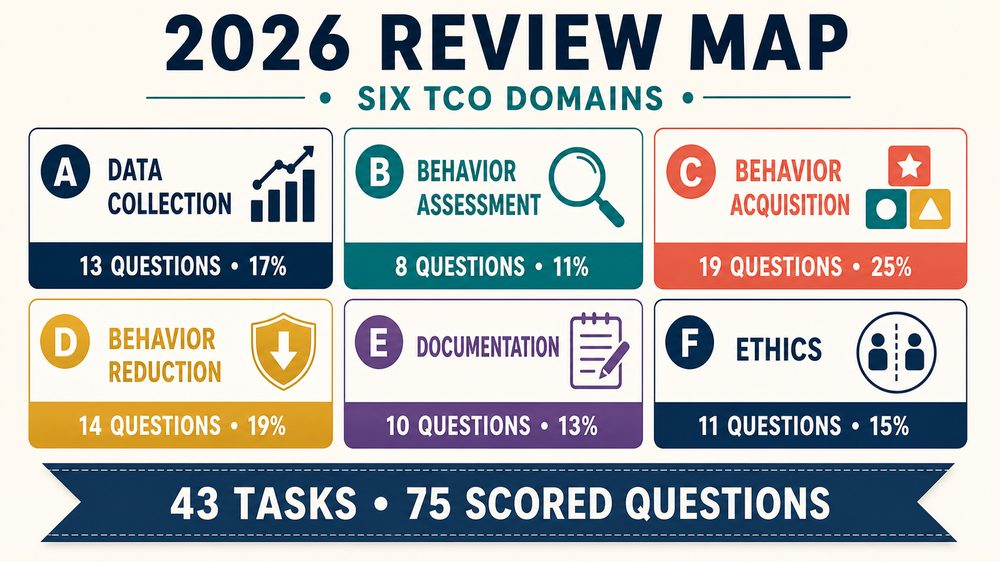
The current TCO provides a stable map for organizing review. The scored-question distribution below comes from the published outline. It is a study-weighting reference, not a promise about the order or wording of questions on your appointment.
| Domain | Tasks | Scored-question map | Review emphasis |
|---|---|---|---|
| A. Data Collection and Graphing | 8 | 13, about 17% | Measurement match, data quality, graph reading, and objective definitions. |
| B. Behavior Assessment | 3 | 8, about 11% | Preference assessments, ABC data, and the RBT’s assessment role. |
| C. Behavior Acquisition | 11 | 19, about 25% | Teaching procedures, prompting, reinforcement, chaining, shaping, and discrimination. |
| D. Behavior Reduction | 7 | 14, about 19% | Antecedent strategies, differential reinforcement, extinction, crisis boundaries, and safety. |
| E. Documentation and Reporting | 4 | 10, about 13% | Objective notes, client progress, session variables, and timely reporting. |
| F. Ethics | 10 | 11, about 15% | Professional conduct, supervision, boundaries, confidentiality, and scope of practice. |
The table adds to 43 tasks and 75 scored questions. The 10 unscored questions are mixed into the 85 presented questions and are not identified to the candidate. Use the same care for every item.
How to interpret an RBT practice result safely
A practice score is one signal. It becomes more useful when you read it with the error log and conditions that produced it.
| Signal | Question to ask |
|---|---|
| Total accuracy | Did accuracy improve on new questions, or did I repeat a familiar set? |
| Domain pattern | Which TCO domain or task type has repeated misses? |
| Confidence | Which correct answers were guesses and therefore need explanation review? |
| Timing | Did I complete all items, preserve a review pass, and avoid a single-question time sink? |
| Transfer | Can I explain the concept in a different scenario without seeing the original choices? |
Do not publish or rely on a made-up “green means ready” threshold. Practice sites use different item difficulty, scoring, and content. RBT Training can use a local readiness gate for internal study recommendations, but that gate is not a BACB passing score and does not guarantee certification.
Practice example: a learner scores 82% on a familiar quiz but misses half of the new graph and ethics items in a second set. The best next action is not to celebrate the first percentage or take ten more familiar quizzes. Review the graph-reading and scope errors, then run a fresh mixed set.
A repeatable one-week RBT test review schedule
Use this outline as a flexible study routine. Adjust the number of questions to your time and training context; the important part is the review sequence.
- Day 1, baseline: complete a mixed set and record wrong, guessed, and slow answers by TCO domain.
- Day 2, measurement and assessment: review A and B errors, then answer new data, graph, preference, and ABC scenarios.
- Day 3, acquisition: review C errors and compare prompting, reinforcement, shaping, chaining, and naturalistic teaching choices.
- Day 4, reduction: review D errors, including antecedent interventions, differential reinforcement, extinction, and safety boundaries.
- Day 5, documentation and ethics: review E and F errors, especially objective notes, confidentiality, supervision, and scope.
- Day 6, transfer: complete new mixed questions and write explanations for every uncertain answer.
- Day 7, full simulation: use 85 original questions under a 90-minute clock, then review the error taxonomy rather than only the percentage.
If a supervisor, trainer, or qualified instructor identifies a practical skill gap, address it through the proper supervision and training structure. A website practice answer cannot replace clinical direction or a formal competency assessment.
How to choose a high-quality practice review resource
- Current blueprint: the resource names the RBT Test Content Outline (3rd ed.) when it claims current 2026 alignment.
- Original questions: it clearly says the items are independent, not official, recalled, leaked, or endorsed.
- Explanations: each answer explains why the correct option fits and why distractors fail.
- Domain labels: you can connect errors to a task or domain instead of collecting an unstructured score.
- Timing controls: full-length practice uses the current 85-question and 90-minute format, while study mode permits learning.
- Privacy and scope: examples protect client information and do not teach RBTs to make unsupervised clinical decisions.
More questions are not automatically better. A smaller set with a clear rationale can teach more than a large bank that only tells you whether a letter was right.
Bottom line: an effective rbt test review turns every wrong or uncertain answer into a task, evidence, distractor, error type, and next action. Use the current six-domain TCO to organize the work, simulate 85 questions in 90 minutes when you need an endurance check, and remember that independent practice feedback is not an official BACB score or a certification guarantee.
Review the reasoning, not just the score.
Use original RBT practice scenarios, answer explanations, and domain-level feedback to decide what to study next.
Try the RBT practice materials →
Frequently Asked Questions
What should an RBT test review include?
Review wrong and uncertain answers by identifying the TCO task, evidence in the stem, best answer, distractor reasons, error type, and next practice action. Reviewing only the answer letter is not enough.
How many questions should I use for a full RBT review?
For a full simulation, use 85 original multiple-choice questions under a 90-minute clock. Shorter domain quizzes are useful for targeted learning but do not measure full-length endurance.
Should I review correct RBT practice answers?
Yes, especially answers you guessed or changed. A correct letter can hide a weak explanation, and reviewing the reasoning helps you transfer the concept to a new scenario.
Does a practice score predict the BACB result?
No. Practice resources use different questions, difficulty, scoring, and conditions. Use the score with your error log and transfer performance; it is not an official passing threshold.
What are the six RBT exam domains?
The current 3rd-edition TCO domains are Data Collection and Graphing, Behavior Assessment, Behavior Acquisition, Behavior Reduction, Documentation and Reporting, and Ethics.
Are RBT practice questions official?
Independent practice questions should be clearly labeled as original and not official, recalled, leaked, or BACB-endorsed. Do not use or share protected exam content.
References
- Behavior Analyst Certification Board. RBT Test Content Outline (3rd ed.).
- Behavior Analyst Certification Board. Registered Behavior Technician Handbook.
- RBT Practice Exam study guide. Reviewed for competitor research; not an official source.
- RBT Practice Test study guide. Reviewed for competitor research; not an official source.
- RBT Hub practice-question index. Reviewed for competitor research; not an official source.
- ABA Sprout RBT exam tips. Reviewed for competitor research; not an official source.
- ABA Exam Review practice-question video. Reviewed for competitor research; not an official source.