
ABA data collection sheets are only useful when their fields match the behavior definition, measurement system, program, and setting. A polished template cannot decide whether frequency, duration, latency, interval recording, trial-by-trial accuracy, ABC data, or permanent-product recording is the right method. That decision comes from the current program and qualified supervision.
Table of Contents
- What ABA data collection sheets should do
- Choose the measurement before the template
- Essential fields in a usable ABA data sheet
- Common ABA data collection sheet types
- Audit data quality before interpreting a trend
- Original sheet examples for RBT study
- Map ABA data collection sheets to six RBT domains
- Frequently Asked Questions
- References
A good sheet reduces memory load while preserving the information another professional needs to verify. It should identify the client or session safely, define the target, record the correct unit, capture relevant prompts or conditions, and leave enough room for objective notes. It should also make errors visible instead of hiding them behind a convenient checkbox.
The current RBT Test Content Outline, 3rd edition, includes 43 tasks across six domains. Data collection and graphing is Domain A, but a sheet also touches assessment, acquisition, reduction, documentation, and ethics. RBT Training’s examples are independent study content, not official, recalled, leaked, or BACB-endorsed questions. No template or data score can guarantee a clinical or examination outcome.
The current exam frame presents 75 scored questions and 10 unscored pilot questions within 85 presented questions. A data-sheet article should support the same applied reasoning the current outline tests, but it should never present an online form or practice item as official exam content.
What ABA data collection sheets should do
A data sheet is a structured recording tool. It is not the operational definition, the behavior plan, the graph, or the clinical decision itself. Its job is to make the defined observation easy to record with enough context to support later review.
| Sheet function | What it captures | Quality question |
|---|---|---|
| Event record | Each occurrence or count within a defined observation period. | Is the event definition observable and the observation time known? |
| Time record | How long behavior lasts or how long it takes to begin. | Are onset, offset, cue, and time unit clear? |
| Opportunity record | Response outcome for each teaching or naturally occurring opportunity. | Can independent, prompted, incorrect, and no-response outcomes be separated? |
| Context record | Antecedent, behavior, consequence, setting, or relevant condition. | Are observations separated from interpretations? |
| Product record | Evidence left by a behavior, such as completed work or a task step. | Does the product reliably represent the target? |
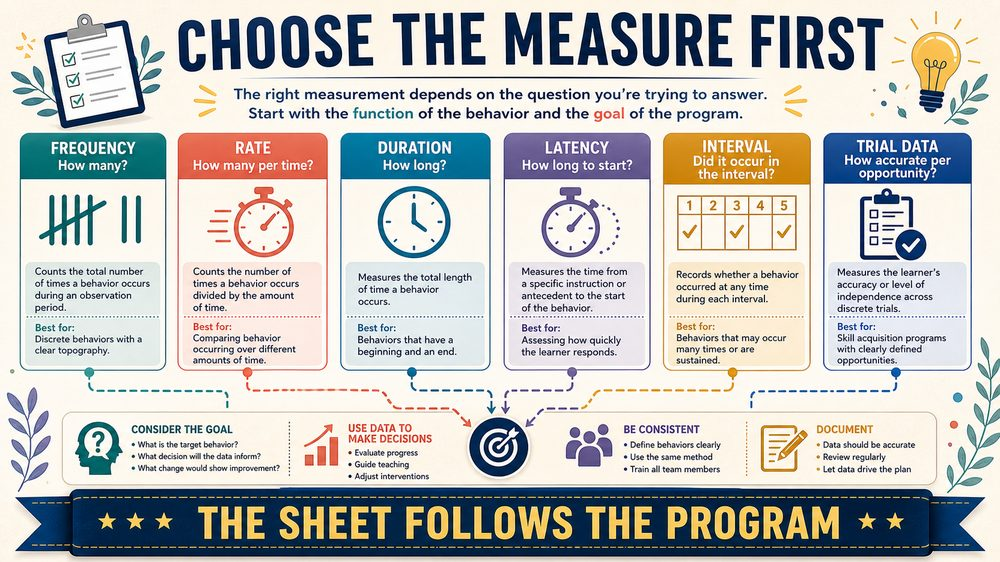
Do not select a sheet because its title sounds familiar. Start with the question the team needs answered: how often, how long, how quickly, how consistently across intervals, how independently across opportunities, or under what context?
Choose the measurement before the template
| Question | Possible measure | Sheet feature |
|---|---|---|
| How many times did the behavior occur? | Frequency or event count. | Tally marks, observation start and end, and total count. |
| How often per unit of time? | Rate. | Count plus the exact time denominator. |
| How long did an episode last? | Duration. | Onset, offset, and time unit. |
| How long from cue to response? | Latency. | Instruction time and response-start time. |
| How much time between responses? | Interresponse time. | End or start points defined by the plan. |
| Did behavior occur during timed blocks? | Partial, whole, or momentary time sampling. | Intervals, rule, timer, and yes/no code. |
| How accurate per teaching chance? | Trial-by-trial or percent of opportunities. | Opportunity, response, prompt level, and outcome code. |
The same target can require different measures for different decisions. A count may answer “how many,” while duration answers “how long.” A rate makes counts from different observation lengths comparable, but only when the denominator is defined. Interval recording samples behavior and can over- or underestimate occurrence depending on the method. The sheet must preserve the method rather than making the data look more precise than they are.
For example: if the program asks how long a learner waits before starting a task, a frequency sheet cannot answer the question. Use a latency field with a defined cue and response onset. If the program asks how many times a behavior occurs in a 30-minute session, a duration timer alone does not answer it.
Essential fields in a usable ABA data sheet
- Target label: use the current operational definition or program name, not a vague label.
- Date and observation window: record when and for how long the observation occurred.
- Setting and relevant condition: include only the context fields required by the program and privacy policy.
- Measurement unit: count, rate, duration, latency, interval, trial, percentage, or permanent product.
- Response code: define independent, prompted, incorrect, no response, occurrence, nonoccurrence, or other codes.
- Prompt and consequence fields: include them when they are part of the teaching or decision rule.
- Observer and review fields: identify the authorized recorder and any required reliability or supervisor review.
- Objective note space: allow a concise description of unusual context, barrier, or safety event.
A sheet should be fast enough to use during the session and specific enough to audit afterward. If a field is never used, ask whether it belongs. If a critical field is missing, the form may be convenient but not adequate for the program.
Common ABA data collection sheet types
| Type | Best fit | Watch for |
|---|---|---|
| ABC sheet | Descriptive observation of events before and after a target behavior. | Do not turn an observed consequence into a confirmed function. |
| Frequency or rate sheet | Countable behavior with a defined observation period. | Rate requires the time denominator. |
| Duration or latency sheet | Behavior with meaningful temporal onset and offset. | Define exactly when timing starts and ends. |
| Interval sheet | Behavior sampled across partial, whole, or momentary intervals. | Use the correct yes/no rule for the method. |
| Trial-by-trial sheet | Discrete teaching, task steps, or repeated opportunities. | Preserve prompt level and independent criteria. |
| Task-analysis sheet | Sequence of steps in a chained skill. | Define whether a step is independent, prompted, or incorrect. |
| Permanent-product sheet | Evidence left after the behavior, such as completed work. | Confirm the product is a valid proxy for the target. |
Templates found online may combine several methods. That is not automatically better. A crowded form can slow recording and create accidental mixing of units. Use the smallest form that captures the program’s required information and no less.
Audit data quality before interpreting a trend
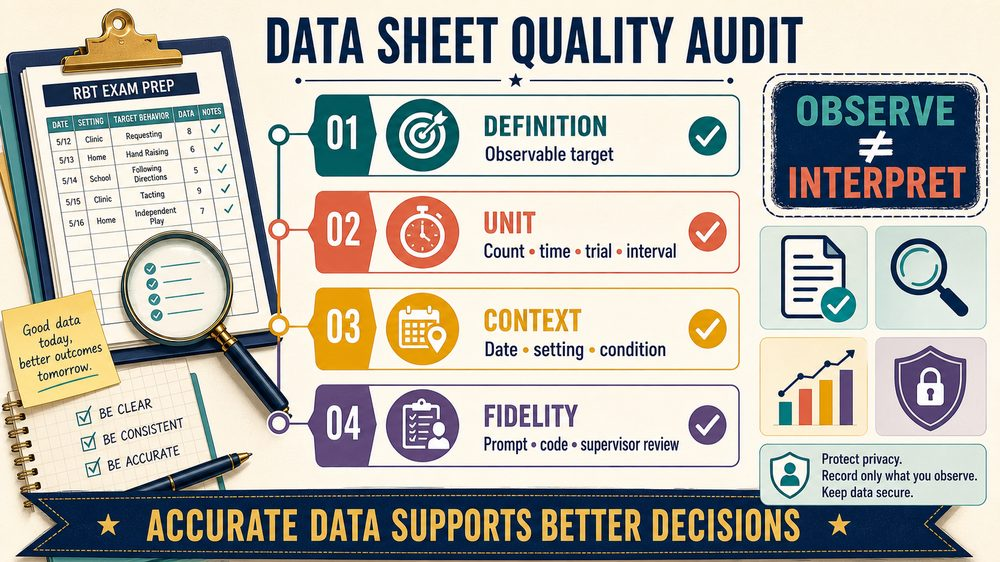
| Audit question | What a pass looks like | What a failure suggests |
|---|---|---|
| Definition | Two observers can identify the target consistently. | Rewrite or clarify through the authorized supervisor. |
| Unit | The sheet’s unit matches the program and graph. | Do not compare incompatible values. |
| Time | Observation window or denominator is recorded. | A count may be mistaken for a rate. |
| Prompt | Prompted and independent responses are distinguishable when needed. | Mastery may be overstated. |
| Completeness | Missing trials or unusual events are marked and explained. | Do not silently fill gaps from memory. |
| Reliability | Required interobserver agreement or review is completed as assigned. | Observer drift or recording bias may be present. |
An RBT can notice a data irregularity and report it. The RBT should not change the measurement system, graphing rule, mastery criterion, or target definition independently. A better-looking graph is not a reason to change the sheet after the fact.
Original sheet examples for RBT study
Trial example: the sheet has ten rows, each with an opportunity, response code, prompt level, and consequence. If the learner answers correctly after a verbal prompt, mark prompted correct rather than independent.
ABC example: the sheet records “instruction to clean up,” “threw block,” and “adult removed block.” Those are observations. The phrase “behavior was maintained by escape” is a hypothesis that requires appropriate analysis and supervision.
Interval example: a five-minute observation uses partial-interval recording. Mark occurrence if the defined behavior happens at any point in an interval; do not use whole-interval scoring because it makes the percentage look different.
Permanent-product example: completed worksheets are used to evaluate a writing target. Confirm that the worksheet actually represents the target and that the program defines how incomplete or assisted work is scored.
These examples are newly written independent study content, not official, recalled, leaked, or BACB-endorsed questions.
Map ABA data collection sheets to six RBT domains
| Domain | Connection to sheets | Study check |
|---|---|---|
| A. Data Collection and Graphing | Select and use the defined measure, record accurately, and support graphing. | Does the sheet capture the right unit? |
| B. Behavior Assessment | Record assigned preference, skill, and functional-assessment information. | Are observation and interpretation separated? |
| C. Behavior Acquisition | Record opportunities, prompts, errors, reinforcement, and generalization. | Can independent performance be distinguished? |
| D. Behavior Reduction | Track target behavior, replacement skills, context, and safety events as written. | Does the sheet match the reduction plan? |
| E. Documentation and Reporting | Complete notes, preserve records, and communicate irregularities. | Is the record objective and secure? |
| F. Ethics | Protect privacy, dignity, consent or assent, competence, and data integrity. | Does the form reveal only authorized information? |
Domain A is the center of the topic, but a data sheet can fail ethically or clinically even when the arithmetic is correct. Use the full map when reviewing a form.
Bottom line: choose ABA data collection sheets by measurement question, operational definition, time window, response code, prompt rule, context, and privacy—not by visual convenience alone. Use the authorized program, record close to the event, audit the data, and bring irregularities to supervision.
Connect measurement to exam decisions.
Use original RBT practice questions to review measurement, data quality, and plan-fidelity scenarios.
Try free RBT practice questions →
Frequently Asked Questions
What should ABA data collection sheets include?
They should include the target definition or program label, date and observation window, measurement unit, response or prompt code, required context, observer information, and objective notes appropriate to the program.
How do I choose the right ABA data sheet?
Start with the question: count, rate, duration, latency, interresponse time, interval occurrence, trial accuracy, ABC context, or permanent product. Then select a form that matches the authorized measurement procedure.
Can an RBT change a data sheet?
An RBT can report that a form is missing, confusing, or not capturing a required field. The RBT should not independently change the measurement system or data rules; ask the supervisor.
What is the difference between frequency and rate?
Frequency is a count of occurrences. Rate expresses a count per unit of time, so the observation duration or denominator must be defined.
Are online ABA data sheets official BACB forms?
Not automatically. Online templates are independent resources unless an official BACB source identifies them as an official form. Verify the current program and BACB requirements.
References
- Behavior Analyst Certification Board. RBT Test Content Outline (3rd ed.).
- Behavior Analyst Certification Board. RBT examination resources.
- Data sheet template library. Reviewed for competitor research; not an endorsement.
- Rethink Behavioral Health data sheets. Reviewed for competitor research; not an endorsement.
- Special Learning data collection resources. Reviewed for competitor research; not an endorsement.
- Achieve Beyond provider resources. Reviewed for competitor research.