
If you are asking how to be a better RBT, start with observable practice rather than a personality label. A better RBT is more accurate with data, more consistent with the current program, more prepared for supervision, more respectful of learner communication and dignity, and more willing to report uncertainty before it becomes a larger error.
Table of Contents
- How to be a better RBT: define improvement in observable terms
- Use a plan-observe-practice-feedback-transfer loop
- Improve data collection and program fidelity
- Improve teaching and behavior support
- Use supervision as a performance tool
- Strengthen ethics, communication, and documentation
- Original better-RBT scenarios
- How to be a better RBT: a 30-day practice plan
- Frequently Asked Questions
- References
“Better” does not mean taking over clinical decisions or trying to look independent. RBTs assist with behavior-analytic services under the direction and close supervision of the responsible supervisor structure. Improvement means building a stronger implementation, measurement, documentation, communication, and ethical repertoire within that role.
The current RBT Test Content Outline, 3rd edition, describes 43 tasks across six domains. The current exam frame includes 75 scored questions and 10 unscored pilot questions. RBT Training’s examples are newly written independent study content, not official, recalled, leaked, or BACB-endorsed questions. No checklist, article, supervisor relationship, or practice score can guarantee certification or a clinical result.
How to be a better RBT: define improvement in observable terms
| Improvement area | Observable behavior | Evidence |
|---|---|---|
| Accuracy | Uses the defined target, prompt, consequence, and data code. | Fewer recording corrections and clearer session notes. |
| Consistency | Implements the current procedure across opportunities without improvising. | Supervisor observes procedural fidelity. |
| Responsiveness | Notices learner communication, barriers, safety concerns, and data irregularities. | Timely, objective communication. |
| Teachability | Requests specific feedback and rehearses the corrected step. | Feedback changes later performance. |
| Professionalism | Protects privacy, dignity, boundaries, records, and role limits. | Ethical decisions remain stable under pressure. |
A better RBT is not the person who never asks a question. It is the person who asks a precise question early enough for the learner, team, and data to benefit.
If you are deciding how to be a better RBT, choose evidence that another person can observe: a correctly coded trial, an objective note, a rehearsed prompt, a timely escalation, or a documented feedback target.
Use a plan-observe-practice-feedback-transfer loop
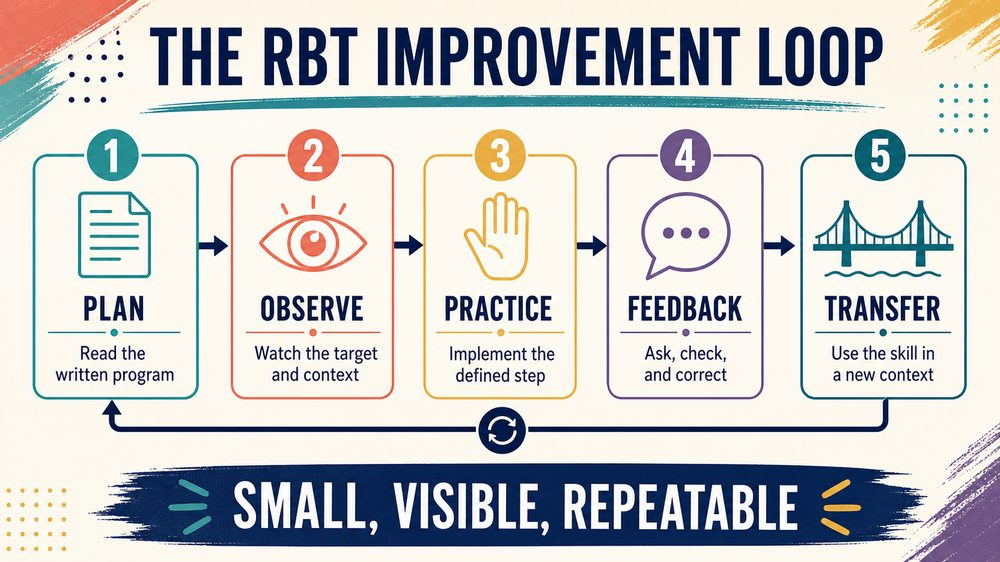
- Plan: read the current program and identify the target, cue, prompt, consequence, data, safety, and communication rule.
- Observe: watch the learner and your own implementation; separate what happened from what you think it means.
- Practice: rehearse one small improvement with the supervisor or through behavioral skills training.
- Receive feedback: ask what to keep, what to change, and what the correct criterion is.
- Transfer: apply the corrected skill with a new material, person, setting, or example when the program permits.
- Document: record the learning question and the next check rather than relying on memory.
For example: an RBT notices that prompted and independent responses are being recorded in the same column. The improvement loop is to review the definition, observe a correctly scored session, practice the code, ask the supervisor to check several rows, and then use the distinction in a new program. “Collect better data” becomes a sequence that can be verified.
Improve data collection and program fidelity
- Read the operational definition before the session and ask about ambiguous examples.
- Know the measurement unit: frequency, rate, duration, latency, interval, trial, or another defined system.
- Record close to the event instead of reconstructing a session from memory.
- Preserve independent versus prompted, correct versus incorrect, and no-response distinctions when required.
- Mark missing or unusual data honestly and report the reason.
- Use the current form, app, or sheet; do not silently change a field or graphing rule.
Program fidelity is not robotic speed. It means the action can be traced to the current written procedure and adapted only where the procedure permits. If the learner is not responding, the better move may be to follow the assigned correction, pause for safety, or contact the supervisor—not to add intensity or remove a demand based on a guess.
Improve teaching and behavior support
| Skill | Better practice | Avoid |
|---|---|---|
| Prompting | Use the assigned hierarchy, timing, and fading procedure. | Using a favorite prompt because it feels faster. |
| Reinforcement | Deliver the programmed consequence contingently and observe its effect. | Calling every preferred item a reinforcer. |
| Generalization | Practice new people, materials, or settings when the plan includes them. | Assuming table mastery transfers automatically. |
| Behavior reduction | Follow the plan and safety procedure and teach the replacement response as written. | Adding an unapproved consequence or negotiating outside the plan. |
| Learner communication | Honor the communication and choice or break procedure in the program. | Interpreting refusal as defiance and escalating without guidance. |
Better teaching is more precise and more humane at the same time. Precision tells you what to do; ethics tells you to notice whether the person is willing, safe, respected, and receiving effective support within the authorized plan.
Use supervision as a performance tool
Bring a prepared supervision agenda instead of waiting for a vague “How did it go?” Include one program question, one data question, one learner-communication or safety observation, one skill you want modeled, and one example of feedback you are practicing.
| Before supervision | During supervision | After supervision |
|---|---|---|
| Review data and mark irregularities. | Ask for the exact criterion and observe a model. | Write the corrected action in plain language. |
| Choose one skill to improve. | Rehearse and receive specific feedback. | Practice again under the permitted conditions. |
| Bring an objective scenario. | Clarify what is in and out of role. | Report whether the change transferred. |
Do not hide an error because you want to appear competent. Timely self-reporting and corrective action protect the learner and improve the quality of supervision. If supervision is missing, unclear, or not meeting the current requirements, consult the current Handbook and the responsible organization or BACB process rather than quietly treating the gap as normal.
Strengthen ethics, communication, and documentation
- Privacy: discuss client information only through authorized channels and protect records and devices.
- Dignity: use respectful language and avoid describing a person with judgmental labels.
- Competence: do not perform a task without training, observation, or direction when those are required.
- Boundaries: keep relationships, gifts, social media, and communication within policy and the RBT Ethics Code.
- Communication: report observable facts, questions, and safety concerns promptly.
- Self-reporting: review the current Ethics Code and Handbook when a potential compliance issue arises.
Replace “the learner was manipulative” with “the learner pushed the materials away after the instruction and used the programmed break communication.” The second statement is not perfect merely because it sounds clinical; it is better because another professional can evaluate it and decide what to do.
Original better-RBT scenarios
Scenario 1—data: an RBT realizes that five prompted responses were scored independent. The better action is to correct the record through the authorized process, tell the supervisor, and review the prompt code—not to leave the data because the learner eventually responded.
Scenario 2—unclear plan: a caregiver requests a new target during a session. Listen respectfully, document the request, and route it to the supervisor or clinical team. Do not promise a program change.
Scenario 3—feedback: a supervisor says the inter-trial interval is too short. Ask what timing or readiness cue to use, rehearse it, and request a follow-up observation. “Be slower” becomes an observable implementation target.
Scenario 4—ethics: a coworker asks you to share a client video in a personal group chat for advice. Decline and use the authorized consultation channel. The better decision protects privacy even if the intention is educational.
These are newly written independent examples, not official, recalled, leaked, or BACB-endorsed questions.
How to be a better RBT: a 30-day practice plan
| Week | Focus | Evidence to keep |
|---|---|---|
| 1 | Read current programs and audit measurement definitions. | Three clarified data or prompt questions. |
| 2 | Practice one teaching or behavior-support procedure with feedback. | Supervisor observation and one corrected rehearsal. |
| 3 | Improve objective notes, privacy, and communication. | Two rewritten notes that separate observation from interpretation. |
| 4 | Transfer the skill and review ethics and supervision boundaries. | One new scenario, error log, and next goal. |
Keep the goal small enough to observe and specific enough to revisit. “Be more confident” is hard to audit. “Record independent and prompted trials in separate fields for the next three sessions and ask for a review” is actionable. Confidence can follow accurate practice; it should not replace it.
This is the practical answer to how to be a better RBT: make one behavior visible, practice it under supervision, and check whether it transfers before choosing the next goal.
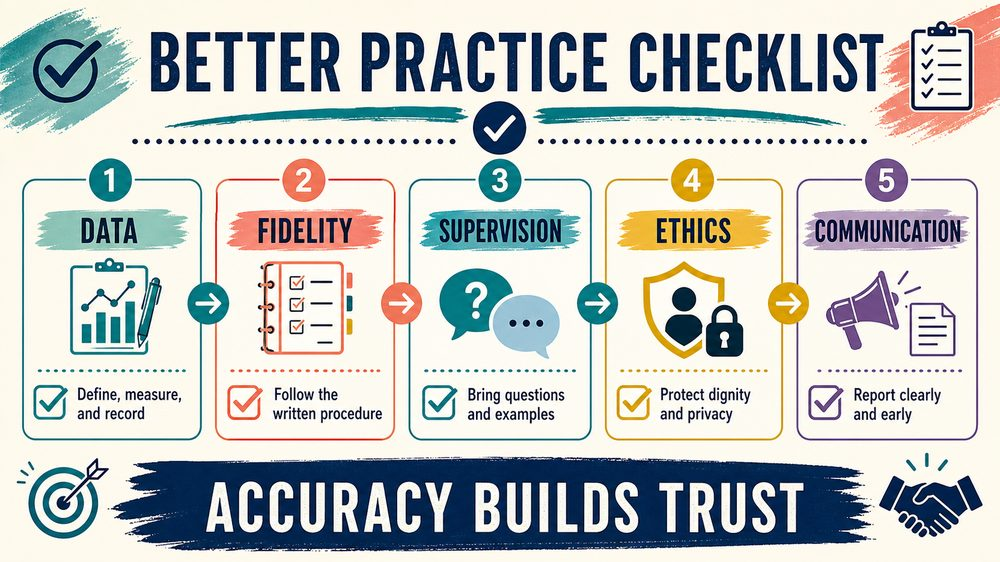
Bottom line: if you are asking how to be a better RBT, improve the behaviors that protect learning: read the current plan, implement with fidelity, measure objectively, honor communication and dignity, prepare for supervision, document honestly, and report uncertainty early. Use the current Handbook, Ethics Code, and TCO as anchors, then turn feedback into small, transferable practice goals.
Turn feedback into targeted RBT practice.
Use original scenarios to review data, teaching, ethics, documentation, and role-safe decisions.
Try free RBT practice questions →
Frequently Asked Questions
How can I be a better RBT?
Define one observable improvement at a time: accurate data, plan fidelity, precise prompting, objective notes, respectful communication, timely supervision questions, or a specific ethics behavior. Practice it, receive feedback, and check transfer.
Does being a better RBT mean working independently?
No. RBTs work under the direction and close supervision required by the current role structure. Better practice includes knowing when to ask before changing a procedure.
What should I improve first?
Start with data and program fidelity because accurate measurement and consistent implementation make later feedback useful. Ask your supervisor to help prioritize the next skill.
How does the RBT Ethics Code relate to improvement?
The RBT Ethics Code 2.0 provides current ethical standards. Use it with the Handbook and supervision to guide privacy, competence, communication, boundaries, and self-reporting.
Are these better-RBT scenarios official?
No. They are newly written independent study examples and are not official, recalled, leaked, or BACB-endorsed questions.
References
- Behavior Analyst Certification Board. RBT Handbook.
- Behavior Analyst Certification Board. Ethics Codes and RBT Ethics Code (2.0).
- Behavior Analyst Certification Board. Supervision, Assessment, Training, and Oversight.
- Behavior Analyst Certification Board. RBT Test Content Outline (3rd ed.).
- RBT ethics study guide. Reviewed for competitor research; not an endorsement.
- RBT training workflow article. Reviewed for competitor research.