

Learning the types of data collection aba procedures is easier when you connect each type to the question it answers. Continuous measures count, time, or locate a response directly. Discontinuous measures sample intervals. Permanent-product recording looks at a lasting outcome. Each procedure has strengths, limits, and a written rule that an RBT must follow consistently.
Table of Contents
- types of data collection aba: an organized overview
- Continuous measurement types
- Frequency, rate, and opportunity-based measures
- Duration and latency measures
- Discontinuous measurement types
- Permanent-product recording
- How to select the right procedure in a study question
- Accuracy, procedural fidelity, and role boundaries
- Frequently Asked Questions
- References
Quick answer: The main types include frequency, rate, duration, latency, interval recording, momentary time sampling, and permanent-product recording. Choose the procedure that the behavior plan specifies for the target and context. Do not substitute a convenient measure because two labels sound similar.
Study boundary: This is independent exam-preparation content, not an official BACB handbook, task answer key, or application determination. The examples in this article are newly written for study. They are not official, recalled, leaked, or BACB-endorsed exam questions. Requirements and policies can change, so use the current BACB handbook and your supervisor or requirements coordinator for decisions about an individual application or client program.
types of data collection aba: an organized overview
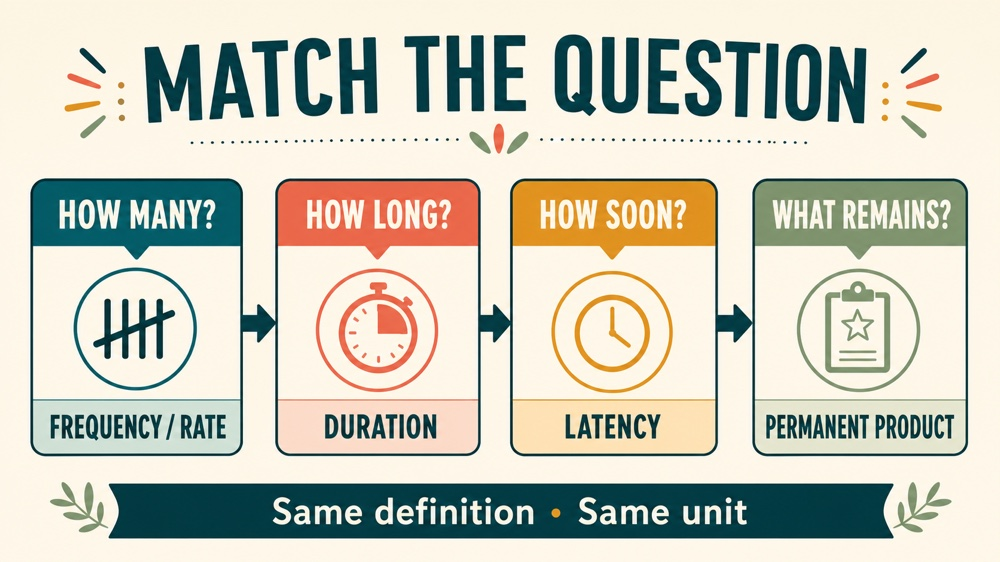
Data collection begins with a decision about what must be measured. If the team needs to know the number of responses, use a count-based procedure. If the concern is how long a response persists, use duration. If the concern is the delay after an instruction, use latency. If direct timing is difficult or the program is designed around samples, use the defined interval method. If the response creates a reliable artifact, permanent product may be appropriate.
| Type | Question answered | Key caution |
|---|---|---|
| Frequency | How many times? | Define one response and the observation window. |
| Rate | How many per unit of time? | Use the correct denominator. |
| Duration | How long? | Apply consistent onset and offset rules. |
| Latency | How soon after a cue? | Start from the defined antecedent. |
| Interval recording | Did it occur under this interval rule? | Partial, whole, and momentary rules differ. |
| Permanent product | What lasting outcome was produced? | The product may not show every response or prompt. |
Continuous measurement types
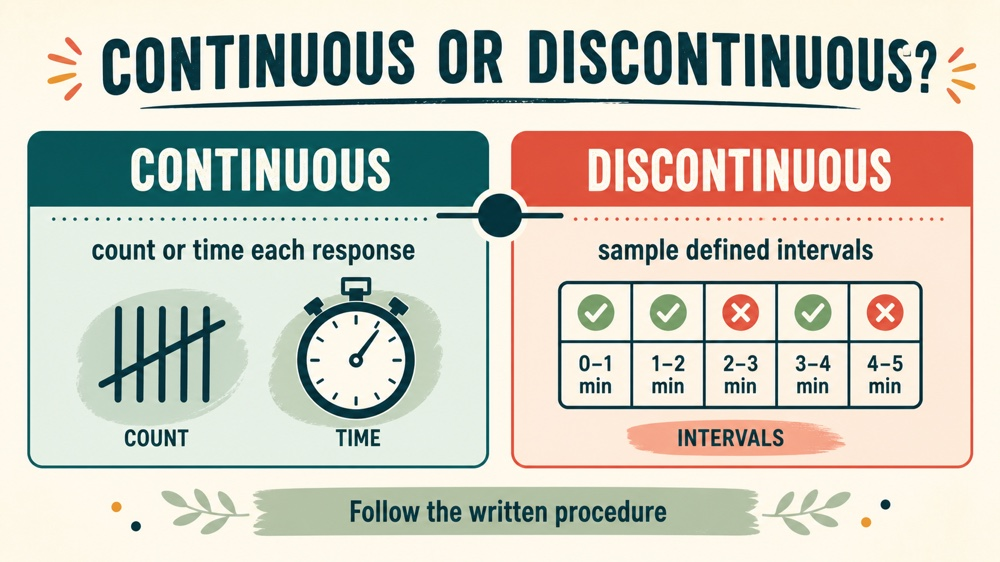
Continuous measurement records each instance or the timing of each defined response during the observation. Frequency is a count. Rate is a count divided by time. Duration tracks how long a response lasts. Latency tracks time from a specified event to response onset. These are not automatically superior to sampling; the best procedure depends on the behavior, purpose, and plan.
Original example: A program defines “independent request” as handing over a break card within 10 seconds of the defined opportunity without a prompt. The technician can record the number of independent requests, the latency to the handover, and the prompt level if the data system requires it. The count and latency answer different questions.
Frequency, rate, and opportunity-based measures
Frequency works well when the response has a clear countable unit and the opportunity to observe it is reasonably comparable. Rate helps when session lengths differ. Percentage or opportunities correct can be useful when the plan defines a stable set of opportunities, but the denominator must be stated.
Original example: A learner answers 12 of 15 teaching trials correctly with no prompt. Reporting “12” loses the denominator. Reporting “80% independent correct” is meaningful only if the plan defines the 15 trials, the response, and the scoring rule. Do not replace an opportunity-based measure with frequency without permission.
Duration and latency measures
Duration is appropriate when persistence matters, such as time engaged with a task or length of a defined episode. Latency is appropriate when initiation matters, such as beginning a response after an instruction. A response can have a short latency and short duration, or a long latency and long duration; one does not stand in for the other.
Original example: After “put the cup away,” a learner begins moving within 6 seconds and completes the action in 14 seconds. If the plan defines the first movement as response onset, latency is 6 seconds. If it defines the completed action as the target product, duration may be recorded from first movement to completion. Use the written definitions, not intuition.
Discontinuous measurement types
Discontinuous procedures sample behavior rather than timing every response. In partial-interval recording, a mark is made if the behavior occurs at any time in the interval. In whole-interval recording, the behavior must occur for the entire interval. In momentary time sampling, the observer checks whether it occurs at the specified moment, such as the end of the interval.
Sampling can be practical, but it creates measurement bias. Partial-interval recording may overestimate brief or high-rate behavior because a few seconds earns a mark. Whole-interval recording may underestimate behavior that is important but not continuous. Momentary time sampling can miss behavior between checks. The RBT does not “correct” these biases by changing the rule; the procedure is selected and interpreted by the qualified team.
Permanent-product recording
Permanent-product recording uses an observable outcome that remains after the response, such as completed math problems, assembled materials, or sorted objects. The product must be linked to the target behavior and scored using the plan’s definition. It may be efficient, but it may not show the timing, prompts, errors, or process that produced the outcome.
Original example: At the end of a sorting activity, 10 objects are in the correct bins. The technician checks the record and sees that 3 placements followed a model prompt. If the target is independent sorting, the product count is not the same as 10 independent responses.
How to select the right procedure in a study question
- Underline the target behavior and its operational definition.
- Circle the question: count, time, delay, interval occurrence, opportunity accuracy, or lasting product.
- Check whether the observation length, opportunities, and intervals are defined.
- Match the answer to the written procedure rather than the easiest device or familiar label.
- Ask what data the RBT records and what interpretation requires supervisor direction.
Accuracy, procedural fidelity, and role boundaries
Reliable data require consistent definitions, timing, materials, and recording. If a timer fails, a trial is interrupted, or a definition does not fit the situation, follow the plan’s exception process and document the issue. Do not fill in a value from memory merely to complete a row.
An RBT is a paraprofessional who provides behavior-analytic services under the direction and close supervision of the responsible supervisor or requirements coordinator. A strong answer therefore separates what an RBT can implement as written from what requires assessment, clinical interpretation, plan changes, or supervisor direction.
Current exam frame: The current RBT Test Content Outline (3rd ed.) applies beginning January 1, 2026. It describes 43 tasks across six content domains. The current examination format is 75 scored questions plus 10 unscored pilot questions, four answer choices per item, and a 90-minute testing period. These facts explain the study frame; they do not turn an independent guide into an official BACB resource.
For study, make a two-column card for each procedure: “question answered” and “recording rule.” Add one example and one nonexample. That format makes close concepts easier to retrieve under time pressure.
Review data collection choices
Practice original RBT-style measurement scenarios and verify each rule with the current official outline and training materials.
Review the RBT resource →
Frequently Asked Questions
What are common ABA data collection types?
Common procedures include frequency, rate, duration, latency, interval recording, momentary time sampling, and permanent-product recording.
What is the difference between continuous and discontinuous measurement?
Continuous measurement records each defined response or its timing. Discontinuous measurement samples whether or when behavior occurs under an interval rule.
Can partial-interval and whole-interval recording be used interchangeably?
No. Partial interval marks any occurrence in the interval, while whole interval requires occurrence for the entire interval. Follow the plan.
Does a permanent product show the whole behavior process?
Not necessarily. It shows a lasting outcome, but may not show prompts, errors, timing, or every response that produced it.
Are these official BACB questions?
No. The scenarios are newly written independent study examples and are not official, recalled, leaked, or BACB-endorsed exam questions.