
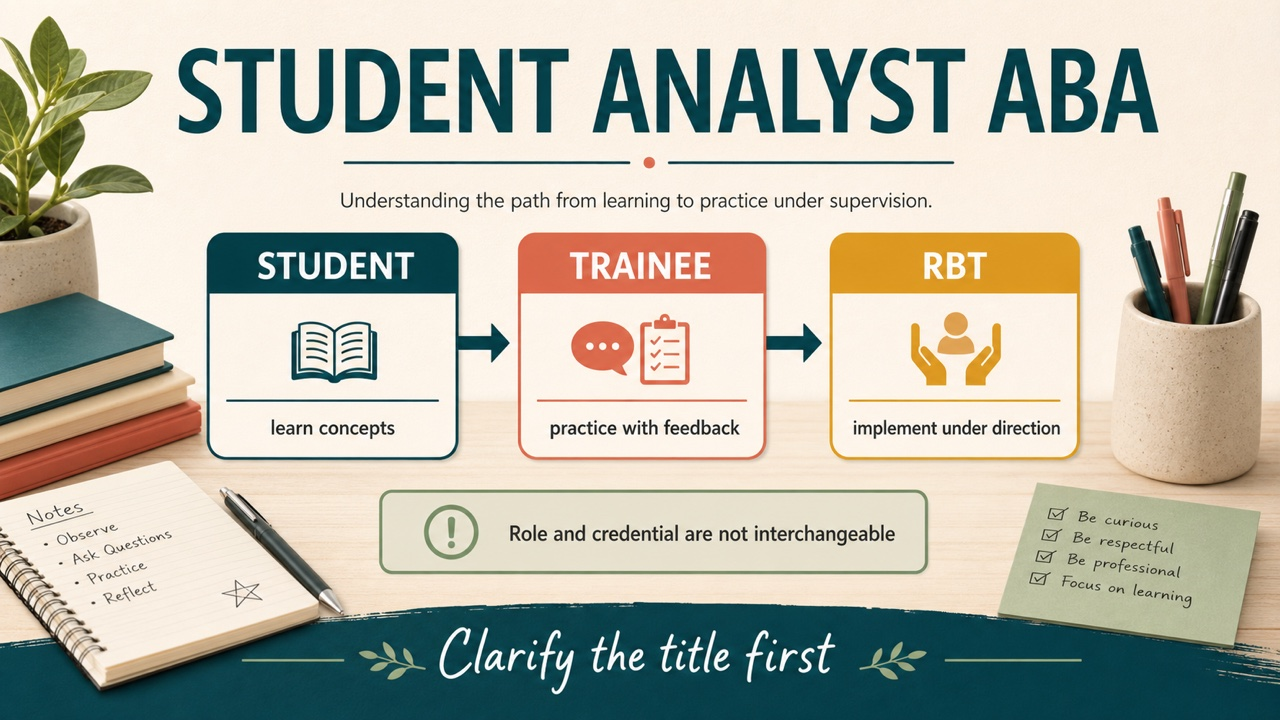
student analyst aba is an ambiguous search phrase, so the first step is to clarify the role rather than assume it is a BACB credential. It may refer to a student learning applied behavior analysis, a trainee in a university or employer program, or an informal label used in a study discussion. “Student analyst” is not a substitute for the Registered Behavior Technician credential, and the exact meaning depends on the institution or employer using it.
Table of Contents
- student analyst aba: clarify the label first
- Student, trainee, and RBT are not interchangeable
- Core concepts a student may study
- A role-safe learning pathway
- Why supervision and boundaries matter
- Using the RBT outline as a study map
- Frequently Asked Questions
- References
Quick answer: Treat student analyst ABA as a terminology and role-boundary question. A learner may study ABA concepts, collect practice data, or complete supervised training, while an RBT is a BACB credentialed paraprofessional who provides services under the required direction and supervision structure. Verify the official title, training status, and permitted activities with the relevant organization.
Study boundary: This is independent exam-preparation content, not an official BACB handbook, certification decision, task answer key, or application determination. The examples in this article are newly written for study. They are not official, recalled, leaked, or BACB-endorsed exam questions. Requirements and policies can change, so use the current BACB handbook and your supervisor or requirements coordinator for decisions about an individual application or client program.
student analyst aba: clarify the label first
Search language can blur several different stages: student, trainee, technician, supervisee, and certified professional. A university student may be studying behavior analysis without providing clinical services. An employee may be called a trainee while completing onboarding. An RBT candidate may be preparing for certification. None of those labels alone tells a reader whether a person holds a current BACB credential.
Ask three questions: Who uses the title? What training or credential does it represent? Under whose direction may the person observe, collect data, or implement a procedure? If an institution has a formal definition, that definition controls the local role.
Student, trainee, and RBT are not interchangeable
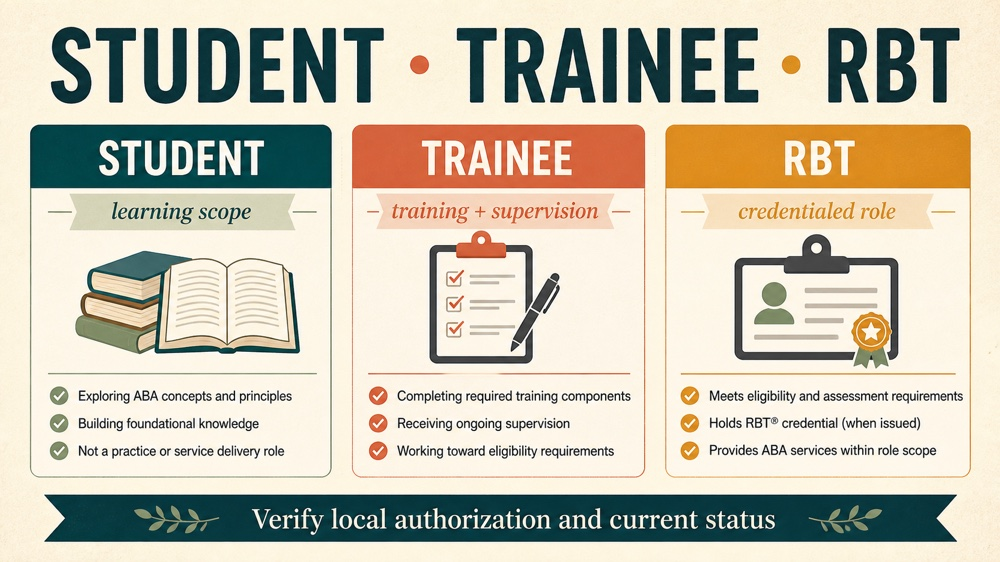
| Label | What it may describe | What to verify |
|---|---|---|
| Student | A person learning ABA concepts in a course or program. | Enrollment, training scope, and whether clinical work is authorized. |
| Trainee | A person completing employer or program onboarding. | Written supervision, competency steps, and permitted tasks. |
| RBT candidate | A person pursuing the BACB RBT credential. | Current BACB requirements and application status. |
| RBT | A credentialed paraprofessional providing services under direction and supervision. | Current credential status and the supervising structure. |
Core concepts a student may study
Study topics can include operational definitions, frequency and rate, duration and latency, interval recording, preference-assessment participation, reinforcement, prompting, chaining, generalization, objective documentation, confidentiality, and supervision. The concept is not the same as permission to implement it in a client program. Training, competence, written procedures, and local authorization matter.
For example: A student practices scoring a video with an instructor and gets a different total from a classmate. The learning task is to compare definitions and scoring rules. It does not authorize the student to change a client’s data sheet or announce a clinical conclusion.
A role-safe learning pathway
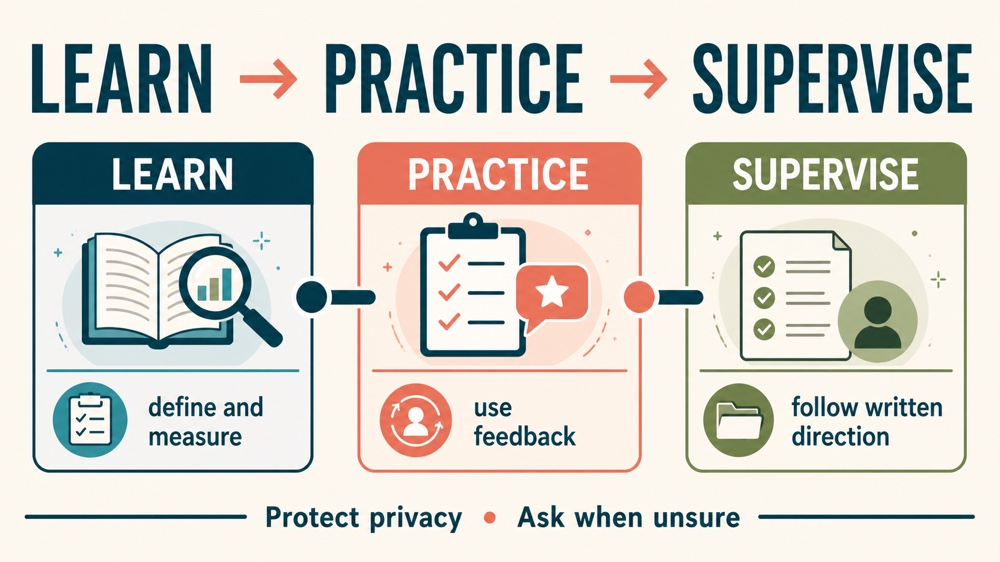
- Learn the language: Define the behavior, measure, prompt, consequence, and data unit.
- Practice with feedback: Use original scenarios, role-play, or instructor-approved materials.
- Confirm competence: Complete the assessment or training step required by the program.
- Use supervision: Ask what can be observed, recorded, or implemented and when.
- Protect privacy: Keep practice examples de-identified and use approved systems for real clinical information.
- Check credential claims: Do not describe course completion or student status as BACB certification.
Why supervision and boundaries matter
An RBT is a paraprofessional, not an independent diagnostician or plan designer. An RBT may implement a written procedure, collect data, support teaching, document objectively, and communicate concerns when trained and directed to do so. Assessment interpretation, diagnosis, functional claims, treatment-plan changes, and safety decisions outside the written procedure require appropriate professional direction.
For example: A student observes that a learner responds differently after a transition. The role-safe note describes the transition, the defined response, timing, prompts, and consequence. It does not state that the student discovered the function or should redesign the plan.
Using the RBT outline as a study map
The current RBT Test Content Outline (3rd ed.) is a blueprint for content, not a list of secure exam questions and not a credential itself. Use task statements to organize notes, then connect each term to a direct example and a role boundary. Check the current Handbook for application and maintenance requirements.
- Write one operational definition and one nonexample.
- Choose the measure that matches the question.
- Mark whether the scenario asks an RBT to implement, record, document, or communicate.
- Flag assessment, interpretation, and plan-change language for supervisor direction.
- Review ethical and confidentiality expectations alongside technical terms.
Current exam frame: The current RBT Test Content Outline (3rd ed.) applies beginning January 1, 2026. It describes 43 tasks across six content domains. The current examination format is 75 scored questions plus 10 unscored pilot questions, four answer choices per item, and a 90-minute testing period. These facts explain the study frame; they do not turn an independent guide into an official BACB resource.
The outline can organize study for students and candidates, but it does not confer certification or determine an individual’s eligibility. Independent examples are practice aids; verify current decisions with the official BACB sources and the responsible supervisor or requirements coordinator.
Practice RBT role-boundary questions
Use independent RBT-style examples to separate student learning, trainee tasks, and supervised RBT implementation, then verify local requirements.
Review the RBT resource →
Frequently Asked Questions
Is student analyst ABA an official BACB credential?
No. The phrase is ambiguous and may describe a learner or trainee. It should not be used as a substitute for a verified RBT credential.
Can an ABA student collect clinical data?
Only when the relevant program authorizes it and provides the required training, supervision, privacy safeguards, and written procedure.
Is an RBT the same as an ABA student?
No. An RBT is a specific BACB credentialed paraprofessional role; a student may be studying without holding that credential.
Can a student analyst change a behavior plan?
Not independently. Plan changes and clinical interpretation require appropriate supervisor or qualified-professional direction.
Are these official BACB questions?
No. The examples here are newly written independent study content and are not official, recalled, leaked, or BACB-endorsed examination questions.