

anecdotal data aba usually refers to a narrative record of what was observed in a behavior-analytic service or learning context. It can preserve useful context around an event, but it is not automatically a frequency count, a functional analysis, or proof of why behavior occurred. Use the written documentation procedure, objective language, and the approved privacy safeguards. RBT Training is an independent study resource and is not affiliated with or endorsed by BACB.
Table of Contents
- anecdotal data aba: what the note captures
- A structure for objective anecdotal notes
- A concrete anecdotal example
- Objective language versus interpretation
- Privacy and record quality
- The RBT role in anecdotal data
- Frequently Asked Questions
- References
Quick answer: A useful anecdotal note states when and where an event occurred, what was observable, what happened immediately before and after when the procedure asks for it, and what communication followed. Separate direct observation from interpretation, and do not use a narrative note to make a diagnosis or independently change a plan.
Study boundary: This is independent exam-preparation content, not an official BACB handbook, certification decision, task answer key, application determination, or source of secure exam material. The examples in this article are newly written for study. They are not official, recalled, leaked, or BACB-endorsed exam questions. Requirements and policies can change, so use the current BACB handbook and your supervisor or requirements coordinator for decisions about an individual application or client program.
anecdotal data aba: what the note captures
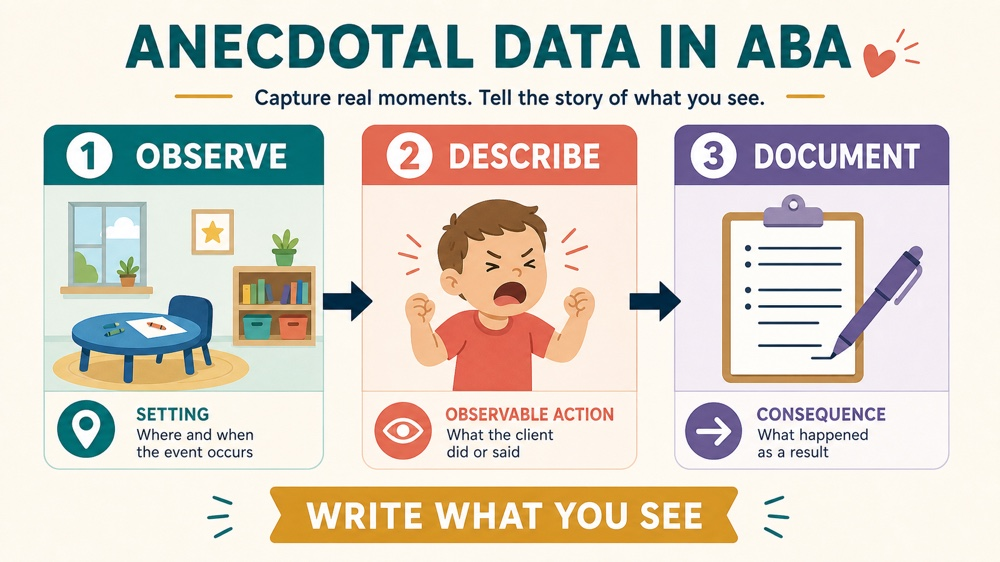
Anecdotal data are typically descriptive and narrative. They may capture a sequence, context, materials, people present, observable behavior, and consequences or responses. The exact format varies by organization. The purpose is to preserve a useful account without turning a brief observation into a stronger conclusion than the evidence supports.
Compare a narrative with a quantitative measure. “The learner left the table after the worksheet was placed down and returned after a break card was offered” describes a sequence. It does not by itself tell you how many episodes occurred across the session, how long each episode lasted, or what function caused the behavior. Those questions require the measures and procedures selected by the responsible team.
A structure for objective anecdotal notes
- Time and setting: Record the date, approximate time, location, activity, and relevant conditions required by the form.
- Antecedent context: Describe the instruction, transition, material, or event that immediately preceded the defined response.
- Observable response: Use what could be seen or heard, with the operational definition and any timing rule.
- Immediate consequence: Record what followed, including the programmed response or communication when applicable.
- Data link: Add the quantitative measure, prompt, opportunity, or safety code the plan requires.
- Follow-up: Note who was informed and what direction was received, without adding an unsupported clinical explanation.
A concrete anecdotal example
For example: During a transition from a puzzle to a writing task, the learner pushed the worksheet away, stood up, and walked approximately two meters toward the hallway. The technician blocked access according to the safety plan, presented the programmed communication option, and notified the supervisor after the event. This note describes the event and response; it does not claim that escape was the function or that a plan change is needed.
If the program also requires frequency and duration, record those measures in the appropriate fields. Do not replace a required quantitative measure with a vivid story. Narrative detail and numeric data can answer different questions and should be labeled separately.
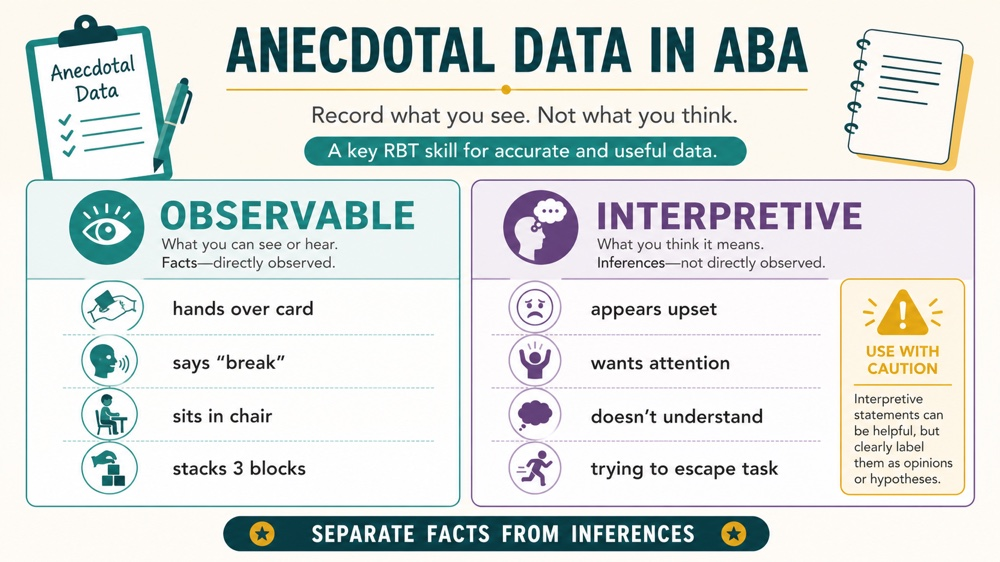
Objective language versus interpretation
| Less objective | More observable | Why it matters |
|---|---|---|
| He was upset. | He cried, pushed the book away, and said “no” for 20 seconds. | Observable details can be scored and reviewed. |
| She wanted attention. | She called the staff member’s name after the task was presented. | A motive is not directly visible. |
| The intervention worked. | The defined response stopped after the programmed break procedure. | A single event does not establish a causal conclusion. |
| He refused everything. | He did not begin the stated task within the defined response window. | A narrow definition avoids overgeneralization. |
Privacy and record quality
Clinical notes may contain identifying information. Use the approved system, share only with authorized people, and avoid copying a client’s name or details into a public study example. Check dates, times, missing fields, correction rules, and whether the note matches the data sheet. If a safety event or documentation error occurs, follow the organization’s reporting route.
The RBT role in anecdotal data
An RBT may document direct observations and implement the authorized recording procedure when trained and supervised. The RBT should not independently diagnose, infer a function, select a new measurement system, or change the behavior plan. When the definition is unclear, ask for direction and record the concern according to policy.
Current exam frame: The current RBT Test Content Outline (3rd ed.) applies beginning January 1, 2026. It describes 43 tasks across six content domains. The current examination format is 75 scored questions plus 10 unscored pilot questions, four answer choices per item, and a 90-minute testing period. These facts explain the study frame; they do not turn an independent guide into an official BACB resource.
For study, practice turning an interpretation into an observable description and then identify which quantitative measure would answer the remaining question. The outline supports study organization; it does not turn an anecdotal note into an official answer key or a clinical decision.
Practice objective documentation
Use independent RBT-style scenarios to rehearse observable notes, measurement choices, privacy, and safe communication with a supervisor.
Review the RBT resource →
Frequently Asked Questions
What is anecdotal data ABA?
It is a narrative description of observed events and context in an ABA service or learning setting, recorded under the applicable procedure.
Is anecdotal data the same as frequency data?
No. A narrative note describes events; frequency counts defined responses. Use each measure the written plan requires.
Can anecdotal data prove a behavior function?
No. It can document context and patterns, but functional interpretation requires the responsible clinical process.
What should an RBT do when a note is unclear?
Use the approved safety and communication route, document observable facts, and ask the supervisor before changing a definition or procedure.
Are these official BACB questions?
No. The examples are newly written independent study content and are not official, recalled, leaked, or BACB-endorsed exam questions.
References
- Behavior Analyst Certification Board: Registered Behavior Technician Handbook, updated June 2026.
- Behavior Analyst Certification Board: RBT Test Content Outline (3rd ed.).
- Behavior Analyst Certification Board: RBT resources.
- Behavior Analyst Certification Board: RBT Ethics Code.
- RBT Training: free independent RBT practice questions.