

aba therapy data collection is the structured recording of defined behavior, skill performance, or treatment-related outcomes during an authorized service. The phrase can sound broad, so start with the operational definition, measurement unit, observation window, and written data procedure. RBT Training is an independent study resource and is not affiliated with or endorsed by BACB.
Table of Contents
- aba therapy data collection: define before recording
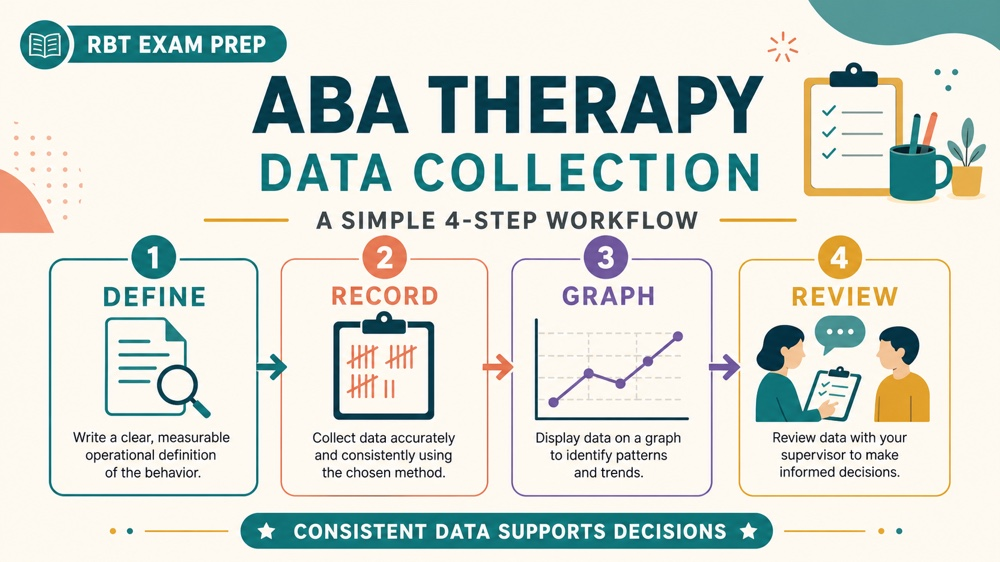
- A session workflow for reliable data
- A concrete therapy-data example
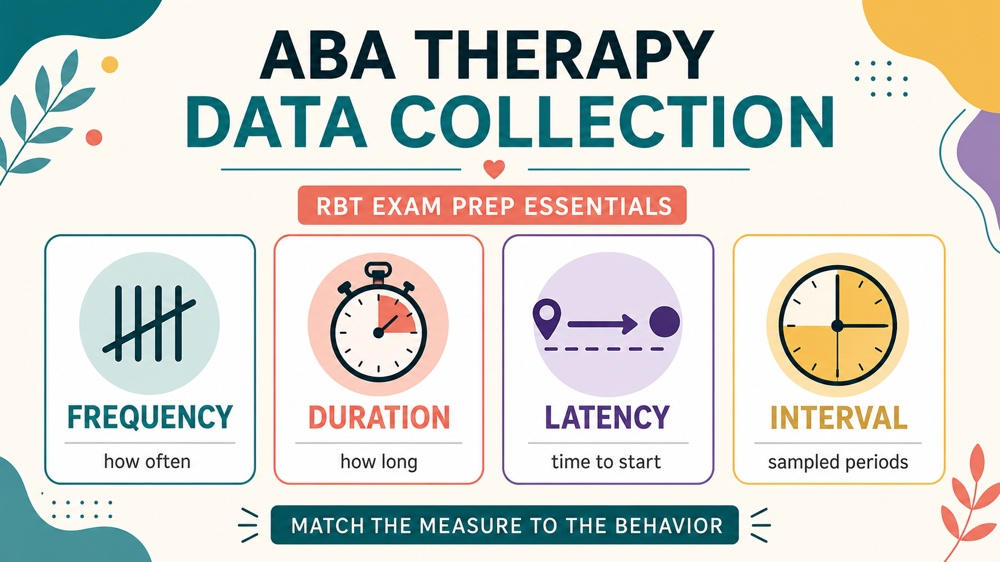
- Match the measure to the question
- Data quality and objective documentation
- RBT role and supervision boundaries
- Frequently Asked Questions
- References
Quick answer: Before a session, confirm what counts, which measure is required, and how prompts or errors are recorded. During the session, observe and record close to the event. Afterward, check totals, denominators, missing fields, and unusual conditions. Communicate concerns through supervision rather than improvising a clinical change.
Study boundary: This is independent exam-preparation content, not an official BACB handbook, certification decision, task answer key, application determination, or source of secure exam material. The examples in this article are newly written for study. They are not official, recalled, leaked, or BACB-endorsed exam questions. Requirements and policies can change, so use the current BACB handbook and your supervisor or requirements coordinator for decisions about an individual application or client program.
aba therapy data collection: define before recording
“Behavior” and “progress” are not data definitions by themselves. A useful operational definition describes what an observer can see or hear, including examples, nonexamples, onset, offset, and the scoring unit when the program provides them. The responsible team owns the definition; an RBT should not rewrite it simply to make a session easier to score.
Clarify the question before choosing the measure. Frequency asks how many defined responses occurred. Rate includes time. Duration asks how long a response lasted. Latency asks how long it took to begin after an instruction or event. Percentage of opportunities depends on a denominator. Interval recording uses defined intervals, while permanent product measures a lasting outcome.
A session workflow for reliable data
- Prepare: Open the authorized form, timer, materials, prompt code legend, and privacy-safe system.
- Review: Read the target definition, examples, nonexamples, observation window, and safety instructions.
- Deliver: Follow the programmed opportunity, teaching procedure, or naturalistic observation.
- Record: Enter the response, prompt, error, timing, opportunity, and context required by the form.
- Check: Review totals, denominator, missing fields, and values that cannot be correct.
- Communicate: Report safety events, definition questions, equipment problems, and data-quality concerns.
A concrete therapy-data example
For example: The program defines an independent request as touching a help card within 10 seconds of a programmed opportunity without a verbal or model prompt. During six opportunities, the learner makes four independent requests and two prompted requests. Record the categories separately. A total of six requests would hide the difference between independent and prompted performance.
In a second example, a learner completes a task more slowly after a room change. Record the defined response, duration or latency, room condition, prompts, and opportunity count the form requires. Do not write that the learner “regressed” or that the room change caused the pattern based on one observation.
Match the measure to the question
| Question | Possible measure | Check before comparing |
|---|---|---|
| How many responses? | Frequency | Definition and session window. |
| How often per minute? | Rate | Time denominator. |
| How long did it last? | Duration | Onset and offset rules. |
| How soon did it begin? | Latency | Start event and response onset. |
| How many opportunities were correct? | Percentage | Opportunities and prompt rule. |
| What product remains? | Permanent product | Product definition and scoring rule. |
Data quality and objective documentation
Data quality depends on consistent definitions, comparable observation conditions, complete fields, and an approved correction policy. Do not backfill a missing value from memory, erase an outlier because it looks unusual, or change the denominator without a note. If a second observer is used, follow the team’s training and interobserver-agreement method.
Objective documentation names the event, response, prompt, timing, and communication. It avoids unsupported motives, diagnoses, and causal claims. It also protects privacy: use the approved system and share information only with authorized people.
RBT role and supervision boundaries
An RBT may implement an authorized data procedure, collect and enter observations when trained, support graphing, and communicate concerns. Selecting a new measure, interpreting a function, diagnosing, changing a treatment plan, or making a safety decision outside the written procedure requires appropriate supervisor or qualified-professional direction.
Current exam frame: The current RBT Test Content Outline (3rd ed.) applies beginning January 1, 2026. It describes 43 tasks across six content domains. The current examination format is 75 scored questions plus 10 unscored pilot questions, four answer choices per item, and a 90-minute testing period. These facts explain the study frame; they do not turn an independent guide into an official BACB resource.
Use the current outline as a study map for measurement, skill acquisition, documentation, and ethics. It does not determine an individual clinical decision or promise an examination outcome. Client-program decisions belong to the responsible team and written plan.
Practice therapy-data decisions
Use independent RBT-style scenarios to match definitions to measures, review data quality, and identify when supervision is required.
Review the RBT resource →
Frequently Asked Questions
What is ABA therapy data collection?
It is the structured recording of defined behavior or skill outcomes during an authorized service using a specified measurement procedure.
Who chooses the data-collection measure?
The responsible clinical team selects and defines it. An RBT implements the written procedure and asks for direction before changing it.
Should prompted and independent responses be combined?
Not when the program defines them as separate categories. Record the prompt and response according to the data sheet.
Can therapy data prove a diagnosis or function?
No. Data describe observations and patterns. Diagnosis, functional interpretation, and plan changes require qualified-professional direction.
Are these official BACB questions?
No. The examples are newly written independent study content and are not official, recalled, leaked, or BACB-endorsed exam questions.
References
- Behavior Analyst Certification Board: Registered Behavior Technician Handbook, updated June 2026.
- Behavior Analyst Certification Board: RBT Test Content Outline (3rd ed.).
- Behavior Analyst Certification Board: RBT resources.
- Behavior Analyst Certification Board: RBT Ethics Code.
- RBT Training: free independent RBT practice questions.