

Describe BACB supervision standards for RBTs by connecting supervision to safe implementation, useful feedback, accurate documentation, and continued competence. Supervision is not just a meeting on a calendar. It is part of how an RBT learns a procedure, receives performance feedback, communicates concerns, and stays within the role.
Table of Contents
- How to describe bacb supervision standards for rbts
- How supervision supports competent performance
- Original study scenario: feedback on prompting
- What should an RBT communicate?
- Documentation is part of supervision
- Role boundaries and ethical practice
- How this connects to RBT exam study
- Common mistakes to avoid
- Supervision study checklist
- Frequently Asked Questions
- References
Quick answer: A strong description explains what the RBT is expected to do, how the supervisor supports that work, what the RBT should document or report, and when the RBT should ask for direction. Use the current BACB Handbook for official eligibility and supervision decisions.
Study boundary: This independent guide summarizes study concepts and original scenarios. It is not BACB policy, an official answer key, or a substitute for an authorized supervisor. The examples are not official, recalled, leaked, or BACB-endorsed questions.
Continue your review with RBT practice questions that reinforce measurement, prompting, supervision, and ethics.
How to describe bacb supervision standards for rbts
Supervision creates a structured connection between assigned service delivery and professional oversight. The RBT may be the person implementing a teaching or behavior-reduction procedure, but the RBT is not automatically the person who designs that procedure. The supervising team provides direction, observes performance, reviews data, and helps determine what training or correction is needed.
When reviewing describe bacb supervision standards for rbts questions, look for the role relationship. The best answer usually mentions an assigned procedure, direct or indirect feedback as appropriate, objective documentation, and communication with the responsible supervisor. It should not suggest that the RBT can independently diagnose, select a new intervention, or promise an outcome.
How supervision supports competent performance
Useful supervision is specific enough to improve performance. A supervisor might observe a technician conducting a discrete-trial teaching sequence, review a data sheet, model a prompting step, or provide corrective feedback after a practice attempt. The RBT can then rehearse the skill, ask questions, and demonstrate the corrected version.
- Prepare: Read the written plan and confirm the materials, target response, and safety instructions.
- Implement: Follow the procedure as trained and avoid adding unapproved steps.
- Measure: Record the response using the defined measurement rule.
- Review: Discuss uncertainty, data irregularities, and feedback with the supervisor.
- Repeat: Practice until the skill is accurate, safe, and consistent.
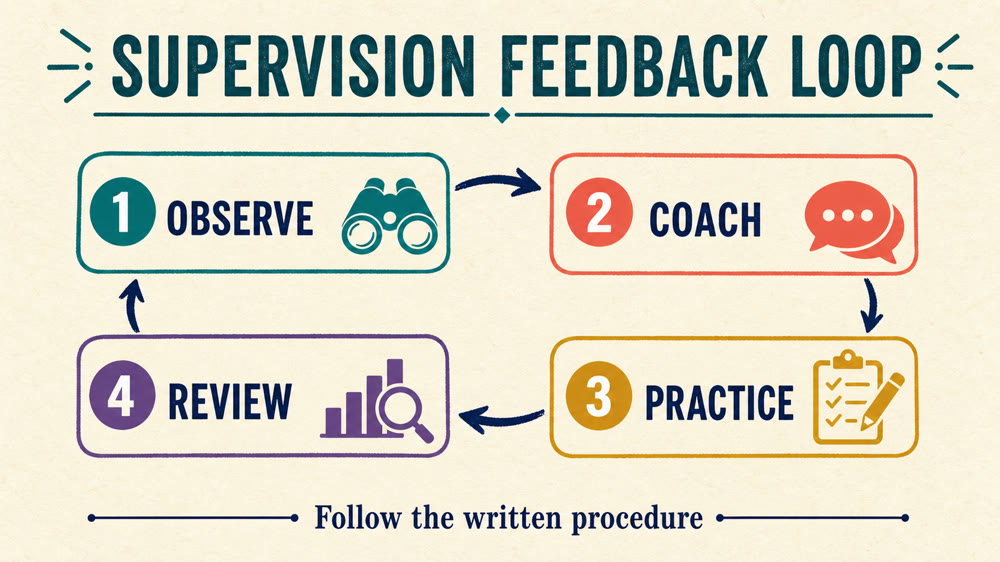
Original study scenario: feedback on prompting
Imagine an RBT is implementing a written matching program. The plan says to present the instruction, wait for the response window, use the specified prompt if needed, deliver the programmed consequence, and record whether the response was independent or prompted. During observation, the supervisor notices that the RBT gives the prompt too quickly on several trials.
A good next step is not to invent a new delay or hide the error. The RBT should listen to the feedback, practice the timing, and document the session accurately. If the written plan is unclear, the RBT should ask the supervisor to clarify the timing rule before changing implementation. This is the practical meaning behind describe bacb supervision standards for rbts: supervision links observation, feedback, correction, and competent follow-through.
What should an RBT communicate?
Communication should be timely, objective, and relevant to service delivery. An RBT may report that a data sheet was incomplete, a learner did not have access to a required material, a safety event occurred, or a procedure could not be implemented as written. The report should describe what happened rather than assign an unsupported motive.
- State the observable event, approximate time, and setting.
- Identify the procedure or data rule involved.
- Explain what action was taken within training.
- Ask for direction when the plan, safety conditions, or materials are unclear.
- Protect private information by using the approved communication channel.
Documentation is part of supervision
Accurate notes allow supervisors to evaluate whether a procedure was implemented as written. A useful note can include the target skill, the procedure used, the learner’s observable response, relevant variables, and any follow-up communication. It should not exaggerate progress, omit an implementation error, or copy language that makes an inference sound like a measurement.
For example, “the learner completed four of five matching opportunities independently after the instruction” is more useful than “the learner was motivated today.” If a measurement rule was misunderstood, report the issue so the supervisor can decide whether data need to be corrected or collected again.
Role boundaries and ethical practice
RBT supervision standards are closely connected to ethics and scope of practice. An RBT should work only with appropriate training and oversight, maintain confidentiality, treat clients and families with dignity, and report concerns through the responsible chain of communication. The RBT should not change a behavior plan, select a diagnosis, conduct an unsupervised clinical assessment, or speak as though personal experience overrides written direction.
- Do not share identifiable client details in an informal group chat.
- Do not perform a procedure you have not been trained to implement safely.
- Do not use a supervisor’s feedback as permission to make unrelated plan changes.
- Do ask for clarification when a direction conflicts with safety or competence.
- Do acknowledge errors and participate in corrective practice.
How this connects to RBT exam study
The current RBT Test Content Outline, 3rd edition, organizes the blueprint into 43 tasks across six domains. Supervision-related study connects especially with Documentation and Reporting and Ethics, while implementation examples may also draw on measurement, assessment, behavior acquisition, and behavior reduction. The current examination includes 75 scored questions and 10 unscored pilot questions. Those numbers describe the written exam, not a private supervision meeting or competency demonstration.
When a practice item asks what an RBT should do, first identify whether the issue is implementation, documentation, safety, or an unauthorized decision. Then choose the response that follows the written procedure, communicates with the responsible supervisor, and protects the client’s dignity and privacy.
Common mistakes to avoid
- Calling supervision a one-time approval: Competence requires ongoing feedback and performance review.
- Changing the procedure independently: Ask the responsible supervisor before making a clinical change.
- Reporting conclusions instead of observations: Separate what was seen from a hypothesis about why it happened.
- Hiding implementation errors: Timely reporting lets the team correct data and training.
- Ignoring privacy: Use approved systems and share only necessary information.
- Using unofficial certainty: No independent article can guarantee certification or an examination result.
Supervision study checklist
Before answering a supervision scenario, ask:
- What task was assigned to the RBT?
- What written procedure or operational definition applies?
- What should the RBT implement, measure, or document?
- What feedback or direction belongs to the supervisor?
- Is there a safety, privacy, or competence concern?
- What should be communicated, to whom, and when?
- Does the answer keep the RBT within a supervised role?
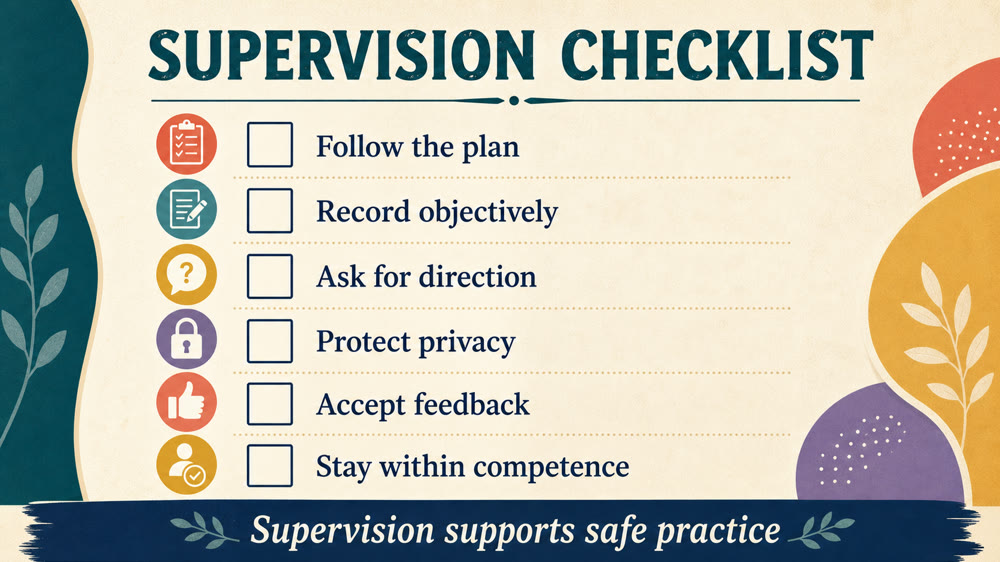
Review supervision decisions
Practice identifying the written procedure, the reporting step, and the role boundary in original RBT-style scenarios.
Try the RBT practice resource →
Frequently Asked Questions
How should I describe bacb supervision standards for rbts
Explain that supervision supports competent implementation, feedback, documentation, communication, and ethical role boundaries. Check the current BACB Handbook for official requirements.
Can an RBT change a procedure after noticing a problem?
The RBT should follow the written direction and ask the responsible supervisor for clarification or a plan change. Do not independently redesign treatment.
What should an RBT do after receiving corrective feedback?
Listen, ask questions, practice the corrected skill, and document or communicate relevant information according to the workplace process.
Are these official supervision standards or exam answers?
No. This is an independent study guide using original examples, not official BACB policy or protected examination content.
References
- Behavior Analyst Certification Board: Registered Behavior Technician Handbook, updated June 2026.
- Behavior Analyst Certification Board: RBT Test Content Outline (3rd ed.).
- Behavior Analyst Certification Board: RBT resources.
- RBT Training: independent RBT practice questions.