

Applied behavior analysis discrete trial training is a structured teaching format that gives a learner a clear opportunity to respond, provides the programmed support when needed, and records what happened. For an RBT, the central skill is accurate implementation of the written procedure—not inventing a new lesson while the session is underway.
Table of Contents
- What is applied behavior analysis discrete trial training?
- The parts of a discrete trial
- Present the instruction consistently
- Use prompts and fading as written
- Deliver the programmed consequence
- Collect data across trials
- Original study scenario
- RBT role boundaries
- How this connects to the current RBT outline
- Protect trial integrity while keeping teaching humane
- Discrete-trial study checklist
- Frequently Asked Questions
- References
Quick answer: A discrete trial commonly includes an antecedent or instruction, a response opportunity, a prompt or correction when specified, a consequence, and data collection. The exact steps depend on the learner’s plan, so follow the trained sequence and ask the responsible supervisor when direction is unclear.
Study boundary: This independent guide uses original examples. It does not provide official, recalled, leaked, or BACB-endorsed questions, and it cannot guarantee a credential or examination result.
Continue your review with RBT practice questions that reinforce measurement, prompting, supervision, and ethics.
What is applied behavior analysis discrete trial training?
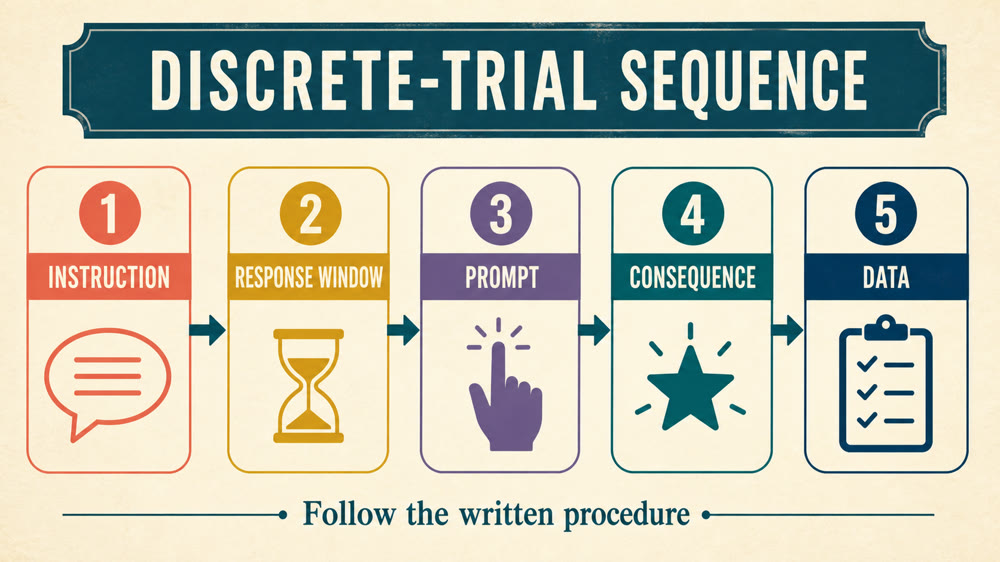
Discrete-trial training breaks a teaching opportunity into observable parts. The practitioner presents a defined instruction or stimulus, allows the programmed response window, provides a prompt if the plan calls for one, responds to the learner’s behavior, and records the result. A trial has a beginning and an end, which makes the teaching sequence easier to observe and measure.
The format is not a script that is identical for every learner. The target, materials, prompt hierarchy, reinforcement schedule, correction procedure, and mastery decision come from the authorized teaching plan. An RBT’s responsibility is to implement those elements accurately and communicate useful observations.
The parts of a discrete trial
- Preparation: Have the approved materials ready and minimize distractions as directed.
- Instruction or antecedent: Present the defined cue or task.
- Response window: Wait for the interval specified in the procedure.
- Prompt: Use the trained prompt level when the learner needs support.
- Consequence: Deliver the programmed reinforcement, correction, or neutral response.
- Data: Record independent, prompted, incorrect, or no-response outcomes as directed.
Present the instruction consistently
Consistency begins with knowing exactly what the instruction means. If the plan says “match,” the RBT should use the trained wording, materials, and presentation arrangement. Avoid adding extra hints, changing the wording from trial to trial, or repeating the instruction in a way that changes the response requirement unless the procedure allows it.
Before a session, review the target definition and ask the supervisor about any ambiguous materials. Small differences in how a cue is presented can make data difficult to interpret. Consistent delivery gives the learner a fair opportunity and gives the team more reliable information.
Use prompts and fading as written
A prompt is additional help that increases the likelihood of the target response. It may be verbal, gestural, model, visual, or physical, depending on the plan and the learner’s needs. The RBT should use only the trained prompt and timing. A prompt that is delivered too soon can prevent a learner from showing an independent response; a prompt that is too late may create unnecessary errors.
Prompt fading is the planned reduction of assistance so the learner can respond with less support. Do not skip a programmed step or create a new fading rule because a trial feels easy. Record the prompt level and ask for direction if the learner’s performance does not fit the plan.
Deliver the programmed consequence
The consequence follows the learner’s response and should match the written procedure. If independent correct responding contacts reinforcement, deliver it as trained and within the stated timing. If an incorrect response calls for correction, implement the correction procedure rather than showing frustration or improvising a lecture.
Reinforcement is not the same as a bribe, and a consequence is not a judgment about the learner. The RBT’s job is to implement the planned contingency respectfully, protect dignity, and report observable changes that may require supervisor review.
Collect data across trials
Data collection turns a series of teaching opportunities into information the team can review. Depending on the plan, record whether each response was independent, prompted, incorrect, or absent; note the prompt level; or use another specified measurement system. Do not mark a response correct simply because the learner eventually completed the task after unplanned help.
If materials are missing, a timing device fails, or the RBT loses track of a trial, document the issue according to the workplace process. An honest note about a measurement problem is more useful than a clean-looking data sheet that misrepresents what occurred.
Original study scenario
Suppose the target is placing a red block in a matching tray. The written plan says to present the tray and block, deliver the instruction, wait three seconds, use a gestural prompt if there is no response, and provide the programmed consequence. On one trial, the learner reaches for the block before the instruction; on the next, the learner waits and responds after the prompt.
A careful RBT records those outcomes according to the plan instead of calling both trials independent. If the plan does not explain how to score the first event, the RBT asks the supervisor for clarification. This is the reasoning expected when studying applied behavior analysis discrete trial training: identify the programmed opportunity, follow the procedure, record what happened, and communicate uncertainty.
RBT role boundaries
The RBT may implement the trial, collect data, and describe what was observed. The RBT should not independently select a new target, change the prompt hierarchy, decide that reinforcement no longer works, or alter mastery criteria. Those decisions require the appropriate supervising professional and current service plan.
How this connects to the current RBT outline
The current RBT Test Content Outline, 3rd edition, includes 43 tasks across six domains. Discrete-trial examples most directly support Behavior Acquisition study, with related skills in data collection, documentation, and ethics. The current examination includes 75 scored questions and 10 unscored pilot questions. Independent practice should explain reasoning and should never claim to reproduce live examination content.
Protect trial integrity while keeping teaching humane
Strong discrete-trial training is not a race to complete more trials. Before a session, check that the target response, materials, prompt plan, reinforcement arrangement, and data method are clear. During the trial, deliver the instruction consistently, allow the planned opportunity to respond, follow the prompting procedure, and record what actually happened. If materials are missing or the learner is not available for the planned activity, document the change and seek supervisor direction instead of quietly changing the target.
Small variations can change the meaning of the data. A longer delay, an extra verbal cue, a different item, or reinforcement delivered for a different response may all matter. When a learner makes an error, respond according to the written teaching plan and maintain a calm, respectful interaction. Do not repeat demands rapidly, use intimidating language, or treat refusal as a reason to increase pressure. A teaching procedure must fit the learner and the authorized plan.
After the session, review more than the percentage correct. Ask whether independence changed, which prompt level was needed, whether reinforcers remained effective, and whether any unusual event affected performance. Bring those observations to the supervisor. This habit makes data more actionable and helps distinguish a genuine learning pattern from a problem with materials, timing, or procedural consistency.
Discrete-trial study checklist
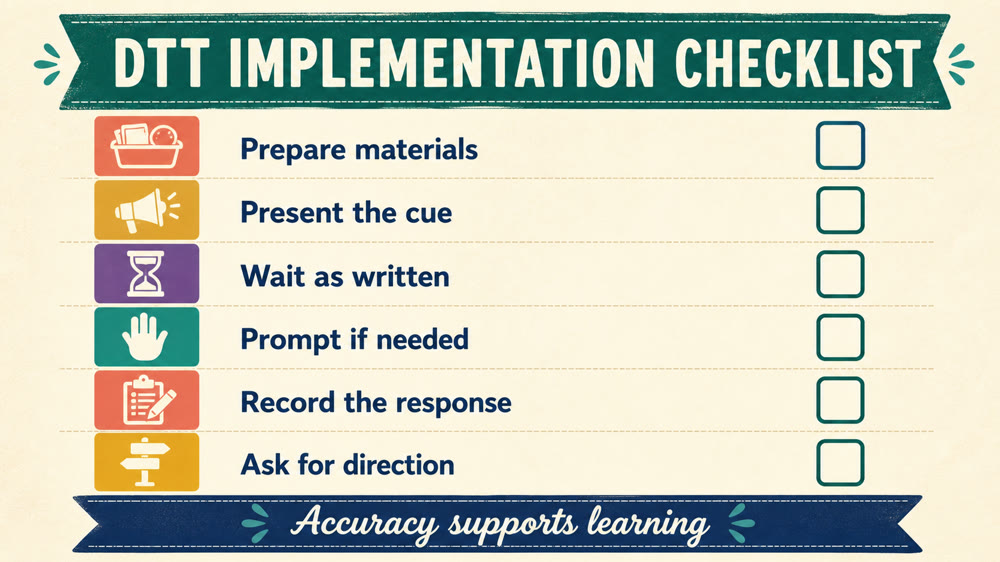
- Can I identify the target response and the exact instruction?
- Do I know the programmed response window?
- Can I use the specified prompt and fading step?
- Do I know which consequence follows each response?
- Can I distinguish independent and prompted responding?
- Can I document a timing or materials problem objectively?
- Do I know when to ask the supervisor before changing anything?
Practice teaching-sequence reasoning
Review original RBT-style scenarios about instructions, prompts, consequences, data, and role boundaries.
Try the RBT practice resource →
Frequently Asked Questions
What is applied behavior analysis discrete trial training?
It is a structured teaching format with a defined opportunity, response window, programmed support, consequence, and data-recording step. The exact procedure depends on the authorized plan.
Can an RBT change a discrete-trial procedure?
No. Implement the trained procedure and ask the responsible supervisor for direction before changing targets, prompts, reinforcement, or mastery rules.
How should prompts be recorded?
Record the prompt level or response category specified by the plan. Do not score a prompted response as independent unless the data rule explicitly says to do so.
Are these official exam questions?
No. The examples are independent and original, not official, recalled, leaked, or BACB-endorsed questions.
References
- Behavior Analyst Certification Board: Registered Behavior Technician Handbook, updated June 2026.
- Behavior Analyst Certification Board: RBT Test Content Outline (3rd ed.).
- Behavior Analyst Certification Board: RBT resources.
- RBT Training: independent RBT practice questions.