

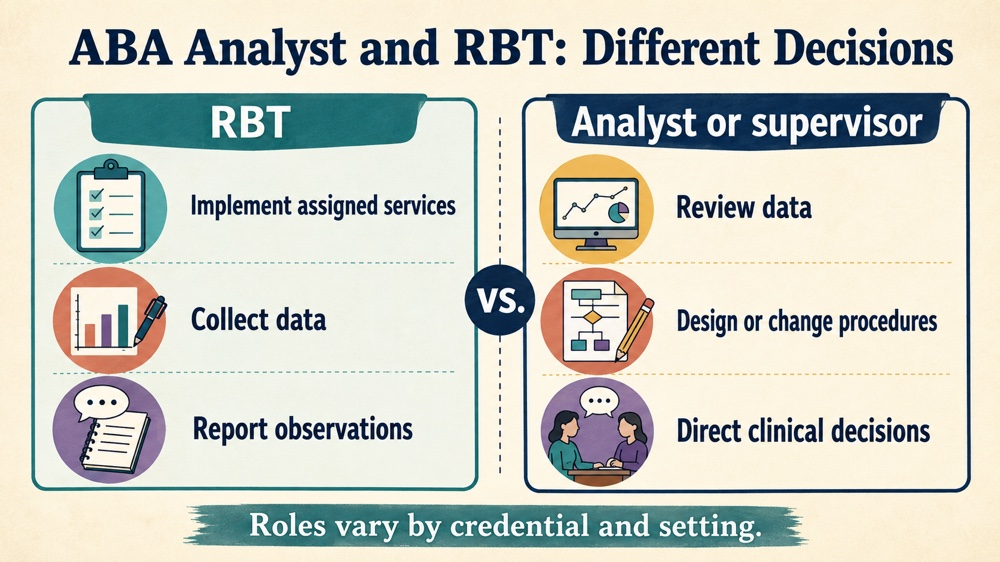
ABA analyst is a broad search phrase that can refer to a behavior analyst, an analyst’s work, or a job title used by an employer. For RBT study, the important distinction is role and responsibility. An RBT collects data and implements assigned services under supervision; an analyst or supervising professional may design, interpret, or change clinical procedures according to the applicable credential and setting.
Table of Contents
- What ABA analyst can mean
- RBT and analyst responsibilities
- Data collection is the bridge to analysis
- Assessment participation and boundaries
- A scenario about an ABA analyst and a changing graph
- Teaching, reduction, and analyst direction
- Documentation and analyst communication
- Current examination map for ABA analyst topics
- Mistakes to avoid with ABA analyst language
- ABA analyst review checklist
- Frequently Asked Questions
- References
Quick answer: Treat aba analyst as a current-source RBT study topic. Identify the actor and decision owner, follow the written procedure, record observable facts, and keep the supervision boundary visible.
Study boundary: This independent guide is educational content. It is not a BACB policy, certification decision, legal opinion, answer key, or guarantee of examination success. Examples are original and are not official, recalled, leaked, or BACB-endorsed questions.
Current exam context: The current BACB RBT Test Content Outline describes 43 tasks across six domains; the examination includes 75 scored questions and 10 unscored pilot questions in a 90-minute testing period. Verify the current handbook and outline before relying on a time-sensitive detail.
What ABA analyst can mean
The phrase ABA analyst is not a complete credential description. It may be used informally for a BCBA, a behavior analyst, a data analyst supporting an ABA program, or a job title that varies by employer. Before answering a question, identify the person, credential, and decision being discussed. Do not infer authority from the word analyst alone.
For an RBT, this distinction prevents two errors. The technician should not claim an analyst’s independent clinical role, and the technician should not undervalue the data and implementation work that makes analysis possible. Accurate measurement, objective notes, and timely communication provide the supervising team with reliable information.
RBT and analyst responsibilities
An RBT typically implements assigned teaching and behavior-reduction procedures, collects data, documents sessions, and reports concerns. A supervising behavior analyst may assess, interpret data, develop or modify goals and procedures, and oversee service quality within the applicable role and laws. The exact workplace structure can vary, but an RBT should know which decisions are delegated and which require supervision.
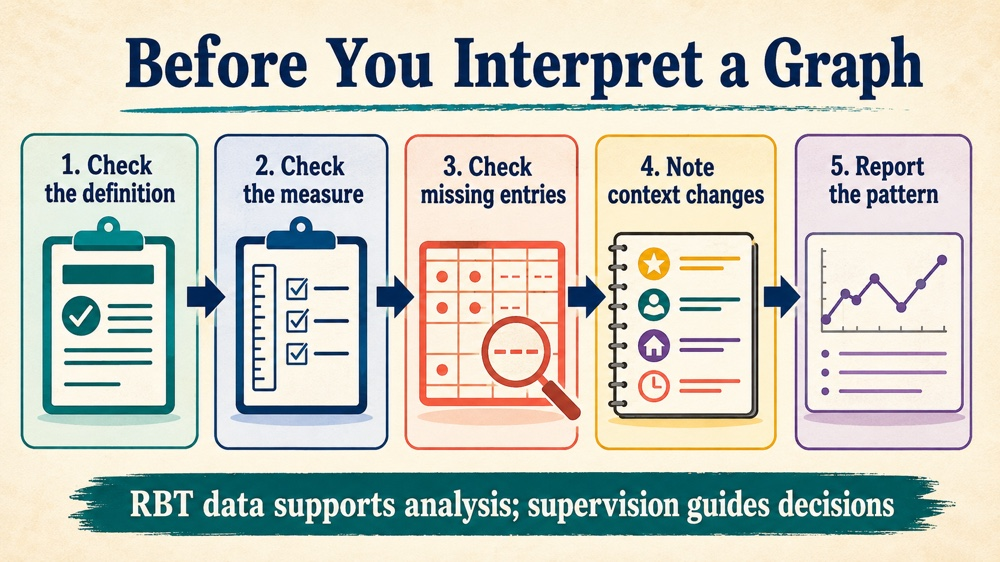
A question that asks what an RBT should do when a graph changes is often testing role boundaries. The RBT can verify the data, describe the trend, check for recording errors, and report the observation. The RBT should not independently conclude that a treatment caused the change or rewrite the intervention without direction.
Data collection is the bridge to analysis
Analysis depends on data that were defined, collected, entered, and summarized consistently. The RBT may use frequency, rate, duration, latency, interval, permanent product, or other systems specified by the program. The analyst or supervising team cannot interpret a measurement accurately if the technician silently changes the definition or records a different event.
Before collecting data, confirm the operational definition, measurement system, timing rules, and materials. During the session, record the event as it occurs. Afterward, check for missing entries or obvious errors and use the approved correction process. If a pattern is unusual, report it with context rather than correcting it to match an expected result.
Assessment participation and boundaries
An RBT may participate in assessment components when trained and assigned, such as implementing a preference assessment or collecting information under a supervisor’s direction. Participation does not mean the RBT independently designs an assessment, diagnoses a function, or communicates a clinical conclusion as the decision owner. The written plan and supervision process determine the technician’s role.
A strong answer distinguishes data gathering from interpretation. If an RBT is asked to run a preference assessment, follow the materials, trial rules, and recording system. If the family asks what the result proves, describe what was observed and refer the interpretive question to the supervising professional. That response is helpful without exceeding competence.
A scenario about an ABA analyst and a changing graph
A graph shows a sudden increase in recorded behavior after a new technician starts working. An RBT should first check whether the operational definition, session length, materials, and recording procedure were consistent. The RBT can report the change and the possible data-quality variables. The RBT should not accuse the new technician or announce that the intervention failed.
The supervising analyst can then evaluate level, trend, variability, treatment changes, and data integrity. The RBT’s contribution is a precise record of what was observed and how it was measured. This scenario shows why analysts need technicians who report anomalies rather than hiding them to make a graph appear stable.
Teaching, reduction, and analyst direction
The analyst or supervising team may specify reinforcement schedules, prompting and fading, skill-acquisition steps, antecedent strategies, differential reinforcement, or safety procedures. An RBT implements those components as trained and reports learner responses. If the RBT sees that a material is unavailable or a step is ineffective, communicate the barrier and follow the interim direction rather than inventing a new intervention.
An RBT can be observant and proactive without being an independent treatment designer. Proactivity means bringing concrete information, asking a focused question, and following through on the answer. It does not mean changing a criterion, withholding reinforcement, or trying a new consequence because it seems logical.
Documentation and analyst communication
A useful note allows the analyst or supervisor to connect the session to the data. Include the relevant instruction, learner response, prompt, consequence, materials, schedule changes, caregiver report, and safety or health variable required by the plan. Use objective language and separate direct observation from a report or hypothesis.
When communicating with an analyst, say what you need: clarification of a prompt, confirmation of a measurement rule, direction after a safety event, or review of an unexpected data pattern. Do not bury the important fact under a long narrative or use a diagnosis as a substitute for the observable sequence. Clear communication improves the speed and quality of review.
Current examination map for ABA analyst topics
The current RBT Test Content Outline connects analyst-facing concepts to six domains: Data Collection and Graphing, Behavior Assessment, Behavior Acquisition, Behavior Reduction, Documentation and Reporting, and Ethics. RBT candidates should study how their data and implementation support the supervising team without claiming the analyst’s decision authority. Use the official outline for task wording and current examination context.
The outline describes 43 tasks; the examination includes 75 scored questions and 10 unscored pilot questions in a 90-minute testing period. Build practice items that ask whether the RBT should record, implement, report, or seek direction. The right answer is often the one that protects data integrity and keeps the clinical decision with the responsible professional.
Mistakes to avoid with ABA analyst language
- Treating an employer job title as proof of a particular certification.
- Assuming an RBT can independently interpret a graph or modify treatment.
- Confusing data collection with assessment design or clinical diagnosis.
- Failing to report a measurement error because the result looks inconvenient.
- Sharing client information with an analyst through an unapproved channel.
- Describing a hypothesis as an observed fact in a note or team message.
- Ignoring the current handbook, TCO, or supervision instructions when roles are unclear.
ABA analyst review checklist
- Can I identify the credential, role, and decision owner in a scenario?
- Can I explain how accurate RBT data supports analysis?
- Can I distinguish implementing an assessment component from independently interpreting it?
- Can I check data quality before reporting an unexpected pattern?
- Can I communicate an observation without turning it into a diagnosis?
- Can I follow a written teaching or reduction plan and report barriers?
- Can I protect privacy and use the current official source when requirements change?
The phrase ABA analyst becomes useful when it is tied to a specific responsibility. For RBT exam questions, keep the sequence clear: collect and implement as assigned, document what happened, communicate the pattern, and allow the responsible supervising professional to analyze or change the plan.
Practice the concept
Review aba analyst with original RBT scenarios, current-source reminders, and clear role boundaries.
Try the RBT practice resource →
Frequently Asked Questions
What does ABA analyst mean?
It is a broad phrase that may refer to a behavior analyst, an analyst’s work, or an employer job title. Identify the credential and decision responsibility before interpreting it.
Can an RBT analyze a learner’s behavior independently?
An RBT can observe, collect data, check data quality, and communicate patterns. Independent clinical interpretation or procedure changes belong to the responsible supervising professional.
How does RBT data support an analyst?
Accurate operational definitions, consistent measurement, objective notes, and timely reports give the supervising team information for review and decision-making.
Are these ABA analyst examples official exam questions?
No. They are original study scenarios and are not official, recalled, leaked, or BACB-endorsed questions.
References
- Behavior Analyst Certification Board: Registered Behavior Technician Handbook, updated June 2026.
- Behavior Analyst Certification Board: RBT Test Content Outline (3rd ed.).
- Behavior Analyst Certification Board: RBT resources.
- Behavior Analyst Certification Board: ethics resources.
- Behavior Analyst Certification Board: RBT Ethics Code (2.0).