

An RBT vocabulary list should do more than collect behavior-analysis words. It should connect each term to a current source, an observable example, the relevant data rule, and the boundary between RBT implementation and clinical decision-making. This independent guide helps organize study without presenting itself as an official BACB document.
Table of Contents
- Start an RBT vocabulary list source log
- Map the list to six RBT domains
- Add measurement and graphing terms
- Add acquisition and learning terms
- Add reduction and assessment terms
- Add ethics and documentation terms
- Use the RBT vocabulary list for active recall
- Keep the list accurate
- RBT vocabulary list checklist
- Frequently Asked Questions
- References
Continue your RBT study with RBT exam study materials and original practice resources.
Quick answer: Treat rbt vocabulary list as a current-source RBT study topic. Define the concept, connect it to an observable action, use original examples, and keep the supervision boundary visible.
Study boundary: This independent guide is educational content. It is not a BACB policy, certification decision, legal opinion, answer key, or guarantee of examination success. It does not promise a passing score or certification outcome. Examples are original and are not official, recalled, leaked, or BACB-endorsed questions.
Current exam context: The current BACB RBT Test Content Outline describes 43 tasks across six domains; the examination includes 75 scored questions and 10 unscored pilot questions in a 90-minute testing period. Verify the current handbook and outline before relying on a time-sensitive detail.
Start an RBT vocabulary list source log
Write the source title, version date, official URL, and check date at the top of the list. The current RBT Test Content Outline provides examination content context, while the Handbook and Ethics Code provide additional pathway and conduct information. A dated list is easier to maintain than a frozen screenshot.
Leave a column for questions. When a definition depends on the written program, record that dependency instead of filling the gap with a generic internet definition.
Map the list to six RBT domains
Organize the list around Data Collection and Graphing, Behavior Assessment, Behavior Acquisition, Behavior Reduction, Documentation and Reporting, and Ethics. The current outline describes 43 tasks across these domains. This structure helps a learner practice retrieval by situation, which is more useful than memorizing an isolated alphabetized list.
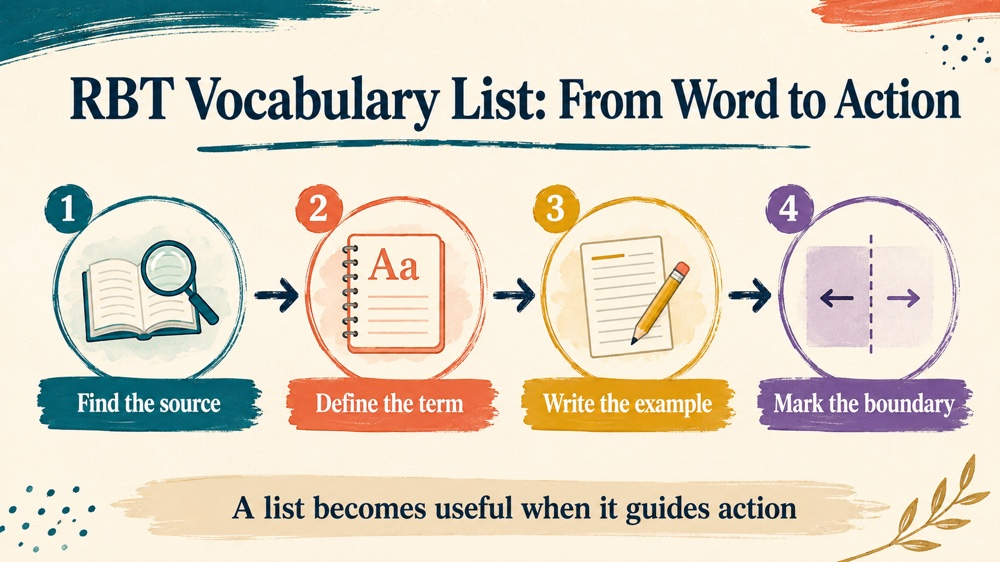
- Name the term.
- Locate the current source.
- Write a plain-language meaning.
- Add an observable RBT example.
- State the data, documentation, or supervision boundary.
Add measurement and graphing terms
Include frequency, rate, duration, latency, interval recording, permanent product, percentage, graphing, trend, and data integrity. For each one, specify what is measured and the start and stop rules. A short original scenario should make the rule visible without adding unsupported details.
If a data sheet or operational definition is incomplete, label the uncertainty and seek direction. A vocabulary list should reinforce accurate recording, not reward a guessed calculation.
Add acquisition and learning terms
Review reinforcement, prompting, fading, shaping, chaining, discrimination, generalization, maintenance, task analysis, and stimulus control. Ask what the learner does, what the RBT does, and what is recorded. Use the written program for the actual sequence and criteria.
Keep the explanation practical: a term is easier to retrieve when it is linked to a condition, response, consequence, and measurement decision.
Add reduction and assessment terms
Include antecedent, consequence, function, differential reinforcement, extinction, safety, and assigned assessment participation. Use scenarios where the RBT observes, implements, records, or reports, then identify who evaluates and approves a clinical change.
Do not let a broad definition imply independent diagnosis, treatment design, or a new consequence. Mark the role boundary directly on the list.
Add ethics and documentation terms
Include confidentiality, competence, supervision, objective note, accurate record, reporting, and professional conduct. Use fictional examples and only the information needed for the communication route. Ethics terms are action rules, not decorative vocabulary.
Review each example for an unsupported interpretation. Replace it with an observable fact or state who should evaluate the interpretation.
Use the RBT vocabulary list for active recall
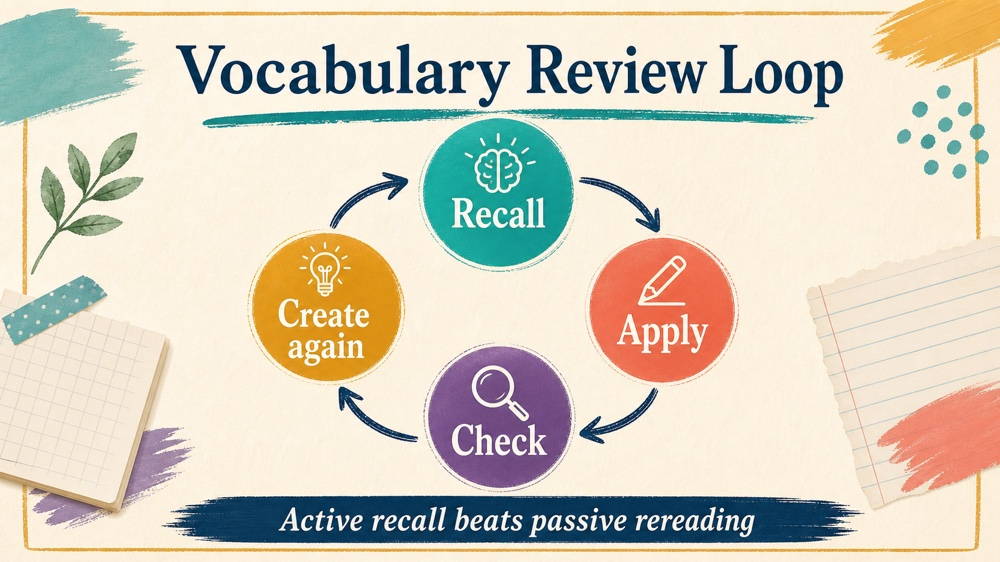
Cover one column, explain a term from a new scenario, check the official source, and create a new example. Mark misses by category and revisit them after a delay. Mix measurement, teaching, reduction, documentation, and ethics so the learner must discriminate among related concepts.
The current examination includes 75 scored questions and 10 unscored pilot questions in a 90-minute testing period. Verify official BACB materials before using a time-sensitive detail in a study schedule.
Keep the list accurate
- Do not use an undated or unlabeled glossary as current.
- Do not define a term without a condition and example.
- Do not confuse a label with a measurement rule.
- Do not omit privacy, competence, supervision, or documentation.
- Do not copy recalled or protected questions.
- Do not use vocabulary as authorization to change a plan.
- Do update the list when official sources change.
RBT vocabulary list checklist
- Is every term linked to a source and date?
- Are the six domains represented?
- Does each entry include an observable example?
- Are data start, stop, and scoring rules clear?
- Is the implementation boundary visible?
- Are examples original and privacy-safe?
- Do missed terms lead to delayed recall and a new scenario?
Use an RBT vocabulary list as a maintained, source-linked study tool. Keep the list concise enough to review and specific enough to guide action. RBT Training is independent educational content and is not affiliated with or endorsed by BACB.
Practice the concept
Review rbt vocabulary list with original RBT scenarios, current-source reminders, and clear role boundaries.
Review the RBT study resource →
Frequently Asked Questions
What should an RBT vocabulary list include?
Include a source, definition, observable example, data or teaching implication, and role boundary.
How should I organize the list?
The six current RBT domains provide a useful structure for retrieval and review.
Can a vocabulary list replace practice?
No. Pair it with original scenarios and active recall so terms are applied under changing conditions.
Are the examples official examination items?
No. They are original educational scenarios and are not official, recalled, leaked, or BACB-endorsed.
References
- Behavior Analyst Certification Board: Registered Behavior Technician Handbook, updated June 2026.
- Behavior Analyst Certification Board: RBT Test Content Outline (3rd ed.).
- Behavior Analyst Certification Board: RBT resources.
- Behavior Analyst Certification Board: ethics resources.
- Behavior Analyst Certification Board: RBT Ethics Code (2.0).