

ABA practice analytics can help an RBT learner decide what to review next, but a practice dashboard is only as useful as the categories behind it. Track the domain, error type, explanation quality, and next action rather than treating a percentage as an official result. This page uses original educational examples and is not a BACB assessment, score report, or certification decision.
Table of Contents
- Start an ABA practice analytics plan
- Separate accuracy from confidence
- Organize analytics by six RBT domains
- Track measurement and calculation errors
- Track application and role-boundary errors
- Turn a score into a review loop
- Use an ABA practice analytics dashboard carefully
- Avoid misleading analytics
- ABA practice analytics checklist
- Frequently Asked Questions
- References
Then reinforce the concepts with free RBT mock exams and review the explanations.
Continue your RBT study with RBT exam study materials and original practice resources.
Quick answer: Treat aba practice analytics as a current-source RBT study topic. Define the concept, connect it to an observable action, use original examples, and keep the supervision boundary visible.
Study boundary: This independent guide is educational content. It is not a BACB policy, certification decision, legal opinion, answer key, or guarantee of examination success. It does not promise a passing score or certification outcome. Examples are original and are not official, recalled, leaked, or BACB-endorsed questions.
Current exam context: The current BACB RBT Test Content Outline describes 43 tasks across six domains; the examination includes 75 scored questions and 10 unscored pilot questions in a 90-minute testing period. Verify the current handbook and outline before relying on a time-sensitive detail.
Start an ABA practice analytics plan
Define what the practice session is meant to measure: vocabulary, data rules, application, calculation, condition reading, documentation, or ethics. Record the current BACB sources used to frame the session, then use original scenarios. A number without a purpose does not tell the learner what to do next.
Keep the dashboard simple enough to update after every session. The useful output is a targeted review decision, not a decorative chart.
Separate accuracy from confidence
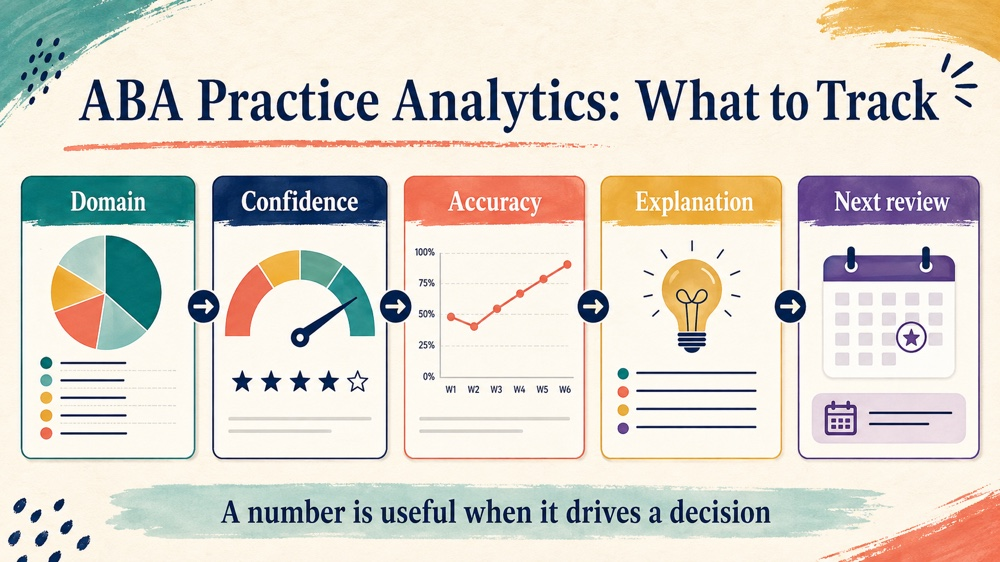
A learner may answer correctly for the wrong reason or miss an item despite understanding the central rule. Track confidence separately from accuracy and require a one-sentence explanation. Review items where confidence was high but the explanation was weak; those are important correction targets.
- Answer the scenario.
- Record confidence before checking.
- Explain the controlling fact.
- Compare with the source or plan boundary.
- Assign a next review action.
Organize analytics by six RBT domains
Use Data Collection and Graphing, Behavior Assessment, Behavior Acquisition, Behavior Reduction, Documentation and Reporting, and Ethics as the main categories. The current RBT Test Content Outline describes 43 tasks across these domains. Domain-level counts reveal patterns that a single total percentage hides.
Do not infer clinical competence from a practice score. The dashboard is for study planning and should remain clearly independent.
Track measurement and calculation errors
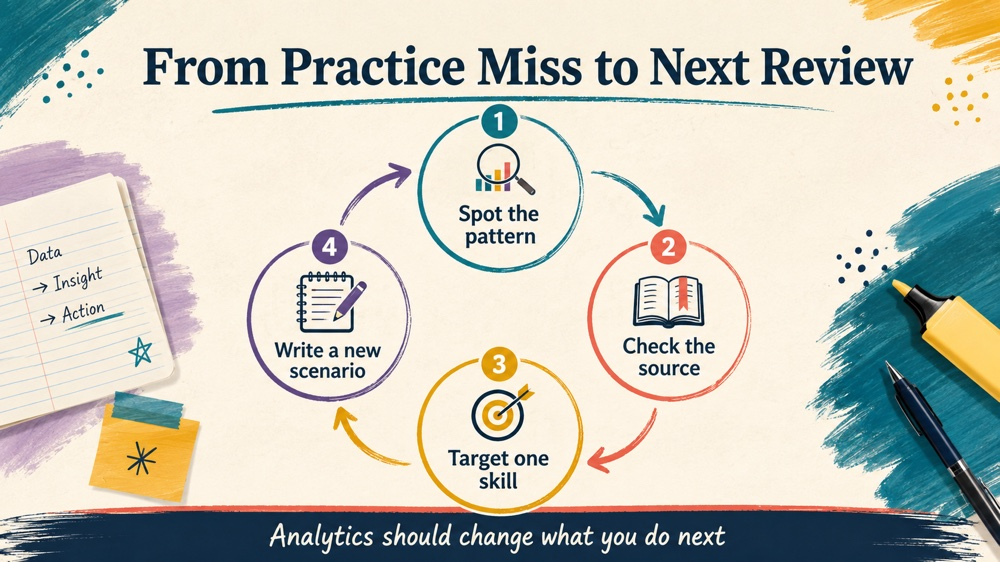
Create separate labels for frequency, rate, duration, latency, interval recording, permanent product, percentage, graphing, and data integrity. A learner who knows the vocabulary may still miss the start and stop rules. Record the exact rule that was missed and write a new scenario with one changed variable.
If the program or operational definition is incomplete, the next action may be to seek direction. Analytics should not reward invented values or unauthorized measurement changes.
Track application and role-boundary errors
Label misses involving reinforcement, prompting, fading, shaping, chaining, generalization, reduction procedures, assessment participation, privacy, documentation, competence, or supervision. Note whether the error came from choosing an unsupported clinical change or failing to report an observation.
This category is especially useful because confident but overbroad answers can sound sophisticated. The dashboard should make the handoff visible.
Turn a score into a review loop
After each session, choose one priority domain, one error type, one source section, and one new scenario. Review the new scenario after a delay. Compare accuracy and explanation quality over time, but do not present the trend as a BACB score or prediction.
The current examination includes 75 scored questions and 10 unscored pilot questions in a 90-minute testing period. Use current official materials for time-sensitive context and plan practice pacing separately from correction time.
Use an ABA practice analytics dashboard carefully
A useful table can include date, domain, question type, confidence, accuracy, explanation status, source checked, and next review date. Protect privacy by using fictional labels and never entering client-identifying information. Keep original question text within the rights and workflow that created it.
Review patterns weekly: repeated measurement misses may need a timeline exercise, while repeated role-boundary misses may need a supervision and ethics review.
Avoid misleading analytics
- Calling a practice percentage an official score.
- Combining unrelated domains into one unexplained number.
- Treating confidence as competence.
- Using recalled or protected questions.
- Entering client-identifying information into a study dashboard.
- Changing a plan because a chart suggests a preferred answer.
- Ignoring explanation quality and only counting correct clicks.
ABA practice analytics checklist
- Does each session have a defined study purpose?
- Are all six domains available as categories?
- Are confidence and explanation tracked separately from accuracy?
- Are measurement errors tied to specific rules?
- Are role-boundary and ethics misses visible?
- Does every pattern produce a source check and new scenario?
- Is the dashboard clearly independent from official scoring?
Use ABA practice analytics to choose the next study action. Keep the categories transparent, examples original, privacy protected, and claims modest. RBT Training is independent educational content and is not affiliated with or endorsed by BACB.
Practice the concept
Review aba practice analytics with original RBT scenarios, current-source reminders, and clear role boundaries.
Review the RBT study resource →
Frequently Asked Questions
What are ABA practice analytics?
They are study-tracking categories that help connect practice results to targeted review actions.
Can analytics predict an examination result?
No. A practice dashboard is an independent study tool, not an official score or certification decision.
What should I track besides accuracy?
Track confidence, explanation quality, domain, error type, source checked, and next review date.
Can I put client data in the dashboard?
Protect privacy. Use fictional study examples and do not enter identifying information.
References
- Behavior Analyst Certification Board: Registered Behavior Technician Handbook, updated June 2026.
- Behavior Analyst Certification Board: RBT Test Content Outline (3rd ed.).
- Behavior Analyst Certification Board: RBT resources.
- Behavior Analyst Certification Board: ethics resources.
- Behavior Analyst Certification Board: RBT Ethics Code (2.0).