
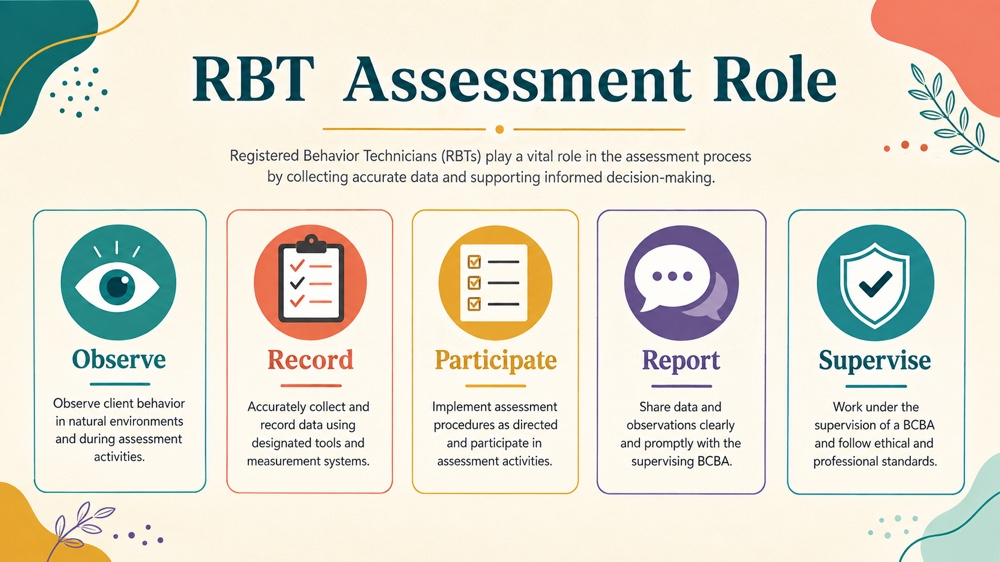
Assessments and the role of the RBT should be studied as a boundary question: what can the technician observe, implement, record, and report, and which decisions belong to the responsible professional? RBTs may participate in assigned assessment activities under direction, but the role does not automatically authorize independent diagnosis, functional interpretation, standardized-test interpretation, or treatment design. This independent guide organizes the topic around source checking, observable behavior, data integrity, privacy, and supervision. The current BACB Handbook, Test Content Outline, Ethics Code, assessment instructions, and written program should be read together. If a scenario is vague, identify the missing instrument, task, training, and oversight rather than guessing. Good assessment practice protects the learner and gives the team information it can responsibly use.
Table of Contents
- Assessments and the role of the RBT: the core distinction
- Assessments and the role of the RBT: observe and record what is defined
- Participate only as assigned
- Standardized assessment needs extra care
- Protect data quality
- Protect privacy and dignity
- Communicate assessment observations
- Avoid assessment-role mistakes
- Assessments and the role of the RBT checklist
- Frequently Asked Questions
- References
Continue your RBT study with RBT exam study materials and original practice resources.
Quick answer: Treat assessments and the role of the rbt as a current-source RBT study topic. Identify the exact action, source, data rule, and supervision boundary before deciding.
Study boundary: This independent guide is educational content. It is not a BACB policy, certification decision, legal opinion, answer key, or guarantee of examination success. Examples are original and are not official, recalled, leaked, or BACB-endorsed questions.
Current exam context: The current BACB RBT Test Content Outline describes 43 tasks across six domains; the examination includes 75 scored questions and 10 unscored pilot questions in a 90-minute testing period. Verify the current handbook and outline before relying on a time-sensitive detail.
The same role boundary applies whether information is collected on paper, in a digital platform, during a classroom observation, or inside a clinical session. A precise note can support a decision without pretending that the technician made the decision. Study each example by naming the action, the source, the data rule, and the person who reviews the information. It is also useful to distinguish a screening activity, a preference assessment, a skill probe, and a standardized instrument, because their procedures and decision owners may differ. When a task changes, recheck the assignment instead of carrying an old assumption forward.
Assessments and the role of the RBT: the core distinction
An assessment may include observation, measurement, interview support, preference assessment, skill probes, standardized procedures, data entry, or review. The RBT’s role depends on the assigned activity and training. Name the action before deciding whether it is within scope.
Assessments and the role of the RBT: observe and record what is defined
Use the operational definition, data measure, timing, and setting specified by the program. Record what happened rather than why you think it happened. An RBT can provide valuable observations without claiming an independent functional conclusion.
Participate only as assigned
If the supervisor asks for a preference assessment, skill probe, or other activity, follow the written procedure and record the assigned data. Do not add items, change criteria, or interpret a result beyond the instruction. Ask when the procedure or purpose is unclear.
Standardized assessment needs extra care
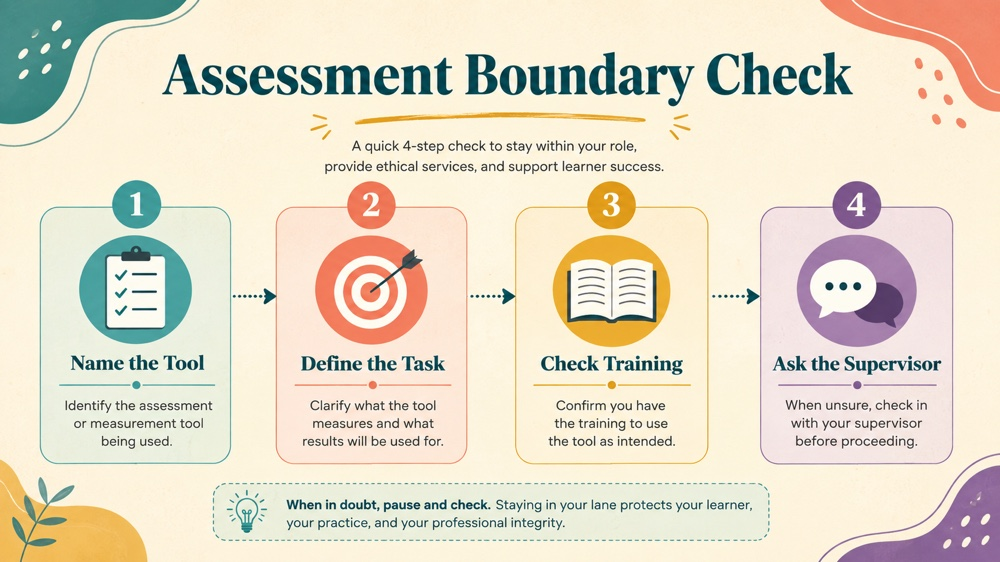
Check the instrument’s edition, instructions, qualifications, timing, scoring, and security rules. A person who can collect an observation is not automatically authorized to administer or interpret every standardized measure. Keep the role question specific.
Protect data quality
Use approved materials and systems, correct errors transparently, and report missing or inconsistent information. Do not backfill from memory or alter an entry to support a preferred conclusion. Data quality is part of ethical service delivery.
Protect privacy and dignity
Use minimum necessary information, secure records, respectful language, and appropriate consent or access procedures. Never place identifying assessment details in personal flashcards, public examples, or an unapproved app. Dignity includes how the assessment is explained and conducted.
Communicate assessment observations
A useful report identifies the activity, condition, observable response, data, barrier, and follow-up question. Share through the approved route. The supervisor or qualified professional decides how information changes assessment, teaching, or treatment.
Avoid assessment-role mistakes
- Treating an RBT credential as independent assessment authority.
- Confusing observation with interpretation.
- Changing a protocol because the session is inconvenient.
- Sharing private or protected assessment materials.
- Failing to identify training or competence limits.
- Ignoring a missing supervisor or unclear assignment.
- Calling original scenarios official examination questions.
Assessments and the role of the RBT checklist
- What assessment activity is being requested?
- What exact step is assigned?
- What source and written procedure control it?
- What data and scoring rules apply?
- Who reviews or interprets the information?
- What privacy and security rules apply?
- What should I do when the role or procedure is unclear?
Use assessments and the role of the RBT as a source-linked scope and data topic. RBT Training is independent educational content and is not affiliated with or endorsed by BACB.
Practice the concept
Review assessments and the role of the rbt with original RBT scenarios, current-source reminders, and clear role boundaries.
Review the RBT study resource →
Frequently Asked Questions
What is the RBT role in assessments?
RBTs may participate in assigned assessment activities under direction, collecting or reporting information within training and the written procedure.
Can RBTs independently interpret assessments?
No. Independent interpretation, diagnosis, and treatment design require the appropriate qualified professional and supervision.
What should be included in an assessment note?
Use objective facts, the assigned data measure, relevant conditions, barriers, and the approved follow-up route.
Are these official exam questions?
No. They are original educational scenarios and are not official, recalled, leaked, or BACB-endorsed.
References
- Behavior Analyst Certification Board: Registered Behavior Technician Handbook, updated June 2026.
- Behavior Analyst Certification Board: RBT Test Content Outline (3rd ed.).
- Behavior Analyst Certification Board: RBT resources.
- Behavior Analyst Certification Board: ethics resources.
- Behavior Analyst Certification Board: RBT Ethics Code (2.0).