

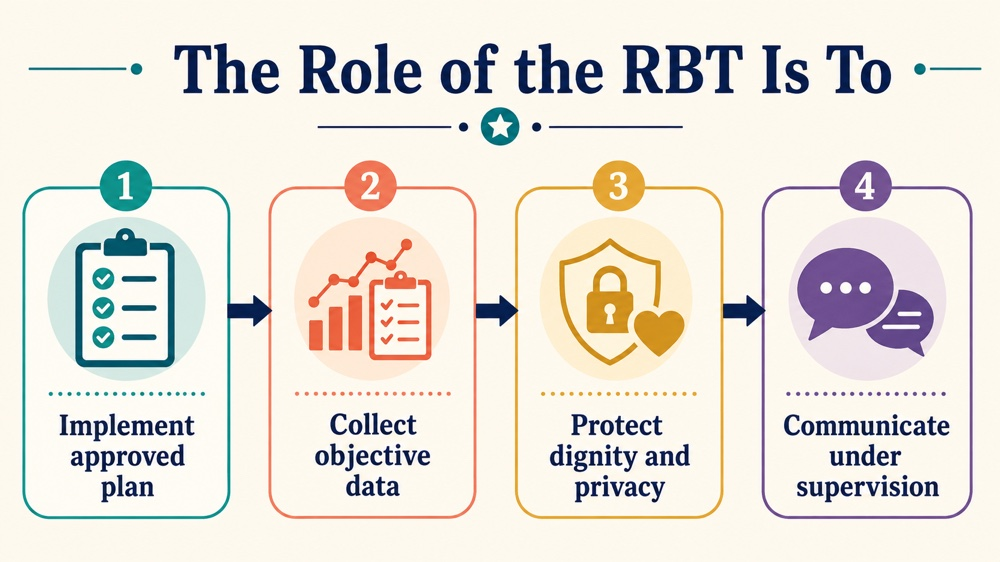
The role of the RBT is to provide assigned, observable behavior-analytic services under the direction and close supervision of a qualified responsible professional. That short phrase is useful for exam study only when it is connected to specific actions: implementing a written plan, preparing materials, collecting accurate data, protecting dignity and privacy, communicating observations, and seeking direction when a task is unclear or outside demonstrated competence. An RBT does not independently diagnose, design treatment, interpret every assessment, or change program criteria. This independent guide turns the phrase the role of the RBT is to into a practical decision framework. It uses original examples, not official or recalled examination questions, and it should be checked against current BACB materials, employer policy, and supervisor direction.
Table of Contents
- The role of the RBT is to: start with assigned services
- Separate implementation from clinical decision-making
- The role of the RBT is to protect data quality
- Support dignity, choice, and communication
- Use supervision as part of the role
- Know common role boundaries
- Communicate observable information
- Avoid role-definition mistakes
- The role of the RBT is to checklist
- Frequently Asked Questions
- References
Continue your RBT study with RBT exam study materials and original practice resources.
Quick answer: Treat the role of the rbt is to as a current-source RBT study topic. Identify the exact action, source, data rule, and supervision boundary before deciding.
Study boundary: This independent guide is educational content. It is not a BACB policy, certification decision, legal opinion, answer key, or guarantee of examination success. Examples are original and are not official, recalled, leaked, or BACB-endorsed questions.
Current exam context: The current BACB RBT Test Content Outline describes 43 tasks across six domains; the examination includes 75 scored questions and 10 unscored pilot questions in a 90-minute testing period. Verify the current handbook and outline before relying on a time-sensitive detail.
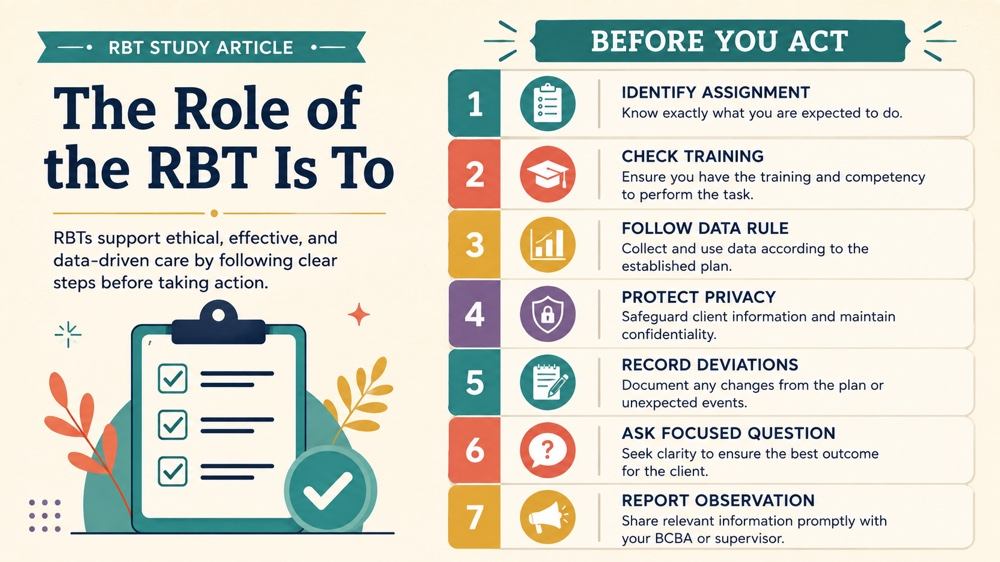
The phrase is easiest to apply when you translate it into a sequence of observable actions. Before a session, check the current assignment and materials. During the session, follow the approved procedure, use the defined prompt and reinforcement rules, and record the assigned measure. After the session, communicate relevant observations, barriers, errors, and safety concerns through the approved route. This sequence keeps the RBT’s contribution visible without assigning independent authority that belongs to the responsible professional. It also helps distinguish an implementation question from a treatment-design question. When a request changes the goal, criterion, assessment interpretation, or privacy risk, stop and ask for direction rather than relying on a general definition.
The role of the RBT is to: start with assigned services
Identify the exact program, target response, materials, setting, data measure, and decision rule before starting. The assignment should tell you what to do and how to report it. If a plan is missing a key step, ask the supervisor rather than filling the gap with personal preference.
Separate implementation from clinical decision-making
Implementation means carrying out the approved procedure consistently and recording what happens. Clinical decision-making may include selecting goals, changing reinforcement criteria, interpreting assessment results, or redesigning treatment. Those decisions require the appropriate professional and supervision process.
The role of the RBT is to protect data quality
Use operational definitions, timing rules, and scoring instructions as written. Record independent and prompted responses accurately, correct errors transparently, and report missing materials or unusual events. A polished note is not useful if it hides a deviation or changes the meaning of the data.
Support dignity, choice, and communication
Use respectful language, reasonable processing time, privacy, and the learner’s authorized communication supports. Do not use procedures to embarrass, threaten, or punish a person for needing help. Report preferences and barriers through the approved route so the team can consider them.
Use supervision as part of the role
Bring focused questions that identify the target, the step that is unclear, the data rule, and the possible risk. Supervision is not only a scheduled meeting; it is also the process for reporting uncertainty, errors, safety concerns, and limits in competence.
Know common role boundaries
An RBT generally should not present an RBT credential as permission to diagnose, independently interpret standardized assessments, create an unapproved intervention, disclose protected records, or promise outcomes. When a request seems to require those actions, pause and seek direction.
Communicate observable information
A strong handoff states what occurred, when and where it occurred, what measure was recorded, what barrier appeared, and what question remains. Keep observation separate from speculation. The supervisor can decide whether a pattern warrants program review.
Avoid role-definition mistakes
- Treating an RBT title as independent clinical authority.
- Changing a program because a different approach feels easier.
- Counting prompted behavior as independent.
- Failing to report missing training or unclear instructions.
- Sharing protected records or assessment materials.
- Using vague notes that cannot support review.
- Calling original educational scenarios official examination questions.
The role of the RBT is to checklist
- What exact service or program is assigned?
- What response and data definition apply?
- Which steps require supervisor direction?
- How will prompting, errors, and deviations be recorded?
- How are dignity, privacy, and communication supported?
- Who reviews the information and makes decisions?
- What should be reported before the next session?
Use the role of the RBT is to as a scope-and-implementation study topic. RBT Training is independent educational content and is not affiliated with or endorsed by BACB.
Practice the concept
Review the role of the rbt is to with original RBT scenarios, current-source reminders, and clear role boundaries.
Review the RBT study resource →
Frequently Asked Questions
What is the role of the RBT?
An RBT implements assigned services, collects and reports data, protects dignity and privacy, and works under the required direction and supervision.
Can an RBT change a treatment plan?
An RBT should not independently change goals, criteria, or procedures. Report observations and ask the responsible supervisor to review the program.
What should an RBT do when a task is unclear?
Pause when needed, identify the exact uncertainty, protect the learner, and ask the responsible supervisor for direction.
Are these official exam questions?
No. They are original educational scenarios and are not official, recalled, leaked, or BACB-endorsed.
References
- Behavior Analyst Certification Board: Registered Behavior Technician Handbook, updated June 2026.
- Behavior Analyst Certification Board: RBT Test Content Outline (3rd ed.).
- Behavior Analyst Certification Board: RBT resources.
- Behavior Analyst Certification Board: ethics resources.
- Behavior Analyst Certification Board: RBT Ethics Code (2.0).