
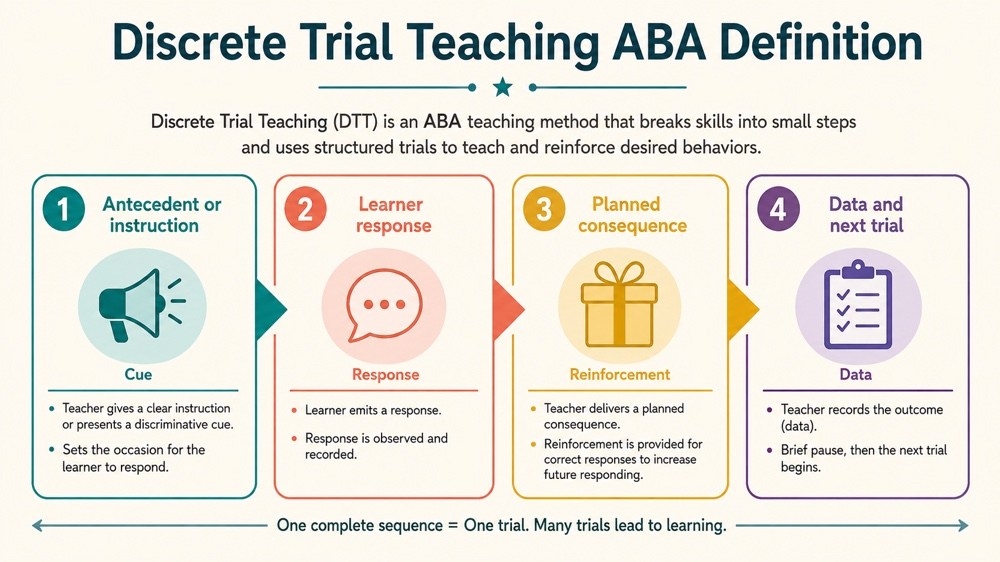
A discrete trial teaching ABA definition describes a structured teaching arrangement in which an antecedent or instruction is presented, the learner responds, and a planned consequence follows, with data collected across opportunities. The trial is not simply a worksheet question or a command repeated until compliance. Good discrete trial teaching uses an operationally defined target, clear materials, an appropriate prompt plan, reinforcement, an error-correction procedure, and a decision rule for the next opportunity. The RBT implements the approved protocol under supervision and records what occurred. This independent guide explains the concept for RBT study using original examples, not official or recalled examination questions. Always follow the current written program, learner-specific communication supports, supervisor direction, and dignity safeguards.
Table of Contents
- Discrete trial teaching ABA definition: identify the parts
- Use an observable target
- Present the antecedent consistently
- Discrete trial teaching ABA definition: prompt and fade
- Plan the consequence
- Collect trial-level data
- Support generalization and dignity
- Avoid discrete-trial mistakes
- Discrete trial teaching ABA definition checklist
- Frequently Asked Questions
- References
Continue your RBT study with RBT exam study materials and original practice resources.
Quick answer: Treat discrete trial teaching aba definition as a current-source RBT study topic. Identify the exact action, source, data rule, and supervision boundary before deciding.
Study boundary: This independent guide is educational content. It is not a BACB policy, certification decision, legal opinion, answer key, or guarantee of examination success. Examples are original and are not official, recalled, leaked, or BACB-endorsed questions.
Current exam context: The current BACB RBT Test Content Outline describes 43 tasks across six domains; the examination includes 75 scored questions and 10 unscored pilot questions in a 90-minute testing period. Verify the current handbook and outline before relying on a time-sensitive detail.
A discrete trial is a teaching arrangement, not a guarantee that every trial will be successful or that a learner must respond immediately. The RBT should prepare the approved materials, present the antecedent clearly, allow an appropriate response opportunity, deliver the planned consequence, and record the outcome. If an error occurs, follow the written correction procedure and preserve the distinction between independent and prompted behavior. Watch for accessibility, communication, motivation, fatigue, and signs that a break or supervisor review is needed. High-quality discrete trial teaching combines procedural consistency with respectful teaching and meaningful skill selection.
Discrete trial teaching ABA definition: identify the parts
Break one trial into the antecedent or instruction, the learner’s observable response, and the consequence. Then identify the intertrial interval or reset, the prompt level, and the data measure. Naming each part makes it easier to find where a procedure changed.
Use an observable target
A target should describe what the learner will do and how it will be measured. Vague goals such as understand the task are difficult to teach and score. A clear response definition helps the RBT deliver consistent opportunities and record independent versus prompted behavior.
Present the antecedent consistently
Use the wording, materials, position, and timing specified by the program. Avoid adding extra hints that are not part of the planned prompt hierarchy. If the learner needs an accommodation or the antecedent is inaccessible, report the issue instead of silently changing the trial.
Discrete trial teaching ABA definition: prompt and fade
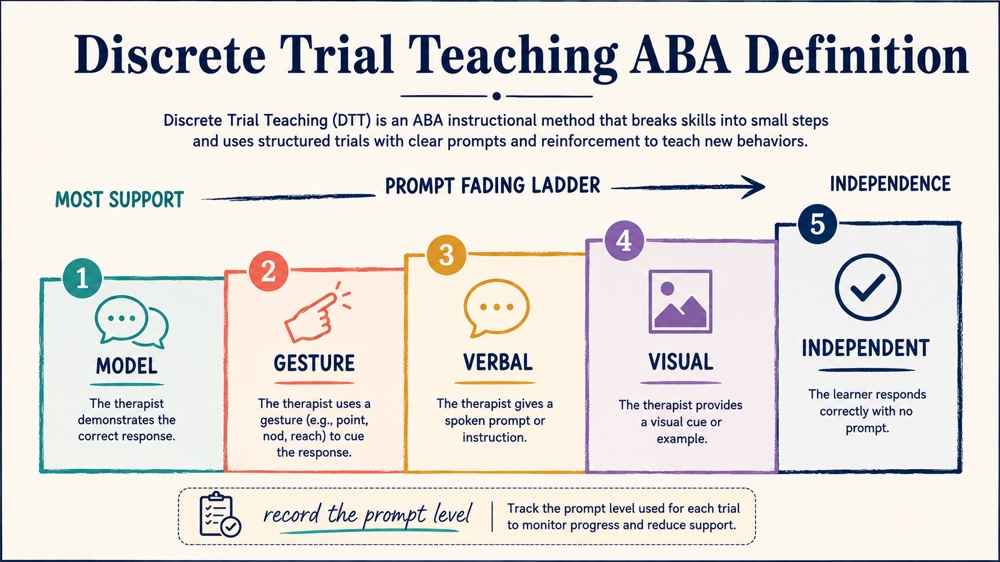
Prompts may help evoke the target response, but the program should state how they are delivered and faded. Record the prompt level required. Do not count a response as independent when the prompt made the response possible.
Plan the consequence
A consequence may include reinforcement for the target response, an error-correction step, or another approved response. Deliver it according to the program and the learner’s preferences. Do not withhold communication or dignity as a consequence, and do not invent a consequence when the plan is unclear.
Collect trial-level data
Record opportunities, correct or incorrect responses, prompt level, latency, duration, or another assigned measure. Use the scoring rule consistently and report missing trials, distractions, material problems, or deviations that could affect interpretation.
Support generalization and dignity
Structured teaching should connect to meaningful skills and should not become mechanical performance without context. Use respectful language, varied approved examples, functional communication, and appropriate breaks. Report when the arrangement is not accessible or the learner shows distress.
Avoid discrete-trial mistakes
- Calling any repeated instruction discrete trial teaching.
- Failing to define the target response.
- Adding unplanned prompts or consequences.
- Counting prompted behavior as independent.
- Changing timing or materials without review.
- Recording only successful trials.
- Calling original scenarios official examination questions.
Discrete trial teaching ABA definition checklist
- What is the observable target response?
- What antecedent and materials start the trial?
- What prompt and fading rules apply?
- What consequence follows each response?
- What data measure and scoring rule apply?
- How are errors, breaks, and deviations recorded?
- How is the skill connected to generalization and dignity?
Use discrete trial teaching ABA definition as a structured skill-acquisition study topic. RBT Training is independent educational content and is not affiliated with or endorsed by BACB.
Practice the concept
Review discrete trial teaching aba definition with original RBT scenarios, current-source reminders, and clear role boundaries.
Review the RBT study resource →
Frequently Asked Questions
What is discrete trial teaching?
It is a structured teaching arrangement with an antecedent, an observable response, a planned consequence, and data collected across opportunities.
Is every repeated instruction discrete trial teaching?
No. The arrangement also requires a defined target, planned prompts or consequences, a consistent procedure, and a data rule.
What does the RBT record?
Follow the program’s assigned measure, such as independent or prompted response, accuracy, latency, or another defined trial-level measure.
Are these official exam questions?
No. They are original educational scenarios and are not official, recalled, leaked, or BACB-endorsed.
References
- Behavior Analyst Certification Board: Registered Behavior Technician Handbook, updated June 2026.
- Behavior Analyst Certification Board: RBT Test Content Outline (3rd ed.).
- Behavior Analyst Certification Board: RBT resources.
- Behavior Analyst Certification Board: ethics resources.
- Behavior Analyst Certification Board: RBT Ethics Code (2.0).