

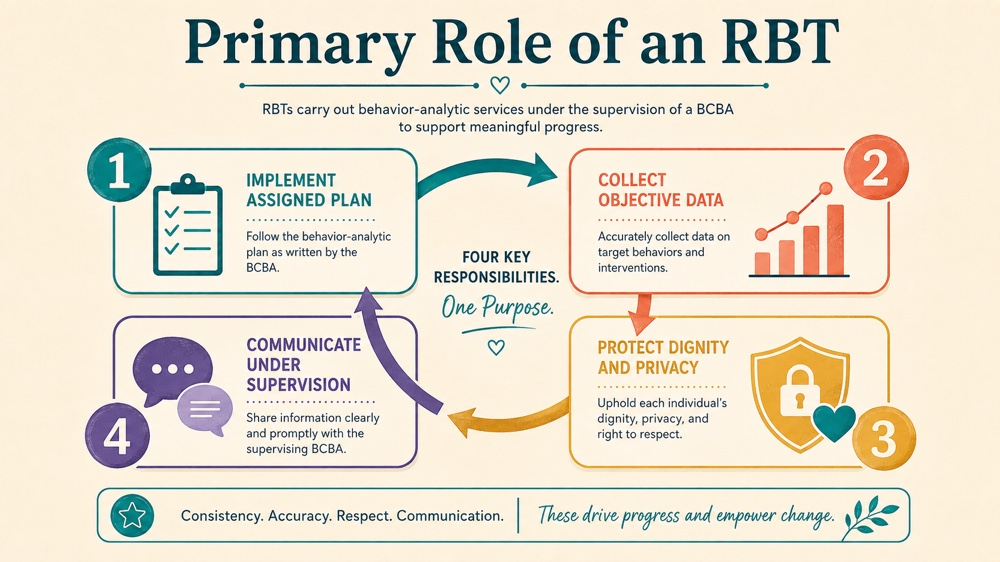
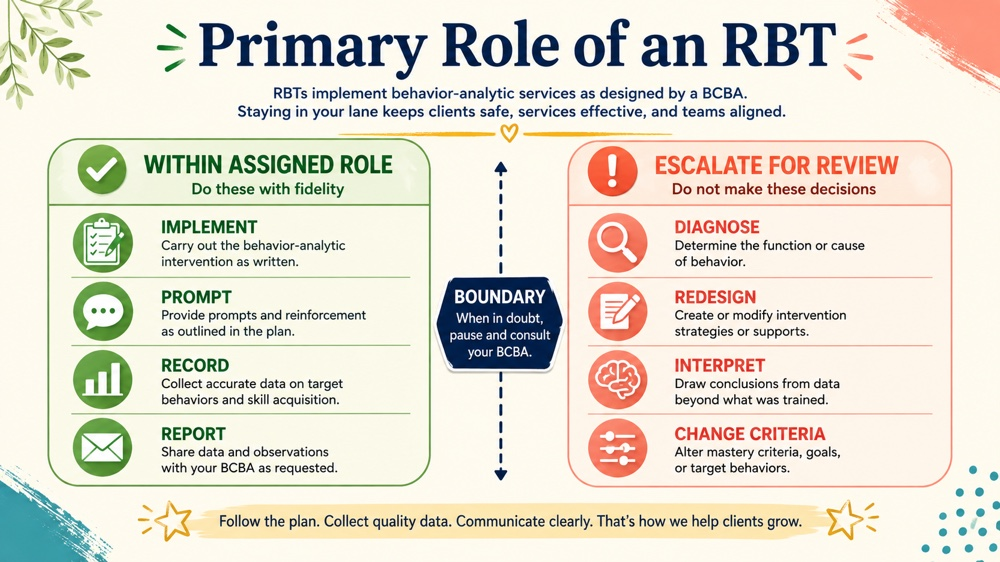
The primary role of an RBT is to implement assigned behavior-analytic services under the direction and close supervision of a qualified responsible professional, while collecting accurate data, protecting the learner’s dignity and privacy, and communicating observations. The role is active and important, but it is not independent clinical practice. An RBT should not diagnose, independently interpret every assessment, design treatment, change criteria, or promise outcomes without the appropriate authority and review. This independent guide explains the phrase primary role of an RBT through concrete actions and boundaries. Use current BACB materials, the written program, employer policy, learner-specific supports, and supervision direction. The examples are original educational scenarios, not official, recalled, leaked, or BACB-endorsed examination questions.
Table of Contents
- Primary role of an RBT: implement assigned services
- Collect objective data
- Primary role of an RBT: support skill acquisition
- Protect dignity and privacy
- Communicate through supervision
- Know what is outside the primary role
- Use professional judgment about limits
- Avoid primary-role mistakes
- Primary role of an RBT checklist
- Frequently Asked Questions
- References
Continue your RBT study with RBT exam study materials and original practice resources.
Quick answer: Treat primary role of an rbt as a current-source RBT study topic. Identify the exact action, source, data rule, and supervision boundary before deciding.
Study boundary: This independent guide is educational content. It is not a BACB policy, certification decision, legal opinion, answer key, or guarantee of examination success. Examples are original and are not official, recalled, leaked, or BACB-endorsed questions.
Current exam context: The current BACB RBT Test Content Outline describes 43 tasks across six domains; the examination includes 75 scored questions and 10 unscored pilot questions in a 90-minute testing period. Verify the current handbook and outline before relying on a time-sensitive detail.
A strong answer about the primary role names both what the technician does and how the technician stays within role. Implementation without accurate data is incomplete; data without privacy and dignity is not sufficient; and action without supervision can become unauthorized clinical decision-making. Before a session, confirm the assignment and materials. During the session, follow the procedure and record the defined measure. Afterward, report observable results, barriers, deviations, and safety concerns. If the learner’s needs or the setting make the written procedure inaccessible, do not quietly rewrite the program. Ask for review and document the question through the approved route. Reliability also means arriving prepared, using approved materials, and accepting corrective feedback without changing the record to make performance look better. It also includes communicating promptly when a scheduled task cannot be completed as written.
Primary role of an RBT: implement assigned services
Start with the current written program and identify the target response, antecedent, prompt plan, consequence, data rule, and decision criteria. Implement what is assigned consistently and communicate when the plan is incomplete or difficult to follow.
Collect objective data
Record independent and prompted responses, latency, duration, frequency, or another assigned measure using the operational definition. Avoid backfilling, guessing, or changing the scoring rule because the session was busy.
Primary role of an RBT: support skill acquisition
Use approved prompting, reinforcement, error correction, and fading procedures. Connect teaching to functional communication, meaningful routines, accessibility, and generalization. Report when a procedure is ineffective or creates a barrier.
Protect dignity and privacy
Use respectful language, reasonable processing time, confidential records, and the learner’s authorized communication supports. Do not use treatment materials to embarrass, threaten, or expose a person’s needs.
Communicate through supervision
A useful handoff describes what happened, under what conditions, what data were recorded, and what question remains. Separate observation from interpretation and escalate safety, ethics, competence, or privacy concerns.
Know what is outside the primary role
Independent diagnosis, treatment design, assessment interpretation, and unapproved program changes are not implied by the RBT credential. Identify the exact request and ask the responsible professional to clarify authority.
Use professional judgment about limits
Being reliable includes recognizing when training is incomplete, materials are missing, instructions conflict, or a learner needs a planned break or accommodation. Report the limit rather than presenting confidence as competence.
Avoid primary-role mistakes
- Calling the RBT an independent clinician.
- Changing a program without review.
- Recording vague data that cannot be checked.
- Ignoring communication, dignity, or privacy.
- Interpreting assessments without authority.
- Failing to report a safety or competence concern.
- Calling original scenarios official examination questions.
Primary role of an RBT checklist
- What service and target are assigned?
- What procedure and data definition control the work?
- What prompt and reinforcement rules apply?
- How are dignity, communication, and privacy protected?
- What observations or deviations must be reported?
- Which decision belongs to the supervisor?
- What training or support is needed before continuing?
Use primary role of an RBT as a scope, implementation, and supervision study topic. RBT Training is independent educational content and is not affiliated with or endorsed by BACB.
Practice the concept
Review primary role of an rbt with original RBT scenarios, current-source reminders, and clear role boundaries.
Review the RBT study resource →
Frequently Asked Questions
What is the primary role of an RBT?
To implement assigned services under direction and supervision, collect and communicate objective data, and work within demonstrated competence and ethical boundaries.
Can an RBT independently change treatment?
No. Report observations and ask the responsible professional to review goals, criteria, or procedures.
Why are data and supervision part of the role?
They show whether implementation is accurate and give the responsible professional information for decisions and program review.
Are these official exam questions?
No. They are original educational scenarios and are not official, recalled, leaked, or BACB-endorsed.
References
- Behavior Analyst Certification Board: Registered Behavior Technician Handbook, updated June 2026.
- Behavior Analyst Certification Board: RBT Test Content Outline (3rd ed.).
- Behavior Analyst Certification Board: RBT resources.
- Behavior Analyst Certification Board: ethics resources.
- Behavior Analyst Certification Board: RBT Ethics Code (2.0).