
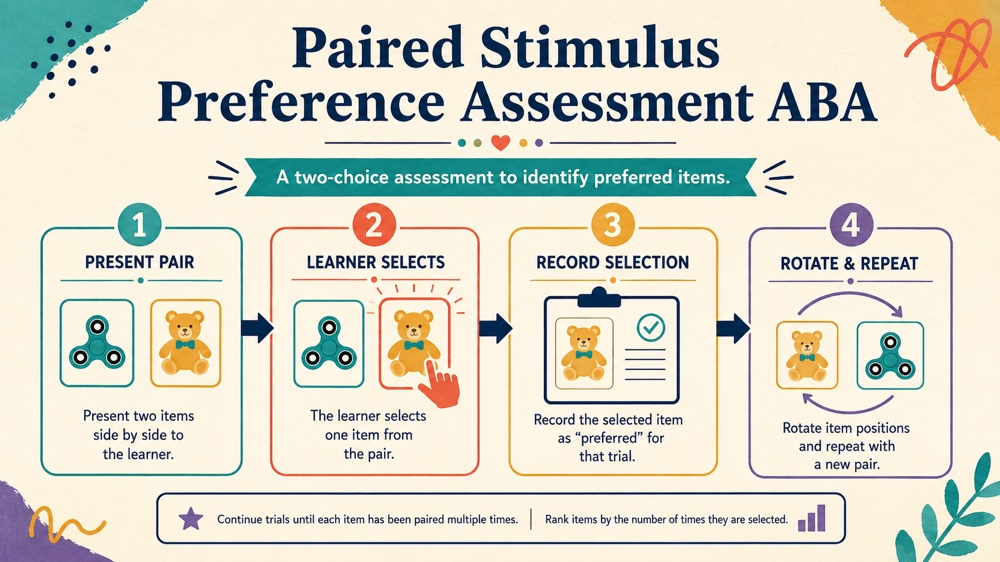
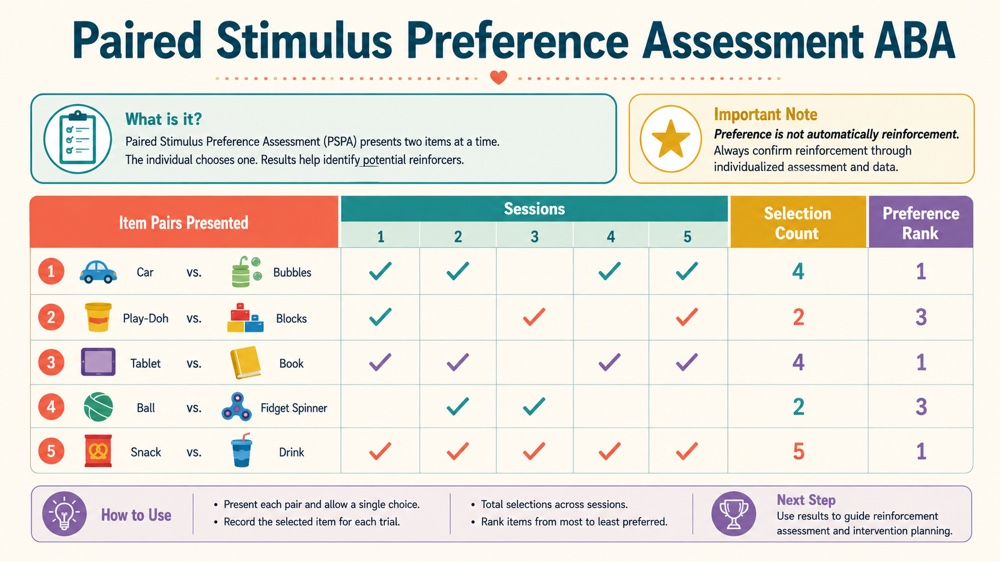
A paired stimulus preference assessment ABA procedure presents two items or activities at a time and records the learner’s selection so the team can compare relative preference across repeated opportunities. The procedure is more than asking which item someone likes. The RBT must follow the written protocol, present the approved pair, honor the learner’s communication, record the choice accurately, and report barriers or deviations. The result is a preference pattern for programming decisions, not a diagnosis and not a guarantee that an item will function as reinforcement in every situation. This independent guide explains paired stimulus preference assessment ABA for RBT study using original educational scenarios. Check the current written program, supervision direction, consent and privacy requirements, and current BACB materials before implementation.
Table of Contents
- Paired stimulus preference assessment ABA: define the arrangement
- Present two choices consistently
- Paired stimulus preference assessment ABA: record selection data
- Respect communication and assent signals
- Separate preference from reinforcement
- Handle nonselection and barriers
- Use results within supervision
- Avoid preference-assessment mistakes
- Paired stimulus preference assessment ABA checklist
- Frequently Asked Questions
- References
Continue your RBT study with RBT exam study materials and original practice resources.
Quick answer: Treat paired stimulus preference assessment aba as a current-source RBT study topic. Identify the exact action, source, data rule, and supervision boundary before deciding.
Study boundary: This independent guide is educational content. It is not a BACB policy, certification decision, legal opinion, answer key, or guarantee of examination success. Examples are original and are not official, recalled, leaked, or BACB-endorsed questions.
Current exam context: The current BACB RBT Test Content Outline describes 43 tasks across six domains; the examination includes 75 scored questions and 10 unscored pilot questions in a 90-minute testing period. Verify the current handbook and outline before relying on a time-sensitive detail.
Study the procedure by separating the arrangement from the conclusion. The arrangement specifies which items are paired, how they are presented, how long the learner can choose, what happens after a selection, and how data are recorded. The conclusion is a ranking or pattern that a qualified team member may use with other information. Do not skip trials because the learner appears to prefer one item, and do not call an item a reinforcer merely because it was selected. If the learner does not choose, reaches for both, refuses, or cannot access the materials, follow the written response and barrier rules and ask for supervision when the protocol is unclear. Keep the learner’s communication and dignity visible throughout every trial.
Paired stimulus preference assessment ABA: define the arrangement
Identify the item set, pairings, presentation order, access period, response definition, and data sheet. The written procedure controls details that can change the meaning of the assessment.
Present two choices consistently
Use the approved materials and position them as directed. Rotate sides or vary order when the protocol requires it, and avoid giving extra cues that make one item more likely to be selected.
Paired stimulus preference assessment ABA: record selection data
Record which item was selected, whether the response was independent, and any assigned latency or refusal measure. Do not reconstruct trials from memory or count a prompted reach as a free choice.
Respect communication and assent signals
A learner may point, reach, look, use a device, vocalize, or use another authorized communication mode. Follow the operational definition and honor refusal or distress signals through the approved procedure.
Separate preference from reinforcement
A preference assessment identifies relative selection under particular conditions. It does not prove that an item will increase a target response. The teaching program and supervisor determine how the result is used.
Handle nonselection and barriers
Record no choice, competing responses, inaccessible materials, fatigue, distractions, and other defined conditions. Do not repeatedly prompt until a choice appears or remove an item because the first trial was inconvenient.
Use results within supervision
Share the data pattern and objective observations through the approved route. A supervisor may combine preference information with reinforcer assessment, skill goals, safety, culture, and learner choice.
Avoid preference-assessment mistakes
- Presenting pairs inconsistently.
- Prompting a preferred answer.
- Treating selection as proof of reinforcement.
- Ignoring refusal or communication access.
- Changing the item set without approval.
- Backfilling missing trial data.
- Calling original scenarios official examination questions.
Paired stimulus preference assessment ABA checklist
- What items and pairings are approved?
- What response counts as a selection?
- How are order and side effects controlled?
- What access and refusal rules apply?
- What data are recorded for each trial?
- Who reviews and interprets the pattern?
- What barrier requires a supervision question?
Use paired stimulus preference assessment ABA as a measurement and procedure study topic. RBT Training is independent educational content and is not affiliated with or endorsed by BACB.
Practice the concept
Review paired stimulus preference assessment aba with original RBT scenarios, current-source reminders, and clear role boundaries.
Review the RBT study resource →
Frequently Asked Questions
What is a paired stimulus preference assessment?
It presents two options at a time and records selections across trials to compare relative preference under the stated conditions.
Does selecting an item prove it is a reinforcer?
No. Selection indicates preference in that arrangement; a separate teaching outcome and supervisor review are needed to evaluate reinforcement.
What if the learner refuses?
Follow the written response and assent rules, record the defined event, protect dignity, and ask for direction if the protocol does not explain it.
Are these official exam questions?
No. They are original educational scenarios and are not official, recalled, leaked, or BACB-endorsed.
References
- Behavior Analyst Certification Board: Registered Behavior Technician Handbook, updated June 2026.
- Behavior Analyst Certification Board: RBT Test Content Outline (3rd ed.).
- Behavior Analyst Certification Board: RBT resources.
- Behavior Analyst Certification Board: ethics resources.
- Behavior Analyst Certification Board: RBT Ethics Code (2.0).