
A single stimulus preference assessment ABA procedure presents one item or activity at a time and records the learner’s response, such as approach, acceptance, interaction, or rejection, according to an approved definition. It can be useful when presenting multiple choices at once is difficult or when the protocol is designed around one item per trial. The RBT’s role is to follow the written arrangement, present the item neutrally, allow the defined response opportunity, record objective data, and report barriers. A selection or approach is not automatically proof that the item will reinforce a target behavior. This independent guide explains the concept for RBT study with original examples. Use the current program, supervision direction, learner communication supports, and official sources rather than a generic internet summary.
Table of Contents
- Single stimulus preference assessment ABA: define one trial
- Present the item neutrally
- Single stimulus preference assessment ABA: collect response data
- Honor communication and refusal
- Compare conditions carefully
- Preference is not the same as reinforcement
- Report barriers and protocol deviations
- Avoid single-stimulus mistakes
- Single stimulus preference assessment ABA checklist
- Frequently Asked Questions
- References
Continue your RBT study with RBT exam study materials and original practice resources.
Quick answer: Treat single stimulus preference assessment aba as a current-source RBT study topic. Identify the exact action, source, data rule, and supervision boundary before deciding.
Study boundary: This independent guide is educational content. It is not a BACB policy, certification decision, legal opinion, answer key, or guarantee of examination success. Examples are original and are not official, recalled, leaked, or BACB-endorsed questions.
Current exam context: The current BACB RBT Test Content Outline describes 43 tasks across six domains; the examination includes 75 scored questions and 10 unscored pilot questions in a 90-minute testing period. Verify the current handbook and outline before relying on a time-sensitive detail.
The key study question is not whether the learner touched the item, but what the protocol defines as a response and what condition surrounded it. Check whether the item is presented for a fixed duration, whether the learner can reject it, how approach and interaction are scored, and what happens after acceptance. Keep the presentation consistent across items and sessions when the procedure requires comparison. If the learner is tired, the item is inaccessible, or the response definition does not fit the learner’s communication, record the barrier and ask for review. Avoid turning a brief approach into a broad claim about motivation, diagnosis, or treatment. Also note whether prior access, competing items, or setting events could influence the response.
Single stimulus preference assessment ABA: define one trial
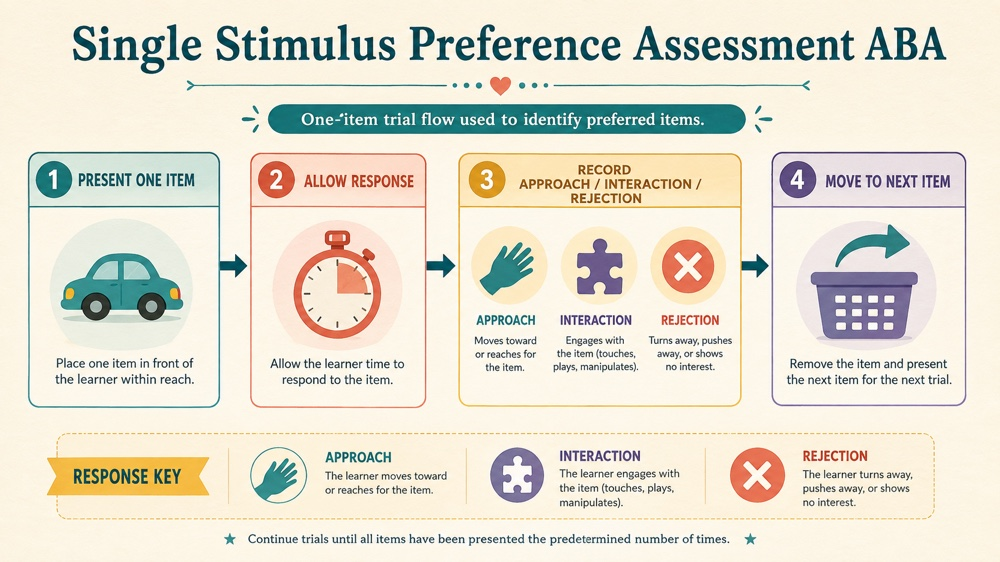
Identify the item, presentation position, access period, response definition, consequence, and data fields. A one-item trial still needs a consistent protocol and a clear rule for acceptance or rejection.
Present the item neutrally
Use the approved wording and materials, avoid exaggerated enthusiasm that biases the response, and allow the learner the stated opportunity to approach, interact, reject, or communicate another choice.
Single stimulus preference assessment ABA: collect response data
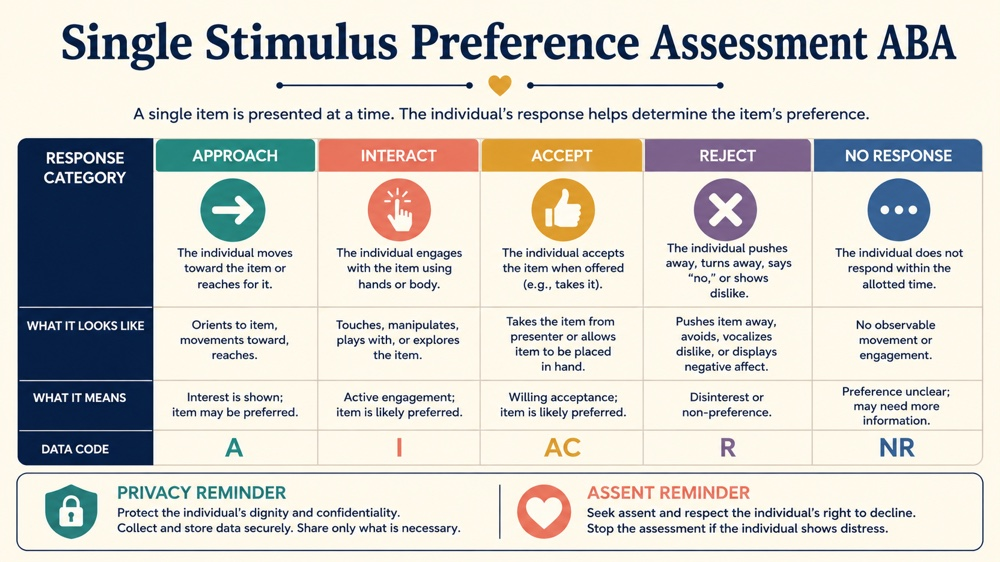
Record the defined response, latency, duration, or rejection measure as required. Do not infer preference from a glance or fill in a missing trial after the session without following the correction process.
Honor communication and refusal
The learner may accept, reject, move away, use a device, gesture, or show another defined response. Follow the program’s communication and assent rules, and do not force interaction with an item.
Compare conditions carefully
The result describes responding to items under particular conditions. Consider presentation order, time of day, access history, competing items, and setting events when the supervisor reviews the pattern.
Preference is not the same as reinforcement
An item can be approached but fail to strengthen a target response. Use the assessment as one information source and follow the teaching program’s reinforcement plan.
Report barriers and protocol deviations
Document inaccessible materials, illness, distractions, refusal, accidental prompts, timing problems, and missing items through the approved route. A deviation is information, not something to hide.
Avoid single-stimulus mistakes
- Treating a glance as the defined response.
- Prompting acceptance or blocking rejection.
- Changing access time between items without approval.
- Calling preference proof of reinforcement.
- Ignoring communication or assent signals.
- Backfilling trial data from memory.
- Calling original scenarios official examination questions.
Single stimulus preference assessment ABA checklist
- What item is presented and for how long?
- What response counts as acceptance or rejection?
- What communication modes are recognized?
- How are latency or interaction data recorded?
- What conditions could affect the pattern?
- Who reviews and uses the results?
- What deviation or barrier needs supervision?
Use single stimulus preference assessment ABA as a measurement and data-integrity study topic. RBT Training is independent educational content and is not affiliated with or endorsed by BACB.
Practice the concept
Review single stimulus preference assessment aba with original RBT scenarios, current-source reminders, and clear role boundaries.
Review the RBT study resource →
Frequently Asked Questions
What is a single stimulus preference assessment?
It presents one item or activity at a time and records the learner’s defined response under the stated conditions.
Should an RBT force a learner to interact with the item?
No. Follow the protocol, recognize refusal and communication, protect dignity, and report when the procedure or response rule is unclear.
Does an approach prove reinforcement?
No. It provides preference information; reinforcement effects must be evaluated within the approved teaching arrangement.
Are these official exam questions?
No. They are original educational scenarios and are not official, recalled, leaked, or BACB-endorsed.
References
- Behavior Analyst Certification Board: Registered Behavior Technician Handbook, updated June 2026.
- Behavior Analyst Certification Board: RBT Test Content Outline (3rd ed.).
- Behavior Analyst Certification Board: RBT resources.
- Behavior Analyst Certification Board: ethics resources.
- Behavior Analyst Certification Board: RBT Ethics Code (2.0).