

If you are asking how to become an RBT, start with the current BACB requirements rather than a generic checklist from a search result. The pathway combines eligibility checks, a qualifying 40-hour training, an Initial Competency Assessment, a certification application, and the RBT examination. Each step has a different source and a different person responsible for confirming it.
Table of Contents
- How to become an RBT at a glance
- Check current RBT eligibility
- Complete RBT training and the competency assessment
- Create your BACB portal account and apply
- Prepare for the RBT examination
- Avoid common RBT application mistakes
- Make a role-safe study plan
- Frequently Asked Questions
- References
This guide is a study and planning aid based on the BACB RBT Handbook updated June 2026, the RBT Test Content Outline (3rd ed.), and the current Initial Competency Assessment Packet. Requirements, fees, forms, jurisdictions, and deadlines can change. Read the current BACB materials before submitting an application or paying a fee.
RBT Training is not affiliated with, operated by, or endorsed by the Behavior Analyst Certification Board (BACB). The examples below are newly written for independent study. They are not official, recalled, leaked, or BACB-endorsed questions. A course, study guide, practice score, or checklist cannot guarantee a passing result or certification.
How to become an RBT at a glance
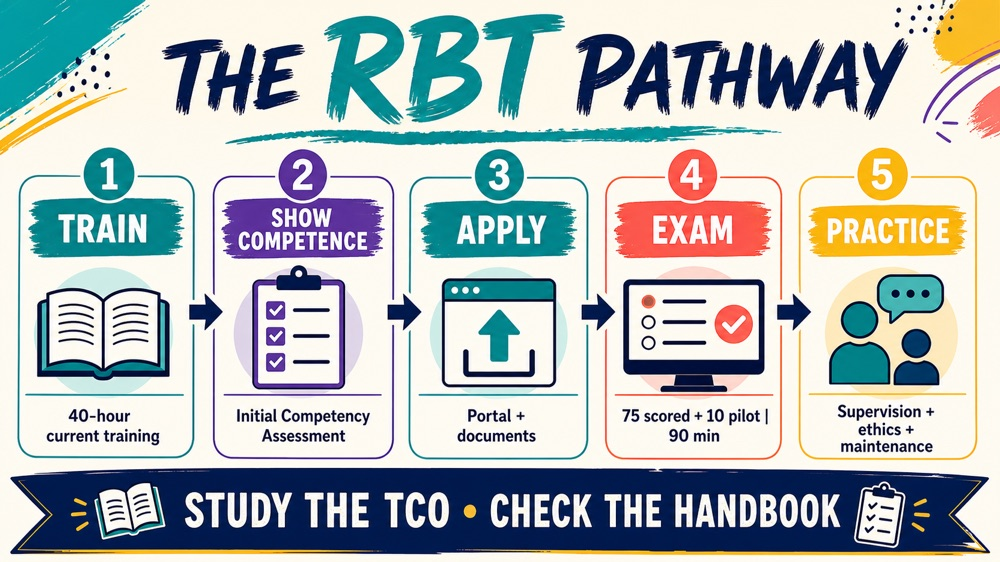
The shortest accurate answer to how to become an RBT is to complete the requirements in this order:
- Confirm that you meet the current age and education requirements.
- Complete the required background and abuse-registry checks through the process accepted for your setting.
- Complete a qualifying 40-hour training within the current timing window and keep the certificate.
- Complete the BACB Initial Competency Assessment with a qualified assessor after the training.
- Create and maintain your own BACB Portal account, upload the required documents, and submit the certification application.
- After application approval, schedule and pass the RBT examination.
- Before providing services, work under the required ongoing supervision and follow the current maintenance rules.
These steps are connected but not interchangeable. Completing a study course does not complete the competency assessment. Passing a practice quiz does not approve an application. Being hired by an ABA provider does not by itself make someone certified. Treat each step as a separate evidence item in a personal checklist.
| Step | Evidence to keep | Who controls the rule? |
|---|---|---|
| Eligibility | Attestation and current checks | Current BACB Handbook and application materials |
| Training | Certificate from the provider | Current 40-hour training requirements |
| Competence | Completed BACB assessment packet | Initial Competency Assessment requirements |
| Application | Uploaded documents and portal status | BACB application instructions |
| Examination | Authorization and result | Current exam and scheduling instructions |
Check current RBT eligibility
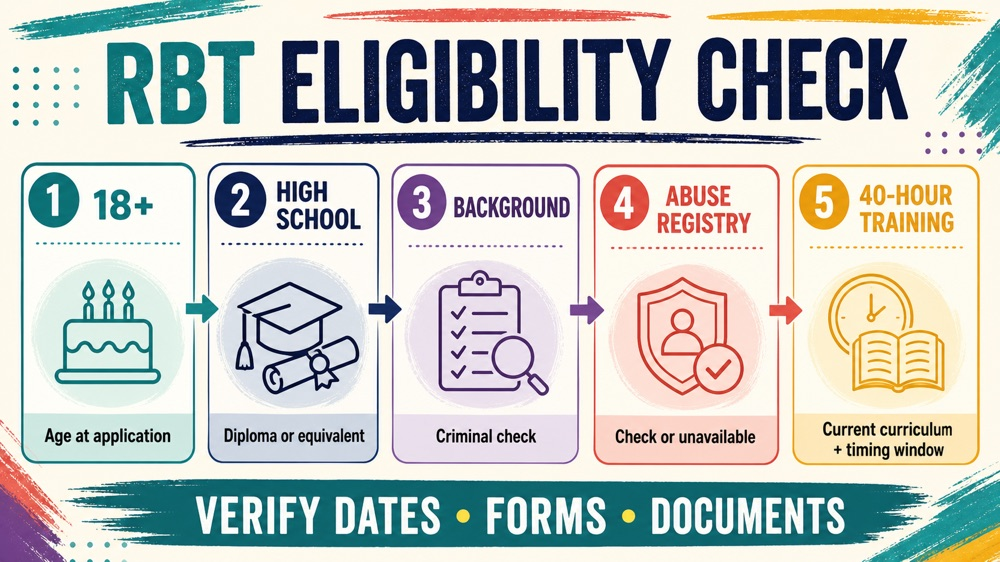
Before paying for an application, read the current eligibility section rather than relying on an old “how to become an RBT” blog post. The June 2026 Handbook states that an applicant must be at least 18, have at least a high-school-level education or equivalent, pass a criminal background check, pass an abuse-registry check, complete the required training, and complete the Initial Competency Assessment.
The Handbook describes timing rules for the checks and attestation. The background and abuse-registry checks generally must be completed no more than 180 days before paying for the certification application. The attesting certificant confirms the applicant’s age, education, and checks, and the attestation form must meet the Handbook’s timing and relationship requirements. Fingerprinting is not required by the BACB itself, although a state, employer, or organization may impose additional procedures.
Do not turn those details into a universal promise. A state or organization may use a different check process, and a registry may be unavailable in a particular jurisdiction. If your situation is unusual, use the current BACB instructions and ask the responsible organization how it documents the requirement.
Make an eligibility folder with five fields:
- date you verified your age and education;
- date and provider of each required check;
- name and role of the attesting certificant;
- the version and date of the forms you used; and
- the next deadline that could make a document stale.
This is administrative preparation, not a substitute for BACB review. A neat folder cannot cure an incomplete, unreadable, inaccurate, or outdated document.
Complete RBT training and the competency assessment
The current Handbook requires a 40-hour training that meets the applicable BACB curriculum requirements. The June 2026 Handbook states that the training must be completed in no fewer than 5 days and no more than 180 days, counting the start and end dates. The provider may be an employer, university, or online program. The BACB does not provide the training, issue completion certificates, or recommend a particular provider.
Before enrolling, ask the provider which current BACB training requirements and curriculum outline the course follows. Keep the certificate, course dates, provider information, and any completion records together. If you completed a course under an earlier rule, do not assume it is automatically accepted; compare it with the current requirements before using it in a new application.
After the training, complete the Initial Competency Assessment. The official packet effective January 1, 2026 says the assessment must occur after the 40-hour training and no more than 90 days before the certification application is submitted. The assessment may be conducted over one or more sessions, in person, live online, or through recorded videos created specifically for the assessment, subject to the packet’s requirements.
The assessor can evaluate tasks with a client, through role-play, or through a live interview, depending on the task instructions and circumstances. If competence is not demonstrated, corrective feedback and another assessment can occur; corrective feedback cannot be delivered on the final assessment of a task. The completed BACB packet—not an informal substitute—is uploaded with the application.
Pay attention to the relationship rules. The responsible assessor is a qualified BACB certificant who has completed the required supervision training and has the relationship to the applicant, organization, and client described in the packet. The assessor cannot be related to, subordinate to, or employed by the applicant during the assessment. Ask the assessor to confirm the current packet and documentation process before scheduling.
Keep a simple training-to-competence log:
| Checkpoint | Question | Next action |
|---|---|---|
| Training | Does the provider identify the current curriculum requirements? | Save the certificate and course dates. |
| Timing | Is the assessment after training and inside the application window? | Choose an application date before scheduling. |
| Assessment | Which task is evaluated by client work, role-play, or interview? | Read the packet and ask the assessor. |
| Documentation | Are all tasks initialed and the final attestation signed? | Check legibility before upload. |
Create your BACB portal account and apply
Create your BACB Portal account yourself. The current Handbook instructs applicants to use their full legal name exactly as it appears on government-issued identification, use a personal email address, keep current contact information, and avoid creating duplicate accounts. A name mismatch can prevent examination attendance or delay review, so check the spelling before uploading documents.
When the eligibility items are ready, start the RBT Certification Application in the portal and upload the current documents identified by the application. The Handbook lists the RBT Certification Application Attestation form, the 40-hour training certificate, and the completed Initial Competency Assessment. Each new application requires the documents requested for that application; do not assume that a prior upload will be reused.
Review every document for four things: the name matches the portal, dates fit the current windows, pages are readable, and the form is the current BACB version. Answer disclosure questions truthfully. If you are unsure how a prior history or professional matter affects eligibility, use the BACB’s published review route rather than hiding the information or guessing.
After submitting, allow the processing time stated in the current Handbook and monitor the portal and email, including spam folders. If the application is approved, follow the instructions for scheduling with Pearson VUE. If it is not approved, read the action items and resolve the specific documentation issue. Do not submit multiple overlapping accounts or applications simply because an email is delayed.
The June 2026 Handbook lists a $65 certification application processing fee and a $45 exam appointment fee for 2026, with the fees paid to different organizations. Fees can change, so verify the current BACB fee table and scheduling instructions before paying.
Prepare for the RBT examination
The current RBT examination is based on the RBT Test Content Outline, 3rd edition, at an entry-level behavior-technician level. The Handbook describes 75 scored questions and 10 unscored pilot questions, four answer choices per item, and 90 minutes to complete the examination. The 43 tasks are organized into six content areas:
| Domain | Scored share | Study decision |
|---|---|---|
| A. Data Collection and Graphing | 13 / 17% | Match observable behavior to measurement, calculation, and graphing. |
| B. Behavior Assessment | 8 / 11% | Follow assigned assessment procedures and report what was observed. |
| C. Behavior Acquisition | 19 / 25% | Recognize teaching, prompting, reinforcement, maintenance, and generalization steps. |
| D. Behavior Reduction | 14 / 19% | Follow the plan, recognize safety direction, and avoid inventing an intervention. |
| E. Documentation and Reporting | 10 / 13% | Write objective notes, protect information, and report concerns accurately. |
| F. Ethics | 11 / 15% | Stay within competence, supervision, confidentiality, and professional boundaries. |
Use the official outline as a coverage map, not as a promise about the exact wording of a secure item. An independent practice test may use a different number of questions. It should not be described as real, recalled, leaked, official, or BACB-endorsed.
Build each study session around one discrimination:
- Underline the observable fact in the scenario.
- Name the TCO domain or task it represents.
- Choose the procedure or measurement that fits the written information.
- Explain why the closest distractor does not fit.
- State the role-safe next action if the plan is incomplete or unclear.
For example, if a prompt asks for the time between an instruction and response onset, the relevant distinction is latency, not duration. If the question says the written plan does not cover a safety event, the RBT should follow established safety direction and contact the responsible supervisor rather than independently designing a new procedure. These are newly written study examples, not official exam questions.
Avoid common RBT application mistakes
- Using an old checklist: compare every requirement, form, and exam detail with the current BACB materials.
- Starting the assessment too early: complete the required training first and check the application timing window.
- Assuming a course certificate is certification: training is one application document, not the credential.
- Uploading a substitute assessment form: use the current BACB packet requested by the application.
- Ignoring name and date mismatches: reconcile the portal, identification, certificate, attestation, and assessment before submission.
- Relying on a third party for the portal account: create and maintain your own account and personal email.
- Calling independent practice “real questions”: use original examples and state the boundary clearly.
- Thinking certification ends at the exam: ongoing supervision, ethics, and current recertification or maintenance rules still matter.
A checklist is most useful when each box links to evidence and a date. If a box has no source, no document, or no responsible person, it is not ready to mark complete. When the BACB publishes a revision, update the source register before updating your study notes.
Make a role-safe study plan
Use a seven-day loop while you prepare:
| Day | Focus | Evidence to save |
|---|---|---|
| 1 | Read the current Handbook pathway. | Eligibility and document checklist. |
| 2 | Review data collection and assessment. | Two measurement contrasts and one assigned-procedure example. |
| 3 | Review acquisition. | One prompt, reinforcement, or generalization decision. |
| 4 | Review behavior reduction and safety. | One plan-fidelity correction and one escalation route. |
| 5 | Review documentation and reporting. | One objective-note rewrite. |
| 6 | Review ethics and supervision. | One confidentiality or role-boundary distinction. |
| 7 | Complete mixed original practice. | Error category and next delayed repeat. |
Bottom line: becoming an RBT is a source-controlled process: confirm current eligibility, complete the qualifying training, demonstrate competence with the current BACB assessment, submit an accurate application, pass the examination, and maintain the credential under current supervision and ethics rules. Use your study guide to understand and rehearse decisions, while using the BACB documents for the requirements that determine your application.
Ready to check your next RBT study step?
Use original practice questions to identify which TCO decision needs review next.
Try Free RBT Practice Questions →
Frequently Asked Questions
What is the first step in how to become an RBT?
Start with the current BACB Handbook and confirm age, education, check, training, and assessment requirements before paying for an application.
Can an RBT study guide replace the BACB Handbook?
No. Use the current BACB Handbook, application materials, TCO, and assessment packet for official requirements. Use an independent guide to organize study and practice.
Can I take the Initial Competency Assessment before the 40-hour training?
The current Initial Competency Assessment Packet states that the assessment must be completed after the required 40-hour training and within the application timing window.
Does passing a practice exam guarantee RBT certification?
No. Independent practice measures performance on that resource. It cannot guarantee a passing result, replace the application steps, or authorize services.
References
- Behavior Analyst Certification Board. RBT certification information.
- Behavior Analyst Certification Board. RBT Handbook, updated June 2026.
- Behavior Analyst Certification Board. RBT Test Content Outline, 3rd edition.
- Behavior Analyst Certification Board. RBT Initial Competency Assessment Packet, effective January 1, 2026.
- Behavior Analyst Certification Board. RBT Ethics Code.