
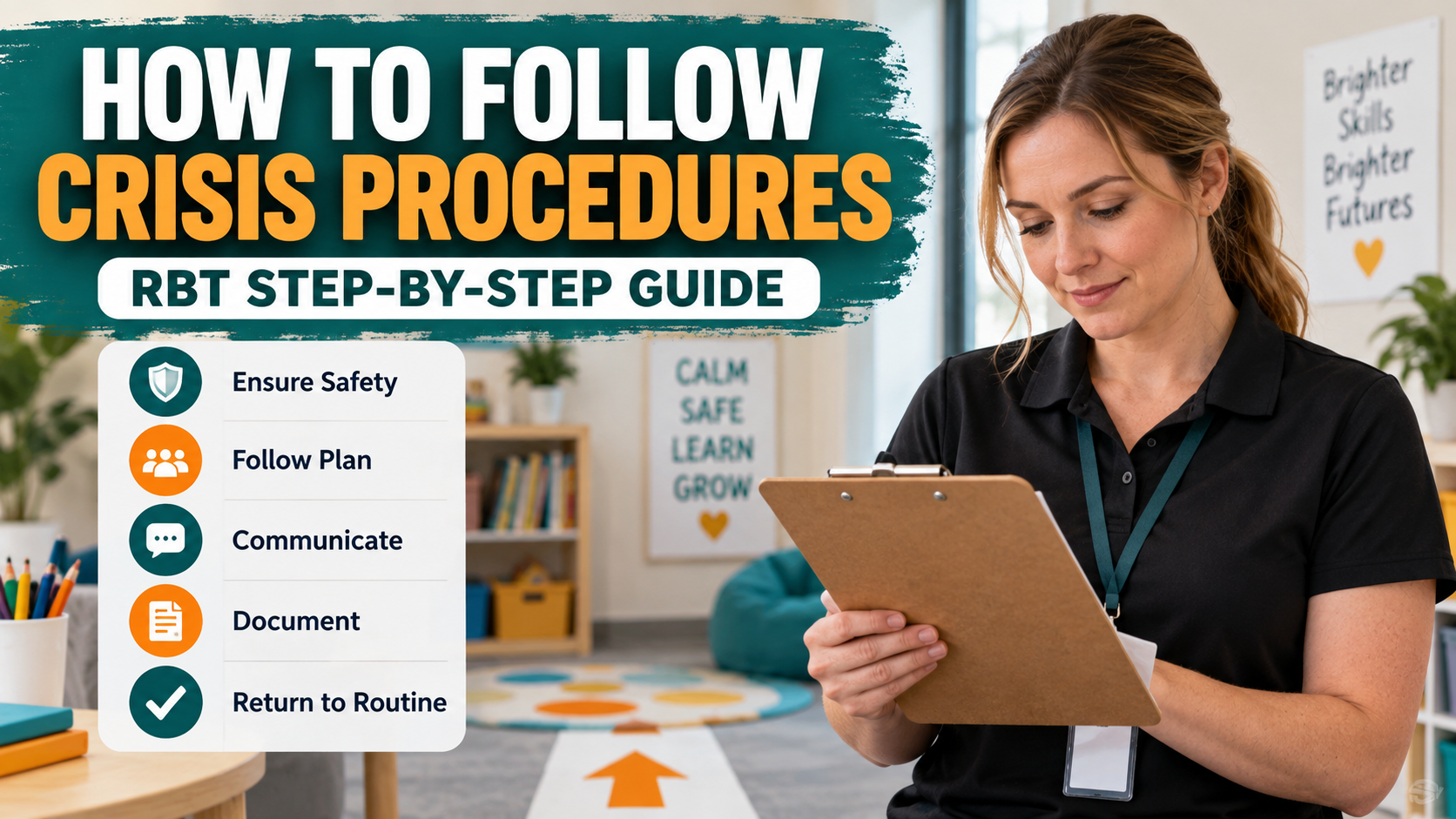
Knowing how to follow crisis procedures as an RBT means using the current approved plan, trained steps, supervisor direction, and objective documentation.
Table of Contents
- How to follow crisis procedures as an RBT: quick answer
- Step 1: Know the approved plan
- Step 2: Notice early signs
- Step 3: Use trained steps
- Step 4: Call for direction
- Step 5: Protect safety and dignity
- Step 6: Record facts after the event
- Before, during, and after checklist
- How to study this topic
- Common mistakes when following crisis procedures
- Frequently asked questions
RBT implementation and safety checklist
How to Follow Crisis Procedures as an RBT: Step-by-Step Guide
Knowing how to follow crisis procedures as an RBT means more than memorizing a list of reactions. You need to know the current approved plan, recognize when it applies, use only the steps you are trained and authorized to use, request direction when the situation changes, and record what occurred without guessing about intent.
How to follow crisis procedures as an RBT: quick answer
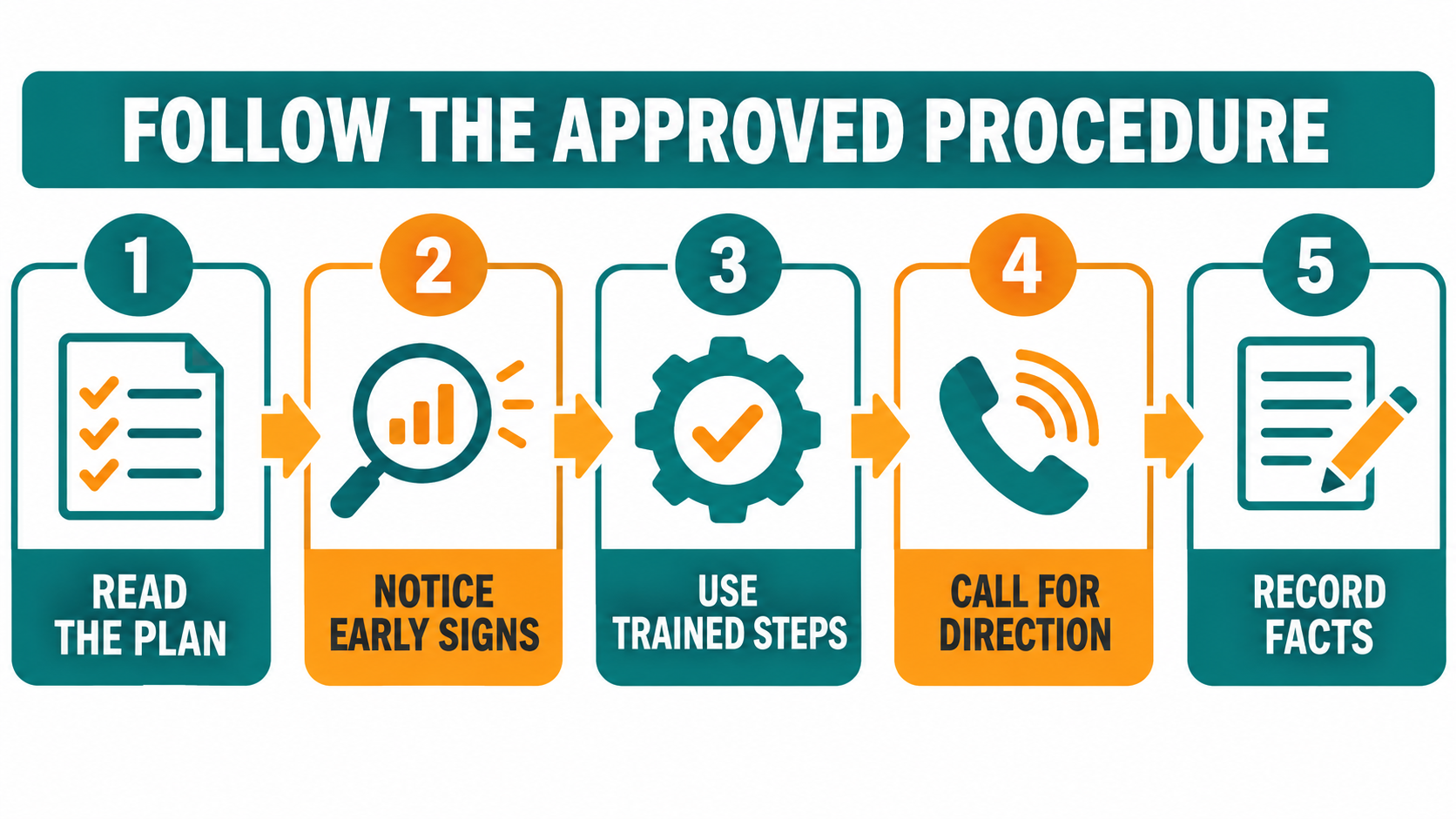
Use this sequence: read and confirm the current plan, notice the signs that activate it, use the trained and approved steps, call the correct supervisor or emergency resource when required, protect safety and dignity, and document observable facts afterward. If the plan does not fit the situation or you are unsure what to do, do not invent a new response. Protect immediate safety and ask for help.
The current BACB RBT Test Content Outline lists “implement crisis/emergency procedures” under behavior reduction. The outline identifies the competency; it does not create one universal technique for every client. Implementation depends on the client-specific plan, training, supervision, and setting.
Step 1: Know the approved plan
Before a session, locate the current crisis or emergency plan and confirm its version date. Ask the supervisor to explain the behaviors or situations that activate the plan, the prevention steps, the response steps, the emergency threshold, and the reporting requirements. Know who is responsible for updating the plan and where the backup copy is stored.
Read the plan as an implementation document, not as a suggestion. If a step is unclear, ask before the session. Clarify terms that could be interpreted differently, such as “aggression,” “elopement,” “unsafe access,” or “call for help.” Ask what to do when two risks happen at the same time.
Confirm your own authorization and training. A procedure in a plan does not automatically mean every staff member can implement it. If you have not been trained, do not practice it on a client. Tell the supervisor what additional instruction or observation you need.
Step 2: Notice early signs
Many plans identify early indicators that allow staff to respond before danger increases. These indicators must be observable: a change in voice volume, leaving the work area, pushing materials away, moving toward a restricted space, or another defined event. Avoid treating a mood label or diagnosis as an activation criterion unless the plan defines it that way.
Use prevention steps exactly as trained. The plan might call for reducing demands, offering a choice, providing space, changing the environment, or contacting the supervisor. These actions are not interchangeable, and the correct choice depends on the plan and the person. Do not pile on multiple changes simply because the first one did not produce an immediate result.
Continue to monitor safety. An early sign can develop into an emergency, and a quiet moment does not mean the risk has disappeared. If the plan says to call for assistance at a defined threshold, call at that threshold rather than waiting for certainty.
Step 3: Use trained steps
When the response plan is activated, implement only the steps you were taught and authorized to use. Follow the sequence, use the communication style modeled by the supervisor, and avoid adding a punishment, restriction, or physical interaction that is not in the plan.
Do not copy a technique from another client, social media, a video, or a previous job. A strategy can be clinically appropriate in one plan and unsafe or prohibited in another. If you forget a step, move to safety and contact the supervisor rather than making up the missing part.
Keep your language brief and neutral. Do not argue about what the person “really wants,” threaten a consequence, or make promises about the outcome. The purpose of the procedure is safe implementation, not winning a debate.
Step 4: Call for direction
Use the contact path written in the plan. A useful call gives the supervisor the location, people involved, observable event, actions already taken, current safety status, and the decision or help you need. If the first contact is unavailable, use the backup chain of command. If immediate danger requires emergency services, follow the emergency route without waiting for a routine supervision response.
Ask for clarification when the environment changes, a new risk appears, or the procedure is not working as written. The supervisor may instruct you to end the session, contact a caregiver, move to a safer setting, or wait for additional training. Document the direction you received and the time of the contact.
Seeking help is part of competent implementation. It is not a failure to admit that a situation is outside your training or that the plan needs review.
Step 5: Protect safety and dignity
Move hazards and bystanders when the plan and setting allow it, keep a clear path for help, and preserve the client’s privacy. Do not corner a person, block an exit, or create a new physical interaction because you feel pressure to control the scene. Use the least intrusive approved action that addresses the risk.
If someone is injured or has a medical emergency, use the emergency instructions and local workplace rules. An RBT should provide only care for which they are trained and authorized and should hand off to emergency responders or other qualified professionals as directed.
After the immediate risk decreases, continue following the plan. A person may need time, space, supervision, or medical attention even after the visible behavior stops. Ask the supervisor what follow-up is required before resuming ordinary teaching or service delivery.
Step 6: Record facts after the event
Once safety is restored, complete the required session note and any incident or emergency report. Record the date, time, setting, people present, observable events, approved steps implemented, contacts made, injuries or damage if known, and what happened next.
Use objective language. “Client ran from the table to the hallway after the demand was presented” is more useful than “client became defiant.” If you did not observe a cause, do not state one as fact. Separate your observations from information reported by another person.
Store and share the record according to confidentiality requirements. Do not post an incident, video, name, or identifying detail on social media. Ask the supervisor whether the plan, environment, or training needs to be reviewed before the next session.
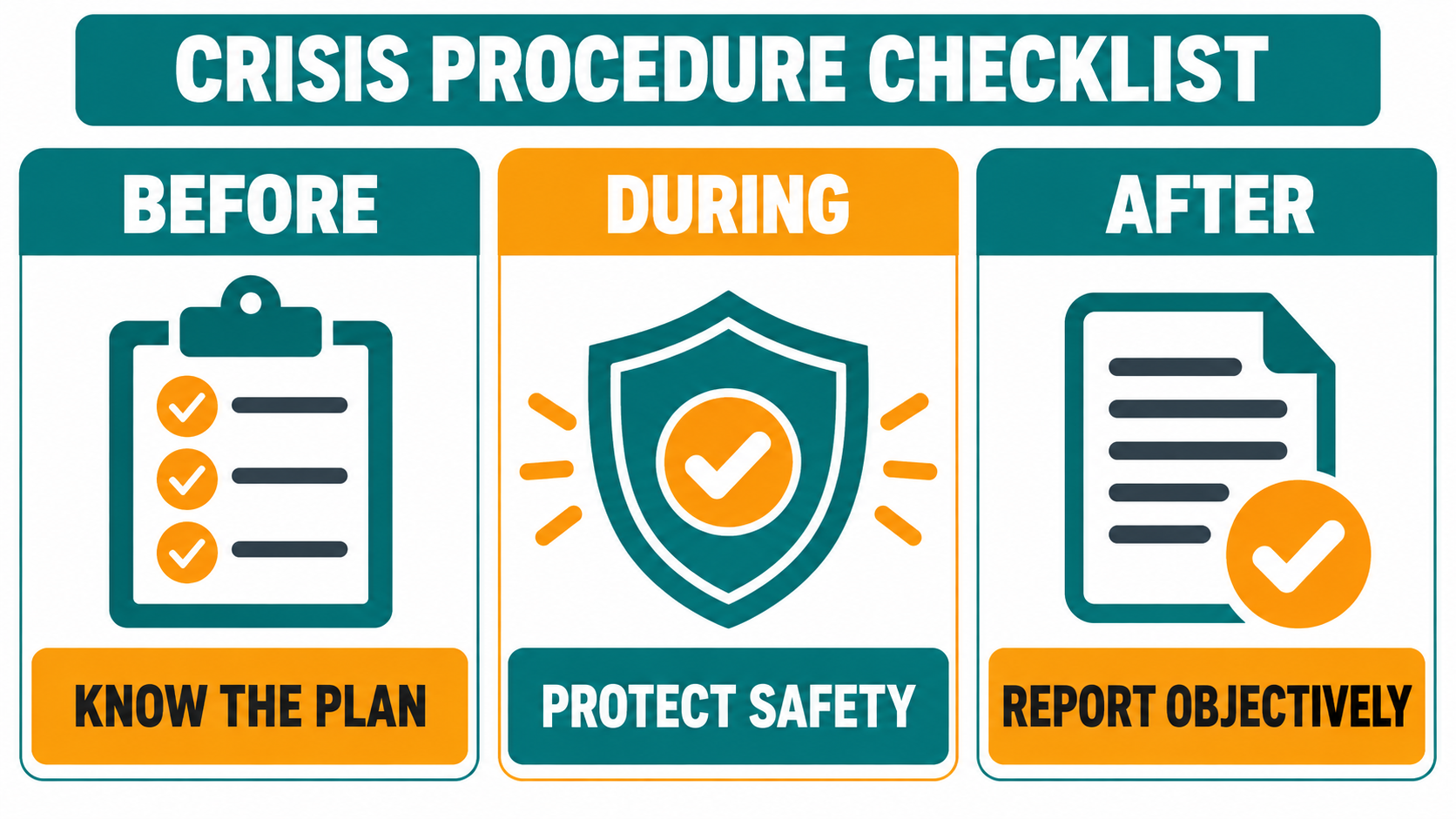
Before, during, and after checklist
Before: locate the current plan, confirm the activation criteria, review the contact chain, verify training, and identify the required forms.
During: follow the plan, use trained steps, protect safety and dignity, communicate briefly, and call for help at the defined threshold.
After: keep the person supervised as directed, hand off facts, complete the required reports, protect confidentiality, and ask about follow-up.
This checklist is useful for a readiness conversation with a supervisor. It is not permission to replace a client-specific protocol with a generic sequence.
How to study this topic
For an exam or competency review, learn the distinction between knowing a general principle and implementing a client-specific procedure. You should be able to explain who approves the plan, what activates it, what you are trained to do, who you call, when emergency services are required, and what must be documented.
Ask a qualified trainer or supervisor to model the plan, let you rehearse communication and objective documentation, and provide feedback. Do not rehearse restrictive or physical procedures on a client as a study method. Use only the formal training environment approved by your organization and applicable requirements.
Common mistakes when following crisis procedures
- Using an old plan: Check the version before the session.
- Waiting for a dramatic event: Use the defined early signs and escalation threshold.
- Mixing plans: Never borrow a technique from another client.
- Improvising: Ask for direction when the procedure does not fit.
- Arguing with the client: Use brief, neutral communication.
- Skipping the report: Complete required incident documentation promptly.
- Writing interpretations as facts: Record observable behavior and separate reported information.
Frequently asked questions
What is the first thing an RBT should do?
Know and follow the current client-specific plan. When a defined activation sign appears, use the trained steps and contact the required support.
Can I use a general crisis technique from the internet?
No. Use only procedures approved for the client and setting and for which you are trained and authorized.
When should I call the supervisor?
Use the threshold and contact chain in the plan. Call earlier when the situation changes, the plan is unclear, or safety cannot be maintained.
What should I write after a crisis?
Record observable events, actions taken under the plan, contacts, current status, and required follow-up. Complete any separate incident report required by policy.
Is following a crisis procedure the same as creating one?
No. An RBT implements an approved plan; the RBT does not independently design a new crisis or emergency procedure.
Official sources: BACB RBT Test Content Outline (3rd ed.); RBT Test Content Outline source document; BACB Supervision, Assessment, Training, and Oversight; BACB RBT examination resources. Retrieved September 28, 2026. Follow the current client-specific plan and workplace policy.
Ready to practice the RBT concepts you just reviewed?
Try an independent, original RBT practice resource with exam-style questions, scoring, and answer explanations.
References
- Behavior Analyst Certification Board. RBT Test Content Outline, 3rd edition.
- Behavior Analyst Certification Board. RBT Handbook.
- Behavior Analyst Certification Board. RBT Ethics Code.