
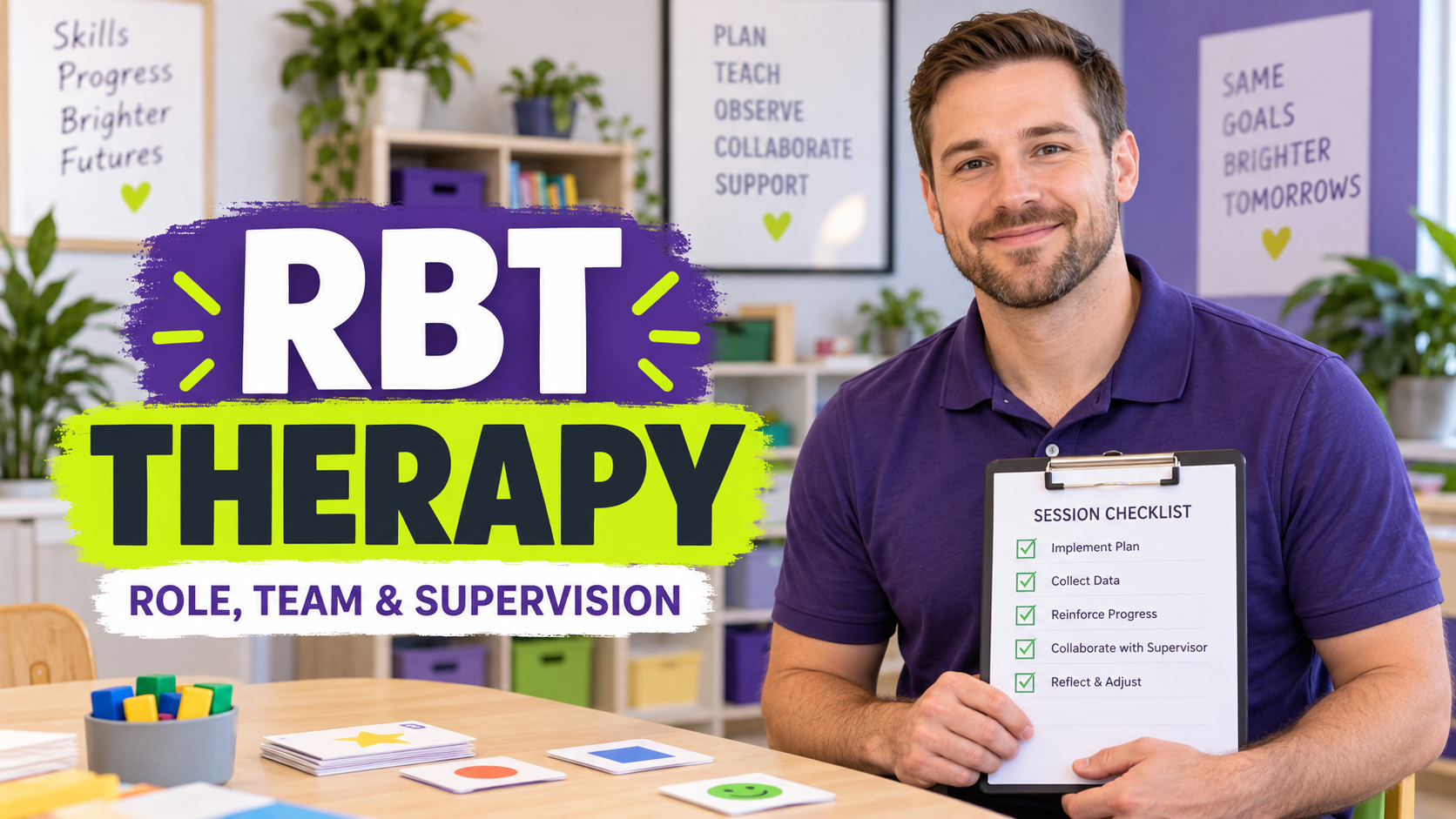
RBT therapy is a common shorthand for ABA services delivered with an RBT, but an RBT works as a supervised paraprofessional rather than an independent clinician.
Table of Contents
- RBT therapy: quick answer
- What does “RBT therapy” mean?
- What an RBT may do in therapy
- What the supervisor directs
- How the therapy team works
- What an RBT session may include
- Data, notes, and communication
- Working with families and caregivers
- How to recognize a well-supported RBT service
- Common misunderstandings about RBT therapy
- Frequently asked questions
RBT role, ABA services, and supervision
RBT Therapy: What RBTs Do, Team Roles, and Supervision
“RBT therapy” is a common search phrase, but it can create a misleading picture of the role. A Registered Behavior Technician is a paraprofessional who assists with behavior-analytic services under the direction and close supervision of a qualified supervisor or RBT Requirements Coordinator. This guide explains what RBTs may do in a therapy team, what they do not independently decide, and what families and new technicians should expect from the relationship.
RBT therapy: quick answer
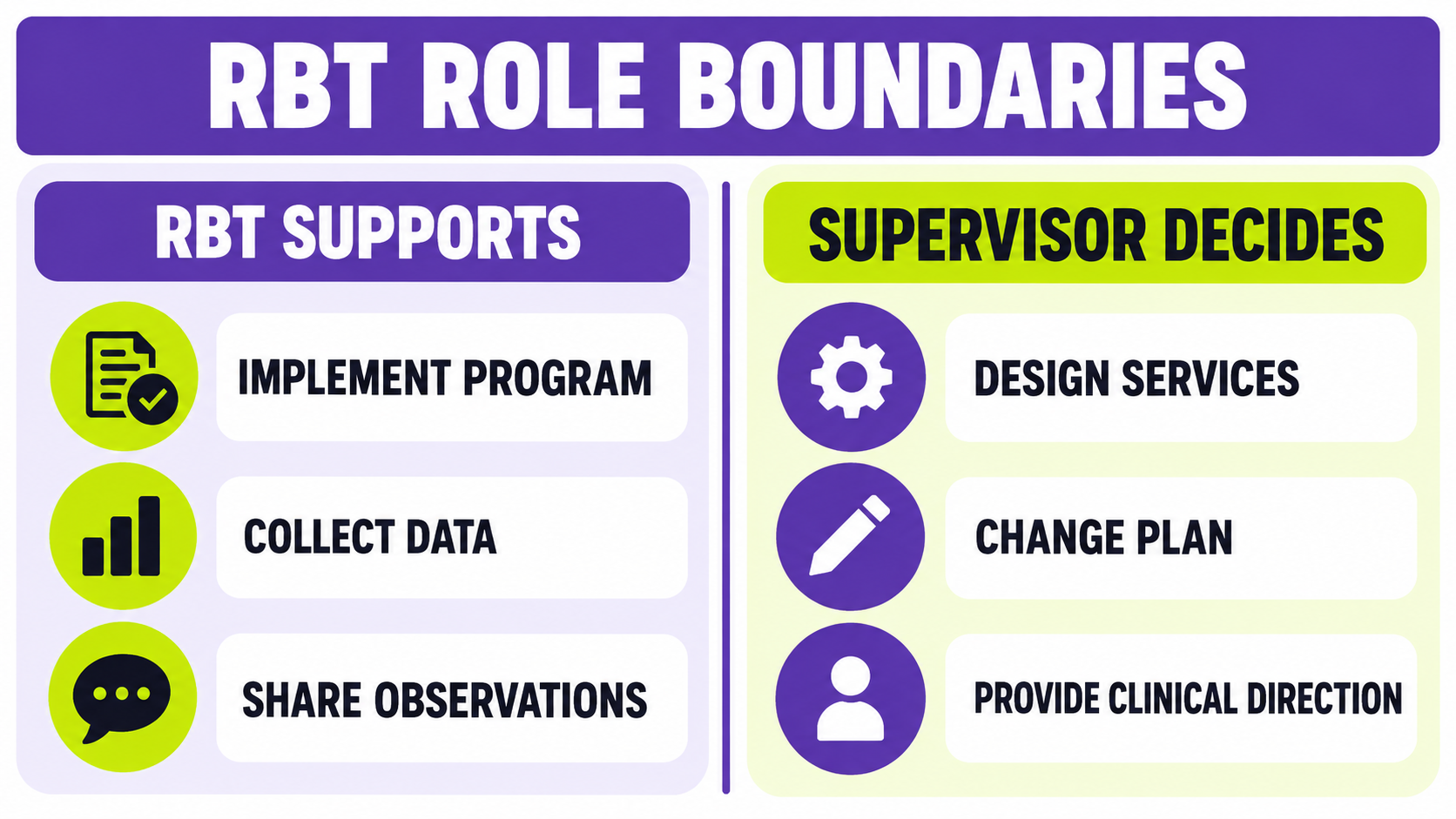
An RBT can implement behavior-analytic teaching and behavior-reduction programs that have been designed or approved by a qualified supervisor. The work may include teaching skills, practicing communication, collecting data, implementing reinforcement or prompting procedures, supporting generalization, and writing objective session notes. The RBT works as part of a supervised team rather than as an independent therapist who creates the clinical plan.
The BACB describes RBTs as paraprofessionals who assist in delivering behavior-analytic services under the direction and close supervision of an RBT Supervisor and/or RBT Requirements Coordinator. That structure protects the client by connecting day-to-day implementation with qualified clinical direction.
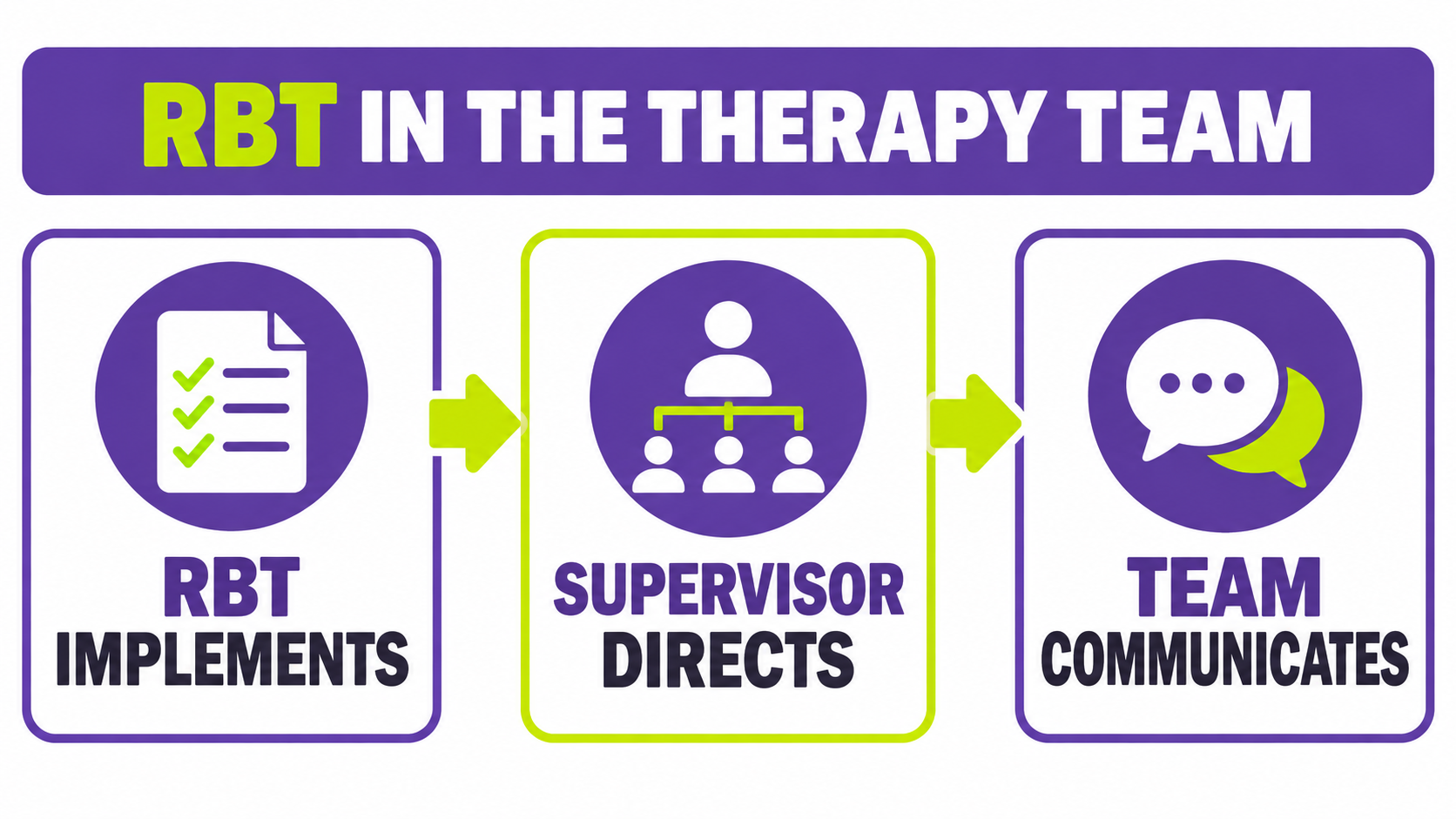
What does “RBT therapy” mean?
People often use “RBT therapy” as shorthand for ABA therapy in which an RBT provides much of the direct, face-to-face implementation. The phrase is understandable, but the certification belongs to the technician, not to a separate therapy method. RBTs deliver behavior-analytic services according to the program and supervision structure established by the responsible clinical team.
The exact service can look different across home, school, clinic, community, and telehealth-supported settings. One client may work on communication and daily living skills; another may practice academic readiness, social behavior, or safety routines. The setting and goals change, but the role boundary remains: implement within competence and seek direction when the program or situation is unclear.
What an RBT may do in therapy
Under current supervision and an approved program, an RBT may perform activities that behavior technicians typically perform. The responsible supervisor determines whether the RBT is competent to perform a specific activity. Common examples can include:
- implementing skill-acquisition programs and teaching procedures;
- using prompts and reinforcement as written in the program;
- conducting a preference assessment when trained and directed to do so;
- supporting discrete-trial or naturalistic teaching procedures;
- helping with generalization across people, materials, or settings;
- collecting, entering, and reviewing assigned data;
- reporting observations and variables that may affect progress;
- writing objective session notes and completing required documentation.
These examples are not an automatic permission list. The supervisor must confirm the RBT’s training, competence, setting, and current program. An activity that appears simple can still require specific instruction, rehearsal, observation, and feedback.
What the supervisor directs
The supervisor or RBT Requirements Coordinator is responsible for the work RBTs perform and provides the clinical direction that turns a goal into an implementable program. Depending on the service arrangement, the qualified supervisor may assess needs, define goals, select procedures, review data, modify programs, determine whether an intervention is working, train the RBT, and evaluate implementation fidelity.
An RBT should not independently change a target, invent a consequence, change a measurement definition, diagnose a function, or promise a particular outcome to a family. If data look unusual or a procedure is not producing the expected result, report the observation and seek direction. The correct action may be a program change, additional training, a safety review, or a decision to pause an activity.
How the therapy team works
A strong team makes responsibilities visible. The RBT should know who provides supervision, who can answer clinical questions, who communicates with caregivers, who updates the program, and who handles an emergency. The client and family should also know how to raise a concern and when a question should go directly to the supervisor.
Team communication is not just a meeting on the calendar. It includes timely feedback, clear handoffs, accurate data, and a shared understanding of the current plan. When a teacher, caregiver, or other provider reports a change, the RBT should communicate it through the authorized route rather than making a solo clinical decision.
Supervision should include instruction, modeling, rehearsal, feedback, and observation of service delivery when those are needed to maintain competence. If supervision is consistently unavailable, vague, or disconnected from the work the RBT performs, the team should address that problem instead of leaving the technician to guess.
What an RBT session may include
A session often begins with a brief handoff: what happened since the last visit, whether there were health or schedule changes, and which programs are current. The RBT then prepares materials, reviews the plan, and implements teaching or behavior-reduction procedures while observing the client’s responses.
During the session, the RBT may deliver reinforcement, use prompts and prompt fading, practice communication, support transitions, collect data, and adjust ordinary teaching decisions that are already specified in the program. “Adjust” does not mean redesign. If the plan does not fit the situation, the RBT records the issue and contacts the supervisor.
The session ends with objective documentation and a handoff of important observations. The note should help the supervisor understand what occurred, what was implemented, and what needs follow-up.
Data, notes, and communication
Data are one of the main ways the supervisor evaluates whether a program is being implemented as intended. Use the definitions and measurement system provided by the program. Do not change a measurement method because a different method feels easier. If the definition is unclear, ask before collecting a large amount of unreliable data.
Session notes should describe observable events and the services delivered. Avoid labels such as “lazy,” “manipulative,” or “uncooperative.” Instead, describe what the person did, what instruction or event preceded it when relevant, what procedure was implemented, and what happened next. Protect private information and use the organization’s approved system.
Communicate concerns promptly. A medication change, illness, sleep disruption, family schedule change, data irregularity, or safety concern can affect progress. Reporting the variable does not mean making a medical or causal conclusion; it gives the supervisor information needed for clinical judgment.
Working with families and caregivers
Families may understandably ask an RBT why a program changed, whether a behavior is improving, or what should happen at home. Answer within your role. You can explain the steps you are implementing and report observations, but refer clinical decisions, diagnoses, treatment changes, and outcome promises to the qualified supervisor.
Respect caregiver knowledge and cultural context. Listen, record relevant concerns, and use the communication route the team has established. Do not discuss another client, share confidential material, or present a personal opinion as the organization’s clinical recommendation.
How to recognize a well-supported RBT service
For families comparing providers, useful questions include: Who supervises the RBT? How can we contact that person? How are programs updated? How are data reviewed? What happens when a safety concern appears? How are caregiver concerns documented and answered? What training does the RBT receive before implementing a procedure?
For RBTs, the same questions reveal whether a workplace supports competent practice. You should have access to current programs, a clear contact chain, feedback on implementation, and a safe way to report concerns. A busy schedule is not a substitute for supervision.
Common misunderstandings about RBT therapy
- “The RBT is the independent therapist”: RBTs provide supervised behavior-analytic services.
- “The RBT can change the plan”: Report observations and seek clinical direction.
- “A certification replaces supervision”: Ongoing supervision remains part of the service structure.
- “A session note is an opinion: Write objective, observable information.
- “Every RBT can do every task”: Competence, training, program, and setting determine authorization.
- “Family concerns can wait”: Communicate relevant concerns through the authorized team route promptly.
Frequently asked questions
Is an RBT a therapist?
An RBT is a paraprofessional certified in behavior analysis who assists with behavior-analytic services under close supervision. The exact job title may vary by employer, but the BACB role is not independent clinical practice.
What does an RBT do during ABA therapy?
An RBT may implement approved teaching and behavior-reduction procedures, collect data, support generalization, communicate observations, and document sessions when trained and directed to do so.
Can an RBT design a behavior plan?
No. Program design and clinical decisions belong to the qualified supervisor or other authorized clinical professional. The RBT implements and reports.
How does RBT supervision work?
The RBT practices under the direction and close supervision of an RBT Supervisor and/or RBT Requirements Coordinator. The current handbook and supervisor determine the applicable requirements.
What should I ask an RBT therapy provider?
Ask who supervises the RBT, how data and programs are reviewed, how concerns are handled, and what happens when a safety or clinical question arises.
Official sources: BACB Registered Behavior Technician resources; BACB RBT supervision resources; BACB Supervision, Assessment, Training, and Oversight; BACB RBT Handbook. Retrieved September 28, 2026. Confirm current handbook requirements and the provider’s service policies.
Ready to practice the RBT concepts you just reviewed?
Try an independent, original RBT practice resource with exam-style questions, scoring, and answer explanations.
References
- Behavior Analyst Certification Board. RBT Test Content Outline, 3rd edition.
- Behavior Analyst Certification Board. RBT Handbook.
- Behavior Analyst Certification Board. RBT Ethics Code.