
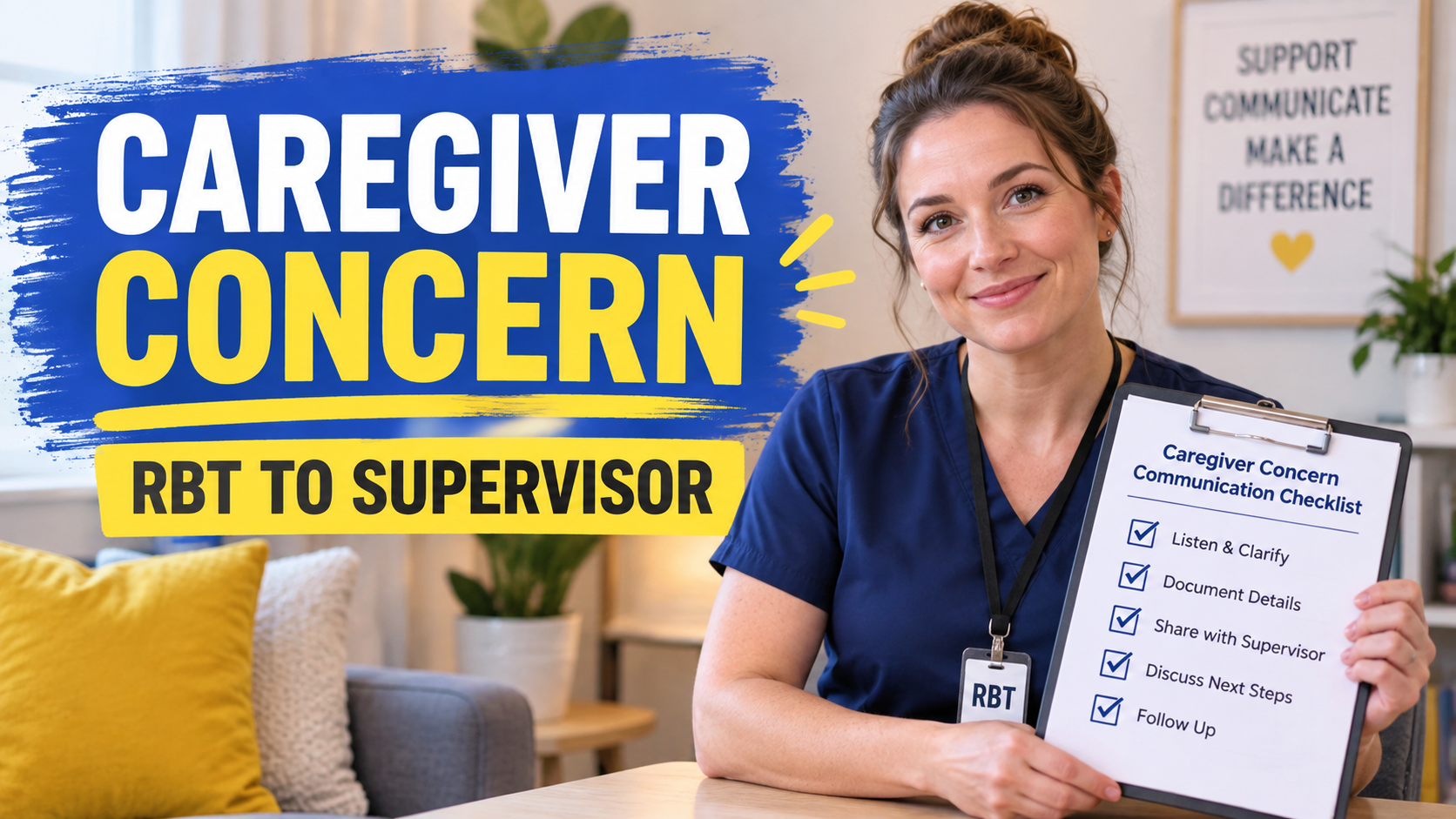
A caregiver concern can contain important information about a client’s routines, safety, progress, or experience of services, so an RBT should route it to the supervisor promptly.
Table of Contents
- Caregiver concern: quick answer for an RBT
- Why caregiver concerns matter
- Step 1: Listen respectfully
- Step 2: Clarify the concern
- Step 3: Record the source and facts
- Step 4: Tell the supervisor
- Step 5: Follow up without overpromising
- When the concern is urgent
- Keep caregiver communication within role
- Examples of helpful RBT responses
- Common caregiver-concern mistakes
- Frequently asked questions
RBT caregiver communication and supervision
Caregiver Concern: What an RBT Should Tell the Supervisor
A caregiver concern can contain important information about a client’s routines, safety, progress, or experience of services. An RBT should listen respectfully, clarify what the caregiver observed, communicate the concern to the supervisor in a timely manner, and follow the authorized next step. The RBT should not dismiss the caregiver, promise a clinical change, or create a private plan outside supervision.
Caregiver concern: quick answer for an RBT
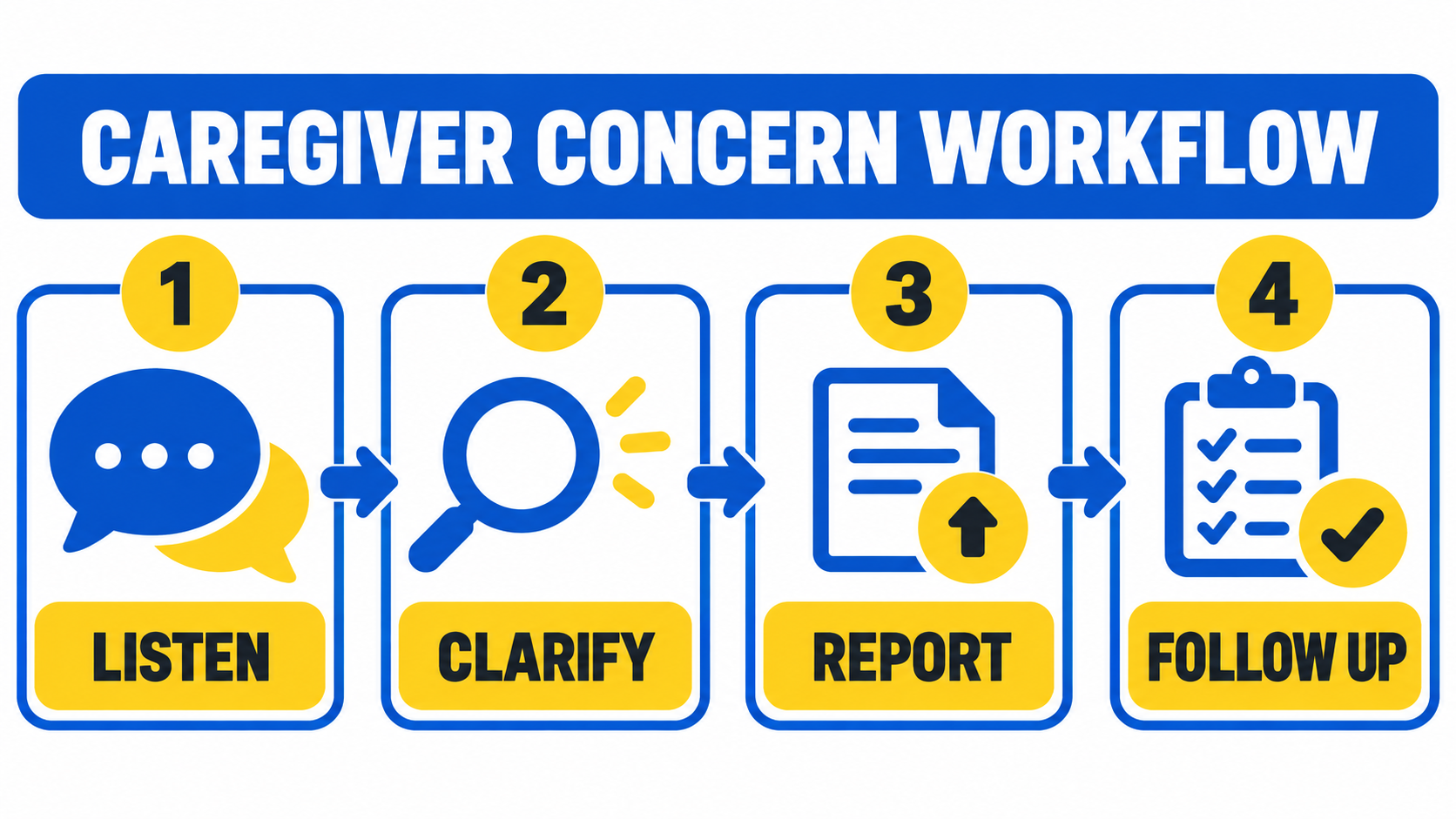
Listen, clarify what happened, identify when and where it happened, record or route the information through the approved process, and tell the supervisor promptly. If the concern is urgent or involves immediate danger, use the emergency route rather than waiting for a routine supervision conversation.
The BACB RBT Test Content Outline includes communicating concerns and suggestions from the intervention team—including caregivers—with a supervisor in a timely manner. This means the RBT does not need to solve every concern at the doorway. The RBT does need to make sure the concern reaches the person responsible for clinical direction.
Why caregiver concerns matter
Caregivers may see the client before school, after a session, during sleep routines, or in community settings that the RBT does not observe. They may notice a change in communication, eating, sleep, medication, schedule, safety, or how a skill transfers outside the therapy setting. A concern may also reveal that the family does not understand a program or that a routine is not practical at home.
Listening does not mean accepting every interpretation as a clinical fact. It means respecting the caregiver as a source of information and routing relevant details to the team. The supervisor can decide whether the information calls for more data, a program review, caregiver training, a safety response, or no change.
Timeliness matters. A medication change, injury, urgent safety concern, or sudden change in functioning may affect today’s service. A routine preference about materials may be appropriate for the next team meeting. Use the organization’s policy to determine the channel and urgency.
Step 1: Listen respectfully
Give the caregiver your attention and avoid becoming defensive. A caregiver may sound frustrated because they have been carrying the concern for several days. Do not interrupt to explain the program before you understand what the person is reporting.
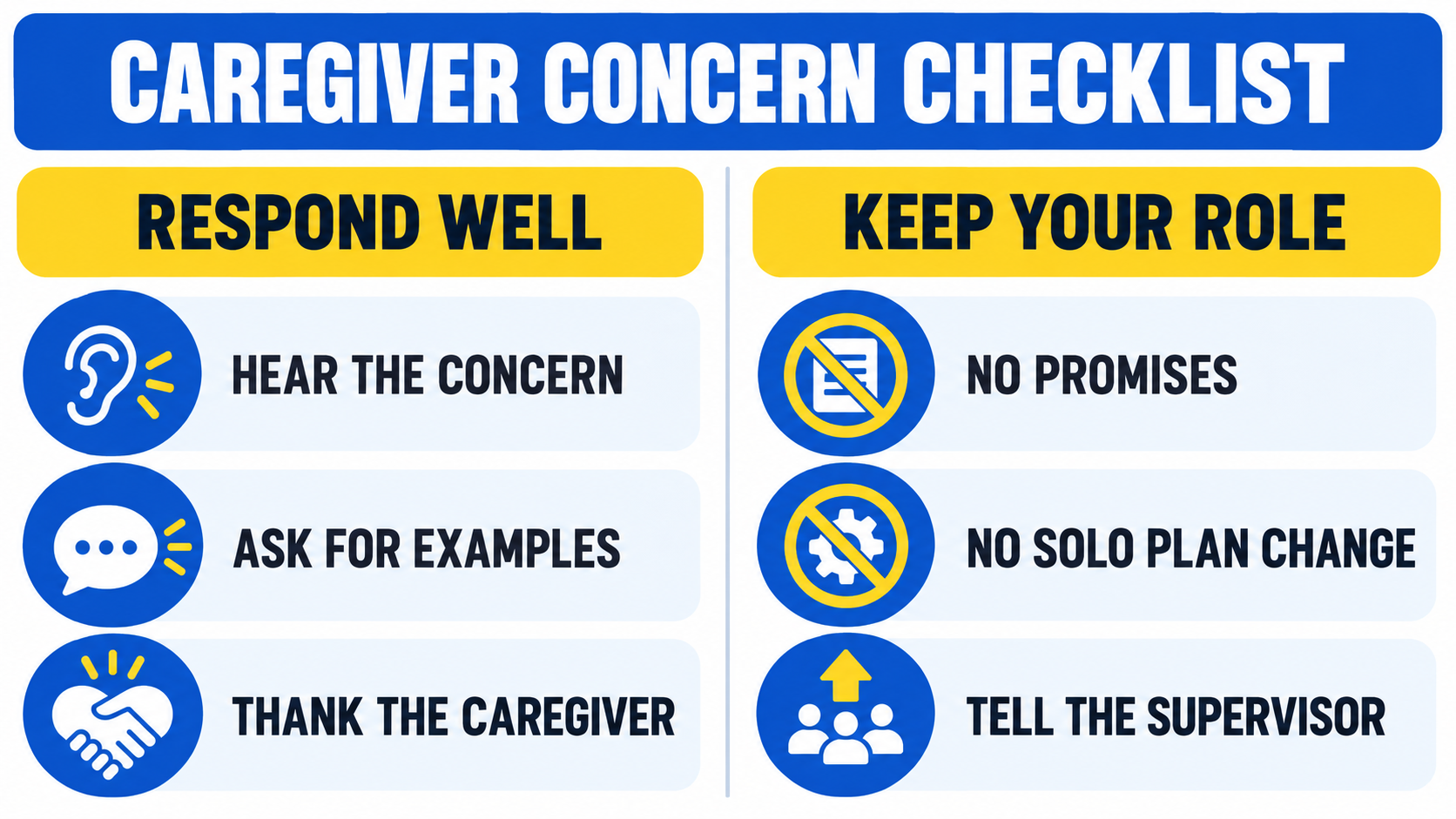
Useful responses include “Thank you for telling me,” “I want to make sure I understand,” and “I will share this with the supervisor through our process.” These statements acknowledge the concern without promising a treatment decision. If you do not know the answer, say so rather than guessing.
Protect the client’s dignity while listening. Move a sensitive conversation to an appropriate private setting when possible, and do not discuss the concern in front of people who are not authorized to hear it.
Step 2: Clarify the concern
Ask only the questions needed to route the information accurately:
- What did you observe?
- When did it happen and how often?
- Where did it happen?
- Who was present?
- What changed from the usual routine?
- Was anyone hurt or in immediate danger?
- What support or answer is the caregiver asking the team to consider?
Avoid asking the caregiver to diagnose a function or defend a conclusion. “What happened right before?” is useful; “Why did the client do that?” may invite speculation. If the caregiver cannot provide a detail, record the uncertainty instead of filling the gap yourself.
Step 3: Record the source and facts
Use attributed language: “Caregiver reported that the client woke several times,” or “Caregiver asked whether the visual schedule can be used at home.” Then separate your direct observations: “During today’s session, I observed two exits from the activity area.”
Do not convert a caregiver concern into a diagnosis, a blame statement, or a guaranteed cause. The concern may be relevant even when its explanation is unknown. Record it in the approved communication or session-note system and follow the workplace rule for incidents, medical information, or safety events.
Step 4: Tell the supervisor
Send the supervisor a concise message that includes the source, the observable concern, when it matters, any action already taken within the plan, and the decision or direction needed. Use the normal chain of command for routine concerns and the urgent or emergency route when policy requires it.
For example: “Caregiver reported a new sleep change before today’s session and asked whether the schedule should be adjusted. I have not changed the program. Please advise whether you want additional data or a program review.” This communicates the concern without making a clinical conclusion or changing the plan.
If the supervisor is unavailable, follow the backup contact process. Keep a record of the contact attempt and any direction received. If the concern involves possible ethical misconduct, missing supervision, or continued risk, use the organization’s chain of command and consult the current BACB reporting resources as appropriate.
Step 5: Follow up without overpromising
After the supervisor responds, implement only the authorized next step. The supervisor may request more data, schedule an observation, speak with the caregiver, review the program, or direct an immediate safety action. Confirm which instruction is current before using it.
Tell the caregiver what you are authorized to share. You can say, “I passed this to the supervisor, and the team will follow up through the usual process.” Do not promise a program change, a timeline the team has not given you, or a particular outcome.
If the caregiver asks again before the supervisor responds, acknowledge the question and repeat the approved route. Consistent communication is better than an improvised answer that later conflicts with the clinical plan.
When the concern is urgent
Use the emergency procedure when there is immediate danger, a serious injury, a medical emergency, or another event identified by the plan as urgent. Do not wait for a routine supervisor meeting or spend time perfecting documentation before calling for required help.
For a time-sensitive but nonemergency concern, use the supervisor’s same-day channel. Report the facts, follow the current plan, and ask what to do next. Do not give medication advice or make a medical decision because a caregiver asks for one.
Keep caregiver communication within role
An RBT can be warm, responsive, and useful without becoming the independent clinician. Do not redesign the behavior plan, change a reinforcement schedule, advise a family to stop medication, promise insurance coverage, diagnose a condition, or hide a concern from the supervisor.
Maintain confidentiality. Use approved channels, avoid discussing another client, and do not store caregiver messages in a personal app or social-media account unless the organization has explicitly authorized that system. If a caregiver asks you to bypass the supervisor, explain that clinical questions must follow the team process.
Examples of helpful RBT responses
Concern about progress: “I hear that you are not seeing the same communication response at home. I’ll record your example and share it with the supervisor so the team can review generalization.”
Concern about a routine: “Thank you for explaining what is difficult about the bedtime routine. I can send that suggestion to the supervisor; I cannot change the program on my own.”
Concern about safety: “I’m going to follow the safety plan and contact the supervisor now. If the emergency threshold is met, I will use the emergency route described by the plan.”
Each response recognizes the caregiver’s information, preserves the RBT’s role, and moves the question toward the person responsible for the decision.
Common caregiver-concern mistakes
- Becoming defensive: Listen before explaining.
- Promising a change: Route the concern to the supervisor.
- Writing a conclusion as a fact: Attribute the caregiver’s report and separate your observation.
- Delaying urgent information: Use the correct same-day or emergency channel.
- Giving medical advice: Refer medication and health decisions to qualified professionals.
- Using a personal message app: Follow approved privacy and documentation systems.
- Ignoring repeated concerns: Use the chain of command when the concern is not addressed.
Frequently asked questions
What should an RBT do when a caregiver complains?
Listen respectfully, clarify what happened, record the source and observable facts, tell the supervisor promptly, and follow the authorized next step.
Can an RBT change the plan because a caregiver asks?
No. The RBT should communicate the suggestion and wait for clinical direction unless the current safety plan requires an immediate action.
What if the supervisor ignores the caregiver concern?
Document the communication and use the organization’s backup chain of command or RBT Requirements Coordinator process. For ongoing serious concerns, review current BACB reporting guidance.
Should a caregiver concern go in the session note?
Follow the workplace form and policy. It may belong in a session note, communication log, incident report, or more than one approved record.
What if the concern is about medication?
Report it through the approved supervisor and caregiver route. Do not advise the family to change medication or make a medical conclusion.
Official sources: BACB RBT Test Content Outline (3rd ed.); BACB RBT 2026 Training Requirements; BACB RBT supervision resources; BACB RBT guidance on supervision concerns. Retrieved September 28, 2026. Follow the current caregiver, privacy, and emergency policies.
Ready to practice the RBT concepts you just reviewed?
Try an independent, original RBT practice resource with exam-style questions, scoring, and answer explanations.
References
- Behavior Analyst Certification Board. RBT Test Content Outline, 3rd edition.
- Behavior Analyst Certification Board. RBT Handbook.
- Behavior Analyst Certification Board. RBT Ethics Code.