

RBT PDUs are a new maintenance topic for people who certify or recertify in 2026.
Table of Contents
- RBT PDUs: quick answer
- What an RBT PDU means
- The three RBT PDU sources
- In-service training: what can count
- ACE professional development events
- University coursework
- Evidence and upload workflow
- Timing and cycle planning
- Common RBT PDU mistakes
- Frequently asked questions
- Official source note
RBT professional development, in-service training, and documentation
RBT PDUs: What Counts for Professional Development in 2026
RBT PDUs are a new maintenance topic for people who certify or recertify in 2026. This guide explains the 12-PDU cycle, the three source types, what in-service training can and cannot cover, and how to keep evidence ready for the BACB process.
RBT PDUs: quick answer
The current BACB guidance says an RBT who certifies or recertifies in 2026 must earn 12 professional development units, or PDUs, during the two-year recertification cycle. The available sources are qualifying organization in-service training, qualifying ACE professional development events, and qualifying behavior-analytic coursework at an accredited university. The training topic and the paperwork both matter. A certificate or attendance email by itself does not make an activity count.
Because this requirement is tied to the certification or recertification cycle, do not assume that every RBT has the same deadline. Check the current RBT Handbook, the professional development page, and the dates in your BACB account. If a supervisor or organization gives you a local procedure, use it to organize your records, but use the BACB requirements to decide whether the activity is an eligible source.
What an RBT PDU means
A PDU is a professional-development unit used for the RBT recertification process. In this context, it is not simply a synonym for supervision, a continuing-education credit issued to another credential, or a general training hour. The important question is whether an activity fits an approved source, addresses acceptable professional content, and can be documented in the way the BACB specifies.
This distinction helps prevent a common planning error: collecting many hours without checking the category first. An RBT may attend a useful session and still discover that it was client-specific, company-policy-only, or otherwise outside the PDU rules. Build the eligibility check into the registration step rather than waiting until the end of the cycle.
PDUs also do not replace the responsibilities of ongoing supervision. Supervision supports competent service delivery and direction from a supervisor. The PDU requirement is a separate professional-development record. The same meeting should not be counted twice just because it was useful or lasted a certain number of hours.
The three RBT PDU sources
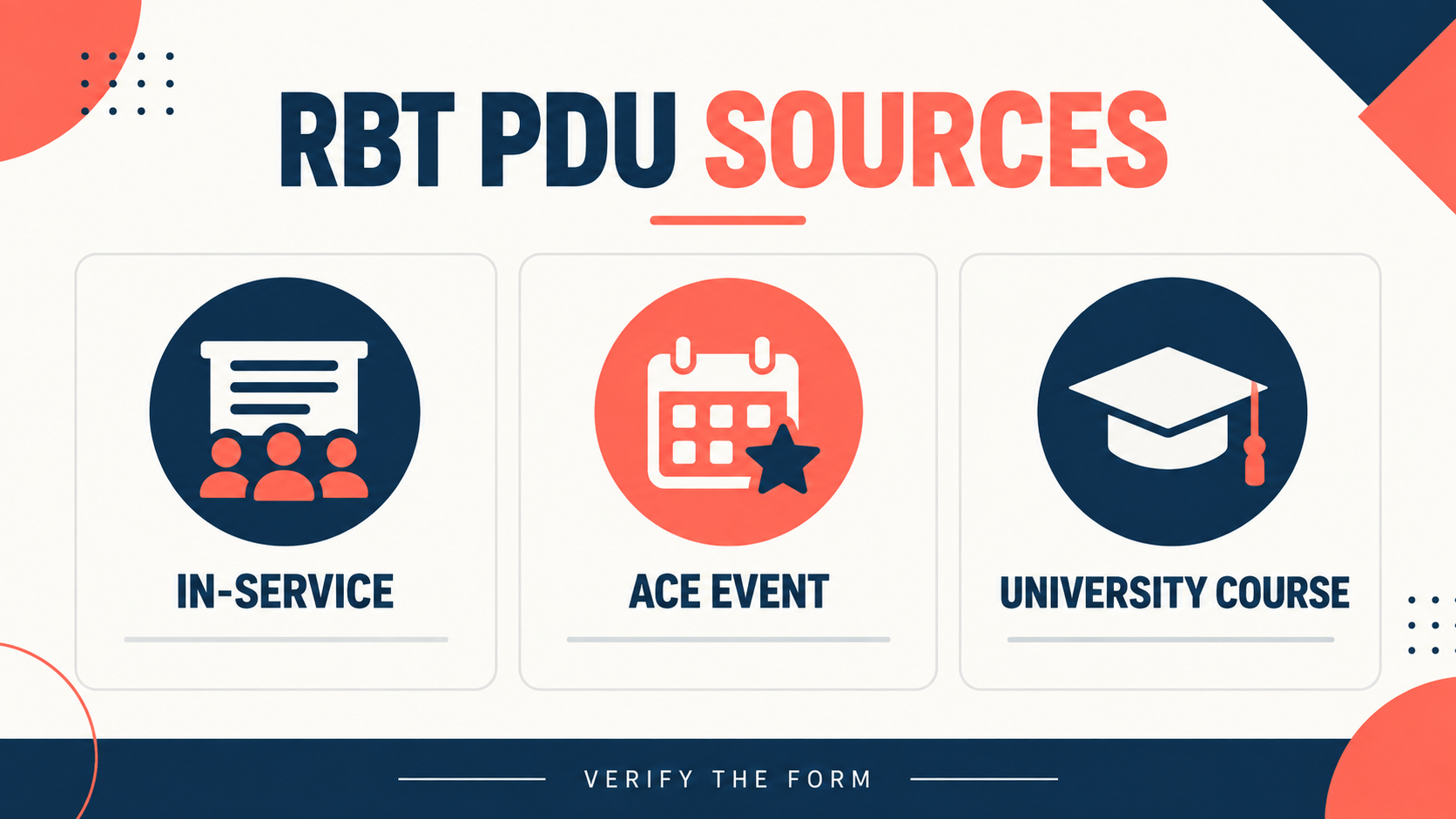
The BACB identifies three broad routes for earning RBT PDUs. Think of them as three lanes with different evidence requirements:
- Organization in-service training: structured professional development offered through the service organization and provided by an appropriately qualified person. It must be more than a discussion of one client’s program.
- ACE professional development events: an event provided through a BACB-authorized continuing education provider. Confirm the provider and use the ACE-related documentation process.
- Accredited-university behavior-analytic coursework: qualifying university study with the required passing result and supporting syllabus and transcript records.
The source determines the form or evidence you should expect. Before enrolling or attending, save the provider name, date, topic, presenter, and any statement about the intended audience. This small habit makes later verification much easier.
In-service training: what can count
In-service training is the route many RBTs will encounter at work, but it has boundaries. Current BACB guidance describes a structured activity that covers or expands appropriate professional content. Examples include material connected to the RBT 2026 40-hour training curriculum, the RBT Ethics Code, BACB requirements, supervisor-directed professional skills, communication, and stress-management content that is appropriate for the RBT role.
Good planning questions include: Is this session intentionally designed as training? Is there an identified presenter or facilitator? Is the topic useful across cases rather than tied to one learner? Will the organization provide the documentation needed for the RBT Professional Development: In-Service Training form? If the answer is unclear, ask the supervisor or training coordinator before you count the time.
Structured participation can include active responding, practice, role-play, discussion, or knowledge checks when those activities are part of the designed training. The key is that the activity is organized learning, not merely private exposure to information. Reading a book or listening to a podcast on your own time may be valuable, but the current in-service guidance does not treat unstructured personal study as an in-service PDU.
Several activities should not be casually relabeled as in-service PDUs. Client- or program-specific training, company policies without professional-development content, individual or group supervision about client programming, BCBA examination preparation, software or data-system instruction, the initial 40-hour RBT course, and CPR training are examples that current guidance distinguishes from qualifying in-service professional development. A training can be useful and still belong in your general employment record instead of your PDU record.
ACE professional development events
ACE events are another route, but the provider status matters. Use the BACB’s authorized continuing education provider registry to verify that the organization is listed and that the event is intended to provide professional development for RBTs. Do not rely only on a marketing phrase such as “CEU,” “certificate,” or “approved training.” Confirm the event’s category and the documentation process.
Keep the event title, date, provider, presenter, agenda or description, attendance evidence, and the completed form required for the ACE route. If the event is a large conference, identify the specific session rather than treating the entire conference pass as one undifferentiated activity. Save the event page or confirmation while it is available, because web pages and registration portals can change.
ACE providers may serve different credential audiences. A session that is advertised primarily for BCBA or BCaBA continuing education is not automatically an RBT PDU. Look for an explicit RBT professional-development pathway or ask the provider how an RBT should document the event before paying or attending.
University coursework
University coursework can be a high-value option for an RBT who is already taking an accredited program. The course should be behavior-analytic, offered by an accredited university, and completed with the required passing result. Current BACB information indicates that one semester credit hour can equal 15 PDUs, so a three-credit qualifying course can represent 45 PDUs. That math is useful, but it does not remove the need to verify the course itself.
Keep the course syllabus and transcript. The syllabus should make the subject and behavior-analytic content clear, while the transcript shows the institution, course, term, and final result. If your school uses quarter credits or a different grading system, do not convert it by guesswork. Ask the BACB or follow the current Handbook instructions for the exact documentation.
Do not use university coursework as a shortcut for any class that happens to mention behavior. The course must meet the current category requirements. A course can be educational, relevant to your job, and still fail the specific PDU test if it is not from an accredited university, does not have behavior-analytic content, or lacks the required completion evidence.
Evidence and upload workflow
The safest workflow is to verify, attend, document, and upload. First, verify the source and eligibility before you commit the time. Second, attend or complete the activity as required. Third, collect the right evidence while the details are easy to find. Fourth, enter or upload it through the current BACB account process and keep a copy for your own records.
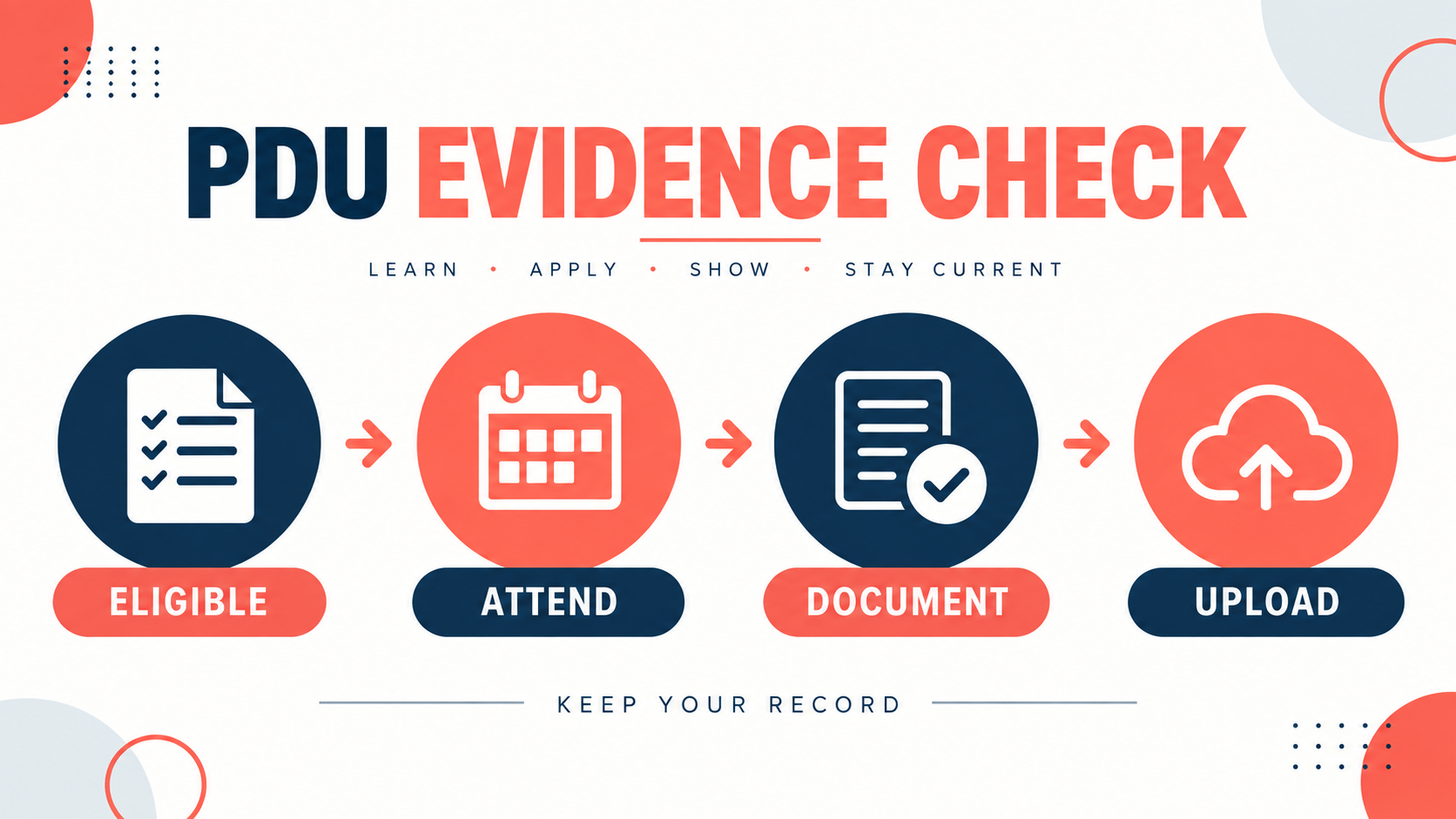
Your evidence folder can use one subfolder per activity. A useful filename includes the date, provider, and topic. Keep the completion certificate or form, but also keep the supporting description, agenda, syllabus, transcript, or provider verification that explains why the activity belongs in the selected category. If a supervisor or organization must sign a form, request the signature before the event is forgotten.
Upload according to the current BACB instructions rather than relying on an old screenshot or a colleague’s memory. The portal layout can change. After submitting, check that the item appears in the correct account area and that any status, date, or category is recorded as expected. Store confirmation or screenshots according to your organization’s privacy and security rules; never put client-identifying information into a PDU record unless the official process specifically requires it.
Timing and cycle planning
The current transition language matters: RBTs start earning these PDUs after certifying or recertifying in 2026. Do not infer that the same 12-PDU rule was imposed on every prior cycle, and do not assume that training completed before your applicable start date will automatically transfer. Your personal certification or recertification date controls the planning conversation.
A practical plan is to divide 12 PDUs across the two-year cycle instead of waiting for the final month. For example, you might identify one qualifying in-service event each quarter, then use an ACE event or university course only after checking the remaining total and the category rules. This is a planning example, not a BACB allocation rule. The goal is to reduce deadline pressure while preserving a clean evidence trail.
Set a calendar reminder for a monthly record check. Compare the total in your folder with the total shown in the BACB account, look for missing forms, and ask early about activities that do not clearly fit. Early questions are easier to resolve than a last-minute attempt to reconstruct a training from memory.
Common RBT PDU mistakes
- Counting every training hour: eligibility is category- and content-dependent.
- Counting ongoing supervision: supervision and professional development are separate records.
- Using a client-specific session: a program meeting is not automatically organization-wide professional development.
- Trusting an old form: use the current BACB instructions and check the date of the source.
- Saving only a certificate: keep the description and supporting evidence that explain the category.
- Waiting until renewal: a simple running folder and monthly check reduce avoidable gaps.
Frequently asked questions
Do RBT PDUs equal CEUs?
Not automatically. Providers may use different labels, and a credit for another credential is not automatically an RBT PDU. Verify the route and evidence with the current BACB guidance.
Does supervision count as an RBT PDU?
Ongoing supervision, supervised fieldwork, and client-programming supervision are not automatically qualifying PDU activities. Keep them in the supervision record unless the current BACB instructions explicitly identify a separate qualifying activity.
Can a podcast or article count?
Independent reading or listening does not automatically become in-service training. Ask whether it is part of a structured qualifying event with the required provider and documentation.
What should I do if a form is unclear?
Pause before submitting the activity as a PDU. Ask the supervisor, training coordinator, provider, or BACB through the current official channel, and keep the written answer with your records.
Official source note
This educational guide was checked against BACB pages and the in-service training guidance retrieved September 28, 2026. Requirements, forms, portal steps, and transition rules can change. Use the current BACB RBT Professional Development page, RBT Professional Development: In-Service Training guidance, RBT Handbook, and authorized provider registry before making a compliance decision.
Role boundary: This article is general education, not individualized compliance advice. When your certification date, activity category, or documentation is uncertain, confirm the current requirement with the BACB and your supervisor.
Ready to practice the RBT concepts you just reviewed?
Try an independent, original RBT practice resource with exam-style questions, scoring, and answer explanations.
References
- Behavior Analyst Certification Board. RBT Test Content Outline, 3rd edition.
- Behavior Analyst Certification Board. RBT Handbook.
- Behavior Analyst Certification Board. RBT Ethics Code.