
Objective session notes RBT professionals write should make it possible for an approved reader to understand what occurred without guessing at motives, diagnoses, or private details.
Table of Contents
- Objective session notes RBT: quick answer
- What objective documentation means
- The five building blocks of a strong note
- A before, during, and after workflow
- Facts, interpretations, and labels
- Data and measurement integrity
- Session variables and changes
- Privacy, confidentiality, and storage
- Corrections and audit trails
- When to contact the supervisor
- Frequently asked questions
- Official source note
Objective documentation, observable language, data integrity, confidentiality, and supervisor communication
Objective Session Notes RBT: How to Write Clear Records
Objective session notes RBT professionals write should make it possible for an approved reader to understand what occurred without guessing at motives, diagnoses, or private details. This guide shows how to record context, actions, responses, data, and next steps while staying within the RBT role and the requirements of the workplace.
Objective session notes RBT: quick answer
In an RBT session note, describe what was observed and done in terms another trained reader could verify. Include the relevant setting or activity, the target or skill addressed, the procedure implemented as written, the learner’s observable response, the data collected, and any variable or follow-up that matters. Separate direct observation from information reported by a caregiver, teacher, or another provider.
“Objective” does not mean that a note has no context or that the RBT must write in an unnatural style. It means the record is anchored to observable events and the approved documentation process. An objective note can be concise and still explain why a planned opportunity was changed, why data were not collected, or why a concern was routed to the supervisor.
What objective documentation means
The BACB RBT Test Content Outline asks RBTs to communicate objectively what occurred during a session in accordance with legal, regulatory, and workplace requirements. That principle applies to the whole record: the wording, the data, the timing, the storage location, and the people who receive the information.
Use language that identifies an action, condition, or result. For example, “At 10:14 a.m., after the instruction to place the blocks in the bin, the learner pushed the bin 20 centimeters and said ‘no’ twice” gives a reader something concrete to understand. It does not claim why the learner acted, whether the learner was being oppositional, or what the behavior “really meant.” Any clinical interpretation belongs in the approved plan and supervision process.
Objective writing also protects the learner from labels. A note should not turn a difficult moment into a character judgment. It should capture the circumstances, the response, the support delivered under the plan, and what the team needs to know next.
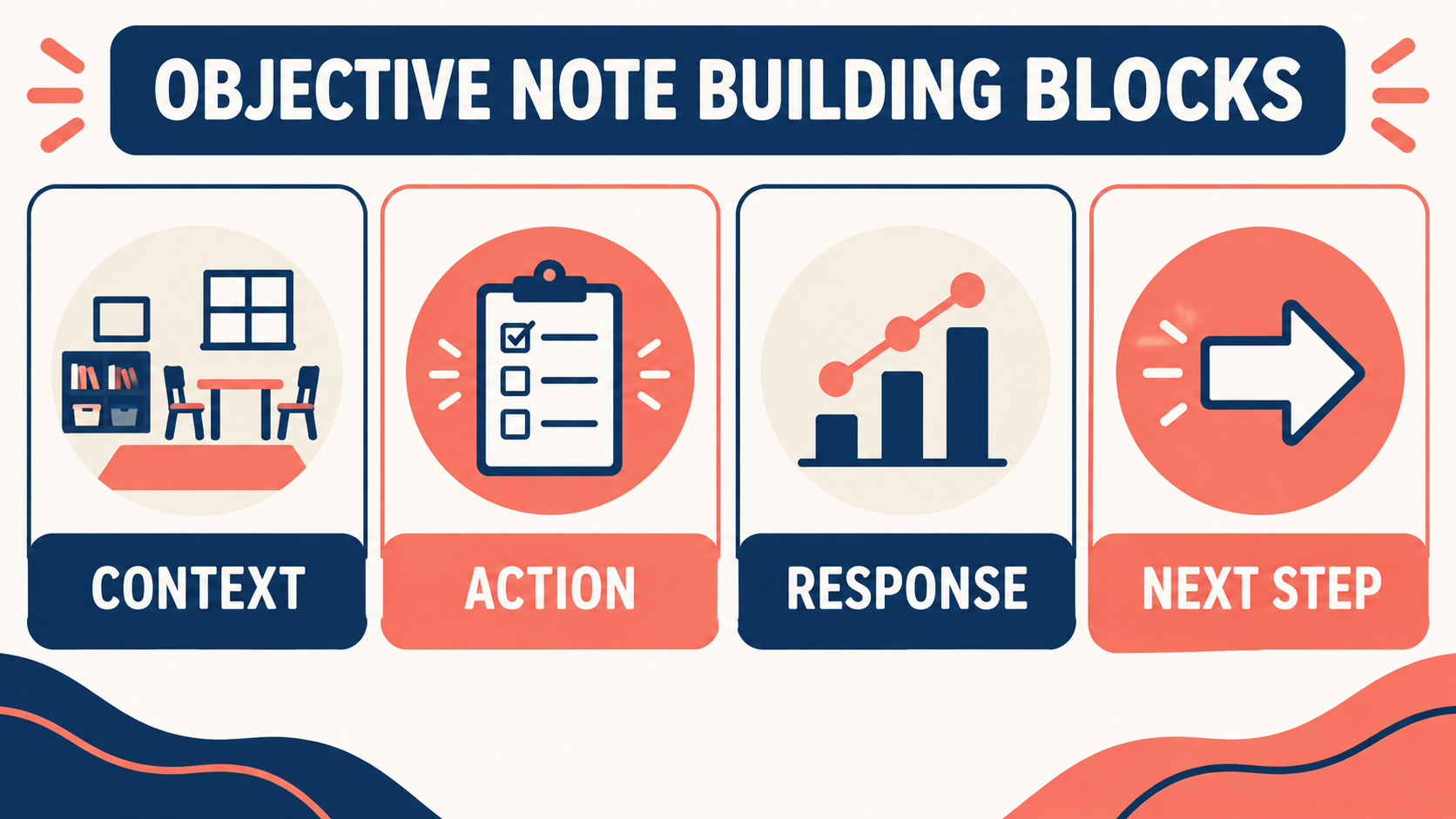
The five building blocks of a strong note
1. Context. Identify the date, session period, setting, activity, and relevant people or materials according to the required form. Include only the information needed for the service record. If the note covers more than one routine, make the transitions clear.
2. Action. State the target, instruction, prompt, teaching arrangement, reinforcement procedure, or behavior-support step that was implemented. Use the plan’s terms and describe what you actually did. Do not imply that a procedure occurred if it was not delivered.
3. Response. Describe the observable response and its timing or duration when relevant. If the learner used a communication response, completed a step, left an area, engaged with materials, or required a safety response, record what was visible or audible rather than assigning a motive.
4. Data. Report the measurement used by the current program: frequency, duration, latency, interval result, percentage, trial result, or another approved measure. Keep the unit and denominator clear. “Better” is not a measurement; “4 of 6 opportunities met the independent-response criterion” is more useful when that is the approved metric.
5. Next step. Record a required follow-up, unresolved question, variable to report, or supervisor communication. A next step is not an invitation to create a new intervention. It tells the team what was shared, what needs clarification, or what should be reviewed at the next authorized opportunity.
A before, during, and after workflow
Before the session: Open the current approved plan and the correct documentation form. Confirm the date, service period, targets, measurement definitions, and required submission route. Check whether there are known schedule, staffing, health, medication, transportation, or setting variables that the supervisor has asked the team to track. Do not copy an old note and edit only the date; that habit makes stale details easy to carry forward.
During the session: Record data close to the event when the workflow allows. Use a quick factual shorthand only if the approved system permits it, then complete the required note without relying on memory for exact counts. If the routine changes, make a brief contemporaneous record of what changed and how it affected the planned opportunity. Follow emergency and safety procedures first when needed.
After the session: Reconcile the note with the data sheet or electronic record. Check that totals, time ranges, target names, and descriptions agree. Remove speculation, sarcasm, filler, and private details that do not belong in the record. Submit through the approved system by the required deadline. If a concern needs a separate message to the supervisor, state that the communication was made without putting unnecessary confidential detail into an unapproved channel.
This workflow is especially helpful when a session feels uneventful. “No major behavior occurred” is less informative than a brief account of the targets offered, opportunities completed, data recorded, and relevant variables observed.
Facts, interpretations, and labels
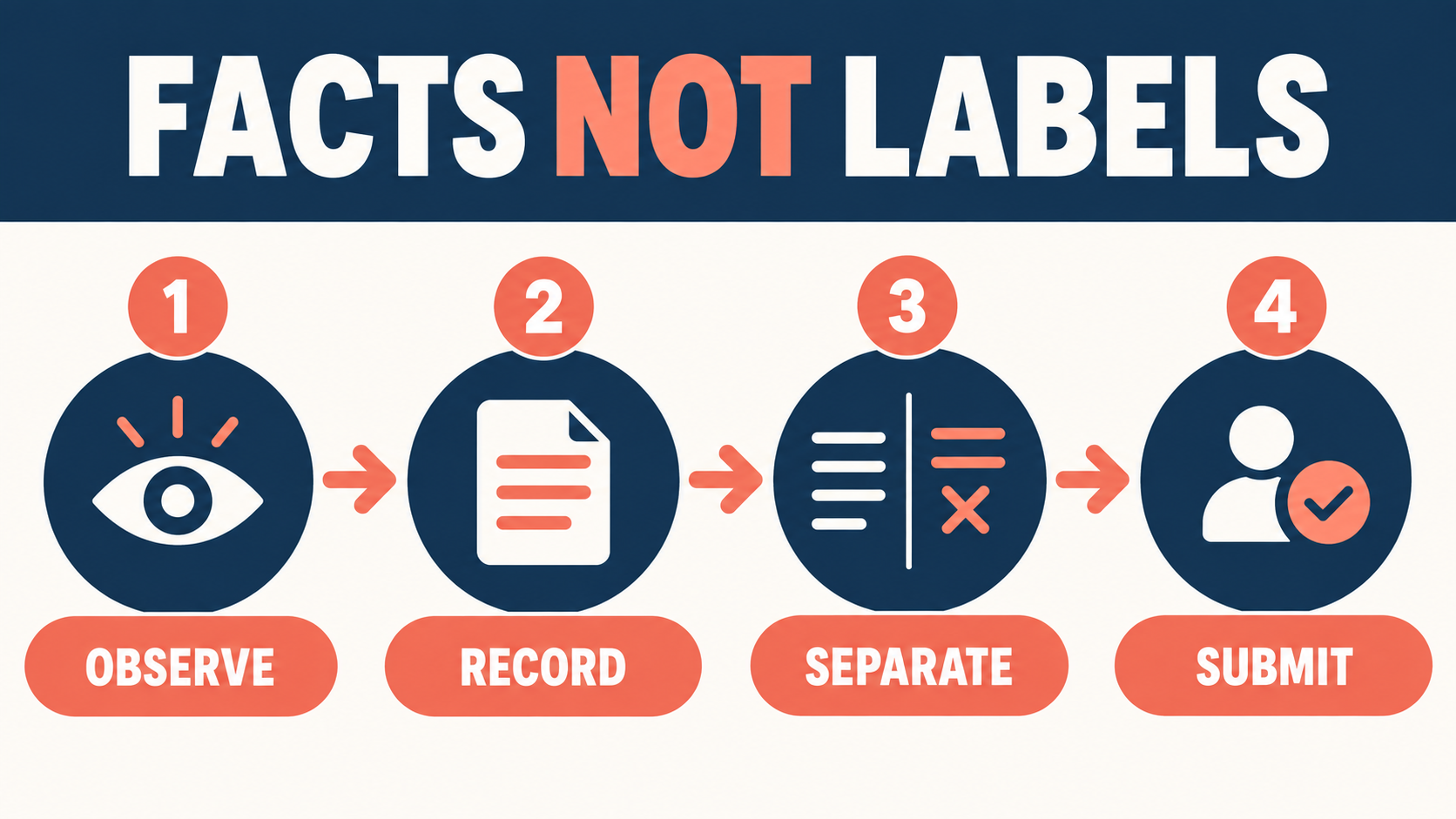
A practical editing test is to ask: Could a second trained person see, hear, count, or verify this sentence? If not, replace the judgment with the event that led you to write it.
| Less useful wording | More objective direction |
|---|---|
| “The learner was defiant.” | Describe the instruction, the learner’s words or action, latency, and what happened next. |
| “The session went badly.” | State which opportunities were run, which data were obtained, and what variable limited implementation. |
| “The caregiver caused the behavior.” | Separate direct observation from the caregiver’s report and describe the sequence without assigning cause. |
| “The learner understood the skill.” | Report the defined response, prompt level, accuracy, and number of opportunities. |
Interpretation is not always forbidden in every professional record, but an RBT should use the role’s authorized language and route clinical conclusions to the supervisor. Avoid diagnosing, predicting, or claiming a causal function merely because a pattern seems obvious in one session.
Data and measurement integrity
A clear note cannot repair unreliable data. Use the operational definition and measurement procedure in the current program. Record the actual observation period, opportunities, prompts, responses, and units required by the system. If a paper tally and an electronic form disagree, pause and reconcile them according to workplace procedure rather than choosing the number that looks better.
Never invent a value because a form requires a field. Do not estimate an exact duration from a general impression, backfill a missing count from memory, or change a result to make progress appear smoother. If an interruption prevented measurement, state that the planned measure was not obtained and explain the observable reason. Ask the supervisor how the missed opportunity should be handled.
Data are also communication. A reader should know whether a percentage is based on five trials or fifty, whether a duration is for one event or the whole session, and whether prompts changed the response criterion. Use the approved definitions instead of creating a private shorthand that another team member cannot interpret.
Session variables and changes
The RBT should report variables that might affect client progress in a timely manner. Relevant examples can include illness reported at arrival, a medication change reported through the approved route, a new staff member, a shortened school day, a room change, missing materials, unusual noise, a transportation delay, or a change in the learner’s communication support.
Report a variable without turning it into a causal claim. “The caregiver reported that the learner slept four hours; this was not directly observed” is different from “poor sleep caused the refusal.” The first preserves the source and the limit of the information. The supervisor can decide how that report should be considered in treatment or data review.
If a plan cannot be implemented as written, document the mismatch and follow the chain of command. Protect safety, maintain dignity, and avoid quietly substituting a new procedure. A note should make the deviation visible so the team can decide what to do next.
Privacy, confidentiality, and storage
Session notes often contain health, educational, behavioral, or identifying information. Use the approved record system, follow the employer’s privacy and retention requirements, and share information only with people who are authorized and need it for their role. Keep screens, paper notes, and devices protected in the same way you would protect other confidential records.
Do not put identifiable details into a personal text thread, public document, social post, or an AI tool that your workplace has not approved. Do not photograph a form for convenience unless the policy specifically permits it. When a caregiver, teacher, or another provider asks for information, confirm the approved communication route and the scope of what you may disclose.
Minimum necessary does not mean “omit anything uncomfortable.” It means include the facts required to understand the service and the decision, while leaving out unrelated family details, personal opinions, and speculative commentary. If you are unsure whether a detail belongs, ask the supervisor or privacy contact before submitting.
Corrections and audit trails
If you discover an error after saving a note, follow the system’s correction process. Preserve the original record when the platform requires an audit trail, identify what was corrected, and add the accurate information promptly. Do not erase a record simply because the original wording is embarrassing or because a later outcome looks different.
A correction should fix the record, not rewrite history. For example, if the session end time was entered incorrectly, use the approved amendment function or notify the responsible person. If a count was transcribed incorrectly from a data sheet, correct the transcription and retain the source according to policy. Never create a second record that makes it unclear which version is official.
When to contact the supervisor
Contact the supervisor when a definition is unclear, data look irregular, the learner’s response changes substantially, a safety issue occurs, a caregiver or teacher requests a change, the current materials are missing, or the task may exceed your training. E.1–E.4 of the BACB outline emphasize timely communication, seeking clinical direction, reporting variables, and objectively communicating what occurred. Those are documentation habits as well as supervision habits.
A useful message contains the setting, time, observable event, relevant variable, action already taken, and the decision needed. For example: “During the transition to the table at 2:10 p.m., the visual schedule was unavailable. I used the approved verbal cue, and the learner remained by the doorway for 90 seconds. I recorded the event and did not add a new prompt. Should the replacement schedule be used next session?” This is more actionable than “The plan did not work today.”
The RBT’s role is to implement authorized procedures, document observations, protect confidentiality, and seek direction. A careful note supports the supervisor’s clinical review; it does not replace supervision or authorize an independent change.
Frequently asked questions
How long should an RBT session note be?
Use the length required by the employer, payer, agency, school, or other governing system. A useful note is complete and specific, not long for its own sake. One accurate paragraph may be better than several paragraphs of repeated impressions.
Can an RBT write “frustrated” or “anxious”?
Those words may be appropriate only when they are part of an approved operational definition or clearly identified as a report from another person. Otherwise describe the observable behavior and source of the information instead of treating an internal state as directly measured.
What if I forgot to record data during part of the session?
Do not guess or backfill an exact value. State what was and was not measured, document the observable reason, and ask the supervisor how to handle the incomplete record under workplace procedure.
Can an RBT correct a submitted note?
Follow the approved correction or amendment process. Keep the audit trail when required, correct the factual error promptly, and notify the responsible person if the system does not allow you to amend the record.
Official source note
This educational guide was checked against the BACB RBT Test Content Outline, the BACB RBT Handbook, and the RBT Ethics Code, retrieved September 28, 2026. Workplace, payer, school, legal, regulatory, and state requirements can differ.
Role boundary: This article is general education, not individualized legal, clinical, documentation, or privacy advice. Follow the current plan, employer policy, approved record system, supervisor direction, and applicable requirements.
Ready to practice the RBT concepts you just reviewed?
Try an independent, original RBT practice resource with exam-style questions, scoring, and answer explanations.
References
- Behavior Analyst Certification Board. RBT Test Content Outline, 3rd edition.
- Behavior Analyst Certification Board. RBT Handbook.
- Behavior Analyst Certification Board. RBT Ethics Code.