
When an RBT study plan asks for continuous measurement ABA, the key idea is simple: record every occurrence of the defined response during the observation period, using the measurement system in the written plan. The difficult part is choosing the right unit and keeping the start and stop rules consistent.
Table of Contents
- What continuous measurement ABA means
- Choose the measurement unit
- Compare continuous and discontinuous procedures
- Calculate common continuous measures
- Follow a role-safe data routine
- Check data quality and procedural fidelity
- Practice continuous measurement ABA
- Avoid these continuous-measurement mistakes
- Frequently Asked Questions
- References
This guide explains count and frequency, rate, duration, latency, and interresponse time (IRT), then compares continuous and discontinuous procedures. It uses the current RBT Test Content Outline (3rd ed.), especially Data Collection and Graphing, and keeps independent examples separate from client-specific clinical direction.
RBT Training is not affiliated with, operated by, or endorsed by the Behavior Analyst Certification Board (BACB). The examples below are newly written for independent study. They are not official, recalled, leaked, or BACB-endorsed questions. No measurement worksheet, practice score, or study guide can guarantee a passing result or a clinical outcome.
What continuous measurement ABA means
In applied behavior analysis, continuous measurement records all detectable instances of a target response throughout a defined observation period. “Continuous” describes the coverage of the observation, not a requirement to use one particular device or software platform. The RBT still needs an observable behavior definition, a measurement rule, and a reliable way to record what happens.
The current RBT TCO places continuous measurement in Domain A, Data Collection and Graphing. The current outline includes 43 tasks across six domains, and the examination includes 75 scored questions plus 10 unscored pilot questions. Those exam facts are context; they do not turn an independent worksheet into an official examination.
| Part of the system | Question to answer | Example |
|---|---|---|
| Response definition | What exactly counts as one occurrence? | “Raises hand above shoulder level after the teacher asks a question.” |
| Observation window | When does recording begin and end? | From the session start signal until the scheduled observation ends. |
| Measurement unit | What dimension matters? | Count, rate, duration, latency, or IRT. |
| Recording rule | What should the RBT write or enter? | Every defined response, with the time or event marker required by the plan. |
A vague label such as “was disruptive” cannot support dependable continuous data. The observer needs the topography, context, onset, offset, and any exclusions defined by the assigned procedure. If the written plan does not answer a measurement question, follow the established supervision route instead of inventing a new rule.
Choose the measurement unit
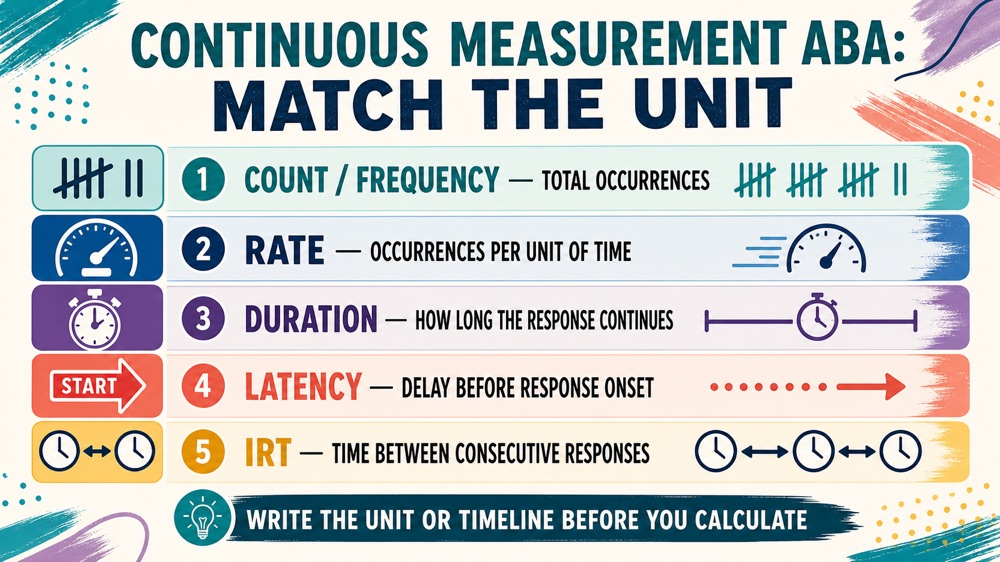
Continuous measurement ABA becomes clearer when the unit matches the dimension of the behavior that matters. The same observation can produce different summaries, but each summary answers a different question.
| Measure | What it records | Best fit in an example | Nearest contrast |
|---|---|---|---|
| Count or frequency | Total occurrences during the observation. | How many independent requests occurred? | Rate adds a time unit. |
| Rate | Occurrences per unit of time. | How many responses per minute occurred? | Count alone ignores different observation lengths. |
| Duration | How long each response or episode continues. | How many seconds did the episode last? | Latency is the delay before onset. |
| Latency | Time between a specified event and response onset. | How long after the instruction did the learner begin? | Duration begins at response onset. |
| Interresponse time | Time between the end or occurrence of one response and the next response, as defined by the procedure. | How much time passed between consecutive responses? | Latency starts from an antecedent or signal. |
Use the wording of the question and the units in the stem. “How often” may point to count or rate, so check whether a time denominator is provided. “How long did it continue?” points to duration. “How long before it started after the instruction?” points to latency. “How much time between responses?” points to IRT.
These are knowledge and distinction points. A learner who memorizes only the first sentence of each definition can still choose the wrong measure when the scenario changes. Put the timeline or unit next to every definition in your study notes.
Compare continuous and discontinuous procedures
Continuous procedures aim to detect every defined occurrence during the observation. Discontinuous procedures sample behavior across intervals or moments, so some occurrences may not be detected. Neither label automatically tells the RBT which procedure to use; the written plan and the clinical question control.
| Feature | Continuous procedure | Discontinuous procedure |
|---|---|---|
| Coverage | Every detectable occurrence during the observation window. | A sample of behavior at intervals or selected moments. |
| Useful output | Count, rate, duration, latency, or IRT when the definitions fit. | Interval or moment scores that estimate occurrence or engagement. |
| Strength | Detailed information about each response or episode. | More feasible when continuous recording is not practical. |
| Risk | Missed responses when the observer is overloaded or the definition is unclear. | Sampling can overestimate or underestimate depending on the method and behavior. |
| Role boundary | Follow the assigned measurement system. | Do not switch methods because one seems easier. |
For example, partial-interval recording scores an interval when the behavior occurs at any time in that interval; whole-interval recording scores it only when the behavior occurs for the entire interval; momentary time sampling checks at a specified moment. These are discontinuous procedures. They are not interchangeable with a continuous count just because all use time.
When a question asks which method is being used, look for the sampling rule. When a session plan specifies a method, implement that method and report feasibility or data-quality concerns to the supervisor. Do not choose a different measure to make the graph look better.
Calculate common continuous measures
Calculation questions become easier when you write the unit before doing the arithmetic. Keep the example data separate from a real client’s record; the numbers below are newly written for study.
- Count/frequency: if five defined requests occur during a 20-minute observation, the count is 5. The count does not become 0.25 unless you intentionally calculate a rate.
- Rate: if 12 responses occur in 30 minutes, the rate is 12 ÷ 30 = 0.4 responses per minute, or 24 responses per hour if that conversion is useful.
- Duration: if three episodes last 20, 30, and 10 seconds, total duration is 60 seconds and mean duration is 20 seconds per episode. State which summary the question asks for.
- Latency: if an instruction occurs at 10:02:00 and response onset occurs at 10:02:08, latency is 8 seconds. The later end of the response is irrelevant to latency.
- IRT: if one response ends at 10:03:12 and the next begins at 10:03:27, the interresponse time is 15 seconds, assuming those are the procedure’s start and stop points.
Check whether the observation periods are equal. A count from a 15-minute session and a count from a 60-minute session should not be compared as if they had the same exposure. A rate can make the time denominator visible, but only when the plan and question call for that summary.
Also check the response definition. If two observers count different topographies, a perfect calculation will still summarize unreliable data. Calculation follows definition; it does not repair a definition that is too broad or inconsistent.
Follow a role-safe data routine
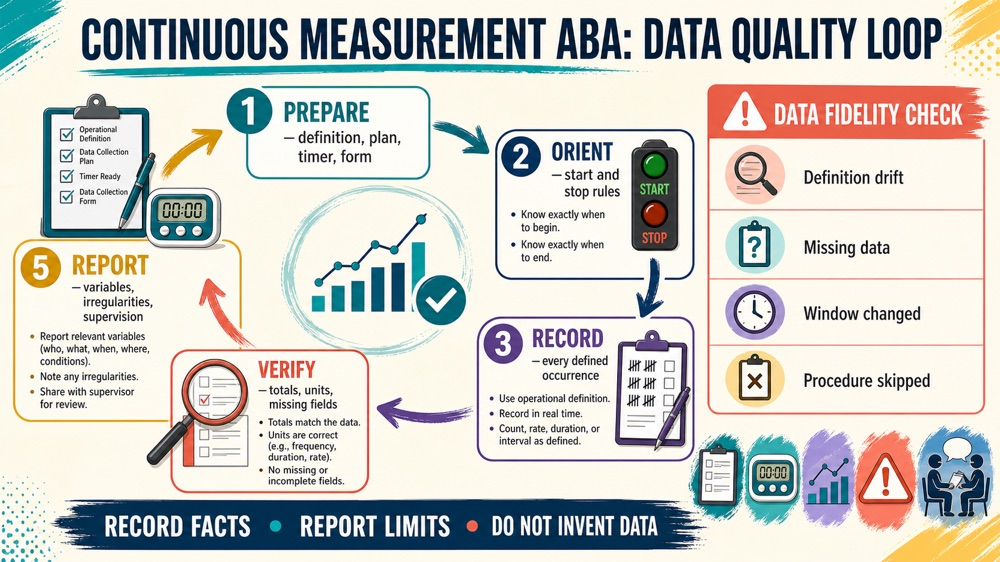
Use a consistent routine before, during, and after recording:
- Prepare: read the current written plan, confirm the target definition, open the correct data form, and check the timer or recording tool.
- Orient: identify the observation window and any start signal, stop signal, or exclusion rule.
- Record: mark each occurrence or time point according to the assigned procedure, without adding guesses about intent.
- Verify: check totals, units, missing fields, and calculation steps before submitting the record.
- Report: communicate unusual variables, data irregularities, or uncertainty through the established supervisor route.
For example, if the timer fails during a latency procedure, do not estimate the missing seconds from memory and present the result as exact. Record what happened, follow the workplace correction rule, and seek direction. Accurate documentation includes the limitation, not only the number.
Check data quality and procedural fidelity
The current TCO asks learners to understand the risks associated with unreliable data collection and poor procedural fidelity. That means a measurement note should include more than a result. It should help the team decide whether the result can be interpreted.
| Warning sign | Why it matters | Role-safe response |
|---|---|---|
| Definition changes mid-session. | Counts before and after the change may not describe the same response. | Follow the plan, document the concern, and seek clinical direction. |
| Observation window changes. | Raw counts may no longer be comparable. | Record the actual time and use the prescribed summary. |
| Missing or copied data. | The record may falsely suggest behavior was observed. | Report the missing information; never backfill invented events. |
| Procedure step is skipped. | Poor fidelity can make a change look like a behavior change. | Follow the written procedure and report the implementation issue. |
| Observer is overloaded. | Responses can be missed or recorded late. | Use the established support or supervision process. |
Do not describe a client as “better” or “worse” from one raw number alone. Describe the measure, observation window, relevant context, and any data-quality limitation. Clinical interpretation and plan changes belong to the responsible behavior-analytic team.
Practice continuous measurement ABA
Try these original practice prompts after reviewing the definitions:
- A learner emits 18 defined responses during a 45-minute session. Is the question asking for count or rate? Write both, then identify which unit the stem requests.
- An instruction is delivered at 2:10:00, the response begins at 2:10:06, and ends at 2:10:09. Identify latency and duration without swapping their start points.
- Two responses occur 14 seconds apart, but the procedure defines IRT from the end of one response to the start of the next. What information is needed before calculating?
- An observer records only whether behavior happened in each 10-second interval. Is this a continuous count or a discontinuous sample? Which words in the procedure decide?
- The data form says rate, but the observer records only a total count and forgets the session length. What should be reported before the record is finalized?
After each answer, write the decisive clue: unit, timeline, sampling rule, or written procedure. That correction step makes continuous measurement ABA more than a vocabulary topic; it becomes a repeatable decision process.
Avoid these continuous-measurement mistakes
- Calling every time-based procedure continuous: identify whether the method records every occurrence or samples intervals.
- Confusing rate and count: write the denominator and unit before calculating.
- Confusing latency and duration: mark the event that starts the clock.
- Changing the plan for convenience: report feasibility concerns and seek direction.
- Using subjective labels: record the observable response and context.
- Ignoring data quality: document missing data, definition drift, and procedural-fidelity concerns.
- Calling independent examples official: keep practice content newly written and source-labeled.
Bottom line: continuous measurement ABA means complete coverage of a defined response during an observation period. Select the unit that answers the question, follow the written procedure, calculate with the correct time boundary, and report any limitation that affects interpretation.
Ready to turn measurement errors into study targets?
Use independent RBT practice questions to compare units, timelines, and data-quality decisions after reviewing the current TCO.
Try Free RBT Practice Questions →
Frequently Asked Questions
What is continuous measurement in ABA?
It records every detectable occurrence of a defined response during the observation period, using the assigned measurement system.
Is rate the same as frequency?
Count or frequency is the total number of occurrences. Rate adds a time denominator, such as responses per minute.
What is the difference between latency and duration?
Latency is the time between a specified event and response onset. Duration is how long the response continues after it begins.
Can an RBT switch from continuous to discontinuous measurement?
Do not change the assigned procedure independently. Follow the written plan and report feasibility or data-quality concerns through supervision.
References
- Behavior Analyst Certification Board. RBT Test Content Outline, 3rd edition.
- Behavior Analyst Certification Board. RBT Handbook, updated June 2026.
- Behavior Analyst Certification Board. RBT Ethics Code.