
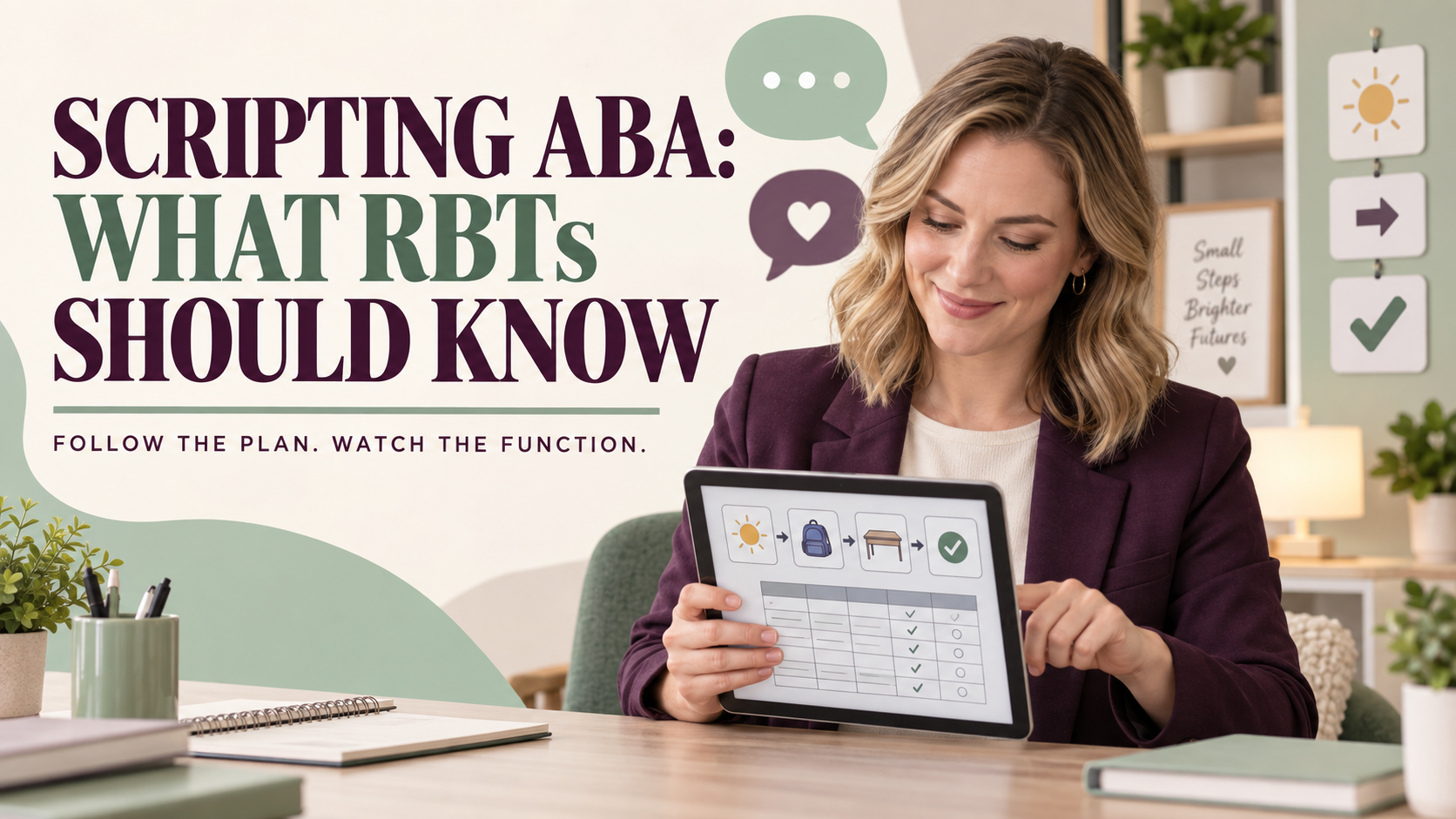
Scripting ABA can refer to a planned script used to support communication and social interaction, or to repeated language that a learner uses from memory, media, or a familiar routine.
Table of Contents
- Scripting ABA: quick answer
- Two meanings of “scripting”
- What script fading is
- Why a team may use a script
- The RBT’s role
- How to implement a written plan
- What to measure
- When repeated language may be communication
- Common mistakes to avoid
- When to contact the supervisor
- Frequently asked questions
Scripts, script fading, repeated language, RBT role boundaries, data, and respectful communication support
Scripting ABA: What RBTs Should Know
Scripting ABA can refer to a planned script used to support communication and social interaction, or to repeated language that a learner uses from memory, media, or a familiar routine. Those meanings are related but not identical. For an RBT, the practical question is not simply how to make scripting stop. It is how to understand the behavior’s function, follow the supervisor’s written plan, support meaningful communication, collect useful data, and report changes without replacing the learner’s voice with a rehearsed performance.
Scripting ABA: quick answer
In ABA, a script is a written, spoken, audio, visual, or otherwise arranged cue that helps a learner start or continue a targeted interaction. Script fading is the planned reduction of that support as the learner gains independence. Research summaries describe scripts and script fading as procedures that have been used to teach verbal initiations, peer interaction, and conversation skills, including by gradually removing words from a cue.
“Scripting” can also describe a learner repeating phrases, lines, or routines. Repetition may communicate a request, share interest, rehearse a social exchange, regulate emotion, or occur for another reason that is not obvious from the words alone. An RBT should not assume that all repeated language has the same function or that every instance should be interrupted. The RBT follows the supervisor’s plan, treats the learner with dignity, records observable data, and reports patterns that may require reassessment.
Two meanings of “scripting”
The search phrase scripting ABA is broad because professionals and families use the word in more than one way. Clarifying the meaning prevents a team from choosing the wrong response.
Script-based teaching
In script-based teaching, the team intentionally provides a cue for a skill. The cue may be a written sentence, a picture sequence, an audio prompt, a model, or a short phrase that helps the learner initiate a conversation or complete a social routine. For example, a learner may use a card that says, “Can I play?” during a planned peer activity. The goal is not to make the learner recite an adult’s preferred words forever. The plan should explain what communication opportunity is being taught and how independence, variation, and generalization will be evaluated.
Repeated language or memorized phrases
In everyday conversation, “scripting” may describe repeated lines from a show, a familiar question-and-answer sequence, or language that sounds copied from another person. The phrase may be meaningful even when it does not look like a direct answer. It may be a way to request, comment, connect, anticipate an event, practice a phrase, express excitement, or manage uncertainty. The RBT observes the context and the learner’s response rather than labeling the language as meaningless or automatically treating it as a reduction target.
These two meanings can overlap. A team may teach a script and later observe that the learner uses parts of it in new situations. A learner may also bring an existing phrase into a teaching activity. The written plan and supervisor’s interpretation should determine the intervention, not the label alone.
What script fading is
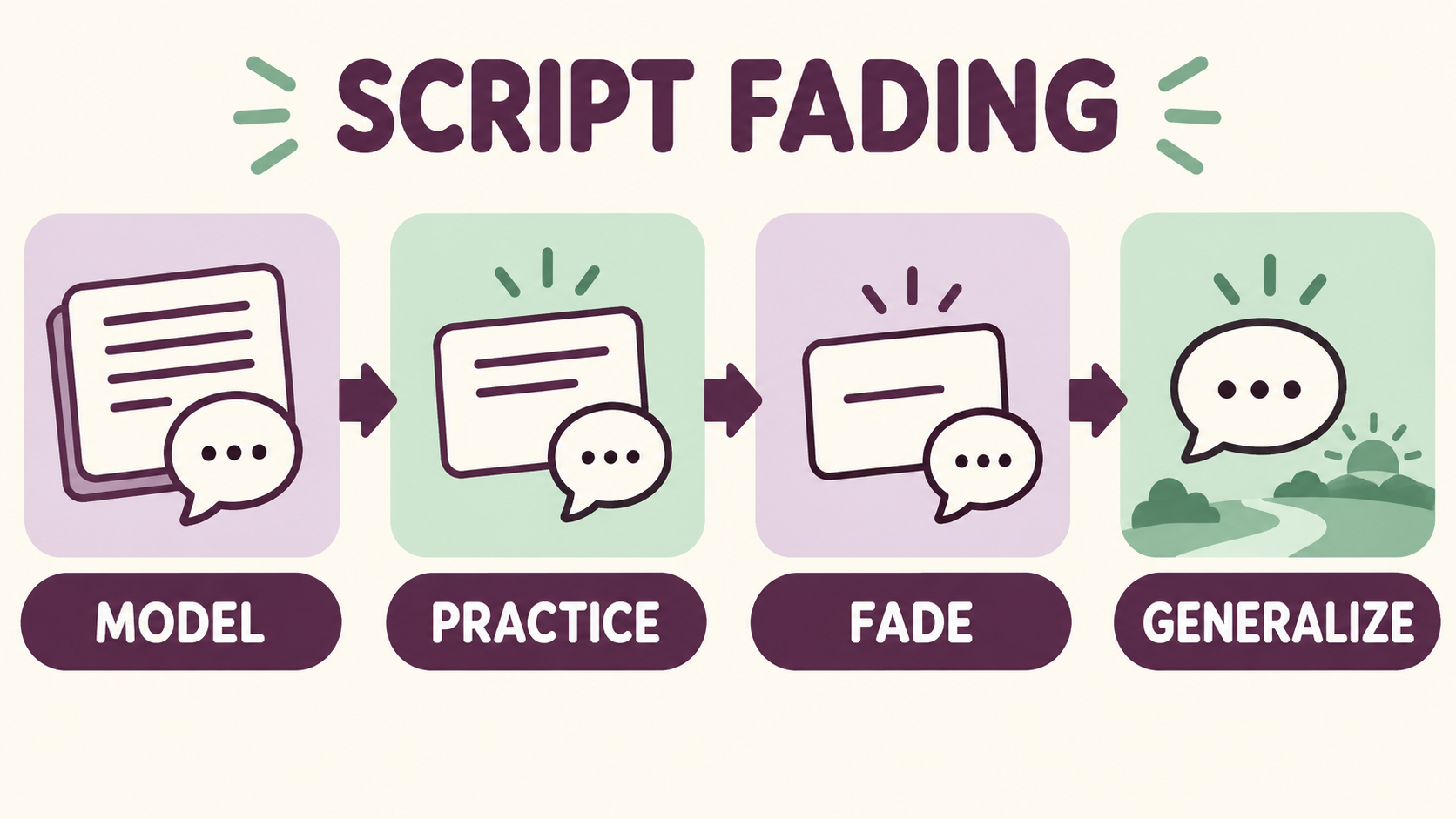
Script fading is a prompting procedure in which a support is gradually reduced after the learner has had successful practice. A common example is a written social script that begins as a complete phrase and is then shortened, often from the end, while the learner continues to produce the response. The exact sequence, fading criterion, prompt level, reinforcement, and generalization plan must be specified by the qualified supervisor.
A script is not the same thing as a demand to sound “normal.” A useful plan identifies a meaningful communication outcome: initiating with a peer, requesting help, answering a question, joining an activity, or using an effective alternative to an unsafe response. It also defines how the learner can communicate refusal, ask for a break, use an AAC system, or choose a different wording when that better fits the situation.
Research is informative but does not guarantee that one script or fading schedule will work for every learner. A PubMed-indexed study on teaching sociodramatic scripts reported increased theme-related social behavior in the small groups studied, while later work has examined script training and peer-to-peer communication. These findings support careful, individualized use—not a universal recipe.
Why a team may use a script
A script may reduce the language load of a new social situation and make a first attempt more predictable. Possible goals include:
- starting an interaction with a peer;
- requesting an item, action, or assistance;
- joining a routine such as a game or group activity;
- practicing a safety or self-advocacy phrase;
- building a conversation exchange around a preferred topic; or
- supporting communication while a more independent response develops.
A strong goal describes what the learner will be able to do, where the skill matters, and how the learner can express choice. “Say this exact sentence ten times” may be a measurement step, but it is not enough as a long-term outcome. The team should consider whether the response transfers to a new person, material, setting, topic, or natural opportunity.
The RBT’s role
The BACB RBT Ethics Code states that RBTs provide behavior-technician services within a clearly defined role and under close, ongoing supervision. RBTs implement authorized procedures, collect data, document accurately, and communicate observations. They do not independently invent a script-fading protocol, change a target, decide that a learner’s communication is invalid, or alter reinforcement criteria without direction.
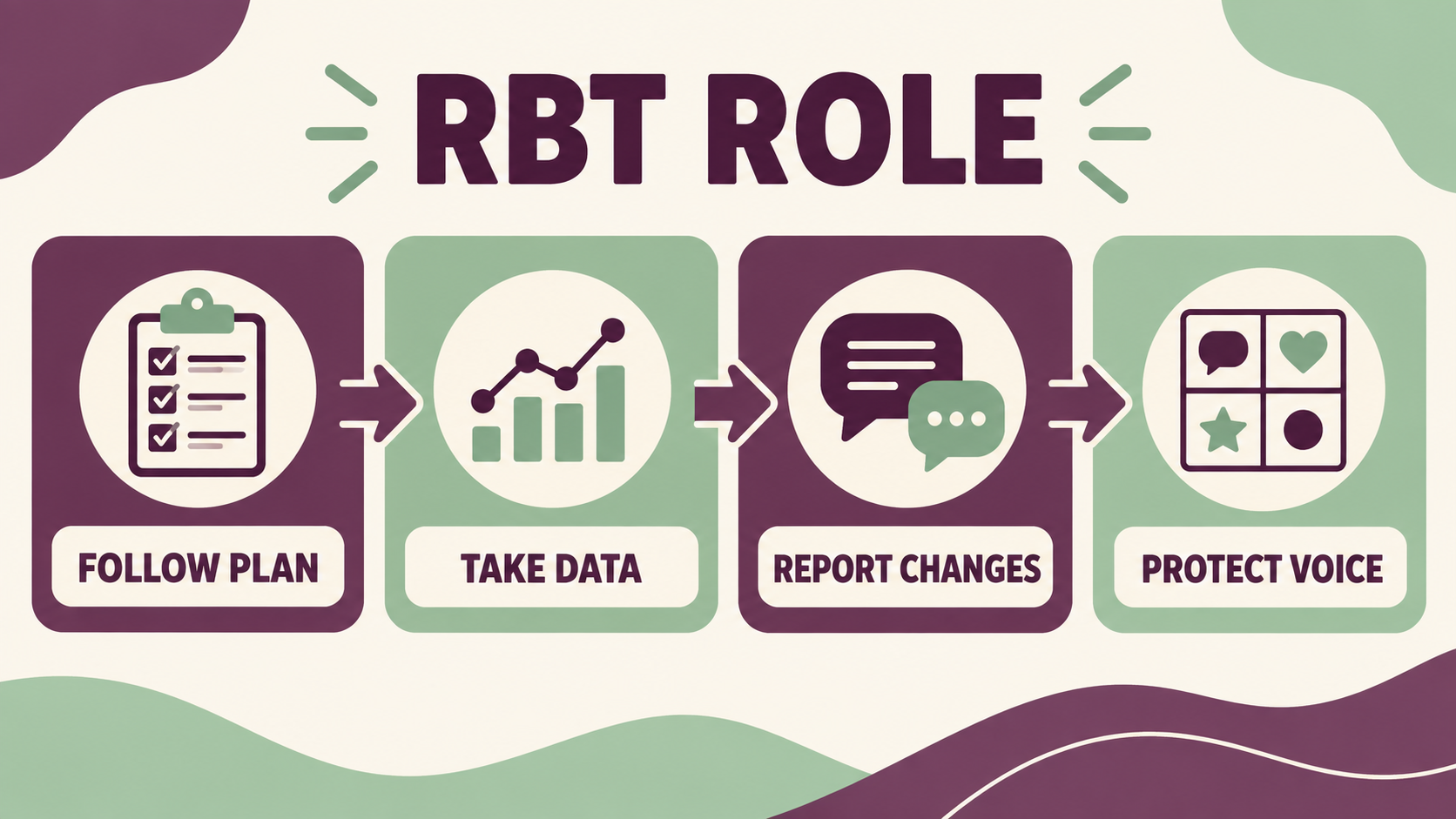
The RBT role typically includes:
- reviewing the current written program before the session;
- checking what counts as an opportunity, prompted response, independent response, and error;
- presenting the approved cue in the specified way;
- allowing reasonable processing time rather than rushing the learner;
- reinforcing the response according to the plan;
- recording what actually happened, including prompt level and context; and
- telling the supervisor when the plan is unclear, ineffective, distressing, or no longer a good fit.
Respectful implementation matters as much as procedural accuracy. Speak to the learner, not about the learner. Protect privacy, use approved communication channels, and avoid sharing a video, script sample, or client story outside the authorized team.
How to implement a written plan
Before the session, identify the target and the cue. Is the script written, spoken, pictured, modeled, or delivered through an AAC device? When is it available? What natural event should evoke it? What does the RBT do if the learner uses a shorter phrase, a different but functional phrase, a sign, or a device response?
During practice, keep the prompt consistent with the plan and avoid adding extra language that changes the teaching condition. Provide the approved opportunity, wait for the defined interval, and use the least intrusive prompt that the program specifies. Reinforce the meaningful communication response rather than rewarding a particular accent, facial expression, eye contact pattern, or exact performance that is not part of the goal.
When fading begins, do not fade simply because the calendar says it is time. Follow the written criterion and data review. If removing a word causes errors, frustration, avoidance, or a drop in functional communication, record the pattern and contact the supervisor. A temporary return to a fuller cue may be part of an authorized plan; it is not an independent RBT decision.
Generalization should be planned. A phrase learned at a table with one adult may need practice with a peer, in a different room, with a new material, or during a naturally occurring opportunity. Generalization should never mean forcing the learner into an unsafe or humiliating situation. The team should preserve access to AAC, breaks, refusal, and other communication options throughout the process.
What to measure
Data should answer the question the program is trying to answer. Depending on the plan, useful measures may include:
- the number of opportunities presented;
- independent, prompted, and incorrect responses;
- the level and type of prompt used;
- latency from the opportunity to the response;
- whether the learner initiated, responded, or maintained an exchange;
- variation or flexibility in the learner’s wording; and
- generalization across people, settings, activities, and materials.
Record context as well as totals. A response that occurs after a loud transition, unexpected change, or peer invitation may tell the team more than a percentage alone. Note whether the learner had access to a preferred communication mode, whether the script was available, and whether the learner showed signs of distress or requested a break.
When repeated language may be communication
Repeated language can be easy to notice and easy to misunderstand. Before interrupting it, observe what happened before the phrase, what the learner did while saying it, what happened afterward, and whether the phrase changes with context. A repeated line may signal interest, a request for reassurance, an attempt to join someone, anticipation, sensory regulation, or a need for support.
The goal of observation is not to excuse every behavior or to assume a single explanation. It is to avoid replacing a meaningful communication attempt with an arbitrary demand for silence. If the learner’s safety, participation, sleep, learning, or quality of life is affected, bring objective observations to the supervisor. A BCBA, SLP, occupational therapist, caregiver, and learner may each contribute relevant information within their roles.
Use neutral language in the record. “Repeated the line ‘ready, set, go’ three times while waiting for the swing and then pointed toward the swing” is more useful than “engaged in meaningless scripting.” The first description allows the team to investigate possible communication and environmental variables.
Common mistakes to avoid
- Assuming all scripting is a reduction target. The same words may have different functions in different moments.
- Fading too quickly. The learner’s data, response quality, and well-being should guide an authorized adjustment.
- Requiring exact adult language. Functional communication may be spoken, signed, pictured, typed, generated by AAC, or expressed in a different phrase.
- Adding prompts that are not in the plan. Extra cues can change the teaching condition and create prompt dependence.
- Ignoring assent and refusal. A learner needs a safe way to pause, decline, request help, or choose a different communication mode.
- Recording only success. Errors, latency, context, and prompt level help the supervisor evaluate the procedure.
- Sharing examples casually. Client language, videos, and data remain confidential and should stay in approved systems.
When to contact the supervisor
Contact the supervisor promptly when the script is missing, contradictory, outside your competence, or difficult to implement as written. Also report a meaningful change in the learner’s communication, a new safety concern, repeated distress, a sharp increase in prompting, a loss of previously acquired skills, or evidence that the procedure is not generalizing.
The RBT Ethics Code requires RBTs to seek supervisor support when interpreting and applying the Code and when addressing an ethical dilemma. It also requires accurate, necessary job-related communication and documentation. If you are asked to suppress data, use an unapproved intervention, share confidential information, or represent an independent clinical decision as your own, document the concern and follow the appropriate reporting route.
A useful message is specific: “Across six opportunities today, the learner used the full script only after a model, then independently pointed to the AAC request. The current program does not say how to score the AAC response. Please clarify the response definition and whether the plan should be reviewed.”
Frequently asked questions
Is scripting in ABA always a treatment problem?
No. “Scripting” may refer to an intentional communication support or to repeated language that serves a meaningful function. The team should observe context and follow an individualized plan rather than treating the word itself as proof of a problem.
Does script fading mean removing every support?
No. Fading is a planned reduction of a particular prompt when the learner is ready. A learner may continue to need visual supports, AAC, extra processing time, or another accommodation. The plan should define independence in a way that preserves communication access.
Can an RBT create a new script during a session?
An RBT should not independently design or change a clinical procedure. If the learner needs a different cue or the current script is not working, record the observation and ask the supervisor for direction.
What should an RBT do when a learner repeats a phrase from a show?
Observe the context, respond respectfully, and follow the current plan. Do not assume the phrase is meaningless or interrupt it automatically. Document what occurred before and after the phrase and bring questions about function, communication, or safety to the supervisor.
Where can I learn more about script fading?
The Association for Science in Autism Treatment summary of script and script-fading procedures describes common uses and references research. A PubMed-indexed study on teaching scripts during sociodramatic play reports one research example. For RBT scope, supervision, confidentiality, and ethics, read the BACB RBT Ethics Code and the current RBT Handbook.
Source note: This article was reviewed against the BACB RBT Ethics Code (2.0), the BACB RBT Handbook, PubMed-indexed research, and an evidence summary on script/script fading, retrieved September 28, 2026. It is educational information, not individualized clinical, legal, or speech-language advice.
Ready to practice the RBT concepts you just reviewed?
Try an independent, original RBT practice resource with exam-style questions, scoring, and answer explanations.
References
- Behavior Analyst Certification Board. RBT Test Content Outline, 3rd edition.
- Behavior Analyst Certification Board. RBT Handbook.
- Behavior Analyst Certification Board. RBT Ethics Code.