

RBT training materials are easier to choose when you separate three jobs: learning the concepts, implementing an authorized program, and documenting what happened.
Table of Contents
- RBT training materials: quick answer
- The three material kits
- Kit 1: study and exam preparation
- Kit 2: approved session tools
- Kit 3: documentation and privacy
- How to evaluate a resource
- Materials to avoid or question
- How supervision changes the answer
- A simple weekly checklist
- Frequently Asked Questions
Study resources, approved session tools, documentation habits, and privacy checks
RBT Training Materials: What You Really Need
RBT training materials are easier to choose when you separate three jobs: learning the concepts, implementing an authorized program, and documenting what happened. A thick binder or a polished app does not automatically make training better. The useful question is whether a material is current, connected to the written plan, appropriate for the RBT role, and safe for client information. This guide builds a practical materials system without turning a general checklist into an independent clinical protocol.
RBT training materials: quick answer
The right RBT training materials depend on the task. For study, you need current source documents, a way to retrieve definitions, original practice questions, and an error log. For a session, you need the materials identified or approved by the written program, the data system, and the items required to implement the assigned procedure. For documentation, you need an authorized record system, objective notes, a secure communication path, and a method for reporting barriers.
There is no universal shopping list that can replace a supervisor’s instructions. A material can be educationally useful and still be inappropriate for a particular learner, setting, or program. Keep the distinction visible: a study flashcard is not a treatment plan, a generic token board is not automatically an approved reinforcement system, and a free app is not automatically a secure record.
The three material kits
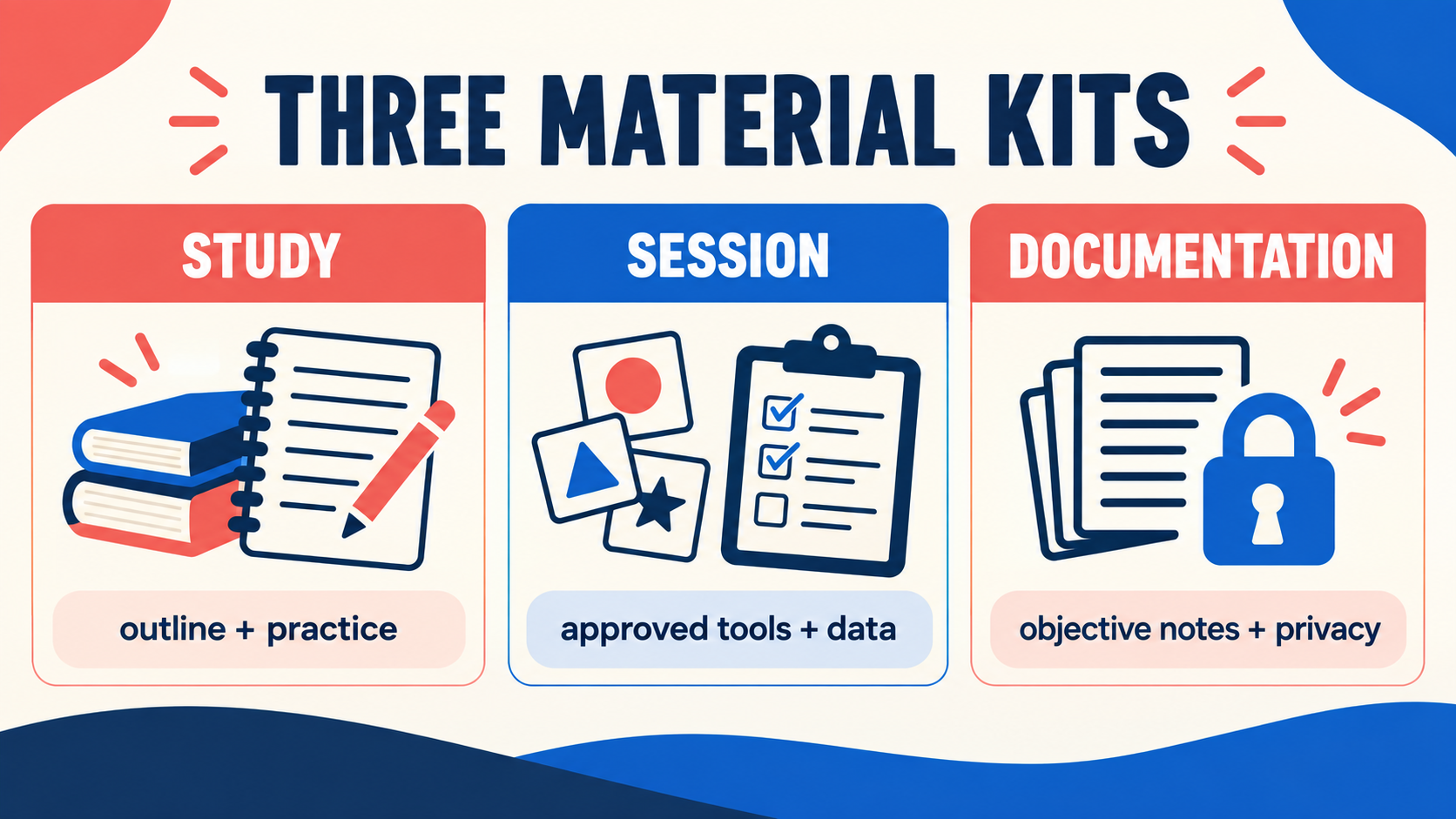
Organize your resources into three separate kits. The physical items may overlap, but the decision rules do not.
- Study kit: official outlines, current handbook and ethics resources, notes, flashcards, practice questions, and an error log.
- Session kit: only the tools and materials authorized for the learner and procedure, plus the current data form and safety information.
- Documentation kit: the approved platform or paper record, objective language prompts, privacy rules, and a route for reporting concerns.
This structure prevents a common mistake: buying a general resource and assuming it tells you what to do with a client. Training materials should improve your knowledge and implementation accuracy; they should not silently create a new intervention.
Kit 1: study and exam preparation
A strong study kit begins with primary sources. Keep the current RBT Test Content Outline, the RBT Handbook, and the RBT Ethics Code easy to find. Add a dated note showing when you checked each source. A study guide can translate the language, but it should not outrank the official source when the topic is eligibility, examination administration, supervision, or professional conduct.
Use a small set of active-recall tools:
- Concept cards: one term, plain-language definition, observable example, and a note about what data or role boundary matters.
- Comparison cards: pairs that are easy to confuse, such as frequency and duration, prompt and reinforcement, or preference and reinforcer.
- Scenario cards: an original situation followed by the decisive clue and the most appropriate next step.
- Error log: the domain, the mistake, the corrected rule, and a new example to answer later.
Practice questions are most useful when they include explanations. A score tells you what happened in one attempt; an explanation helps you decide what to study next. Avoid resources that claim to contain recalled, leaked, or identical examination questions. Independent practice should be labeled as independent and should encourage reasoning rather than answer memorization.
Kit 2: approved session tools
Session materials are controlled by the written program, the setting, and supervision. Start with the program’s instructions: what target is being taught or measured, what materials are named, what prompt or reinforcement procedure is authorized, what data are required, and what safety steps apply. If a material is missing, broken, confusing, or likely to change the learner’s response, ask the supervisor before improvising.
Common categories may include:
- the current program sheet or session instructions;
- the exact teaching materials named in the procedure;
- data sheets, timer, counter, or approved digital data tool;
- reinforcement items or choice materials identified by the plan;
- visual supports, task materials, or communication tools used as directed; and
- any safety or emergency information required by the setting.
Do not treat this list as a protocol. For example, a generic visual schedule, edible item, sensory tool, or token board may be inappropriate if it has not been assessed, authorized, or documented. The RBT implements within the defined scope and reports what is not working. Choosing a new target, changing a mastery criterion, selecting a new consequence, or modifying a procedure belongs in the supervisory process.
Kit 3: documentation and privacy
Documentation materials should make objective reporting easier, not encourage more data collection than the plan requires. Know where the record is stored, who may access it, what fields are required, and how to correct an error. Keep notes about observable events, relevant context, the procedure implemented, the learner’s response, and any needed follow-up.
Privacy is part of the materials decision. A free spreadsheet, messaging app, cloud drive, or photo folder may be convenient but not authorized. Never place identifiable client information into a personal tool simply because it is easier to use. Follow the organization’s approved system and ask the supervisor or responsible organization when the rule is unclear.
A useful documentation kit may include a secure approved platform, the correct data definitions, an objective-language checklist, a way to record implementation barriers, and the contact path for urgent or routine concerns. It does not include personal copies of confidential records stored on an unapproved device.
How to evaluate a resource
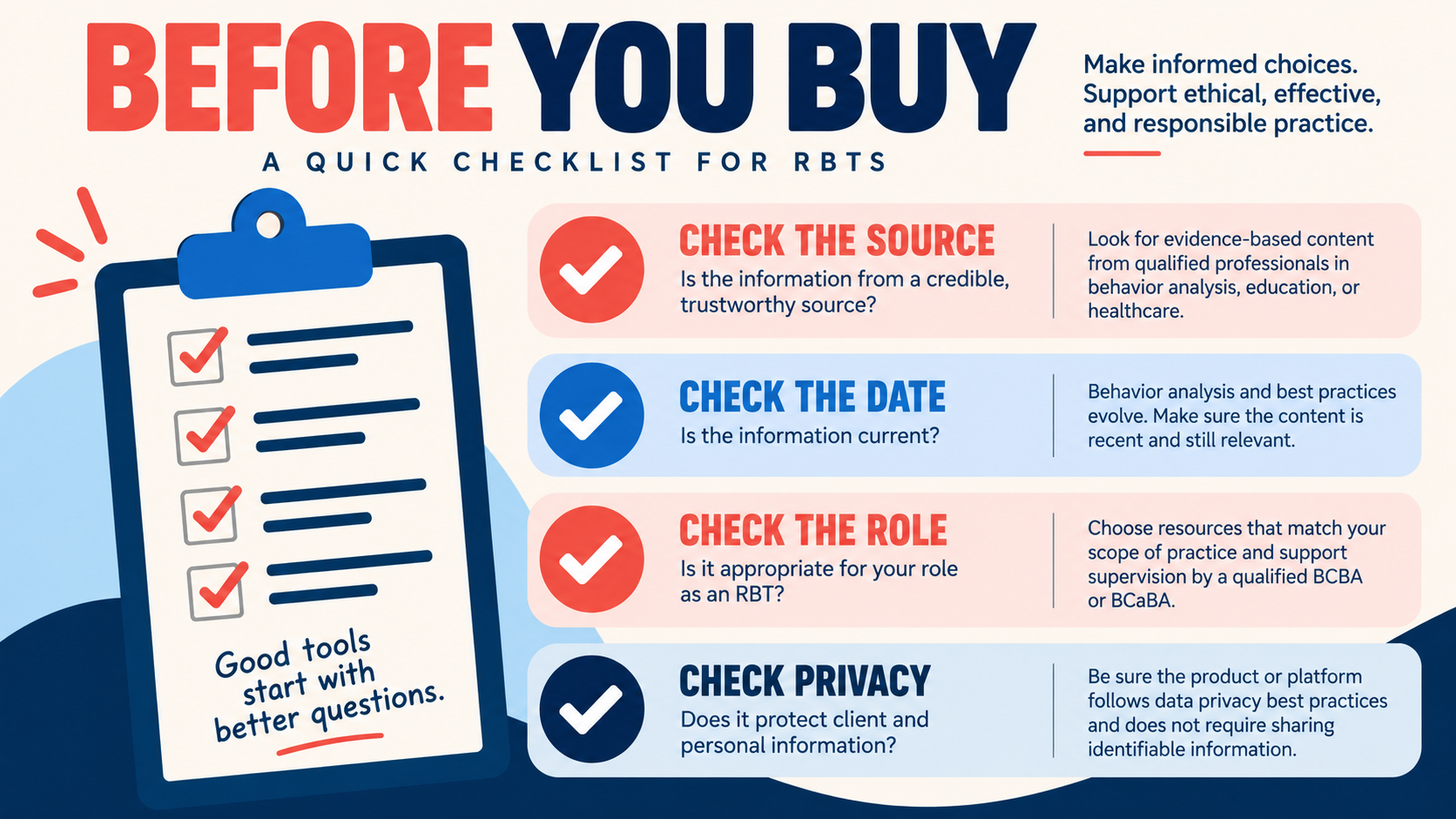
Before you download, buy, print, or share a resource, ask four questions:
- What is the source? Is the author identifiable, qualified for the claim, and clear about whether the material is official or independent?
- What is the date? Does the resource show when it was reviewed, and could the rule or outline have changed?
- What is the role? Does it support RBT implementation and learning, or does it invite an RBT to design treatment independently?
- What is the privacy impact? Does it require identifiable information, photographs, recordings, or client data in a system that has not been approved?
Also check whether the material is usable. A beautiful template that takes longer to complete than the session does not necessarily improve accuracy. A practical form should have clear definitions, enough space for the required response, and a version or date so an outdated copy can be removed.
Materials to avoid or question
Be cautious with any resource that makes one of these promises:
- “This is the official exam” or “these are the real questions.”
- “Use this intervention with any learner” without a written program or supervision.
- “Collect everything” without defining the measurement, purpose, or storage.
- “Send client videos or records through this personal app.”
- “You can change the procedure when the learner does not respond.”
These claims confuse education, treatment design, documentation, and administration. A resource can still be useful if you narrow its purpose, remove unsupported claims, and confirm its use with the supervising team. If the resource depends on confidential examples, use fictional or de-identified practice material instead.
How supervision changes the answer
Supervision is not an afterthought to materials selection. A supervisor or responsible organization can identify which version of a program is current, which tools are approved, what data to record, and what to do when a tool is unavailable. Bring specific questions: “The program names a timer, but the app is unavailable; which approved alternative should I use?” is more useful than silently substituting a tool.
Report patterns, not only emergencies. Tell the supervisor when a material is consistently missing, a definition is unclear, a data field cannot be completed as written, or a resource encourages a step outside your role. Document the relevant facts objectively and follow the organization’s process for urgent safety concerns.
A simple weekly checklist
Once a week, spend a few minutes checking:
- Are the official study sources and program documents current?
- Are your study questions original, explained, and separated from official exam content?
- Do session materials match the current written instructions?
- Can you define the data you are recording and identify where it is stored?
- Are any personal devices, photos, or apps being used in a way the organization has not approved?
- Have you written down a clear question for the supervisor about any barrier?
This checklist is intentionally small. The goal is to keep materials aligned with the source, date, role, and privacy—not to build a giant collection that nobody can maintain.
Frequently Asked Questions
What are the most important RBT training materials?
For study, start with current BACB sources, a retrieval system, original practice questions, and an error log. For sessions, use the program’s approved tools and data system. For documentation, use the authorized record process and privacy rules.
Do RBTs need to buy special session materials?
Not automatically. The supervising team or organization should identify what is needed for the assigned program. Do not purchase or introduce a tool as a substitute for written instructions without asking.
Can I use a free app for RBT data collection?
Only if it is approved for the setting and appropriate for the information it stores. Convenience does not replace authorization, security, or the organization’s documentation process.
Are online RBT training materials official?
Not unless the issuing organization clearly identifies them as official, and even then, confirm current requirements at the BACB source. Many helpful guides are independent educational materials and should be labeled that way.
Where can I verify current RBT requirements?
Use the BACB RBT Handbook, the RBT Test Content Outline, and the RBT Ethics Code. This article is educational and does not replace the written plan, supervision, or official instructions.
Source note: This article was reviewed against current BACB resources and independent training-material practices on September 28, 2026. RBT Training is independent educational content and is not affiliated with or endorsed by the BACB.
Ready to practice the RBT concepts you just reviewed?
Try an independent, original RBT practice resource with exam-style questions, scoring, and answer explanations.
References
- Behavior Analyst Certification Board. RBT Test Content Outline, 3rd edition.
- Behavior Analyst Certification Board. RBT Handbook.
- Behavior Analyst Certification Board. RBT Ethics Code.