
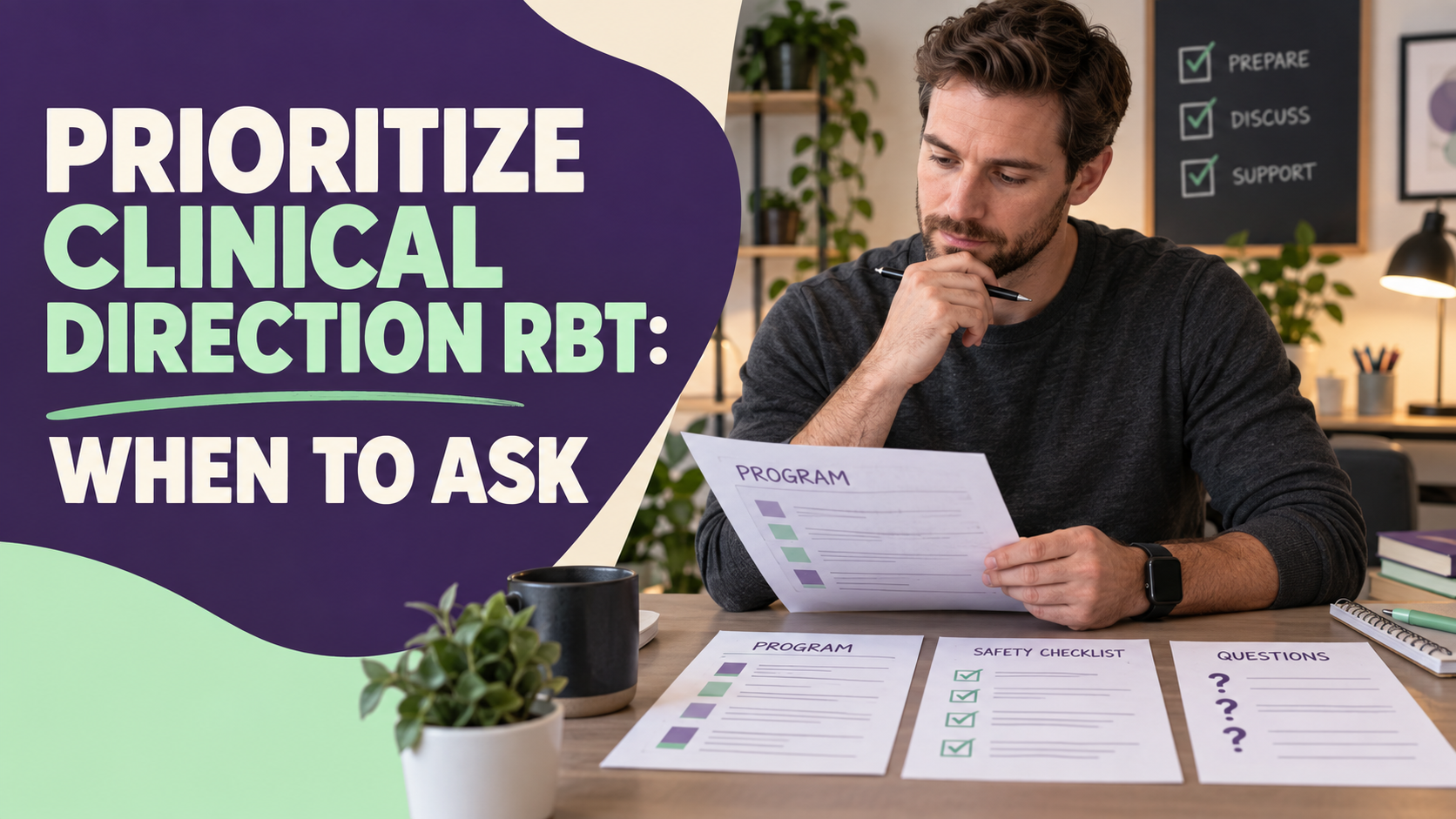
Prioritize clinical direction RBT decisions by knowing when a situation needs supervisor input before you continue, improvise, or change anything.
Table of Contents
- Prioritize clinical direction RBT: quick answer
- Four signals that direction is needed
- Safety comes first
- Check the current plan
- Use data without overinterpreting it
- How to ask a focused question
- What to document
- What an RBT should not change independently
- Worked examples
- A supervision-ready routine
- Frequently Asked Questions
How to pause, organize facts, ask focused questions, and stay inside the RBT role
Prioritize Clinical Direction RBT: When to Ask and What to Document
To prioritize clinical direction as an RBT means knowing when a situation needs supervisor input before you continue, improvise, or change anything. It is not a sign that you are incapable. It is a professional way to protect safety, follow the written plan, preserve accurate data, and keep clinical decisions with the person authorized to make them. This guide explains a practical sequence for identifying the signal, checking the current instructions, asking a useful question, and documenting the result.
Prioritize clinical direction RBT: quick answer
Prioritize clinical direction when safety is uncertain, the written plan is unclear or unavailable, the data do not match what you are observing, or someone asks you to act outside your training or authorization. First protect immediate safety according to the setting’s emergency process. Then describe what happened objectively, check the current instructions, identify the exact decision that is unclear, contact the appropriate supervisor or responsible organization, and document the guidance you receive.
The key is to ask before making a clinical change. “The learner did not respond, so I changed the prompt” is a change that may affect the program and the data. “The learner did not respond after the authorized prompt sequence; which step should I implement next?” preserves the decision boundary and gives the supervisor useful information.
Four signals that direction is needed
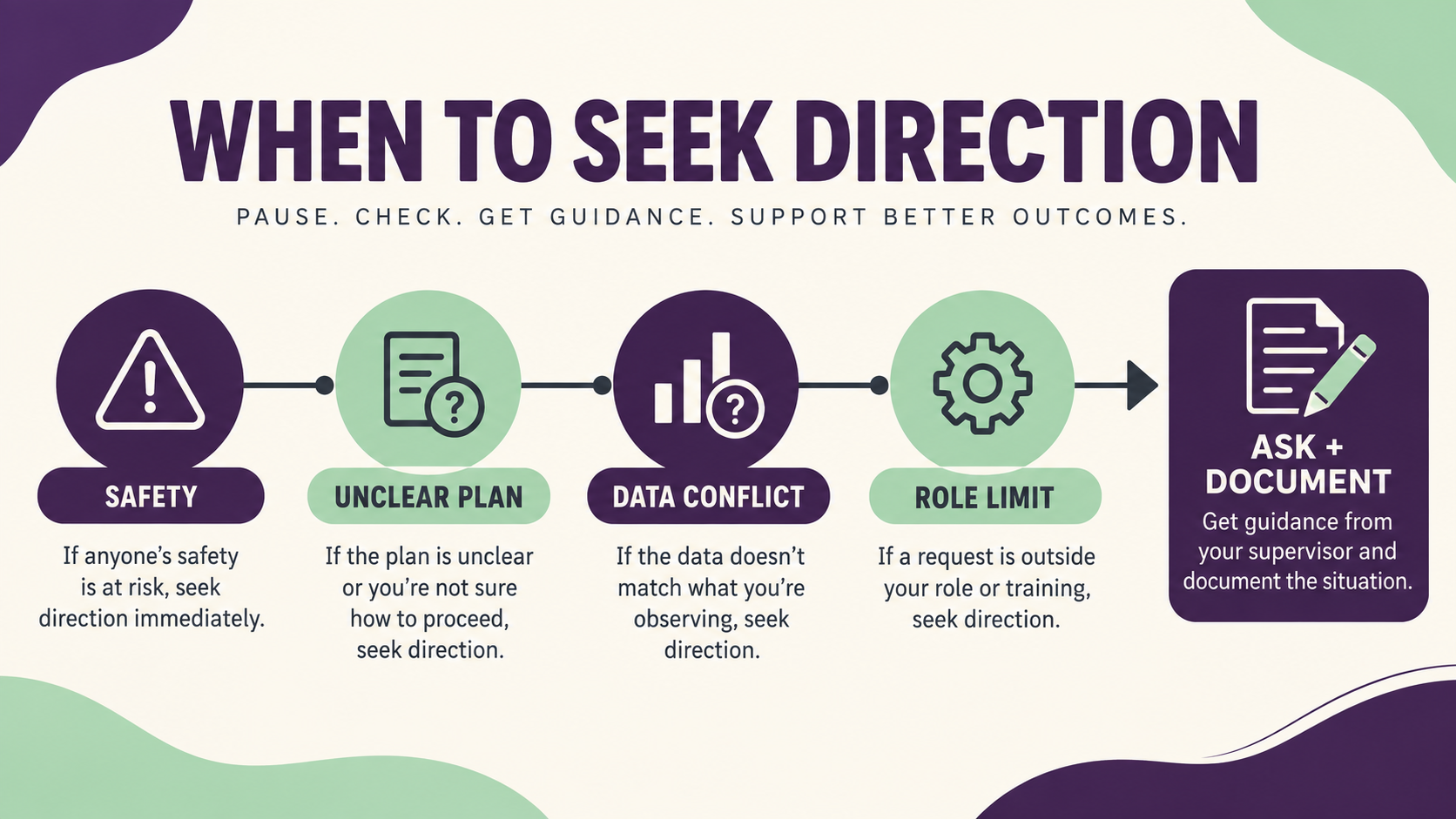
Not every small inconvenience requires an urgent call, but four recurring signals should move a question up your priority list:
- Safety signal: a person may be at immediate risk, a crisis procedure is triggered, or the written safety response does not fit what is happening.
- Plan signal: the current program is missing, contradictory, outdated, or too vague to identify the next authorized step.
- Data signal: the measurement cannot be completed as defined, the record conflicts with the observation, or a pattern changes enough to require review.
- Role signal: someone asks you to select a new target, change a procedure, set a mastery criterion, interpret a diagnosis, or share information outside the approved process.
These signals are about the decision, not about blaming a learner, caregiver, or coworker. Describe the condition that requires direction and avoid turning a question into a conclusion about why behavior occurred.
Safety comes first
If there is an immediate safety concern, follow the setting’s emergency and crisis procedures, seek the responsible help identified by the organization, and do not wait for a routine supervision meeting. Use only actions you are trained and authorized to perform. After the immediate situation is stable, report the facts through the required channel and complete the required documentation.
Do not use a general blog checklist as an emergency protocol. The correct response depends on the learner, setting, approved plan, staffing, and local requirements. If you are unsure whether a situation meets the organization’s urgent threshold, use the designated escalation path and state what you observed, where you are, and what immediate risk is present.
Check the current plan
Before asking a routine clinical question, locate the current program or session instructions. Check the target, operational definition, materials, prompt sequence, reinforcement arrangement, data definition, mastery criterion, and safety notes that apply to the situation. Record which version or date you used if the organization maintains version control.
If two documents disagree, do not choose the one you prefer. Pause the disputed step and ask which instruction controls. If a material is missing, report that barrier and ask for an approved alternative. If the plan is written for a condition that is not present, describe the difference rather than silently adapting the procedure.
A useful question includes the point of uncertainty: “The program specifies a visual choice between two items, but only one approved item is available. Should I pause this target, use the listed alternative, or follow another instruction?” That question is easier to answer than “What should I do?” because it identifies the available facts and the decision needed.
Use data without overinterpreting it
Data can help prioritize a question, but a single observation does not automatically explain a pattern or authorize a new intervention. Confirm what the measurement means. Are you recording frequency, rate, duration, latency, interval data, percentage correct, prompt level, or another defined measure? If the data form does not match the program, ask before changing the form.
Separate observation from interpretation. “The response occurred four times during the 20-minute observation” is different from “the learner was seeking attention.” The first is an observable record; the second is a hypothesis that may require assessment. Report both only when the distinction is clear and the process requires it.
Prioritize clinical direction when the same measurement problem repeats, when a new pattern could affect safety or treatment decisions, or when your notes cannot represent what happened accurately. Bring the raw observation, the definition you used, and the question you need answered.
How to ask a focused question
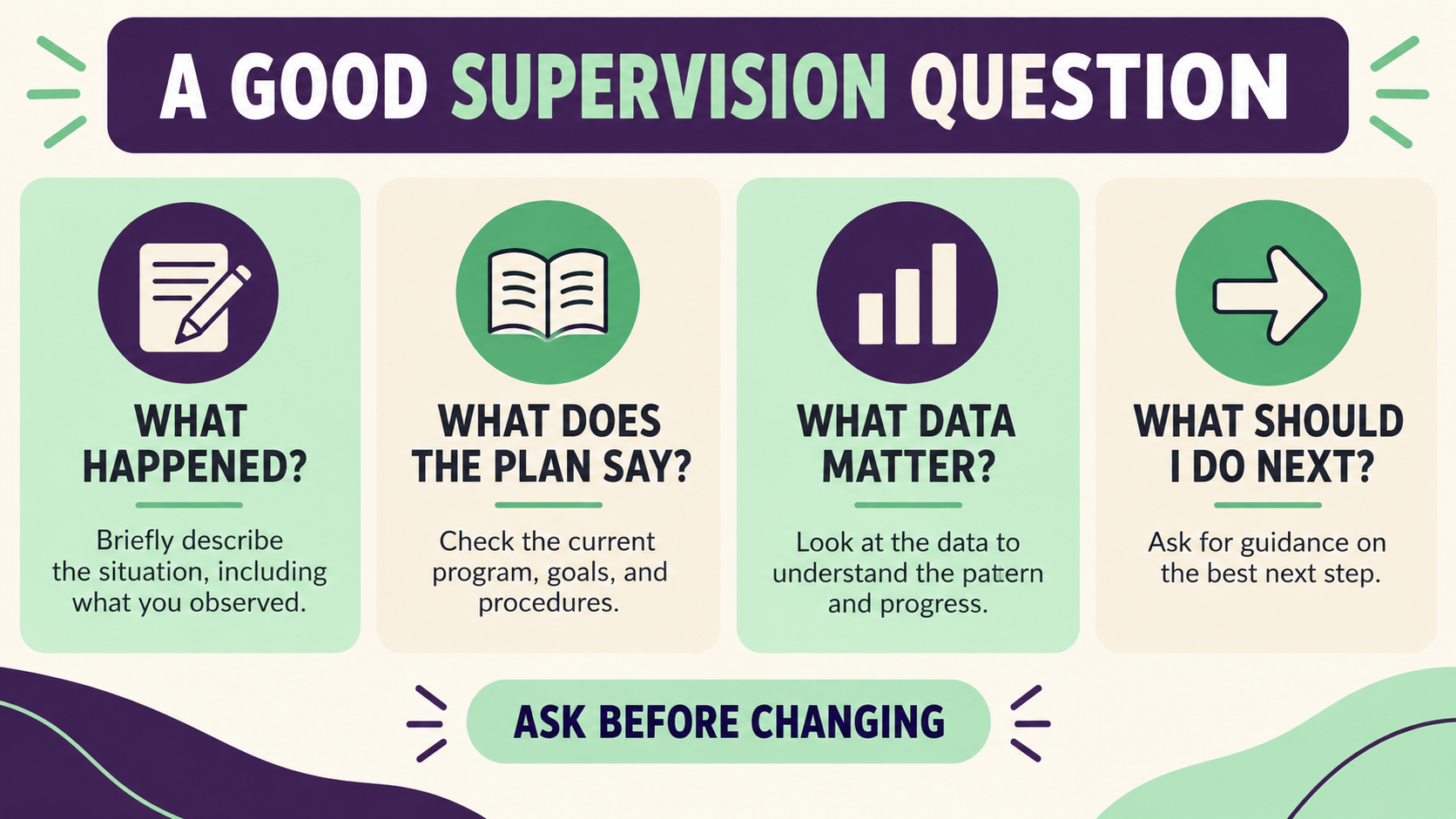
A focused supervision question has four parts:
- What happened? Give the setting, relevant antecedent, observable response, and immediate consequence without adding a diagnosis.
- What does the plan say? Quote or summarize the current step, prompt, data rule, or safety instruction.
- What data matter? Include the count, duration, prompt level, missing material, or other fact that changes the decision.
- What should I do next? Ask for the authorized next step and whether the event needs additional reporting.
Use the question to create a learning loop. After the supervisor answers, repeat the instruction in your own words, confirm how to record it, and ask when to follow up. This reduces the chance that an informal message becomes a different procedure through misunderstanding.
What to document
Document the facts required by the organization’s record system. Depending on the process, that may include the date, time, setting, people present, observable event, procedure implemented, data, safety action, who was contacted, guidance received, and follow-up task. Keep language objective and protect confidential information.
Do not rewrite the record to make the session appear smoother. If an error occurred, follow the correction process and report it. Accurate documentation helps the supervisor distinguish a learner response from a materials problem, implementation barrier, data-definition problem, or safety concern.
Keep clinical questions in authorized channels. Avoid sending identifiable details through personal messaging, storing screenshots on a personal device, or copying confidential information into an unapproved note-taking app. Privacy is part of prioritizing direction.
What an RBT should not change independently
As an RBT, do not independently select new treatment targets, rewrite an operational definition, change a mastery criterion, choose a new consequence, alter the prompt hierarchy, introduce a new behavior-reduction procedure, conduct an assessment outside your authorization, or interpret a diagnosis as a treatment decision. Even a well-intended change can affect safety, fidelity, data, and consent.
Implementation does require judgment, such as noticing a missing item, describing a barrier, or following an established error-correction step. The boundary is whether the decision is already authorized in the current plan. If not, prioritize clinical direction and ask.
Worked examples
The prompt sequence is unclear
You have a target that names least-to-most prompting, but the next prompt is not defined and the learner is waiting. Record what was available, avoid inventing a new hierarchy, and ask the supervisor to clarify the sequence. If waiting creates a safety concern, use the urgent process.
The data do not match the observation
Your note shows two responses, but the session record has one because the form was completed before a late response. Do not silently edit another person’s record or change the definition. Preserve the correction trail and ask how the organization wants the discrepancy reconciled.
A caregiver asks for a new intervention
A caregiver asks you to add a consequence that is not in the program. Acknowledge the request, avoid promising a change, document the relevant concern through the approved process, and direct the request to the supervisor or responsible team.
A safety event occurs
Follow the setting’s emergency procedure and get the designated help first. Once the situation is stable, report the event through the required channel and document observable facts, actions taken, and follow-up instructions.
A supervision-ready routine
At the end of a session, sort open questions into three levels:
- Immediate: safety or urgent risk; use the escalation process now.
- Before the next implementation: unclear plan, missing authorization, or a data rule that prevents accurate recording.
- Learning review: a concept, pattern, or communication issue that can be discussed in scheduled supervision.
Bring the current program, a short objective description, the relevant data, and one clear question. After direction is given, record the authorized next step and update the correct document through the responsible person or process. The goal is not to escalate every uncertainty forever; it is to make uncertainty visible early enough for safe, consistent decisions.
Frequently Asked Questions
What does it mean to prioritize clinical direction as an RBT?
It means seeking supervisor or organizational guidance before making an unclear, safety-sensitive, data-changing, or out-of-scope clinical decision.
Should an RBT stop every time a learner does not respond?
No. Follow the authorized procedure and its error-correction steps. Seek direction when the plan does not specify the next step, the pattern changes, safety is involved, or continuing would require an unapproved change.
What should I include in a supervision question?
State what happened, what the current plan says, what data or barrier matters, and the exact next-step decision you need clarified.
Can I change a program if I believe another approach would work better?
Do not change it independently. Share the observation and question with the supervisor or responsible clinical team through the approved process.
Where can I confirm the RBT role and ethics expectations?
Review the BACB RBT Ethics Code, the RBT Handbook, and the current RBT Test Content Outline. This article is educational and does not replace supervision, the written plan, or emergency procedures.
Source note: This article was reviewed against current BACB role, ethics, and handbook resources on September 29, 2026. RBT Training is independent educational content and is not affiliated with or endorsed by the BACB.
Ready to practice the RBT concepts you just reviewed?
Try an independent, original RBT practice resource with exam-style questions, scoring, and answer explanations.
References
- Behavior Analyst Certification Board. RBT Test Content Outline, 3rd edition.
- Behavior Analyst Certification Board. RBT Handbook.
- Behavior Analyst Certification Board. RBT Ethics Code.