
Behavior skills training ABA, often shortened to BST, is a structured way to teach someone how to perform a behavior or procedure.
Table of Contents
- Behavior skills training ABA: quick answer
- What BST includes
- Step 1: instruction
- Step 2: modeling
- Step 3: rehearsal
- Step 4: feedback
- A worked RBT example
- How to measure implementation fidelity
- Maintenance and generalization
- RBT role boundaries
- Frequently Asked Questions
Instruction, modeling, rehearsal, feedback, fidelity, and RBT supervision
Behavior Skills Training ABA: The Four-Step Teaching Method
Behavior skills training ABA, often shortened to BST, is a structured way to teach someone how to perform a behavior or procedure. The commonly described sequence includes instruction, modeling, rehearsal, and feedback. It is more than handing someone a written guide: the learner practices the target skill and receives specific information about performance. For RBTs, BST is useful for learning and implementing authorized procedures under supervision; it is not permission to invent a treatment plan or change one independently.
Behavior skills training ABA: quick answer
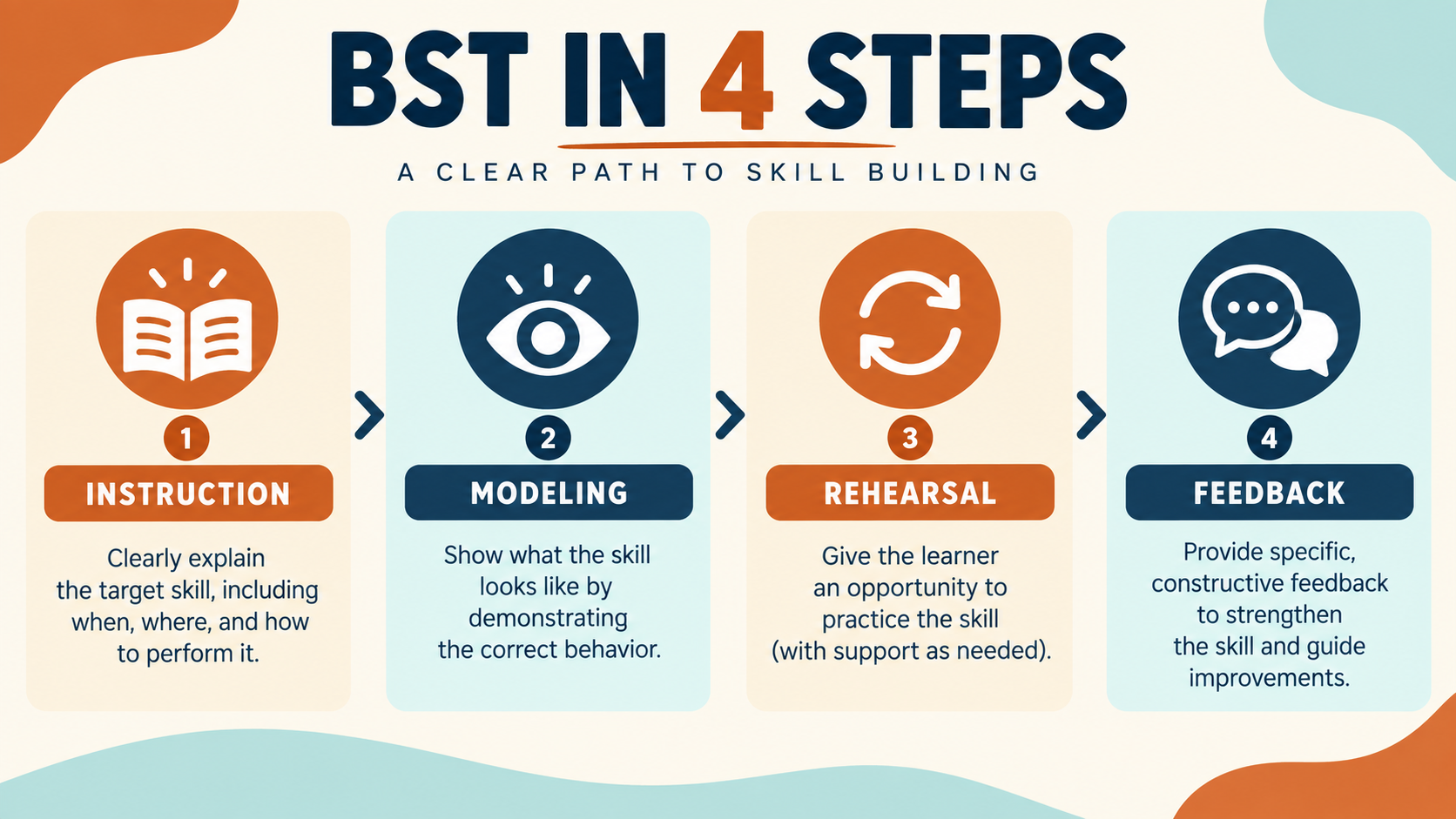
Behavior skills training ABA is a practice-based training package with four core components: instruction, modeling, rehearsal, and feedback. The trainer explains the skill, shows what it looks like, gives the learner a chance to perform it, and provides specific feedback about what to keep or change. The cycle can repeat until performance meets the defined training criterion.
The target should be observable. “Understand prompting” is too broad to score directly; “deliver the written prompt within five seconds and record the learner’s response” is more measurable when the program defines those steps. The exact criterion, materials, and procedure belong to the supervising team or training plan.
What BST includes
BST is often taught as four connected parts, although a complete training package may also include a rationale, task analysis, written materials, role-play, video models, and a plan for checking performance in the real setting. Research has examined BST for staff, caregivers, teachers, and practitioners implementing ABA procedures, including discrete-trial teaching and communication training.
- Instruction: describe the skill, conditions, steps, and performance standard.
- Modeling: demonstrate the skill accurately, including important details and common errors.
- Rehearsal: let the trainee practice in role-play or another safe arranged situation.
- Feedback: deliver specific praise and correction tied to observable performance.
One component alone may not be enough. Reading a procedure can create knowledge without fluent performance. Watching a model can help, but it does not show whether the learner can perform the skill. Rehearsal without feedback can repeat errors. Feedback without a clear model can be difficult to apply. The strength of BST is the sequence and the opportunity to repeat it.
Step 1: instruction
Instruction tells the trainee what to do, when to do it, and how performance will be evaluated. Use plain language and define terms that can be interpreted in different ways. If a skill has several parts, a task analysis or checklist can show the order without relying on memory.
A useful instruction answers questions such as:
- What event or cue starts the response?
- What exact action should the trainee perform?
- What materials or words are authorized?
- What learner response should be recorded?
- What should happen if the learner does not respond or a safety concern appears?
For an RBT, instruction should point back to the current written program and supervision. A generic article can explain the concept, but it cannot replace program-specific directions.
Step 2: modeling
Modeling makes the instruction visible. The trainer demonstrates the steps in the right order and shows the level of precision expected. If the skill involves communication, prompting, data collection, or a safety response, the model should include the details that affect fidelity.
Models can be live, video-based, or written with worked examples. A model should not hide important decisions. If the trainer uses a prompt, reinforcement, correction, or data rule, explain what it was and why it belonged in the training plan. Otherwise the trainee may copy an action without understanding the condition under which it applies.
Step 3: rehearsal
Rehearsal gives the trainee an opportunity to perform the skill. Role-play is often useful because it lets the trainer arrange practice without exposing a learner to an untrained implementation. The role-play should resemble the real task enough to test the relevant steps, while remaining safe and clearly identified as practice.
Start with a manageable scenario, then vary the conditions that matter. For example, practice a teaching response with different materials, learner responses, or communication partners only when the training plan calls for that variation. Do not use rehearsal as an excuse to add a new clinical target or procedure.
During rehearsal, record observable performance rather than a global impression. “Completed four of five checklist steps” is more useful than “seemed confident.” The checklist should match the defined skill.
Step 4: feedback
Feedback should be prompt, specific, and connected to the performance standard. Begin with what was accurate, identify the step that needs correction, describe or model the corrected response, and let the trainee rehearse again. “Good job” may be encouraging, but it does not tell the learner what to repeat.
Corrective feedback should describe the behavior, not attack the person. “You recorded the prompt level after the response; the form requires it before moving to the next trial. Let’s practice that step again” is more actionable than “You were careless.” The goal is accurate implementation and a clear next attempt.
Feedback can be delivered by a supervisor, trainer, or another person authorized by the program. The person giving feedback must understand the procedure and the performance criterion. Unqualified advice can produce a new version of the procedure rather than improve fidelity.
A worked RBT example
Imagine a supervisor is training an RBT to implement a written teaching procedure for requesting help. The program defines the communication response, the prompt sequence, the reinforcement arrangement, and the data to record. The example below illustrates the training structure; it is not a universal intervention protocol.
- Instruction: the supervisor reviews the target response, the authorized prompt, the reinforcement rule, and the data definition.
- Modeling: the supervisor demonstrates the procedure with the materials and shows how to record an independent or prompted response.
- Rehearsal: the RBT practices with the supervisor acting as the learner and uses a fresh trial sheet.
- Feedback: the supervisor notes one accurate step and one correction, models the correction, and asks the RBT to rehearse again.
Only after the supervisor determines that the RBT can implement the authorized steps should the procedure move into the actual service context, subject to the organization’s requirements. Performance should continue to be monitored rather than assumed to remain accurate forever.
How to measure implementation fidelity
Implementation fidelity asks whether the procedure was carried out as defined. Build the fidelity measure from the written plan or task analysis. Possible items might include presenting the specified instruction, using the authorized prompt, delivering the programmed consequence, recording the response, and following the safety step. The actual items and criterion must come from the supervising plan.
Use data to answer a specific question. A percentage of completed steps can summarize performance, but also inspect which step is missed, under what condition, and whether the same error repeats. A high total can hide one safety-critical omission. A low total can reflect a missing material or unclear instruction rather than a lack of effort.
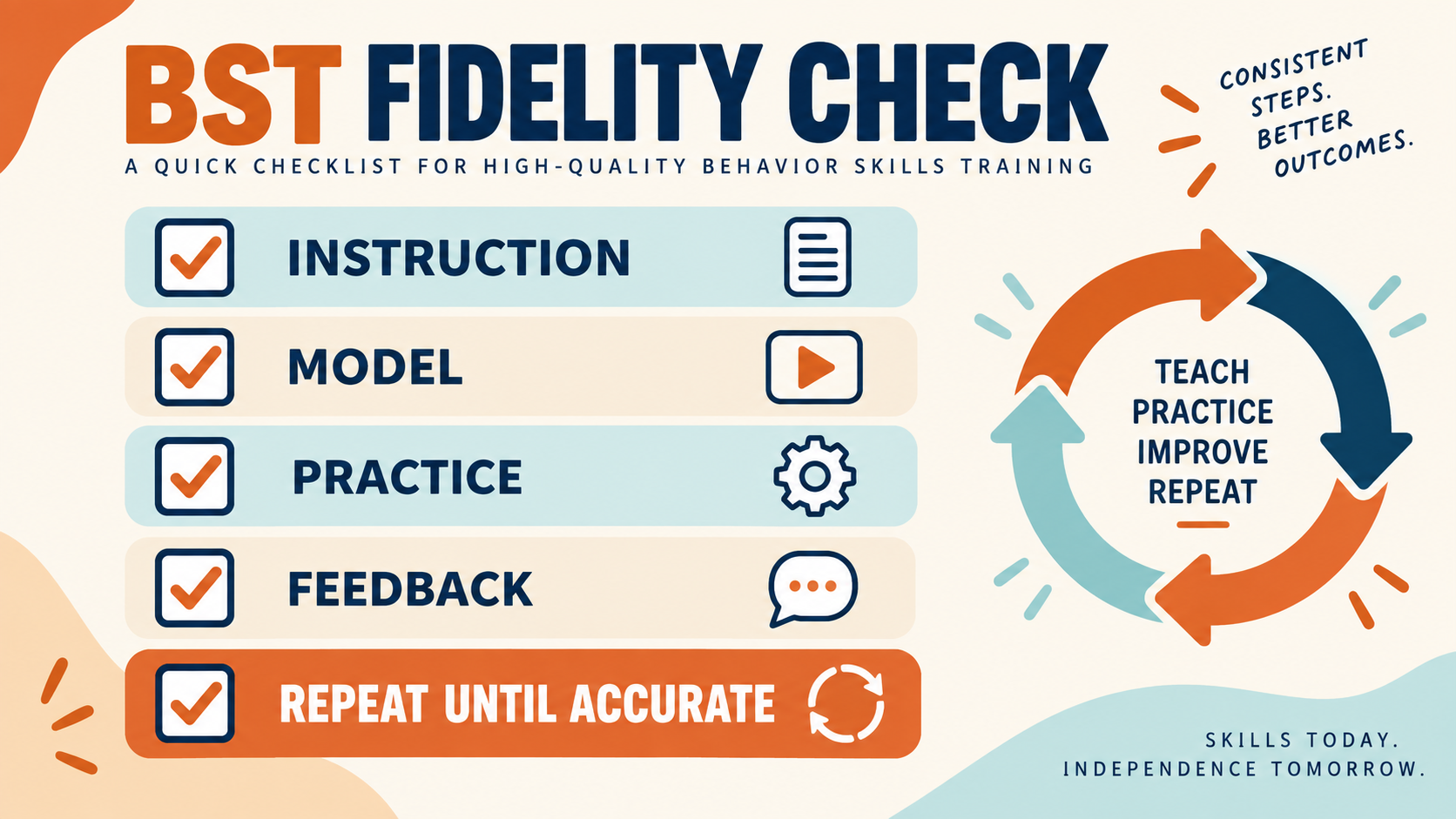
If fidelity is low, return to the BST cycle: clarify the instruction, model the step, rehearse it, and give feedback. Do not solve a fidelity problem by silently changing the program.
Maintenance and generalization
Performance during a role-play is not the same as stable performance in every setting. After training, the team may plan probes across people, materials, locations, or time. These changes should be intentional and supervised. If the RBT notices that a skill or implementation does not transfer, report the conditions rather than deciding independently that the program should be expanded.
Maintenance asks whether the skill continues after teaching or feedback is reduced. Generalization asks whether the skill occurs under appropriate new conditions. Both require planned measurement. A single successful rehearsal does not prove either one.
RBT role boundaries
BST can train an RBT to implement a procedure; it does not make the RBT the designer of that procedure. Do not independently select a treatment target, change the prompt hierarchy, choose a new consequence, rewrite a mastery criterion, or interpret a learner’s diagnosis as a clinical decision. Follow the current written plan and ask the supervisor when the plan or training is incomplete.
It is appropriate to report an implementation barrier, ask for more modeling, request feedback, and document what occurred. It is not appropriate to hide an error because you were trained once or to keep repeating an unclear step without seeking direction.
Frequently Asked Questions
What are the four steps of behavior skills training ABA?
The four commonly described components are instruction, modeling, rehearsal, and feedback. The cycle can repeat until performance meets the defined criterion.
Is BST the same as giving an RBT a manual?
No. Written instruction can be one part of training, but BST adds a model, active practice, and specific feedback tied to observable performance.
Can an RBT use BST to create a new intervention?
No. An RBT can be trained to implement an authorized procedure. Program design and clinical changes remain within the responsible supervisory process.
How do you know whether BST worked?
Measure the defined performance steps during rehearsal and, when planned, in the service context. Look at which steps are accurate, which errors repeat, and whether performance maintains or generalizes.
Where can I read more about the research?
See the research on BST and staff implementation of discrete-trial teaching, the BST scoping review, and current BACB RBT resources. This article is educational and does not replace supervision or a written program.
Source note: This article was reviewed against behavior-analytic BST research and current BACB RBT resources on September 29, 2026. RBT Training is independent educational content and is not affiliated with or endorsed by the BACB.
Ready to practice the RBT concepts you just reviewed?
Try an independent, original RBT practice resource with exam-style questions, scoring, and answer explanations.
References
- Behavior Analyst Certification Board. RBT Test Content Outline, 3rd edition.
- Behavior Analyst Certification Board. RBT Handbook.
- Behavior Analyst Certification Board. RBT Ethics Code.