

An ABA behavior definition turns a broad label into a clear description that different observers can see, measure, and record consistently.
Table of Contents
- What an ABA behavior definition does
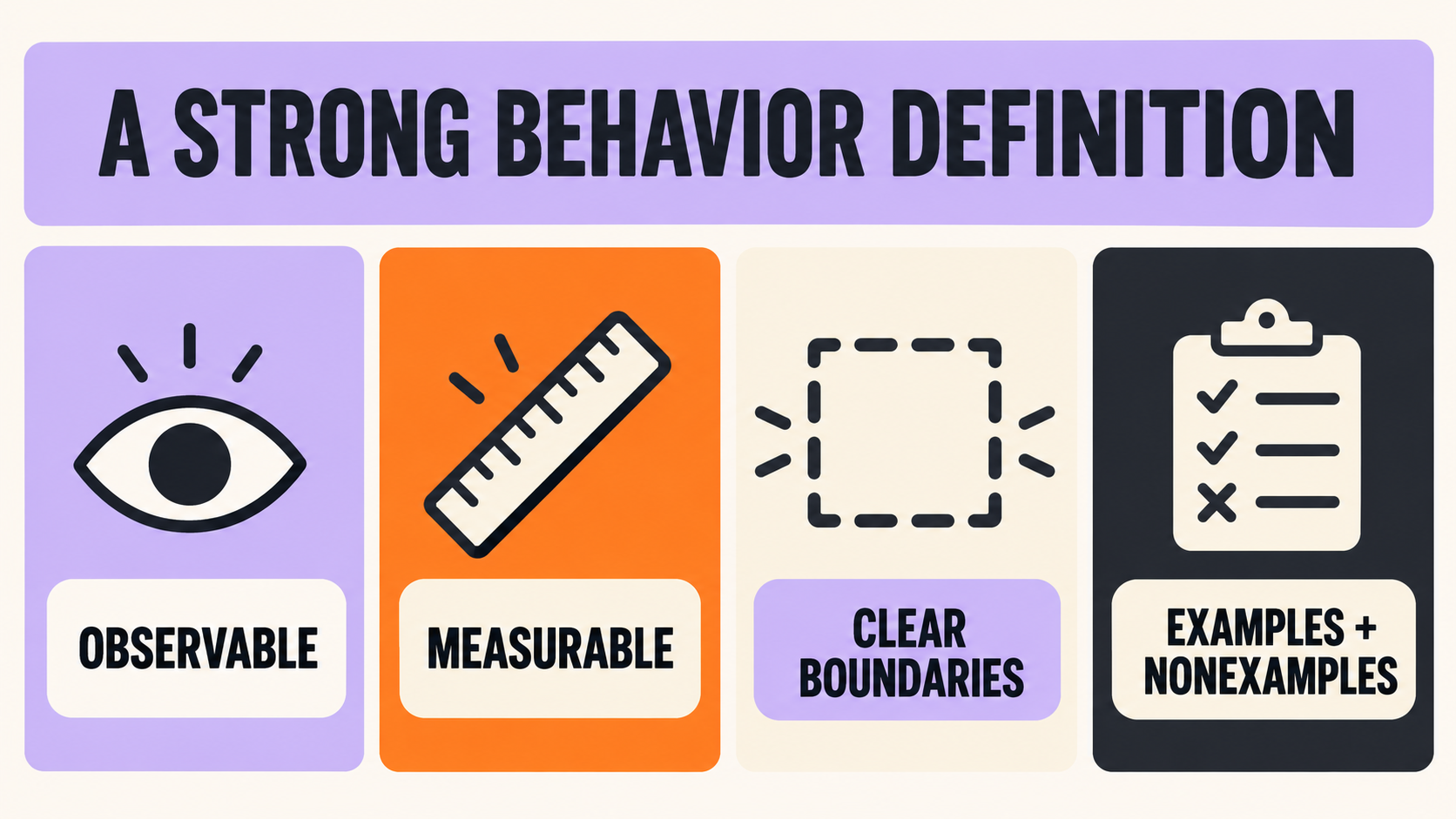
- Make the behavior observable
- Make the behavior measurable
- Add clear boundaries
- Use examples and nonexamples
- Separate topography from function
- Match the definition to measurement
- What an RBT should do with the definition
- Common definition mistakes
- A quick definition-review workflow
- FAQ
- Key takeaways
- Sources and scope
ABA KNOWLEDGE GUIDE · RBT PRACTICE
ABA Behavior Definition: How to Make It Observable and Measurable
A practical guide to turning broad behavior labels into clear descriptions that can be observed, measured, and implemented consistently by an ABA team.
An ABA behavior definition turns a broad label into a description that different observers can see, measure, and record in the same way. That precision matters because decisions about support and progress depend on the quality of the data collected. Words such as “noncompliance,” “anxiety,” or “being disruptive” may communicate a concern, but they do not tell an observer exactly what to look for or when to record it.
This guide is educational. A learner’s target definition, measurement system, and intervention plan must come from the supervising clinician and the current authorized plan. RBTs implement the definition they are given, collect data as directed, and ask for clarification when the wording or scoring rules are unclear.
What an ABA behavior definition does
A useful definition identifies the behavior in terms of what a person does, rather than what an observer thinks the person feels or intends. It should be specific enough that two trained observers can watch the same event and reach the same decision about whether the behavior occurred. The definition also needs to fit the setting, learner, data sheet, and purpose of measurement.
Consider the difference between these two descriptions:
- Broad label: “The learner is aggressive.”
- Observable description: “The learner makes contact between an open hand or closed fist and another person’s body, including the arm, leg, or torso.”
The second description gives the observer something visible to identify. It may still need boundaries, examples, nonexamples, and a measurement rule, but it is a workable starting point.
Make the behavior observable
Observable means that the behavior can be detected through the senses or through a defined recording system. Use action words that describe movement, speech, contact, or a change in the environment. Avoid relying on an inferred private event as the definition itself.
Words such as hits, throws, pushes, stands, leaves, hands an item to another person, and says “help” are often more useful than abstract labels. They describe a response form an observer can identify. The right wording depends on the learner and plan, so these examples should not be copied into a clinical program without supervisor review.
Replace interpretations with actions
“Refuses work” may mean several different things: pushing materials away, saying “no,” not beginning within a specified interval, leaving the area, or some combination. “Is frustrated” is an interpretation unless the plan separately defines observable indicators. Ask: What would I write in my notes if a camera recorded only the learner’s actions?
Make the behavior measurable
Measurable means the response has features that can be counted, timed, or scored according to a stated rule. A definition does not need every possible detail, but it should give the team enough information to choose a defensible measurement system.
For example, “leaves the assigned area” becomes more measurable when the plan states the area boundary and what counts as leaving. “The learner moves both feet beyond the tape line marking the work area” is more precise than “wanders away.” The team can then decide whether frequency, rate, duration, latency, or another measure captures the important feature.
Add clear boundaries
Strong definitions explain where the response begins and ends. Boundaries prevent small differences in observer judgment from becoming large differences in the data. Depending on the target, a plan may specify:
- Onset: the first action that qualifies as the behavior.
- Offset: the condition that marks the end of the episode.
- Intensity or magnitude: a defined level if severity changes the response or safety procedure.
- Context: the materials, activity, location, or instruction relevant to the target.
- Episode rule: how much time without the behavior separates two events, when the plan uses episodes.
Do not add arbitrary boundaries just to make a sentence sound technical. Each boundary should support consistent observation and the purpose of the data. If the existing plan does not state a needed boundary, the RBT should ask the supervisor rather than invent a new scoring rule.
Use examples and nonexamples
Examples show what belongs inside the definition. Nonexamples show similar-looking actions that do not count. Together they create a practical test for observers, especially when a label could be interpreted in several ways.
For a target defined as “throwing materials,” examples might include releasing a pencil so it travels more than a stated distance through the air, if that is the plan’s rule. Nonexamples might include placing the pencil on the table, dropping it accidentally while reaching, or handing it to another person. The exact distance and context must come from the authorized definition.
Examples should vary enough to demonstrate the rule rather than repeat the same scene. Nonexamples should be close enough to the target that they expose a likely observer mistake. If observers disagree about an example, the definition needs clarification or the team needs more training.
Separate topography from function
Topography is the form of the behavior: what it looks or sounds like. Function is the environmental relation the team is evaluating, such as what happens before or after the behavior and what consequence may maintain it. A behavior definition should describe the response form; it should not assume a function from the label.
For instance, “attention-seeking” is not a complete behavior definition. A learner might call a person’s name, touch an adult’s arm, move close to someone, or engage in loud vocalizations. Those actions may have different functions in different contexts. The team can analyze function separately while keeping the response definition observable.
Match the definition to measurement
The measurement should answer the question the team is asking. Frequency or rate may fit discrete responses such as requests or hits. Duration may fit behavior that persists over time. Latency may fit the time between an instruction and a response. Percentage or trial-based scoring may fit a defined opportunity system.
A definition and a data form should not contradict each other. If the definition describes an episode but the sheet asks for individual responses, the team may produce inconsistent data. If the target is “on task” but the form records only duration, the plan should define what on-task actions are and how breaks or transitions are handled. Data rules are part of the operational system, not an afterthought.
What an RBT should do with the definition
An RBT typically uses the current authorized definition during implementation and data collection. Before a session, review the wording, examples, nonexamples, response options, and measurement instructions. During the session, record what the plan says to record rather than replacing it with a personal interpretation.
Ask the supervising clinician when:
- two parts of the plan appear to define the target differently;
- an event is difficult to classify using the listed examples and nonexamples;
- the data sheet does not match the written measurement rule;
- the learner’s context changes in a way the definition does not address; or
- you believe the definition needs to be changed, narrowed, or expanded.
Asking for clarification protects data quality and keeps clinical decision-making within the appropriate supervision structure. An RBT should not independently rewrite a target definition or measurement criterion during service delivery.
Common definition mistakes
Using a label as if it were a definition
“Tantrum,” “disruption,” and “noncompliance” can be useful shorthand among a team, but each label may contain several different response forms. Expand the label into actions, boundaries, and scoring rules.
Including inferred thoughts or feelings
“Wants attention,” “is angry,” and “is avoiding work” state an interpretation or possible function. They do not tell an observer exactly what to record. Describe the visible response and analyze context separately.
Making the definition too narrow or too broad
A definition that lists only one exact example may miss valid instances. A definition that includes every vaguely related action may produce noisy data. Use varied examples and near-miss nonexamples to test the boundary.
Changing wording without changing the data system
Even a well-intended wording change can alter what counts, how often events are scored, and how old data compare with new data. Route proposed changes through the supervising clinician and document the authorized version.
A quick definition-review workflow
- Read the target name and definition together. Check whether the label matches the described actions.
- Underline observable verbs. Mark words that an observer can see, hear, count, or time.
- Circle missing boundaries. Look for unclear onset, offset, context, and episode rules.
- Compare the examples and nonexamples. Ask whether they demonstrate one consistent rule.
- Compare the data sheet. Confirm that the measurement and recording options fit the definition.
- Ask before changing anything. Escalate ambiguity to the supervisor and use the authorized clarification.
FAQ
Is an ABA behavior definition the same as a diagnosis?
No. A behavior definition describes a response for observation and measurement. It does not diagnose a person or explain every reason a response occurs.
Can an RBT write a new behavior definition?
An RBT can notice ambiguity and communicate it, but the RBT should follow the current authorized plan and supervision structure for changes. Do not silently replace the definition during a session.
Why are nonexamples important?
Nonexamples show what looks similar but does not meet the rule. They help observers avoid overcounting and make training discussions more concrete.
What is the fastest test for a weak definition?
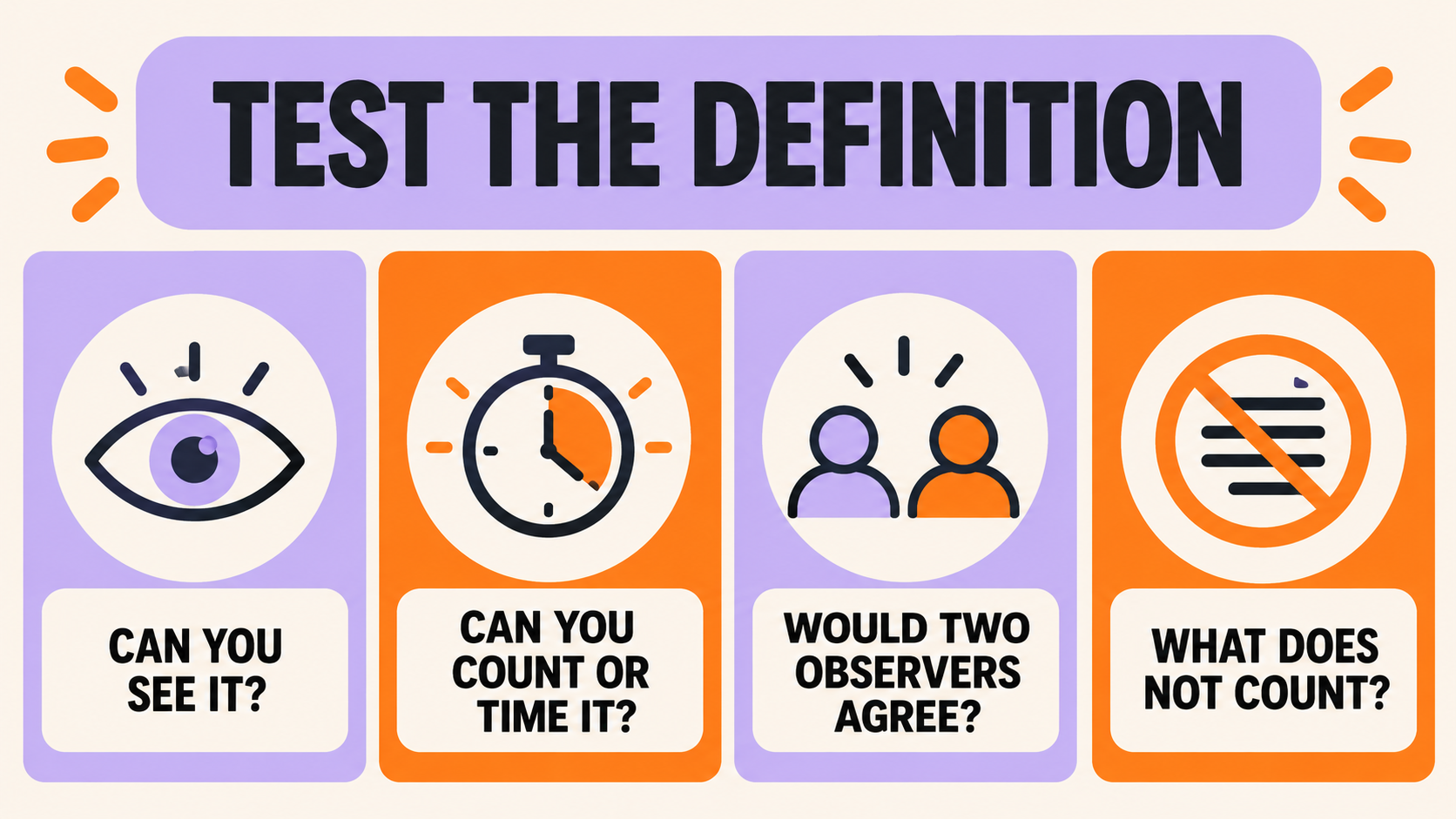
Ask three questions: Can I see or hear the response? Can I count or time it using the stated rule? Would another trained observer likely make the same decision? If not, ask the supervisor for clarification.
Key takeaways
A strong ABA behavior definition uses observable and measurable language, sets clear boundaries, includes useful examples and nonexamples, and aligns with the data system. It describes what the learner does without assuming a function or internal state. For RBTs, the safest workflow is to implement the current authorized definition, record data consistently, and bring ambiguity or proposed changes to the supervising clinician.
Ready to practice the RBT concepts you just reviewed?
Try an independent, original RBT practice resource with exam-style questions, scoring, and answer explanations.
References
- Behavior Analyst Certification Board. RBT Test Content Outline, 3rd edition.
- Behavior Analyst Certification Board. RBT Handbook.
- Behavior Analyst Certification Board. RBT Ethics Code.