
Discontinuous measurement ABA uses planned intervals or moments to sample whether a defined behavior occurs. It can make observation more feasible, but it also changes what the data can tell you. The core study skill is matching the recording rule to the behavior, the question, and the written plan.
Table of Contents
- What discontinuous measurement ABA means
- Three core sampling procedures
- Overestimate, underestimate, and fit
- Design the recording routine
- Compare continuous and discontinuous data
- Protect data quality and fidelity
- Practice discontinuous measurement ABA
- Avoid these common sampling mistakes
- Frequently Asked Questions
- References
This guide compares partial-interval recording, whole-interval recording, and momentary time sampling. It also explains overestimation and underestimation, interval design, data quality, and the RBT role boundary under the current RBT Test Content Outline, 3rd edition.
RBT Training is independent and is not affiliated with, operated by, or endorsed by the Behavior Analyst Certification Board (BACB). The examples and practice prompts below are newly written for study. They are not official, recalled, leaked, or BACB-endorsed questions. No practice article, worksheet, or score can guarantee a passing result or a clinical outcome.
What discontinuous measurement ABA means
In discontinuous measurement, the observer does not attempt to record every instance of a target response across the entire observation. Instead, the observation is divided into intervals or checked at planned moments. The record therefore describes a sample of behavior under the stated conditions, not a complete count of every occurrence.
The current RBT TCO places measurement and data collection in Domain A, with related applications across the rest of the six-domain outline. The current outline includes 43 tasks across six domains, and the examination includes 75 scored questions plus 10 unscored pilot questions. Those facts identify the academic boundary for this independent article; they do not make the article an official test resource.
| Part of the system | Decision to make | Example |
|---|---|---|
| Target definition | What observable response counts? | “Leaves the assigned chair area by both feet crossing the marked boundary.” |
| Interval length | How long is each observation segment? | Ten 30-second intervals during a five-minute sample. |
| Sampling rule | When does the observer score behavior? | Any time in the interval, the entire interval, or at the end point. |
| Summary | What does the final percentage represent? | Percent of intervals scored positive, under the selected rule. |
A label such as “off task” is not enough by itself. The assigned plan should define the observable response, the observation window, the interval timer, the scoring rule, and any exclusions. If a critical detail is missing, follow the established supervision route rather than inventing a procedure.
Discontinuous measurement is not automatically “less accurate” in every practical situation. It is a different sampling strategy with known tradeoffs. The exam-ready question is not whether one system is universally best; it is whether the method fits the behavior and the purpose while its limitations are understood.
Three core sampling procedures
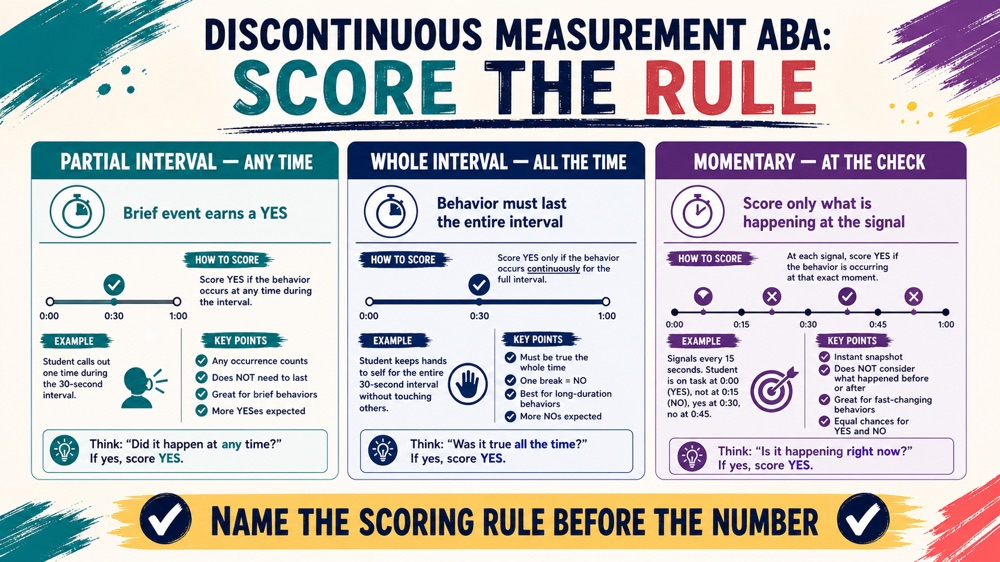
The most common interval and time-sampling distinctions are easier when you focus on the exact condition for a positive score.
| Procedure | Positive score when… | General measurement tendency | Decision clue |
|---|---|---|---|
| Partial-interval recording | The behavior occurs at any point during the interval. | Often overestimates occurrence or duration because a brief occurrence earns a positive score. | Look for “at any time” or “occurred during the interval.” |
| Whole-interval recording | The behavior occurs for the entire interval. | Often underestimates occurrence or duration because a short gap makes the score negative. | Look for “throughout the entire interval.” |
| Momentary time sampling | The behavior is occurring at the planned check moment, often the end of the interval. | May overestimate or underestimate depending on timing, interval length, and behavior pattern. | Look for “at the moment” or “when the timer signals.” |
Partial interval example: The learner taps the table for two seconds during a 30-second interval. Because the behavior occurred at some point, the interval is scored positive. The percentage of positive intervals can be higher than the percentage of total time spent tapping.
Whole interval example: The learner remains engaged for 25 seconds of a 30-second interval, then looks away for five seconds. The interval is scored negative if the rule requires engagement for the full interval. This can be useful when the goal is sustained engagement, but it may hide partial success.
Momentary example: The timer signals at the end of each interval, and the observer scores only what is happening at that instant. Behavior that starts and stops between signals may not be recorded. The timing rule, not the observer’s general impression, determines the score.
These definitions are commonly tested as paired contrasts. Write the phrase that earns a positive score beside each procedure: any time, all the time, or at the moment. Then ask what kind of behavior change the measure will be sensitive to.
Overestimate, underestimate, and fit
The words overestimate and underestimate refer to how a sampled result can differ from the behavior that occurred across the whole observation. They are general tendencies, not promises for every interval arrangement.
- Partial interval: a brief response can make the entire interval positive, so the result may overestimate how much time the behavior occupied.
- Whole interval: a brief interruption can make the entire interval negative, so the result may underestimate how much behavior or engagement occurred.
- Momentary time sampling: the result depends on what happens at the sampled moments. Short episodes between checks can be missed, while behavior that happens to coincide with checks can be represented more strongly.
Before selecting a method in a study scenario, identify the question. If the question is whether a behavior occurred at all during each interval, partial interval may be sensitive to brief events. If the question is sustained engagement across the whole interval, whole interval may reflect the stricter criterion. If the observer needs a quick snapshot at scheduled checks, momentary sampling may be feasible. In real practice, the RBT follows the assigned procedure rather than selecting a method independently.
| Scenario clue | What to notice | Likely reasoning |
|---|---|---|
| High-rate brief behavior | Many short events are hard to count continuously. | A sampling system may be feasible, but its bias must be understood. |
| Sustained behavior goal | The desired change is behavior across the complete interval. | Whole-interval scoring may require uninterrupted behavior for a positive score. |
| Short events between signals | The behavior starts and stops before the check moment. | Momentary sampling can miss it; do not interpret absence as proof of no occurrence. |
| Changing interval length | The denominator or sampling opportunities differ. | Compare only results with the correct context and plan-defined summary. |
Academic precision matters here. A discontinuous percentage is not automatically a percentage of time, a count of responses, or a measure of intensity. Name the procedure and the unit before interpreting the number.
Design the recording routine
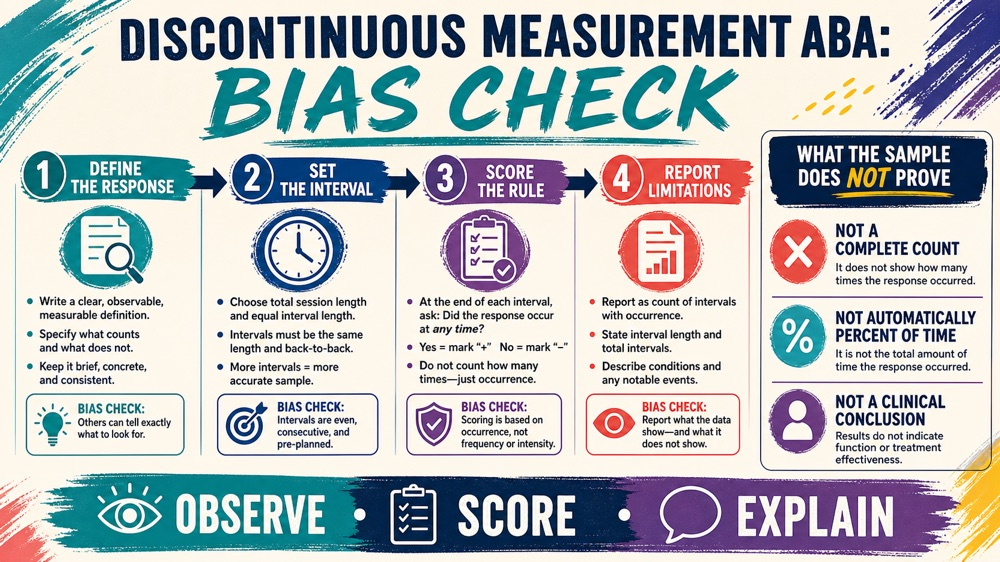
When a plan assigns discontinuous measurement, a role-safe routine keeps timing and scoring consistent:
- Read the plan: confirm the target definition, method, interval length, start point, end point, and scoring rule.
- Prepare the tool: check the timer, form, interval count, and any required prompts or notifications before observation begins.
- Start on the signal: use the defined observation start rather than beginning when it feels convenient.
- Score the rule: record what happened under the procedure, not what you think the learner intended.
- Mark exceptions: note interruptions, missing intervals, timer errors, or environmental events according to the workplace process.
- Verify the summary: check the number of positive intervals, total intervals, and the required calculation before submitting.
- Report uncertainty: communicate data-quality concerns and unusual context through supervision.
For example, if an alarm fails after interval six, do not estimate intervals seven through ten from memory. Preserve the data that were actually observed, mark the missing portion, and use the established correction route. A transparent limitation is more useful than a precise-looking invented percentage.
Keep response observation and client dignity together. A refusal, distress signal, or safety concern is not merely a missing data point. Follow the plan and safety route, document observable facts, and do not continue a procedure outside your role or training.
Compare continuous and discontinuous data
Continuous and discontinuous measurement answer related but different questions. The distinction is about coverage and sampling, not whether one involves a clock.
| Feature | Continuous measurement | Discontinuous measurement |
|---|---|---|
| Coverage | Attempts to record every defined occurrence or episode during the window. | Records behavior at intervals or planned moments. |
| Typical outputs | Count, rate, duration, latency, or IRT when definitions fit. | Positive intervals, sampled moments, or a percentage of opportunities. |
| Strength | More detail about each response or episode. | Can be more feasible when continuous observation is difficult. |
| Sampling risk | Observer overload can still produce missed or late entries. | Method-specific overestimation, underestimation, or missed events. |
| Role boundary | Implement the assigned system. | Implement the assigned system and do not switch for convenience. |
One common trap is assuming that a percentage automatically means accuracy. A result of 60% positive intervals could mean 60% of intervals contained any behavior, 60% of intervals contained behavior throughout, or 60% of sampled moments showed behavior. The procedure gives the number its meaning.
Protect data quality and fidelity
The current TCO expects RBT learners to recognize risks associated with unreliable data and poor procedural fidelity. For discontinuous measurement, data quality can be affected by the definition, timer, interval size, observer attention, or scoring rule.
| Warning sign | Why it matters | Role-safe response |
|---|---|---|
| Intervals are started late. | Scores no longer represent the planned time points. | Record the issue and follow the correction or supervision route. |
| The observer changes “positive” criteria. | Results from different intervals are not comparable. | Use the written rule and report uncertainty. |
| Behavior definition drifts. | The data may combine different responses. | Do not silently rewrite the definition; seek direction. |
| Missing intervals are backfilled. | The record suggests observation that did not occur. | Identify missing data honestly and never invent events. |
| Context changes sharply. | Sampling results may reflect the new context rather than the intervention alone. | Document observable context and communicate it to the team. |
Do not conclude that an intervention worked from a single discontinuous percentage. Describe the method, interval length, observation context, trend across observations, and limitations. Clinical interpretation and plan changes belong to the responsible behavior-analytic team.
Practice discontinuous measurement ABA
Use these original prompts to test the decision point, not just the vocabulary:
- A learner calls out for three seconds during a 30-second interval. Under partial-interval recording, is the interval positive? What does that score say about time occupied?
- A learner is engaged for 28 of 30 seconds, then looks away. Under whole-interval recording, what is the score and why?
- An observer checks only when the timer sounds. The behavior begins and ends between two signals. Which procedure feature explains a possible missed event?
- One session has 20 intervals and another has 40. What context must be reported before comparing the number of positive intervals?
- The plan specifies momentary time sampling, but the observer records every event. Is this a harmless improvement or a procedure change? What should the RBT do?
- A question asks for “percent of intervals in which the behavior occurred at any time.” Which phrase identifies the scoring rule?
After each answer, write the decisive clue: any time, entire interval, sampled moment, or assigned plan. That small correction log helps prevent the common mistake of treating all time-based systems as interchangeable.
Avoid these common sampling mistakes
- Calling a sample a complete count: a discontinuous result does not claim that every response was recorded.
- Swapping partial and whole interval: one needs any occurrence; the other needs behavior throughout.
- Treating MTS as a continuous observation: a momentary check can miss events between signals.
- Ignoring interval length: the same method can produce different sampling sensitivity when the interval changes.
- Changing a procedure independently: report feasibility concerns; do not rewrite the plan in the moment.
- Backfilling missing data: a clean-looking form is not worth an inaccurate record.
- Overinterpreting one percentage: name the method, context, and limitation before drawing a conclusion.
Bottom line: discontinuous measurement ABA samples behavior through intervals or planned moments. Identify the scoring rule, understand the direction of measurement bias, follow the written procedure, protect the integrity of the record, and report limitations instead of turning a sample into an unsupported clinical claim.
Ready to practice interval decisions?
Use independent RBT practice questions to compare partial interval, whole interval, and momentary time sampling after reviewing the current TCO.
Try Free RBT Practice Questions →
Frequently Asked Questions
What is discontinuous measurement in ABA?
It samples whether a defined behavior occurs during planned intervals or at planned moments instead of attempting to record every occurrence.
Which method often overestimates behavior?
Partial-interval recording can overestimate occurrence or time because any brief event makes the interval positive.
Which method often underestimates behavior?
Whole-interval recording can underestimate occurrence or time because behavior must continue for the full interval to earn a positive score.
What does momentary time sampling record?
It records whether the behavior is occurring at the specified check moment, such as the end of an interval.
Can an RBT choose a different measurement method?
Do not change the assigned procedure independently. Follow the written plan and report feasibility or data-quality concerns through supervision.
References
- Behavior Analyst Certification Board. RBT Test Content Outline, 3rd edition.
- Behavior Analyst Certification Board. RBT Handbook, updated June 2026.
- Fiske, K., & Delmolino, L. Use of discontinuous methods of data collection in behavioral intervention.
- Fisher, W. W., et al. Procedures and accuracy of discontinuous measurement.