
The phrase board RBT is often used as shorthand for an RBT credential overseen by the Behavior Analyst Certification Board, or BACB.
Table of Contents
- What “board RBT” usually means
- What the BACB does
- Who does what?
- The RBT pathway at a glance
- Start with eligibility
- Complete the current training requirement
- Understand the competency assessment
- Submit the application
- Prepare for the examination
- What happens after the exam?
- FAQ
- Key takeaways
- Sources and scope
RBT KNOWLEDGE GUIDE · CREDENTIALING
Board RBT: How the Credential and Exam Pathway Work
A plain-language guide to the BACB’s role, the RBT application pathway, the exam, and the different people involved in training, assessment, and supervision.
The phrase board RBT is often used as shorthand for an RBT credential overseen by the Behavior Analyst Certification Board, or BACB. It can also appear in searches from people who want to know whether RBT is a board certification, how the exam works, or which organization handles applications. The key point is that RBT is a certification program administered by the BACB; a training provider or employer does not independently grant the credential.
This overview is educational. Requirements, fees, document versions, and examination details can change. Always check the current BACB RBT Handbook and official resource pages before applying or paying for a course.
What “board RBT” usually means
People usually mean one of four related questions:
- Is RBT a professional certification administered by a board?
- What organization sets the eligibility and examination rules?
- What steps are required before someone can use the RBT credential?
- How are the trainer, competency assessor, and supervisor different?
Answering those questions separately prevents a common misunderstanding: completing a class, passing a competency assessment, submitting an application, and passing an exam are different events. The credential begins only when the certification process is completed and the status is active under the applicable rules.
What the BACB does
The BACB operates certification programs in behavior analysis, establishes certification requirements, administers examinations, and provides ethics and disciplinary systems for its certifications. It is not the same thing as a school, an employer, or an individual RBT supervisor.
For RBT applicants, the BACB publishes the handbook, eligibility instructions, training requirements, competency-assessment materials, examination content outline, application process, and maintenance requirements. A provider may explain those materials, but the official documents control when a promotional page conflicts with them.
Who does what?
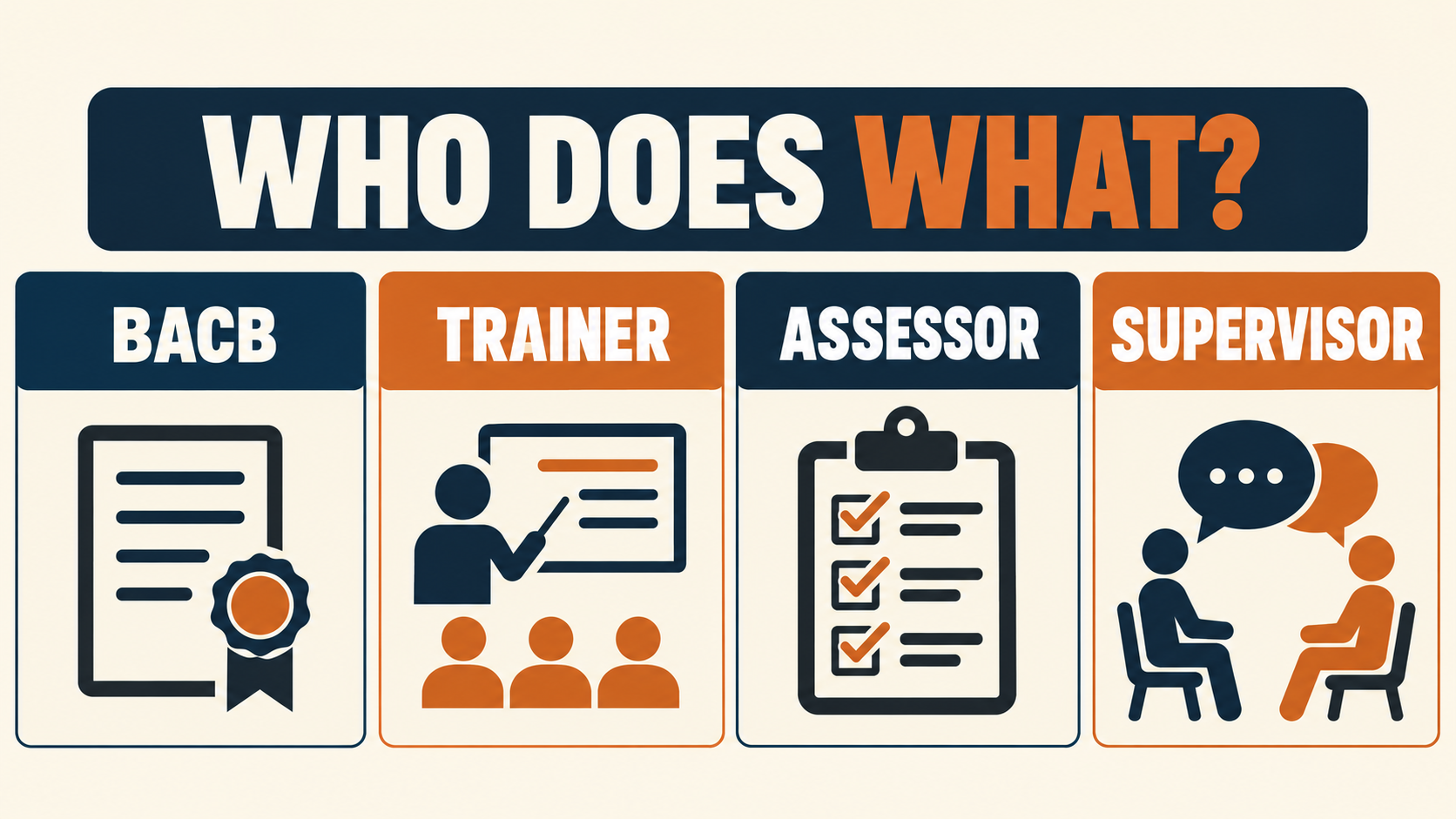
The pathway can involve several roles:
- BACB: operates the RBT certification program and sets the applicable requirements and examination process.
- Responsible trainer: designs and oversees qualifying 40-hour training and maintains training documentation.
- Assessor: evaluates the initial competency assessment under the current assessment requirements.
- RBT Supervisor or Requirements Coordinator: provides the required direction and close supervision when the RBT is practicing.
- Pearson VUE: delivers the computer-based certification examination at authorized testing locations.
One organization may employ more than one of these people, but the responsibilities are still distinct. Ask who is responsible for each step instead of assuming that the person who sold the course also handles assessment, application, supervision, and examination.
The RBT pathway at a glance
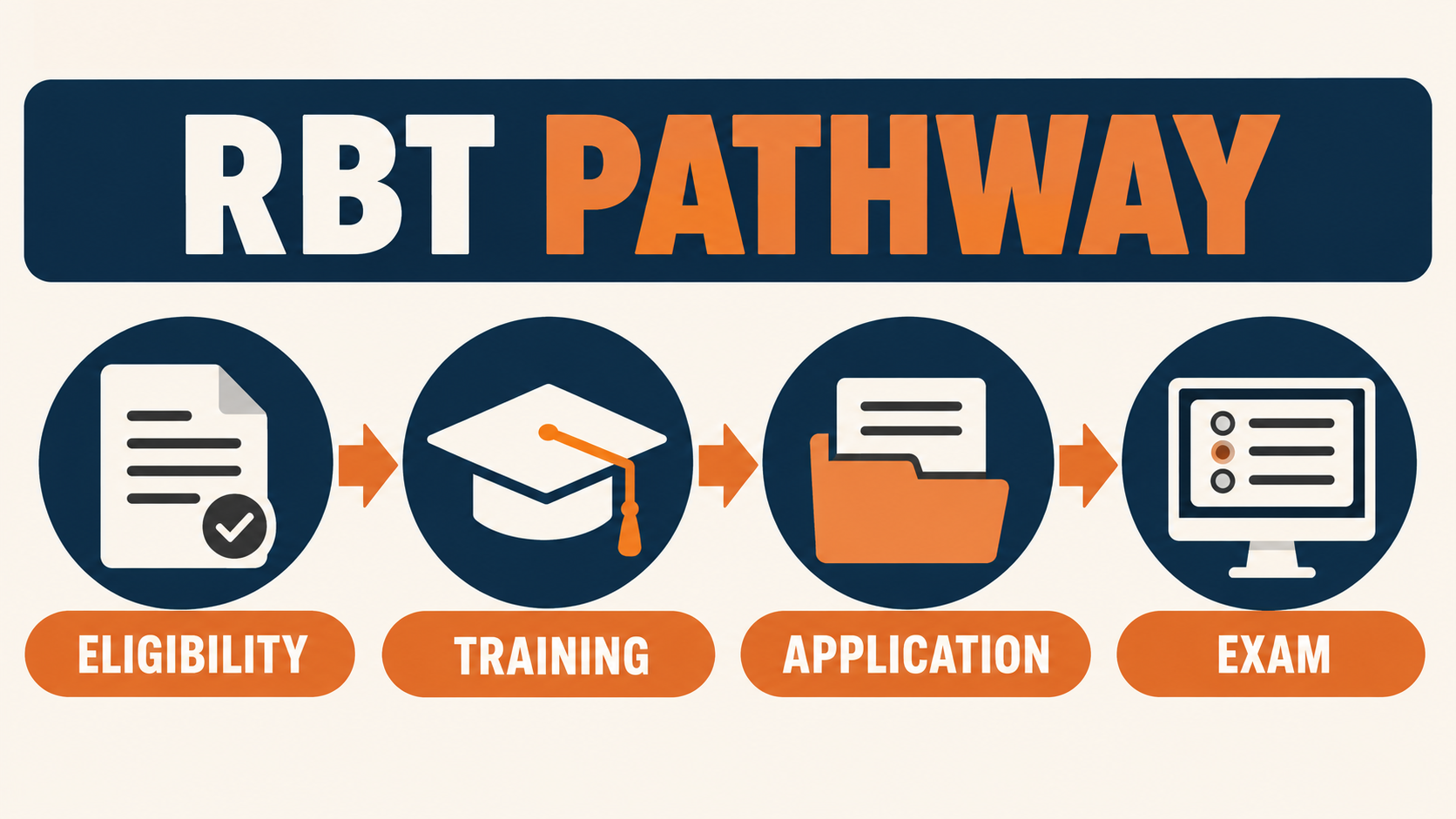
A simplified current pathway looks like this:
- Review eligibility and the current RBT Handbook.
- Complete training that meets the applicable 40-hour requirements.
- Complete the initial competency assessment with an eligible assessor.
- Submit the certification application and required documents.
- After approval, schedule and take the RBT examination.
- After passing, complete the steps needed for an active status and ongoing supervision.
This sequence is a map, not a substitute for the official checklist. Timing and document rules can apply to each stage.
Start with eligibility
Before buying training, review the current eligibility requirements. The 2026 handbook describes requirements such as age, education, background and abuse-registry checks, training, and the initial competency assessment, with an attesting certificant confirming applicable information. The details and timing belong to the current handbook, so do not rely on an older checklist saved from a previous application cycle.
Make a personal document list and confirm which person can provide each attestation. If you are unsure whether your education, location, background-check process, or training history qualifies, use the BACB’s official guidance and discuss the question with an appropriate supervisor or mentor. A course seller cannot guarantee that an application will be approved.
Complete the current training requirement
For applicants applying under the 2026 rules, the 40-hour training must follow the current BACB training requirements and curriculum outline. The outline specifies content, a minimum of 40 hours, a completion window of no fewer than 5 days and no more than 180 days, allowed delivery components, and responsible-trainer requirements.
Review the certificate before enrolling. Current documentation can include the trainee’s name and BACB ID, start and end dates, actual training time, responsible trainer details, applicable assistant-trainer details, and the required statement that the program is designed to meet the 2026 training eligibility requirement and is offered independent of the BACB.
Understand the competency assessment
The initial competency assessment is not the same as the 40-hour training. It evaluates whether the applicant can perform the relevant technician tasks according to the current assessment requirements. It occurs after the required training and within the applicable timing window before the application.
Ask who will assess you, what assessment packet and version will be used, what skills will be demonstrated, and how the completed record will be submitted. An instructor may help you practice, but the assessor must meet the applicable requirements. Do not treat a quiz score or attendance certificate as proof that the competency assessment is complete.
Submit the application
After the required preparation, the applicant submits the certification application and supporting documents through the BACB process. The current handbook and application instructions identify the required attestations, certificates, assessment records, fees, and timelines.
Before submitting, compare every date and name across the documents. Common avoidable problems include a certificate from an outdated training version, missing signatures, incomplete assessment fields, an attestation outside its allowed window, or a mismatch between the applicant’s account and a document. Keep copies of everything you submit.
Prepare for the examination
Once the application is approved, the applicant follows the instructions to schedule the examination through Pearson VUE. The BACB examination-information page describes the RBT exam as a computer-based multiple-choice examination; the current page lists 85 questions and 90 minutes. The current RBT Test Content Outline identifies the examination content to study.
Build preparation around the official outline, not only a commercial question bank. Use practice questions to identify gaps, then return to the underlying task, definition, ethical rule, or implementation principle. Learn the difference between selecting a correct answer on a quiz and performing a technician task accurately under supervision.
Follow current examination rules for identification, scheduling, accommodations, cancellations, rescheduling, and retakes. Policies can change, and Pearson VUE handles the appointment details after the certification application is approved.
What happens after the exam?
Passing the exam is not the end of professional responsibility. The current handbook describes the status and activation process and the ongoing supervision and maintenance requirements. An RBT practices under the direction and close supervision of an RBT Supervisor or RBT Requirements Coordinator.
If an applicant fails, the retake process and waiting period come from the current handbook. Use the performance information provided for the RBT exam to identify task areas that need study. Do not assume that one failed attempt or one practice score diagnoses the reason for a performance gap.
FAQ
Is “board RBT” a separate credential?
No. It is usually an informal search phrase for the RBT certification administered by the BACB. Check the official RBT pages for the actual credential name and requirements.
Does passing an RBT course give me the credential?
No. Training is one part of the pathway. The applicant must also meet eligibility rules, complete the required competency assessment, submit the application, receive approval, pass the examination, and follow the status and supervision requirements.
Who supervises an RBT after certification?
An RBT practices under the direction and close supervision of an RBT Supervisor or RBT Requirements Coordinator. The employer, supervisor, and trainer may be different people.
Where should I check for the latest exam information?
Use the BACB RBT examination resources, the current RBT Handbook, the RBT Test Content Outline, and Pearson VUE’s BACB testing information. Avoid relying on an old social post or a course page that does not show its update date.
Key takeaways
“Board RBT” usually points to the BACB-administered RBT certification, not a separate course or employer title. Keep the roles distinct: the BACB sets the program, trainers provide qualifying instruction, assessors evaluate competency, supervisors direct practice, and Pearson VUE delivers the exam. Follow the current official pathway from eligibility through training, assessment, application, examination, and active supervised practice.
Ready to practice the RBT concepts you just reviewed?
Try an independent, original RBT practice resource with exam-style questions, scoring, and answer explanations.
References
- Behavior Analyst Certification Board. RBT Test Content Outline, 3rd edition.
- Behavior Analyst Certification Board. RBT Handbook.
- Behavior Analyst Certification Board. RBT Ethics Code.