
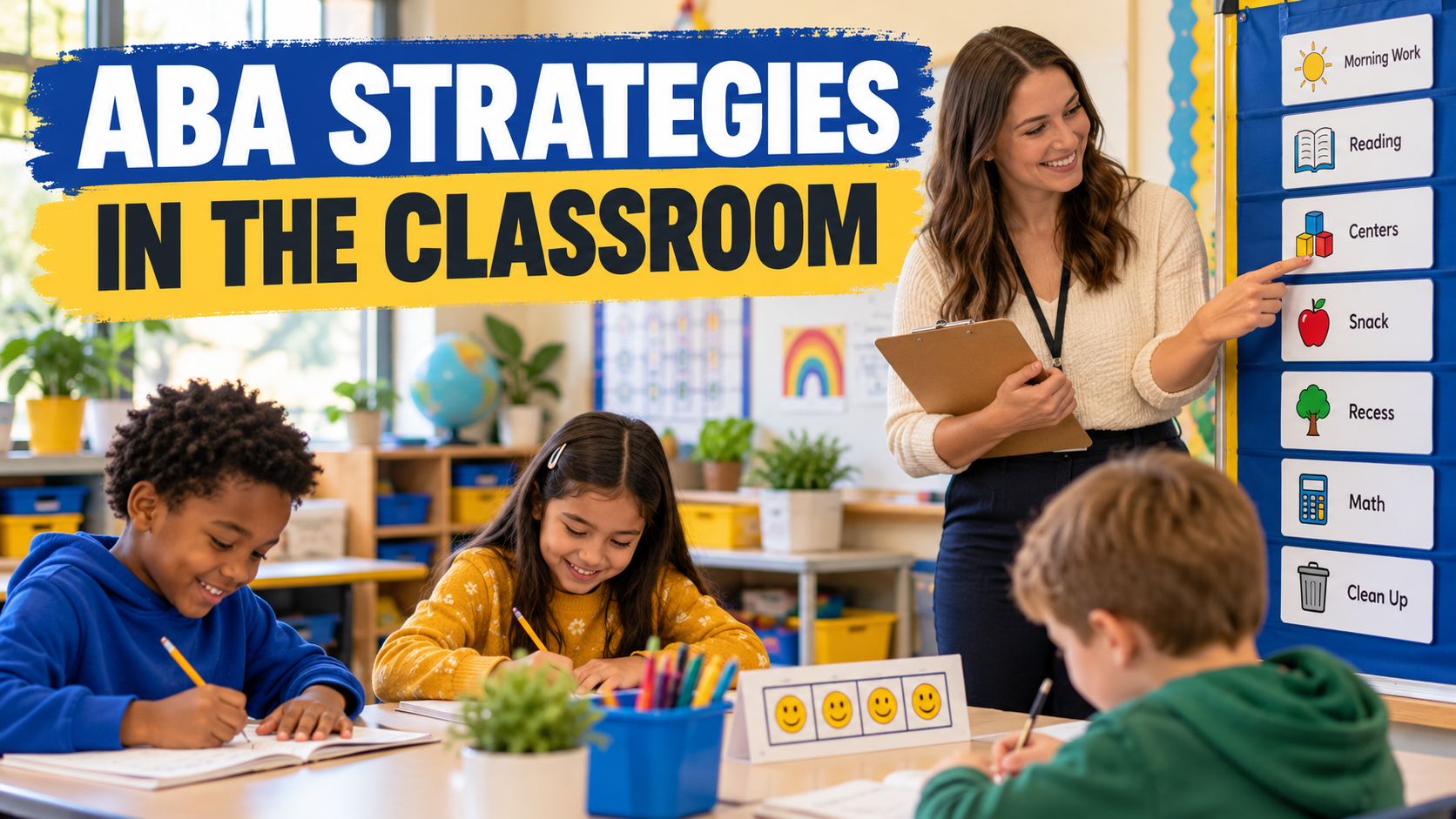
ABA strategies in the classroom work best when they make expectations clear, reduce avoidable uncertainty, increase meaningful engagement, and teach the skills students need to participate.
Table of Contents
- How ABA strategies in the classroom support learning
- The classroom strategy mix
- Teach clear expectations
- Build predictable routines
- Use proactive prompts and visual supports
- Increase opportunities to respond
- Use behavior-specific praise
- Collect data and review fidelity
- Coordinate with the classroom team
- When an individual plan is involved
- FAQ
- Key takeaways
- Sources and scope
ABA KNOWLEDGE GUIDE · CLASSROOM SUPPORT
ABA Strategies in the Classroom: Practical Supports That Start With the Environment
A classroom-focused guide to predictable routines, clear expectations, active engagement, proactive prompts, specific praise, and data-informed review.
ABA strategies in the classroom work best when they make expectations clear, reduce avoidable uncertainty, increase meaningful engagement, and teach the skills students need to participate. Many useful supports are preventive: a predictable routine, a visual schedule, a brief pre-correction, a choice between materials, or specific feedback can change what happens before a problem behavior occurs.
This article is an educational overview. Classroom teachers, special education teams, and supervisors decide which practices fit their students and setting. An RBT should follow the current authorized plan and team direction rather than independently creating a new intervention. Universal classroom supports are not automatically individualized treatment.
How ABA strategies in the classroom support learning
Classroom support has two related goals: make learning accessible and help students use appropriate academic, social, and communication behaviors. A strategy should be connected to a clearly described expectation or skill. “Improve behavior” is too broad; “start the assigned task within two minutes” or “use the help card before leaving the work area” gives a team something observable to teach and measure.
The Institute of Education Sciences recommends identifying the conditions that prompt and reinforce a problem behavior, modifying the learning environment, and teaching and reinforcing appropriate alternatives. That does not mean every classroom challenge needs a formal individualized plan. It means the team should first understand the context and choose a proportionate, teachable support.
The classroom strategy mix
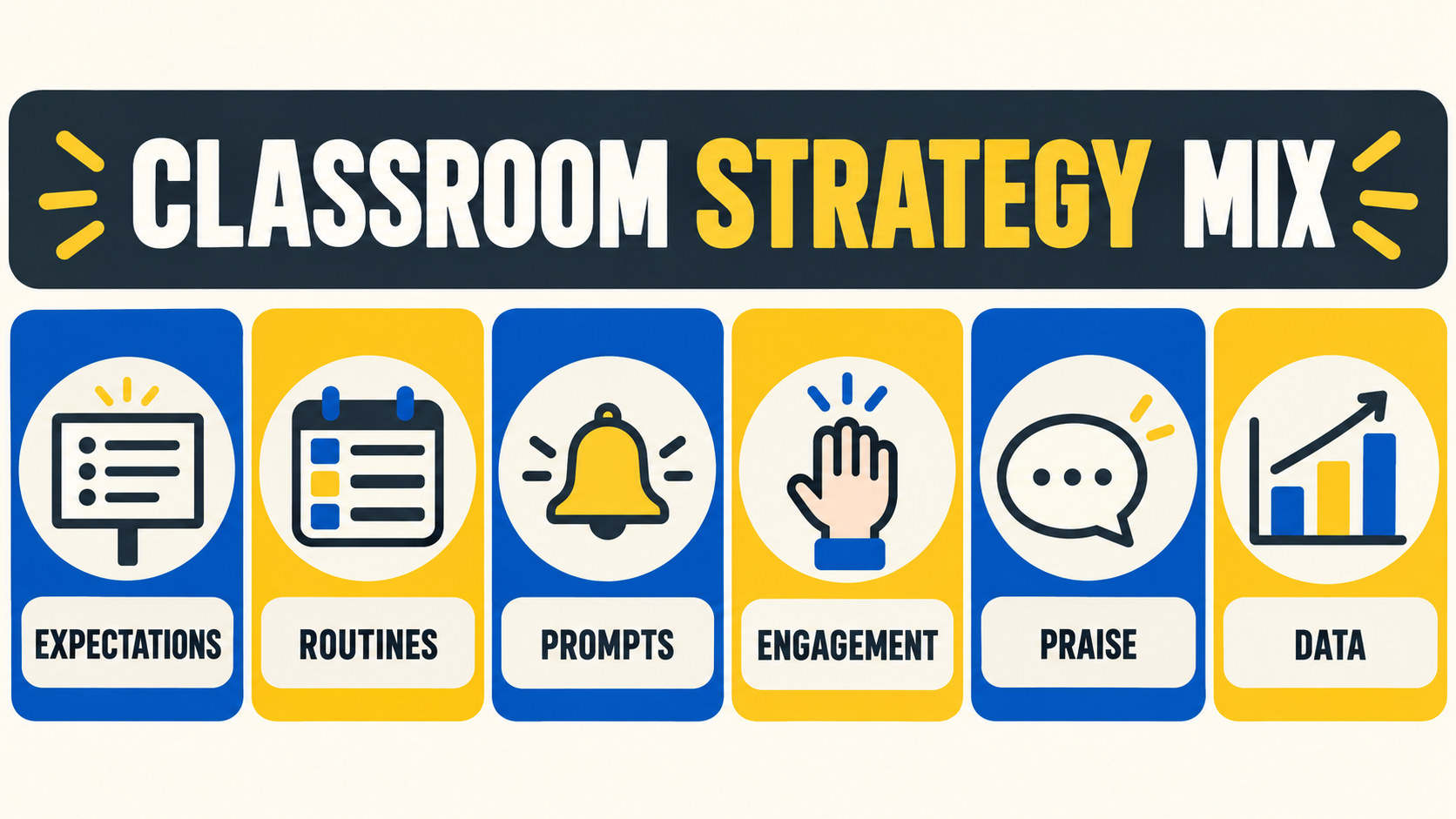
A useful classroom plan may combine six elements:
- Expectations: a small set of positively stated behaviors that are defined and taught.
- Routines: predictable steps for arrival, transitions, independent work, help, and cleanup.
- Prompts: reminders delivered before the expected response, then faded when appropriate.
- Engagement: opportunities for students to respond, choose, practice, and experience academic success.
- Praise: specific feedback that names the behavior or effort being acknowledged.
- Data: information about implementation and outcomes that helps the team adjust support.
Teach clear expectations
Students cannot consistently meet a classroom expectation that has not been made clear. Keep expectations few, positive, observable, and relevant to the setting. “Be respectful” may be a useful value, but the classroom team may need to teach what it looks and sounds like during group work, discussion, independent work, and transitions.
Teach the expectation explicitly:
- State the expected action in student-friendly language.
- Model what it looks like.
- Show a near example or nonexample when helpful.
- Give students a chance to practice.
- Provide specific feedback and revisit the expectation before likely trouble spots.
A posted rule is a prompt, not proof that the skill has been taught. Use visuals, demonstrations, and practice that match students’ communication and access needs.
Build predictable routines
Predictability reduces the amount of effort students spend guessing what happens next. Map the steps of common routines such as entering the room, moving to a center, requesting help, turning in work, and transitioning away from a preferred activity.
Use a schedule, first-then board, task checklist, timer, or other visual support when it makes the routine easier to understand or complete independently. Teach how to use the visual rather than simply putting it on a wall. Review the routine before a transition, give a consistent cue, and acknowledge the expected step.
Routines should be flexible enough for real classrooms. If the schedule changes, show the change, explain what is different, and identify the next available activity. A visual support that is inaccurate can create more confusion than clarity.
Use proactive prompts and visual supports
A prompt delivered before a likely difficulty can prevent an error and remind a student of a replacement skill. For example, before independent work, a teacher may point to a help card or remind the student how to request a break if that response is part of the authorized plan.
Prompting should be intentional. Define what the prompt is, when it is delivered, and how it will be faded when the student demonstrates the skill. Avoid repeating louder or more intrusive prompts simply because the first prompt did not work. Ask the team whether the task, visual, instruction, or reinforcer needs adjustment.
Increase opportunities to respond
Engagement is a prevention strategy because students have more opportunities to practice appropriate behavior when instruction is active and accessible. Opportunities to respond can include spoken answers, pointing, writing, selecting a picture, using a device, movement, partner responses, or another valid response mode.
Teachers can vary the task, offer limited choices, adjust the amount of work, provide breaks as authorized, and use materials that connect with student interests. These changes should preserve the learning goal while making success more reachable. If a student repeatedly disengages, examine the task and context before assuming a motivation or attitude.
Use behavior-specific praise
Behavior-specific praise names the action being acknowledged: “You opened your notebook and started the first problem” is clearer than “Good job.” Specific feedback tells the student what to repeat and gives peers a model of the expected behavior.
Praise can be social, descriptive, brief, and genuine. It can also be paired with a planned reward or reinforcement system when the classroom team has selected one. Avoid making praise conditional on perfection. Acknowledge approximations and effort when those are the defined teaching targets, and keep the system inclusive so students can access it through appropriate response forms.
Collect data and review fidelity
Data help a team decide whether a strategy is being used as planned and whether student behavior or engagement is changing. Choose a measure that matches the target: frequency, duration, latency, percentage of opportunities, task completion, or another defined measure.
Review implementation fidelity as well as outcomes. If a visual schedule was not available, a pre-correction was skipped, or praise was delivered inconsistently, a lack of change does not prove that the strategy cannot work. Conversely, one good day does not prove that the strategy generalized to every class, teacher, or schedule.
Coordinate with the classroom team
Classroom strategies are more likely to be consistent when the teacher, special education team, related service providers, family, and RBT understand their roles. Agree on the language for expectations, the visual supports, the data form, the communication channel, and the process for changes.
An RBT can report objective observations and implement an authorized procedure. The RBT should ask before changing a prompt, reinforcement schedule, consequence, crisis response, or target definition. A teacher can request support, but requests still need to fit the supervising clinician’s direction and the learner’s current plan.
When an individual plan is involved
Universal classroom practices and individualized behavior support can work together, but they are not interchangeable. If a student has a behavior intervention plan or other individualized protocol, follow that plan and coordinate with the responsible team. Do not add extinction, punishment, physical intervention, response cost, or a new reinforcement arrangement because a general article mentioned it.
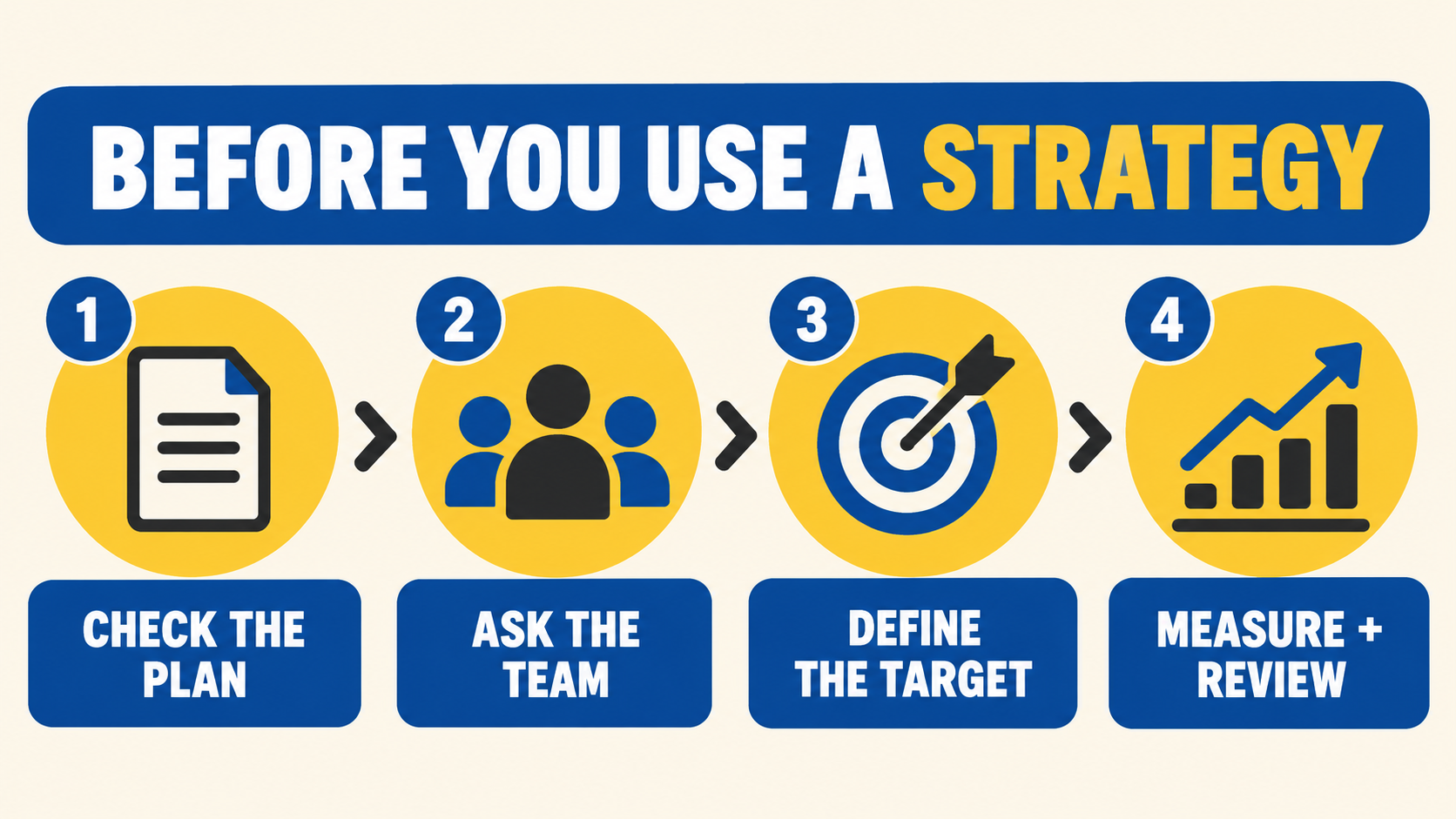
Before using a strategy with an individual student, ask:
- What exact behavior or replacement skill is defined?
- What is the authorized teaching or response procedure?
- What should the adult do before, during, and after the response?
- What data should be recorded?
- Who should be contacted if the plan is unclear or safety changes?
Classroom support should be respectful, accessible, and proportionate. If a strategy is not working, bring data and context to the team rather than improvising a clinical change.
FAQ
What are common ABA strategies in the classroom?
Common classroom supports include explicitly teaching expectations, predictable routines, visual schedules, proactive prompts, opportunities to respond, behavior-specific praise, choices, and data-based review. The appropriate combination depends on the classroom and student needs.
Are classroom strategies only for students with an IEP or behavior plan?
No. Many preventive practices are useful classroom-wide. Individualized plans require additional definition, authorization, training, and data procedures.
Can an RBT choose a classroom strategy independently?
An RBT can use classroom routines and supports as directed by the teacher and supervising team, but should not independently create or change an individualized intervention. Ask the supervisor when the plan, measurement, or role boundary is unclear.
How do we know a strategy is helping?
Define the target, measure it consistently, check whether adults used the strategy as planned, and review the pattern with the team. Avoid conclusions from one observation or one favorable day.
Key takeaways
Effective ABA strategies in the classroom begin with the environment: clear expectations, predictable routines, proactive prompts, active engagement, specific praise, and useful data. Teach the expected skill, make supports accessible, coordinate with the team, and keep individualized decisions inside the authorized plan. A strategy is only as strong as its definition, implementation, and review.
Ready to practice the RBT concepts you just reviewed?
Try an independent, original RBT practice resource with exam-style questions, scoring, and answer explanations.
References
- Behavior Analyst Certification Board. RBT Test Content Outline, 3rd edition.
- Behavior Analyst Certification Board. RBT Handbook.
- Behavior Analyst Certification Board. RBT Ethics Code.