

RBT professional development is more than collecting certificates. It is a structured way to maintain current knowledge, document eligible learning, and prepare for the next recertification step.
Table of Contents
- What RBT professional development means
- The 2026 PDU requirement
- The three main PDU routes
- How in-service training works
- Activities that do not automatically count
- What to document and save
- Build a simple PDU tracking plan
- Common mistakes to avoid
- FAQ
- References
RBT PRACTICE GUIDE · PROFESSIONAL DEVELOPMENT
RBT Professional Development: How to Earn and Track PDUs in 2026
Understand the current 12-PDU cycle, compare the three main learning routes, and build a documentation habit before renewal becomes urgent.
The phrase RBT professional development usually points to two related needs: staying current in practice and meeting the documentation requirements for the next recertification cycle. A certificate by itself is not the whole system. You need to know whether the activity is an accepted route, keep the right evidence, and record it before details disappear.
This is a general education guide, not a substitute for the current RBT Handbook, BACB forms, employer policy, or direction from an authorized supervisor. Requirements can change, so verify the current rule before treating any course, event, or training as eligible.
What RBT professional development means
Professional development is planned learning that helps an RBT maintain or build relevant knowledge, skills, and professional judgment. It may cover behavior-analytic concepts, communication, assent-based practice, reinforcement and punishment distinctions, caregiver interaction, stress management, or another topic that fits the applicable requirements.
There are two useful tests. First, does the learning have a clear connection to competent RBT practice? Second, is there an accepted route and reliable documentation for the activity? A helpful topic can still fail the second test if it is only casual reading, a client-specific instruction, or a private certificate with no qualifying framework.
The 2026 PDU requirement
Under the current BACB RBT professional development guidance, an RBT who certifies or recertifies in 2026 must complete 12 professional development units, or PDUs, during the two-year recertification cycle. The timing matters: do not assume that an older certificate, a routine supervision meeting, or an activity completed before the applicable cycle will be accepted.
The requirement is not a permission to choose any 12 hours of online content. The learning has to fit an accepted route, and the RBT needs to retain the evidence required for that route. Treat the cycle as a small compliance project: identify eligible activities, store records as soon as they are finished, and review the total before the renewal deadline.
The three main PDU routes
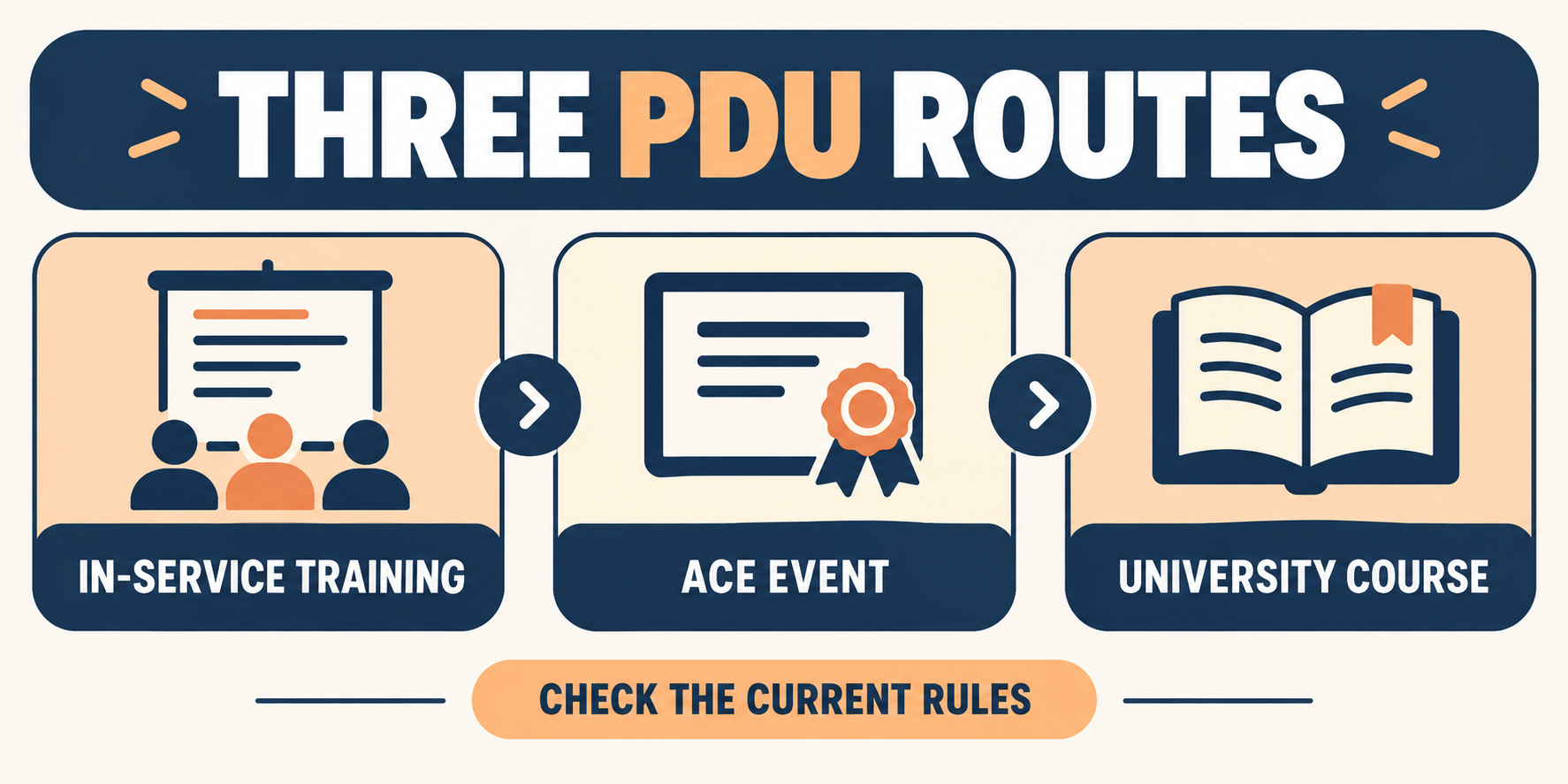
The current BACB materials describe three practical routes for RBT PDUs. Each route has its own proof requirements, so the name of the activity is less important than the route and the records behind it.
1. Organization in-service training
An organization may provide a structured in-service event for RBTs. The event should intentionally deliver relevant knowledge, skills, or competencies. Discussion, role-play, questions, and active responses may be part of the format. Ask the organizer how the event is documented and use the current RBT Professional Development: In-Service Event form or process when applicable.
2. ACE provider events
An Authorized Continuing Education, or ACE, event is supplied through the BACB’s authorized continuing education system. Check the current ACE provider registry rather than relying only on a vendor’s marketing language. Save the completion record and any details needed to show the provider, event, date, topic, and PDU amount.
3. Accredited university behavior-analytic coursework
An accredited university course may qualify when it is behavior-analytic and the student earns at least a C or a passing grade, subject to the current BACB requirements. Keep the syllabus, course information, and transcript or equivalent grade record. BACB’s current explanatory material lists one semester credit as 15 PDUs, but verify the applicable rule and documentation before relying on that conversion.
How in-service training works
Good in-service training is structured rather than accidental. It has a defined topic, intentional delivery, and a record that can be reviewed later. For example, a scheduled workshop on assent-based treatment may include a short presentation, examples, role-play, a question period, and a completion record. The exact format can vary, but a vague claim that someone “watched a few videos” is not the same as a documented in-service event.
Before attending, ask four questions:
- What is the topic, and how does it relate to RBT practice?
- Who is delivering or sponsoring the event?
- Which current form or record will document completion?
- How many PDUs are awarded, and for which recertification cycle?
After the event, review the record while the information is fresh. Correct a misspelled name, missing date, unclear PDU amount, or incomplete provider field promptly. A neat folder is useful, but it cannot repair a record that never identified the activity clearly.
Activities that do not automatically count
Several activities may be valuable at work but are not automatically RBT professional development PDUs. Current BACB in-service guidance distinguishes structured professional development from activities that are specific to one client, one program, or one employer’s operations.
- Client-specific training: instruction about one learner’s program or immediate case is not automatically an in-service PDU.
- Ongoing supervision: routine supervision and feedback are important, but they are not automatically PDUs.
- Company policy review: onboarding, scheduling, billing, and policy acknowledgments do not become professional development just because they are required.
- Initial RBT training: the 40-hour training course is a certification requirement, not a reason to count the same hours again as current-cycle PDUs.
- CPR or first aid: useful credentials may be required by an employer, but they do not automatically qualify as RBT in-service PDUs.
- Exam preparation: BCBA or other exam-prep activities should not be assumed to satisfy the RBT PDU route.
- Unstructured self-study: a book, podcast, or casual online video may support learning but does not automatically become a qualifying in-service event.
These distinctions are not a judgment about whether the activity is useful. They are a reminder to classify it correctly. If an activity sits near the boundary, ask the provider or the person responsible for the organization’s RBT process before counting it.
What to document and save
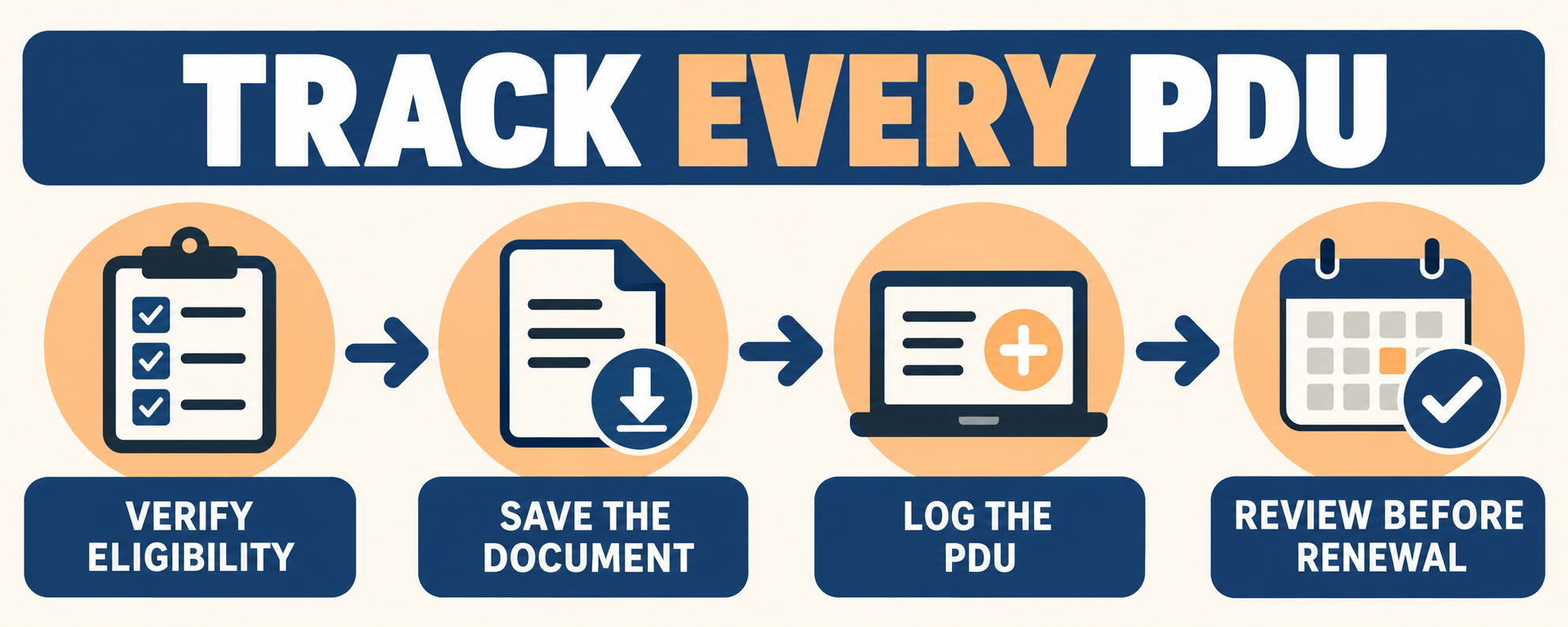
Use one record for every activity. At minimum, capture the activity title, date, provider or organization, format, topic, PDU amount, completion evidence, and the cycle to which you intend to apply it. For university coursework, add the syllabus and grade record. For an ACE event, retain the provider and event details. For in-service training, use the current form and obtain the required completion information.
Use consistent filenames, such as 2026-09-14_assent-training_provider_pdu.pdf. Store the original file, not only a screenshot. Keep a backup in a secure location and avoid placing confidential client information into a professional development folder. Your PDU record should describe the learning activity, not reveal unnecessary client details.
Build a simple PDU tracking plan
A tracking plan can be a spreadsheet, a secure notes system, or the organization’s approved portal. The tool matters less than the fields. Use one row per activity and add a status column: planned, completed, evidence saved, reviewed, or ready to report.
- Start with the cycle dates. Write down the certification or recertification date and the end of the two-year cycle.
- Set a target earlier than the deadline. Aim to finish the requirement with time for corrections, not on the final day.
- Pre-check every activity. Confirm the route, provider, topic, PDU amount, and required form before you attend.
- Save evidence immediately. Do not leave certificates and forms in an inbox where they can be lost.
- Reconcile the total monthly. Check completed PDUs against your records and flag anything uncertain for review.
- Review before submission. Make sure dates fall inside the cycle and that duplicate or repeated activities are not being counted twice.
Common mistakes to avoid
The most common problem is not a lack of effort; it is counting first and checking eligibility later. Other errors include assuming an employer’s certificate is enough, forgetting the cycle dates, losing the syllabus for a university course, counting routine supervision, or treating the same repeated event as a new activity.
Another mistake is confusing professional development with a guarantee of renewal. Completing 12 PDUs is one part of staying ready. The RBT must still meet the current recertification requirements, submit the correct information, and respond to any BACB or employer process that applies. Use the current handbook and forms at the point of submission.
FAQ
Does every ABA webinar count as an RBT PDU?
No. Check the route, provider, content, documentation, and current BACB requirements. A relevant topic alone is not enough.
Can supervision be counted toward the 12 PDUs?
Routine ongoing supervision is not automatically an RBT professional development PDU. Keep supervision records separately and verify any unusual activity before counting it.
What should I do if a certificate does not show the PDU amount?
Contact the provider or organization before relying on it. Ask for the correct completion record or current form, and keep the correspondence with your documentation.
When should I check my PDU total?
Check it after every activity and reconcile it monthly. An early review gives you time to replace an ineligible activity or correct missing documentation.
Bottom line: treat RBT professional development as a documented cycle, not a pile of certificates. Choose an accepted route, verify before counting, save evidence immediately, and compare your records with the current BACB guidance before renewal.
Ready to practice the RBT concepts you just reviewed?
Try an independent, original RBT practice resource with exam-style questions, scoring, and answer explanations.
References
- Behavior Analyst Certification Board. RBT Test Content Outline, 3rd edition.
- Behavior Analyst Certification Board. RBT Handbook.
- Behavior Analyst Certification Board. RBT Ethics Code.