

To prepare for data collection RBT work, start before the first response: review the operational definition, confirm the measurement system, ready the approved tool, and plan how you will observe and record without changing the procedure.
Table of Contents
- Why preparation matters
- Prepare for data collection RBT: start with the definition
- Prepare for data collection RBT: match the measure to the rule
- How to check tools and timing
- How to prepare the observation conditions
- How to protect data and privacy
- What to do when the setup is unclear
- Common data-collection preparation mistakes
- Frequently asked questions
- References
RBT TASK GUIDE · DATA COLLECTION SETUP
Prepare for Data Collection RBT: A Pre-Session Setup Checklist
Check the definition, measurement system, approved tools, timing rules, observation conditions, and privacy before the first response.
To prepare for data collection RBT work, start before the first response: review the operational definition, confirm the measurement system, ready the approved tool, and plan how you will observe and record without changing the procedure. The BACB’s current RBT training materials connect reliable data collection to observable definitions, measurement procedures, and accurate reporting.
This is a pre-session setup guide. Use the client’s current plan, employer procedures, and supervisor direction for the exact target and measurement method. A general checklist cannot replace a client-specific operational definition.
Why preparation matters
Data collection is easier to evaluate when the RBT knows what counts as a response, when measurement starts and stops, which dimension is being recorded, and where the record will be stored. Preparation reduces preventable confusion before the session becomes busy.
It also protects the boundary between observation and interpretation. An RBT can describe what happened and record it using the assigned method. The RBT should not use a new definition, infer a function, or change an intervention simply because a number looks unexpected.
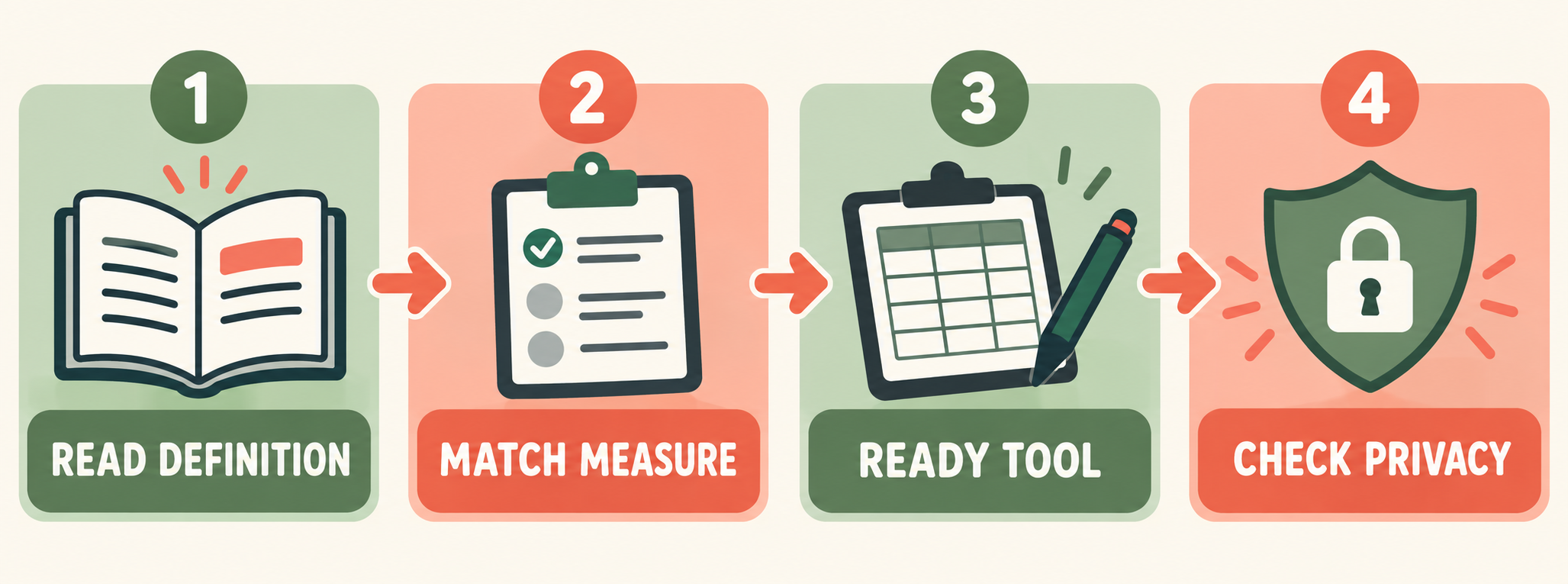
Use this sequence:
- Read the target and operational definition.
- Confirm the assigned measurement dimension and recording rule.
- Prepare the approved data sheet, device, timer, and materials.
- Plan a position and routine that allow observation without unnecessary disruption.
- Protect client information and ask about any unresolved ambiguity before recording.
Prepare for data collection RBT: start with the definition
Read the operational definition exactly as it appears in the current plan. Identify the observable response, the beginning and ending boundaries, and examples or nonexamples if the plan provides them. Ask yourself whether another trained person could use the definition and make a similar decision from the same event.
Do not replace an observable definition with a label. “Noncompliant” does not tell you what to record unless the plan defines it through observable actions. “Left the assigned area by more than two feet for five seconds” is more specific, but only use that wording if it is the approved definition for the client.
Before the session, mark the exact target on the data sheet or approved application. Check that you are not using a similarly named target from another client or an old version of the plan. If the definition is missing, contradictory, or unfamiliar, pause and ask the supervisor before data collection begins.
Prepare for data collection RBT: match the measure to the rule
Confirm the measurement dimension assigned to the target. Common dimensions include frequency, rate, duration, latency, interval recording, percentage correct, and permanent-product recording. The correct choice depends on the plan; an RBT should not select a new dimension because it seems more convenient.
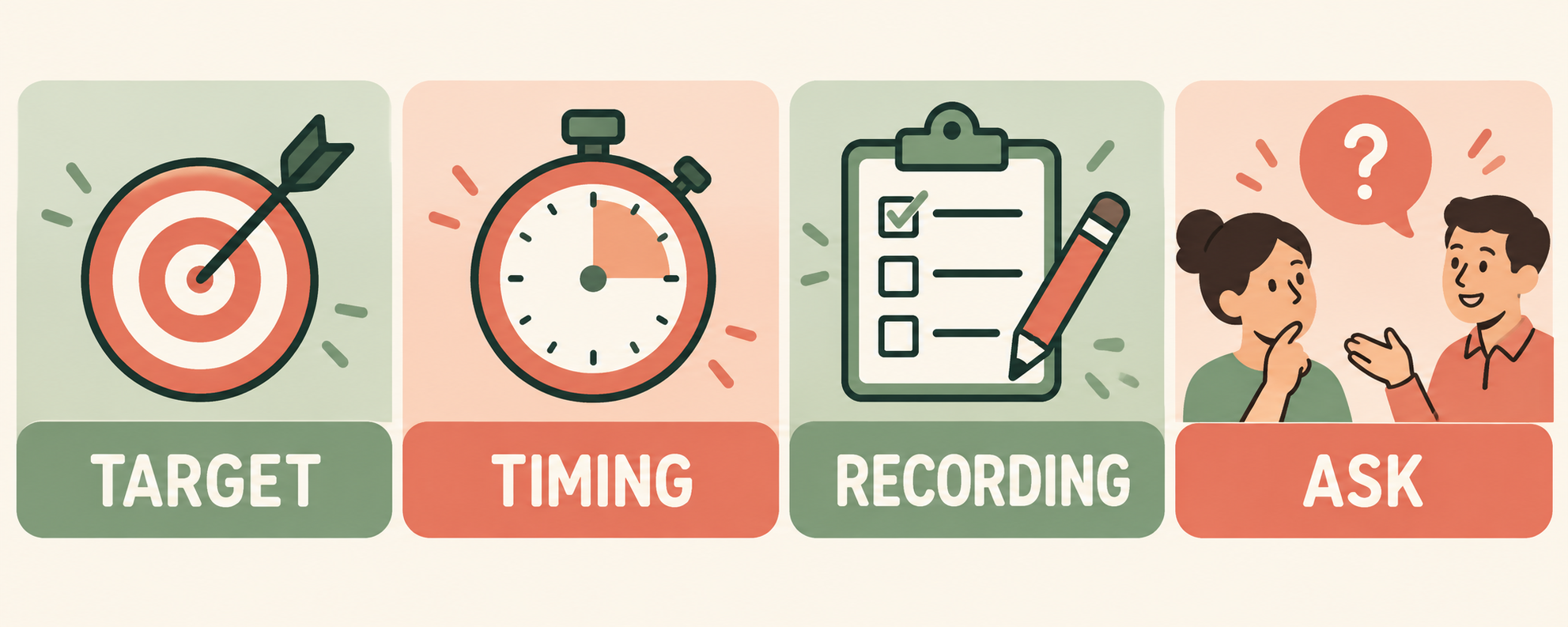
Ask four setup questions:
- What is counted? Responses, opportunities, intervals, seconds, or completed products?
- When is it recorded? Continuously, at an interval, after an opportunity, or at a defined end point?
- What is the scoring rule? What counts as correct, incorrect, occurrence, nonoccurrence, or missing?
- What is summarized later? Rate, mean duration, percentage, graph point, or another assigned summary?
For example, a duration measure requires a clear start and stop rule, while percentage correct requires a defined opportunity and scoring rule. Do not mix the two because both appear as numbers on a sheet. If the plan uses interval recording, confirm the interval length and whether the rule is partial, whole, or momentary time sampling.
How to check tools and timing
Prepare the approved recording tool before the client response occurs. This may be a paper form, an employer-approved app, a timer, a tally counter, or a permanent-product checklist. Verify the client, target, date, session start time, and staff identifier according to the system’s requirements.
Check the tool for practical problems:
- Is the form the current version?
- Is the correct client record open?
- Is the device charged and connected if connection is required?
- Does the timer use the expected units and have a clear reset routine?
- Can you record without placing private information where others can see it?
- Do you have a backup process approved by the employer if the device fails?
Clarify when the session clock starts and how breaks, transitions, interruptions, and late arrivals are handled. Do not fill missing data later from memory unless the plan and employer procedure explicitly authorize the method. If the planned observation cannot happen as written, document the barrier and ask for direction.
How to prepare the observation conditions
Choose a position that lets you observe the target and record it without becoming an unnecessary part of the event. Your position may change by setting: a classroom, home, clinic, community location, or telehealth arrangement can each have different privacy and safety expectations.
Note relevant conditions before the observation begins. This can include the room, materials, task, people present, schedule, or other variables that the plan or employer asks you to document. Use factual descriptions rather than predictions. “The session occurred in the kitchen while two siblings were present” is a recordable context; “the siblings caused the behavior” is a conclusion.
Prepare the materials needed for the task without changing the teaching or behavior-reduction procedure. If a required material is missing or the setting is unsafe, use the chain of command rather than improvising a new arrangement.
How to protect data and privacy
Use only approved accounts, devices, storage, and communication channels. Check that the correct client record is open before entering a value, and close or secure the record when you step away. Keep printed forms and screens away from visitors and other clients.
Collect the minimum information needed for the assigned record. Do not photograph a data sheet with a personal phone, send client details through an unapproved message app, or leave a form in a public place because the session is busy. Follow the employer’s privacy and incident-reporting process if information is exposed or misdirected.
What to do when the setup is unclear
When a definition, measurement rule, or tool is unclear, make the question concrete:
- State the target: identify the assigned behavior or skill without unnecessary client details.
- State what you reviewed: name the plan section, operational definition, or data form.
- State the ambiguity: explain the missing start rule, scoring decision, or tool problem.
- Ask for direction: request clarification or a demonstration before the next observation.
Example: “The plan identifies duration, but the start rule does not say whether the timer begins at the first movement or after the response reaches the defined topography. Which start rule should I use?” This preserves the question without inventing a rule.
Common data-collection preparation mistakes
- Using memory instead of the definition: Review the current plan before the session.
- Choosing the easiest measure: Use the assigned measurement system unless the supervisor changes it.
- Opening the wrong record: Verify the client, target, date, and session fields before recording.
- Ignoring timing rules: Confirm starts, stops, breaks, interruptions, and units.
- Recording later without authorization: Ask about the approved backup process when live recording fails.
- Confusing context with cause: Document variables without making an independent functional conclusion.
Frequently asked questions
What is the first step to prepare for data collection as an RBT?
Review the current operational definition and assigned measurement procedure. Confirm what counts as a response, when to record it, and which tool the plan requires.
Can an RBT choose a different data-collection method?
Do not independently choose a new method. Ask the supervisor for direction if the assigned method is unclear, impractical, or affected by a session barrier.
What should I do if the data sheet is missing a field?
Use the employer’s approved correction or backup process and contact the supervisor. Do not create a new field or reconstruct values from memory without direction.
How does preparation improve data quality?
It reduces preventable errors by aligning the definition, measure, tool, timing, observation conditions, and privacy routine before the first response occurs.
Bottom line: To prepare for data collection RBT work, make the definition, measure, tool, timing, observation position, privacy routine, and escalation path clear before recording begins. Reliable preparation is careful implementation of the assigned system—not independent redesign of it.
Ready to practice the RBT concepts you just reviewed?
Try an independent, original RBT practice resource with exam-style questions, scoring, and answer explanations.
References
- Behavior Analyst Certification Board. RBT Test Content Outline, 3rd edition.
- Behavior Analyst Certification Board. RBT Handbook.
- Behavior Analyst Certification Board. RBT Ethics Code.