

RBT professional development requirements 2026 add a structured 12-PDU expectation to the two-year recertification cycle after an RBT becomes certified or recertifies in 2026.
Table of Contents
- What changed for RBT professional development
- RBT professional development requirements 2026: the roadmap
- How organization in-service training works
- How ACE professional development events work
- When university coursework may qualify
- What does not count
- How to document and review PDUs
- Common planning mistakes
- Frequently asked questions
- References
RBT CERTIFICATION GUIDE · PROFESSIONAL DEVELOPMENT
RBT Professional Development Requirements 2026: The 12-PDU Roadmap
Map the two-year PDU cycle, choose a qualifying route, keep the right record, and avoid counting training that does not qualify.
RBT professional development requirements 2026 add a structured 12-PDU expectation to the two-year recertification cycle after an RBT becomes certified or recertifies in 2026. The goal is ongoing learning—not simply repeating initial training—and the BACB materials distinguish qualifying professional development from routine supervision, client-specific instruction, and informal study.
Requirements and forms can change. Use the current RBT Handbook, BACB professional development materials, portal instructions, and the correct form for the event. This guide helps you plan; it does not pre-approve a course or determine whether your personal record satisfies recertification.
What changed for RBT professional development
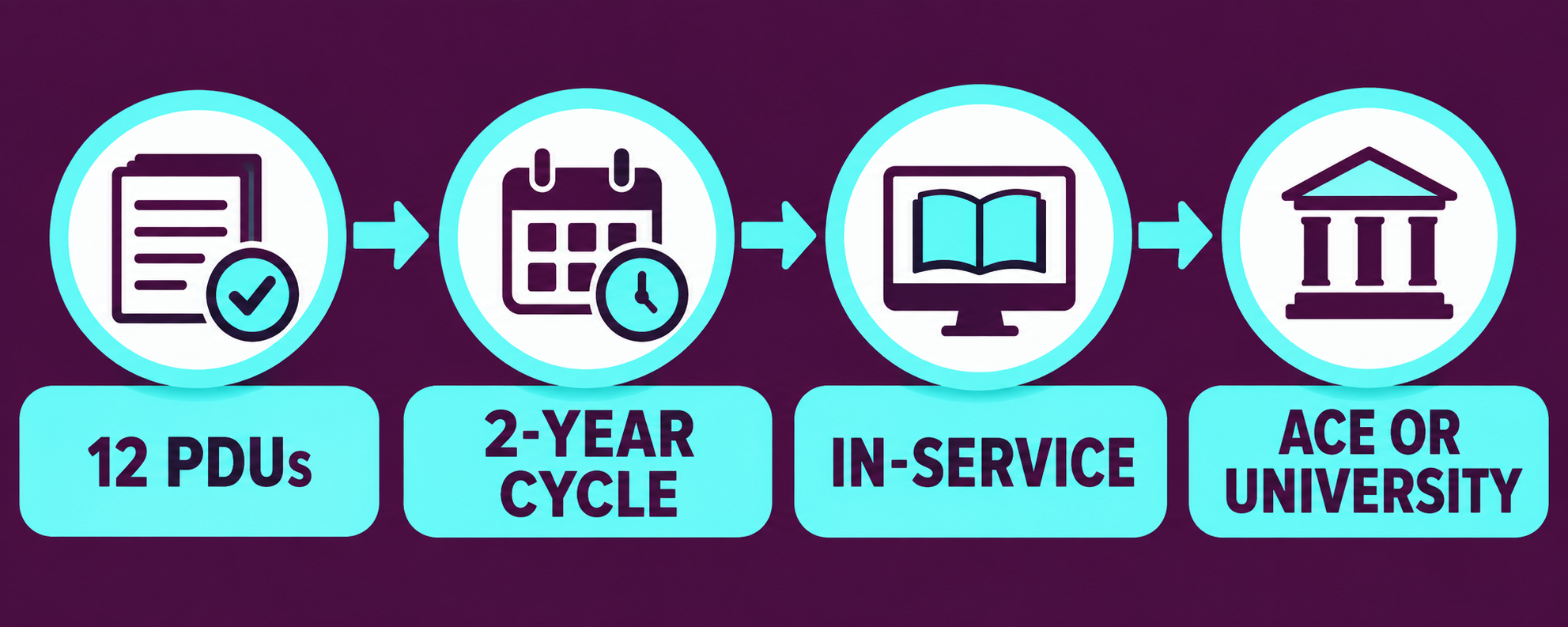
Professional development is a maintenance requirement connected to the RBT recertification cycle. Current BACB materials say RBTs must earn 12 professional development units during each two-year cycle and may begin earning them after becoming certified or recertifying in 2026.
That timing matters. An RBT who certified or recertified before the applicable transition may have a different requirement or cycle. Check the certification date, recertification date, cycle dates, and account instructions instead of applying the 2026 rule to every situation.
Professional development also has a content boundary. A training can be useful at work and still fail to meet the BACB’s PDU definition. The topic, structure, provider, documentation, and timing all matter.
RBT professional development requirements 2026: the roadmap
Use this sequence to plan the cycle:
- Confirm your cycle: check when you became certified or recertified in 2026 and note the two-year period.
- Choose the route: identify organization in-service training, an ACE professional development event, university coursework, or a combination.
- Check the content: verify that the topic is appropriate for RBT professional development and is not client-specific or excluded.
- Complete the event: participate in the structured instruction and retain the required evidence.
- Record the PDU: use the correct organization, ACE, or university documentation and upload it as required.
- Review the account: monitor the BACB portal and correct missing or rejected records before the recertification deadline.
How organization in-service training works
An organization may provide in-service professional development connected to behavior-analytic service delivery. Current BACB materials say the event should be structured and intentionally deliver knowledge, skills, or competencies related to approved content.
Examples of appropriate content include reviewing reinforcement and punishment concepts, communicating with clients and caregivers, assent-based treatment, working with supervisors, or evidence-based ways to manage work-related stress. The topic should be suitable for RBTs and connected to the current professional development requirements.
Ask the organization before attending:
- Who is providing the event and are they eligible under the current rule?
- What learning objectives and active participation are included?
- How many PDUs are assigned and how are they calculated?
- Which RBT Professional Development form will document completion?
- Who signs or submits the form, and when will it appear in the portal?
Simply attending a staff meeting is not enough. A meeting about one client’s program, company policies, or a scheduling issue may be important, but it is not automatically qualifying professional development.
How ACE professional development events work
Authorized Continuing Education providers may offer professional development events for RBTs. Current BACB materials distinguish these events from other continuing education products, so verify that the provider and event are approved for RBT professional development rather than assuming that every certificate from an education company qualifies.
ACE events may be offered outside company time and in formats such as online webinars or conferences. Before registering, check the provider’s current status, event description, RBT audience, PDU amount, attendance rules, and form process. Save the event description and completed RBT Professional Development form with your certification records.
A certificate of attendance may be useful evidence, but the current BACB documentation process controls. If the form is missing a required field, ask the provider to correct it while the event details are still available.
When university coursework may qualify
Current handbook materials identify didactic behavior-analytic university coursework as another route. The coursework must meet the applicable conditions, and a passing grade—“C” or higher in a graded course or “pass” in a pass/fail system—is part of the documentation description in the current materials.
Keep the syllabus and transcript. A course title alone may not show whether the content fits the current requirement. Ask the university or the BACB materials how the course should be documented, and do not assume that every college class or a course taken for another credential will count.
What does not count
The current in-service requirements list examples of non-qualifying activities. These boundaries help prevent a common mistake: counting every learning activity in a work calendar as a PDU.
- Training on one client’s program or individual programming.
- Reviewing company policies and procedures.
- Individual or group supervision meetings about specific client programming.
- BCBA examination preparation materials.
- Training on ABA program or data-management software.
- The initial 40-hour RBT training.
- CPR training.
- Reading an article, listening to a podcast, or other self-study completed on your own time when the current rule excludes it from in-service PDUs.
- Ongoing RBT supervision or supervised fieldwork toward BCaBA or BCBA certification.
Some excluded activities may still be valuable for clinical quality or career development. “Does not count as an RBT PDU” does not mean “not useful”; it means keep it separate from the 12-PDU record.
How to document and review PDUs
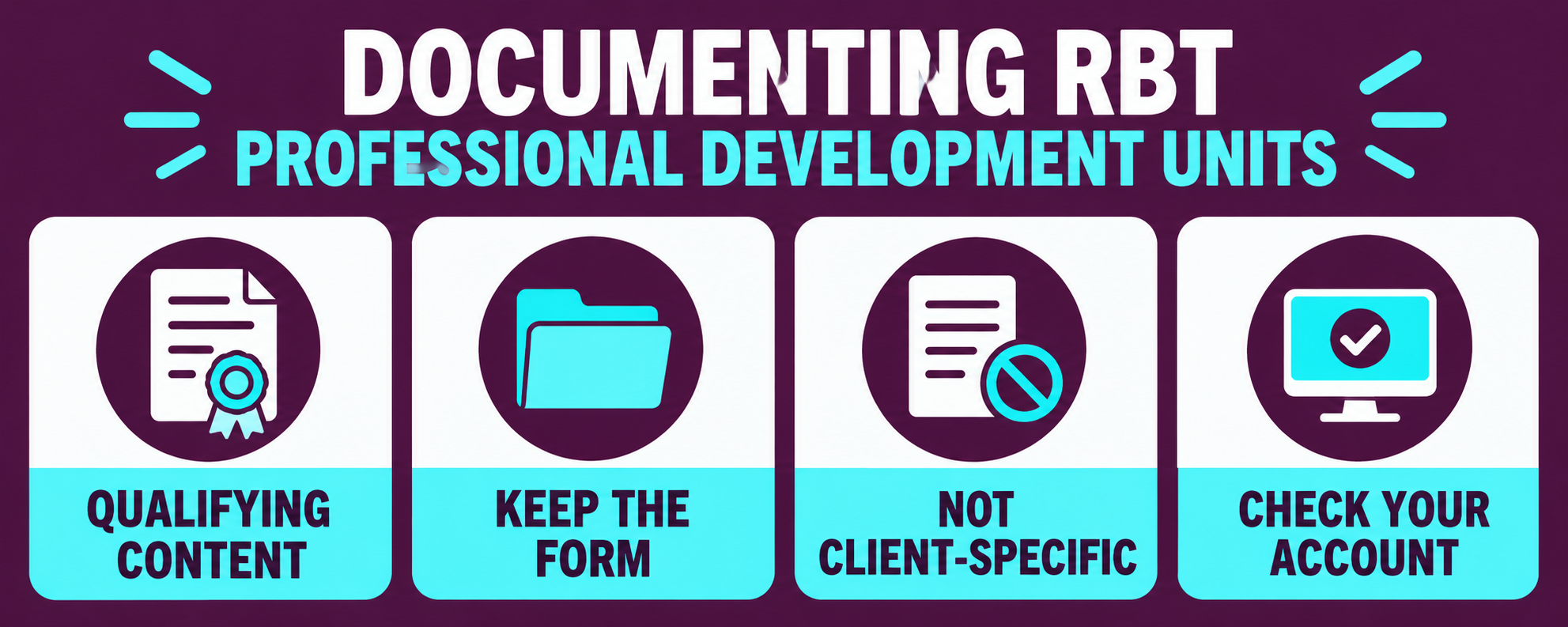
Create a small PDU tracker with the event date, title, provider, route, topic, PDU amount, form or transcript location, submission date, and portal status. Keep a running total, but do not wait until the last month to discover that one event lacked the correct documentation.
At each event, answer four questions:
- What exact requirement or content area did the event address?
- Who provided it and what documentation route applies?
- What proof did I receive—a signed form, ACE form, syllabus, or transcript?
- Where is the record saved and when will I check the BACB account?
Keep copies in a secure place and follow the BACB portal’s upload instructions. If an entry is missing, incomplete, or rejected, contact the provider or appropriate BACB channel early rather than editing evidence yourself.
Common planning mistakes
Counting every training hour: topic, structure, provider, and documentation must fit the current rule.
Confusing supervision with PD: routine supervision supports service quality but is listed separately from the 12-PDU requirement.
Using an old form: check the current handbook and professional development page before uploading documents.
Waiting for the deadline: a missing signature or rejected record is harder to repair at the end of a cycle.
Assuming a certificate guarantees acceptance: retain the full event details and verify the current BACB documentation process.
Frequently asked questions
How many PDUs does an RBT need?
Current BACB materials state 12 PDUs during each two-year recertification cycle for RBTs covered by the 2026 professional development requirement.
When can an RBT start earning PDUs?
The current materials say an RBT may start earning PDUs after becoming certified or recertifying in 2026. Check your account and the current handbook for the cycle that applies to you.
Does RBT supervision count as professional development?
Not automatically. Current in-service materials distinguish ongoing RBT supervision and client-specific programming supervision from qualifying professional development.
Can a BCBA exam-prep course count toward RBT PDUs?
The current in-service requirements list BCBA exam preparation materials as non-qualifying for this RBT PDU requirement.
What records should an RBT keep?
Keep the correct RBT Professional Development form for organization or ACE events, or the syllabus and transcript described for qualifying university coursework, along with your portal submission evidence.
The safest way to meet the 2026 requirement is to plan the two-year cycle early, choose a current qualifying route, keep the right form, and separate professional development from supervision, client-specific training, and informal study.
Ready to practice the RBT concepts you just reviewed?
Try an independent, original RBT practice resource with exam-style questions, scoring, and answer explanations.
References
- Behavior Analyst Certification Board. RBT Test Content Outline, 3rd edition.
- Behavior Analyst Certification Board. RBT Handbook.
- Behavior Analyst Certification Board. RBT Ethics Code.