
Legal documentation RBT work is not about giving yourself legal answers; it is about documenting sessions objectively, checking the applicable rule or workplace policy, protecting information, and escalating uncertainty through supervision.
Table of Contents
- Legal documentation RBT: what the phrase means
- Read E.4 as an objective-documentation task
- Separate legal, regulatory, workplace, and clinical layers
- Build an objective session record
- Protect information and control access
- What to do when a requirement is unclear
- Correct documentation without hiding the original record
- Retention, audits, and version checks
- Common legal-documentation mistakes
- Frequently asked questions
- References
RBT DOCUMENTATION GUIDE · E.4 AND ROLE BOUNDARIES
Legal Documentation RBT: How to Follow E.4 Without Guessing
Understand the legal, regulatory, workplace, and supervision layers behind objective RBT records without turning a study guide into legal advice.
Legal documentation RBT work is not about giving yourself legal answers; it is about documenting sessions objectively, checking the applicable rule or workplace policy, protecting information, and escalating uncertainty through supervision. The current RBT Test Content Outline (3rd ed.) says the technician communicates objectively what occurred during a session in accordance with applicable legal, regulatory, and workplace requirements.
That sentence creates a professional habit, not a universal form. The exact fields, timelines, systems, recipients, and retention rules may vary by employer, payer, school, client arrangement, and jurisdiction. This article explains a safe reasoning process. It does not interpret law, decide whether a record satisfies a statute, or replace instructions from a qualified legal, regulatory, compliance, or clinical source.
Legal documentation RBT: what the phrase means
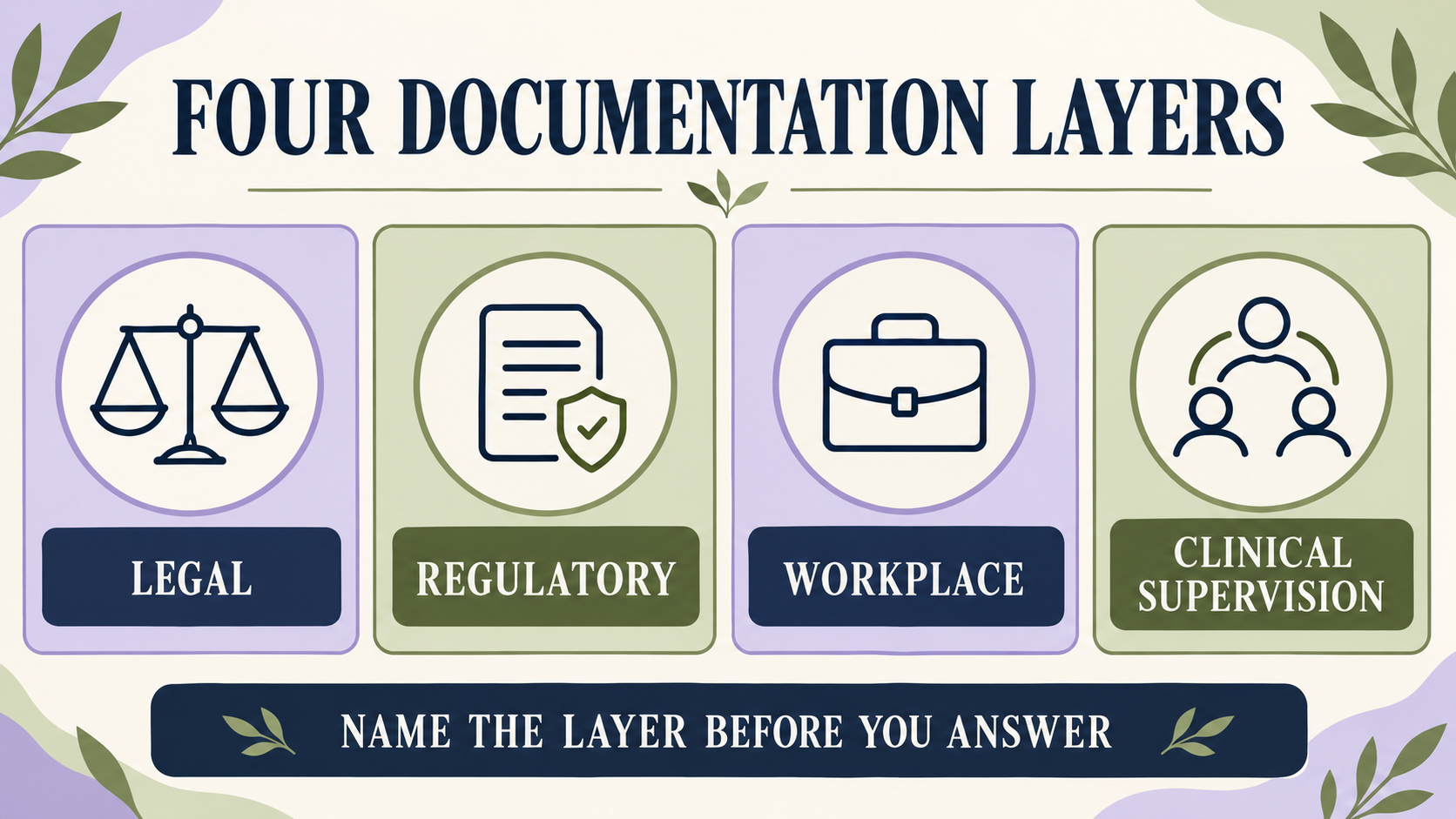
Think of the phrase as four questions that must be kept separate:
- Legal: What law or legally required reporting or record rule applies to this setting?
- Regulatory: What requirement comes from a licensing, certification, payer, education, health, or other oversight body?
- Workplace: What does the employer, school, agency, or contract require for records and communication?
- Clinical supervision: What does the current behavior plan or supervisor’s direction require the RBT to implement, measure, and report?
These layers can overlap, but one does not automatically answer the others. A workplace form may be convenient without being the complete legal record. A clinical note may describe a procedure without answering a jurisdiction’s reporting question. A BACB standard may establish the RBT’s professional expectation without becoming a complete state-law checklist.
Read E.4 as an objective-documentation task
E.4 is about communicating what occurred during the session objectively. Start with observable events: the activity, instruction, response, prompt, consequence, measurement, and relevant variable. Avoid statements that require guessing intention, diagnosis, character, or blame.
Compare these examples:
- Weak: “The learner was manipulative and refused to work because they wanted attention.”
- Stronger: “During the transition from reading to math, the learner pushed the worksheet away twice and said ‘break.’ The RBT followed the current break-request procedure and recorded the response according to the assigned definition.”
The stronger note does not claim to solve the clinical question. It preserves what an observer could verify and identifies the procedure that was used. If a supervisor needs to interpret the pattern, the supervisor has a more reliable record to review.
Separate legal, regulatory, workplace, and clinical layers
When a documentation question appears, write the question before searching for an answer. “How long must this employer retain this record?” is different from “What does BACB require for RBT supervision documentation?” and different again from “What should I do when the client missed a session?” Naming the layer prevents a general web answer from being treated as a local rule.
A simple routing guide looks like this:
- Clinical procedure or data definition: ask the responsible supervisor or RBT Requirements Coordinator.
- Employer form, software, correction, or approval route: ask the employer’s designated documentation or compliance contact.
- Payer, school, or contract requirement: use the authorized contact for that program and keep the instruction in the record when appropriate.
- Legal or jurisdiction-specific interpretation: consult a qualified legal or regulatory resource; do not rely on a generic article.
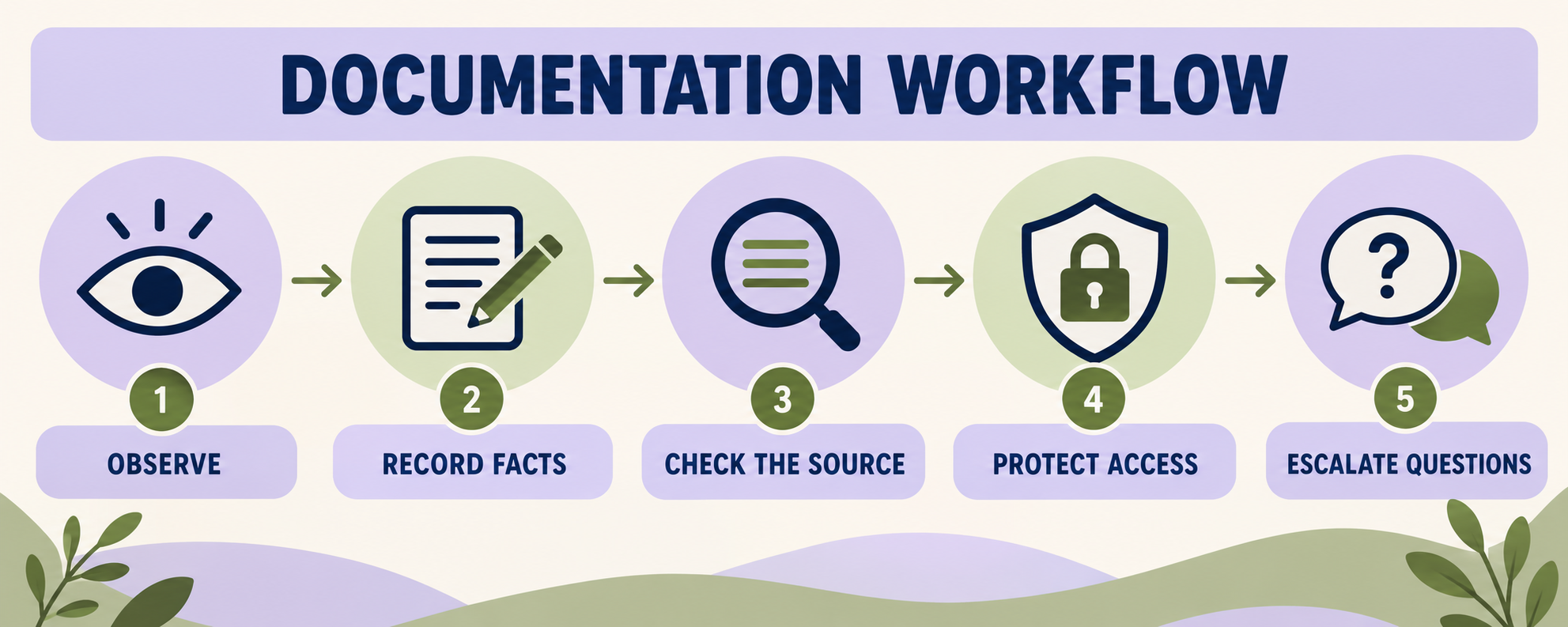
Build an objective session record
Use the assigned documentation system and include the fields it requires. A clear record commonly identifies the date, time, setting, service context, people involved when relevant, activities, procedures implemented, data, response, changes, and follow-up. Do not add private information simply because the software has a large text box.
Use time and sequence when they improve accuracy. If a schedule change occurred before a target response, record the change and the observation without declaring that it caused the response. If a measurement was missed, document the limitation and contact the supervisor according to the correction route. “No data” is not the same as “zero” when no observation was completed.
The current TCO also expects timely communication of variables that might affect client progress and timely clinical-direction requests. A medication change, illness, unusual noise, substitute staff member, altered routine, missing material, or safety concern may require a separate handoff in addition to the session note. Follow the plan and the setting’s procedure for deciding where that information belongs.
Protect information and control access
Objective does not mean public. RBT records may contain identifying, health, educational, behavioral, or family information. Use the approved system, verify the recipient, and share only what the authorized person needs. Do not copy a client record into a personal notes app, email it to a friend, or use an identifiable case in a public question.
Check access before sending a correction or attachment. Lock screens, use the employer’s approved credentials, and follow local rules for transporting paper or electronic records. If a document is accidentally sent to the wrong recipient or stored in the wrong place, report the incident promptly through the workplace process and notify the supervisor as required.
What to do when a requirement is unclear
Do not choose a rule because it is the easiest one to remember. Pause and make the uncertainty specific. For example: “The school form asks for an incident description, but the agency note has a different field. Which system is the official record, and who should receive the follow-up?” A precise question helps the right person answer.
Keep a dated record of the instruction you received when the issue affects future documentation. If two instructions conflict, do not silently choose one and delete the other. Ask the responsible supervisor or designated compliance contact to resolve the conflict and document the direction through the approved channel.
Correct documentation without hiding the original record
Errors happen: a time may be entered incorrectly, a data field may be left blank, or a note may use an imprecise phrase. The correction route depends on the system. Follow the employer or platform process rather than deleting, backdating, overwriting, or quietly changing a completed record.
A transparent correction usually identifies what was wrong, what the corrected information is, when the correction was made, and who made it, if the system requires those details. If you are unsure whether a note can be amended, ask before acting. Preserve the factual history and notify the supervisor when the error could affect data, billing, safety, or a required report.
Retention, audits, and version checks
Retention is one of the easiest areas to overgeneralize. The current RBT Handbook describes retaining supervision documentation for at least seven years and notes that the BACB may audit. That statement should not be turned into a universal retention period for every client note, employer record, school record, or payer record. Confirm the rule that applies to the specific document and setting.
Save the current form or instruction version when the workplace system allows it, and note when a procedure changed. A record written under an older form may need a different correction or resubmission route than a record created under the current one. Use current BACB materials for BACB requirements and current authorized workplace instructions for local workflows.
Common legal-documentation mistakes
- Searching for one universal template: documentation requirements are layered and setting-specific.
- Writing conclusions instead of events: record what was observed and what procedure occurred.
- Confusing zero with missing data: distinguish no response from no observation.
- Backdating a correction: use the platform’s correction route and preserve the history.
- Assuming BACB answers every legal question: route legal interpretation to a qualified legal or regulatory source.
- Keeping a private parallel record: use approved systems and report an access or transmission error promptly.
- Ignoring conflicting instructions: ask for a documented resolution instead of choosing silently.
Frequently asked questions
Does legal documentation mean an RBT must know every law?
No. The RBT must follow applicable training, written procedures, supervision, and workplace instructions, recognize when a question is legal or regulatory, and escalate it to the appropriate qualified source. Do not claim certainty where the rule depends on a location or contract.
Can a supervisor tell me what the law means?
A supervisor can provide clinical direction and may explain workplace procedures within their role. Legal interpretation belongs to a qualified legal or regulatory resource. If the issue affects both clinical service and legal reporting, handle both routes rather than treating one as a substitute for the other.
Is seven-year retention required for every RBT note?
Do not assume that. The RBT Handbook’s seven-year statement concerns supervision documentation. Client, school, payer, and employer records may have different rules. Verify the specific record type and setting.
What if I discover that a completed note is inaccurate?
Do not delete or backdate it. Follow the approved correction process, preserve the original history, describe the correction accurately, and notify the supervisor or designated compliance contact when the error may affect care, data, billing, safety, or reporting.
Good legal documentation RBT practice is disciplined but modest: observe carefully, record objectively, protect the information, identify the governing layer, and ask the right person when the rule is unclear. That approach supports accurate service records without pretending that one article can replace local law, current BACB guidance, or professional legal advice.
Ready to practice the RBT concepts you just reviewed?
Try an independent, original RBT practice resource with exam-style questions, scoring, and answer explanations.
References
- Behavior Analyst Certification Board. RBT Test Content Outline, 3rd edition.
- Behavior Analyst Certification Board. RBT Handbook.
- Behavior Analyst Certification Board. RBT Ethics Code.