

RBT practice within competence means using the skills you have been trained and authorized to use, under required supervision, while pausing and asking when a task is unfamiliar, unsafe, or beyond your demonstrated ability.
Table of Contents
- RBT practice within competence: what it means
- Signals that a task may be outside competence
- Pause without abandoning safety
- Describe the gap clearly
- Contact the supervisor
- Follow the approved next step
- Document the communication
- Field scenarios
- Frequently asked questions
- Sources and scope note
RBT FIELD GUIDE · COMPETENCE AND SUPERVISION
RBT Practice Within Competence: A Field Guide
Recognize the boundary, pause safely, contact the supervisor, and follow the approved next step.
RBT practice within competence means using the skills you have been trained and authorized to use, under required supervision, while pausing and asking when a task is unfamiliar, unsafe, or beyond your demonstrated ability.
The RBT Ethics Code (2.0) says behavior-technician services should be provided only after the supervisor confirms demonstrated competence. It also directs an RBT to inform the supervisor or another appropriate workplace person when asked to do something beyond certification or competence and to document the communication. This article is educational and does not replace a supervisor’s assessment or an emergency procedure.
RBT practice within competence: what it means
Competence is not a permanent feeling of confidence. It is task- and context-specific performance. You may be competent with one data system but need training on another; comfortable with a familiar teaching routine but need coaching for a new intervention; or ready for a clinic procedure but not yet ready to use the same procedure in a different environment.
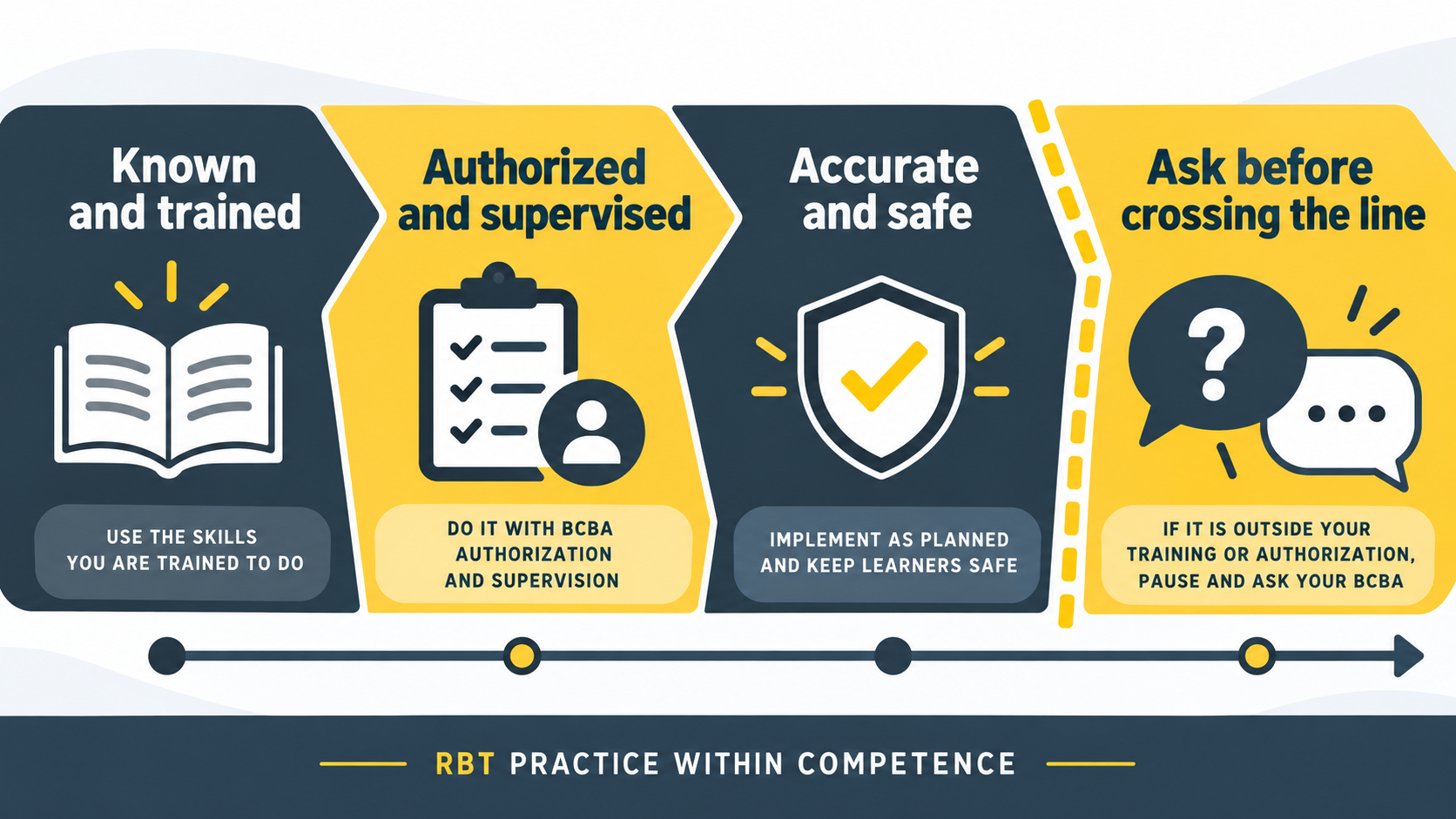
Staying within competence has three parts:
- Use what is known: Follow the current plan and the skills you have been trained to implement.
- Notice the boundary: Identify when the task, context, or risk no longer matches your demonstrated preparation.
- Ask before improvising: Contact the supervisor and follow the approved next step.
This is not an excuse to refuse every difficult task. It is a way to make sure the task is understandable, authorized, supervised, and performed accurately and safely.
Signals that a task may be outside competence
A boundary signal can be obvious, such as being asked to use a procedure you have never been trained on. It can also be subtle:
- The written procedure changed, but you have not been oriented to the new version.
- The client population or communication system is unfamiliar.
- The setting introduces a new safety, privacy, or equipment concern.
- You are unsure how to collect the assigned measurement or respond to an unexpected result.
- A caregiver or coworker asks you to change the plan during the session.
- You would need to invent a step because the supervisor’s direction is unclear.
Do not wait until a serious mistake occurs to name the gap. A question raised early is easier to solve than an inaccurate record or unsafe improvisation that must be repaired later.
Pause without abandoning safety
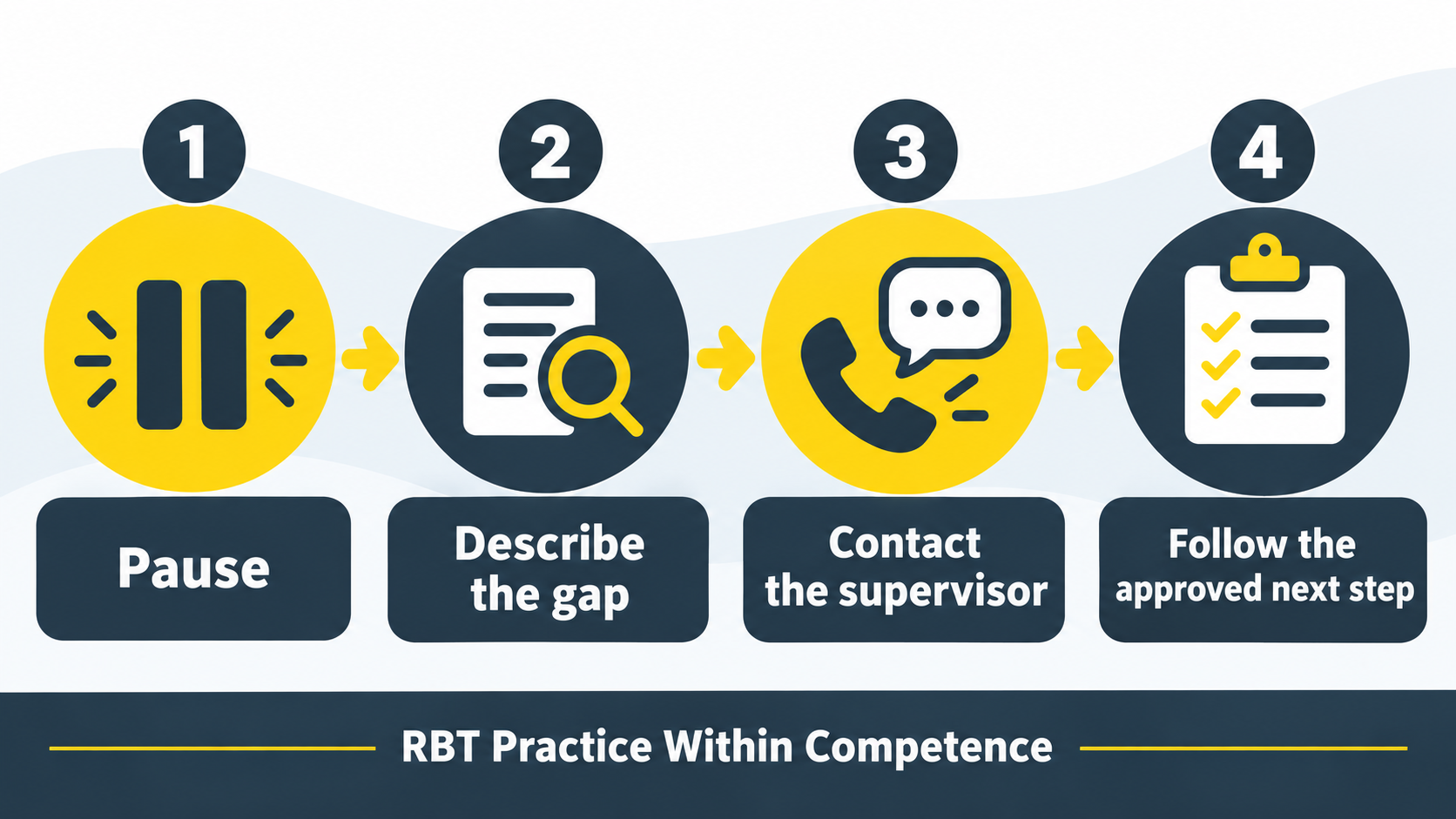
When a task is unfamiliar, pause the questionable action—not the responsibility to protect the learner. Use the current safety procedure, provide the support you are authorized and trained to provide, and contact the supervisor or emergency route as required.
For example, if you are unsure how to implement a new teaching step, do not invent a different intervention. If there is immediate risk, follow the organization’s safety response first. If there is no immediate danger, maintain the established routine as authorized while requesting clarification. The correct pause depends on the facts and the plan.
A pause can be professional and calm: “I have not been trained on this version of the procedure. I can continue the familiar step in the current plan while I contact the supervisor for direction.”
Describe the gap clearly
Supervision works better when the RBT describes the problem rather than saying only, “I cannot do this.” Include the task, the context, the training you have received, what is unclear, and whether there is an immediate safety or privacy concern.
Try this structure:
- Task: “The current plan asks me to…”
- Preparation: “I have practiced…” or “I have not been trained on…”
- Gap: “I am unsure about…”
- Risk: “The immediate concern is…”
- Request: “What is the approved next step?”
Use observable language. “The learner left the area when the new instruction was presented” is more useful than “the procedure failed.” Keep client information in the approved communication channel.
Contact the supervisor
RBTs practice under the direction and close supervision of an RBT Supervisor and/or RBT Requirements Coordinator. Contact the person designated by the workplace for the task. If the supervisor is unavailable, use the stated backup route; do not assume that no response means you have permission to make an independent clinical decision.
Ask what you may do now, what you should not do, whether additional training or observation is needed, and how to record the event. If the concern involves the supervisor, use the supervisor’s manager, requirements coordinator, compliance contact, or another authorized escalation route.
Questions about competence are not accusations. They are part of safe service delivery and help the supervisor identify where training, modeling, rehearsal, or feedback is needed.
Follow the approved next step
The approved next step might be additional instruction, role-play, shadowing, direct observation, a temporary assignment change, or implementation of a clearly defined safety procedure. Follow the direction exactly as given and ask for clarification if a key detail remains unclear.
Do not substitute a favorite technique, remove a difficult step, or change reinforcement because you believe the alternative will work better. RBTs implement authorized services; supervisors and the treatment team determine clinical changes.
Restrictive or punishment-based procedures deserve particular caution. The RBT Ethics Code requires such procedures to be included in a documented behavior-change plan and used only after the supervisor verifies competence. Never treat a verbal suggestion as a substitute for the required plan and supervision.
Document the communication
Record the relevant facts and actions through the approved system. Include the date and time, the task or concern, who was contacted, the direction received, and any follow-up that remains. Separate direct observation from information reported by someone else.
Documentation is not a place to defend yourself with a long story. It should make the timeline clear and protect the integrity of the record. Do not backdate, estimate missing data, or delete an earlier entry when the system requires an amendment or addendum.
Field scenarios
A new data app appears during a session. Use the familiar approved method if directed, ask how the new app should be used, and do not guess at settings that could change measurement.
A caregiver asks you to add a goal. Acknowledge the request, continue the current authorized plan, and bring the request to the supervisor. Do not create a new target on your own.
A safety procedure is unfamiliar. Protect immediate safety using the organization’s emergency instructions, contact the supervisor or appropriate authority, and document what occurred. Do not wait for a perfect explanation before taking an authorized safety action.
You realize you used the wrong prompt. Do not hide the error. Describe what happened, follow the supervisor’s correction direction, and record the relevant limitation or follow-up according to workplace policy.
Frequently asked questions
Does practicing within competence mean I can never learn on the job?
No. Learning can happen through supervised training, rehearsal, observation, feedback, and gradual responsibility. The key is that the learning activity is authorized and supervised rather than improvised with a client as the test.
What if the supervisor is not available?
Follow the written backup and safety route. Continue only the actions you are trained and authorized to perform, and document the attempt to obtain direction. Lack of immediate access does not automatically authorize a new clinical decision.
Can experience replace formal training?
Experience can build skill, but it does not automatically verify competence for a new procedure or context. Ask the supervisor what evidence and training are required.
Sources and scope note
This guide is based on the BACB RBT Ethics Code (2.0), the BACB Registered Behavior Technician Handbook, and BACB RBT information. Requirements can change, and employer, payer, school, state, and legal rules may add obligations. Check current sources and ask the appropriate supervisor about your situation.
Ready to practice the RBT concepts you just reviewed?
Try an independent, original RBT practice resource with exam-style questions, scoring, and answer explanations.
References
- Behavior Analyst Certification Board. RBT Test Content Outline, 3rd edition.
- Behavior Analyst Certification Board. RBT Handbook.
- Behavior Analyst Certification Board. RBT Ethics Code.