

An RBT scope of competence is not a permanent list attached to a certificate. It is a practical, task-specific boundary that must match training, demonstrated performance, authorization, supervision, and the current service context.
Table of Contents
- What an RBT scope of competence means
- The four layers of a usable scope
- How to build a task scope inventory
- When the scope needs a new review
- Examples of tasks within scope
- Signs a task may be outside scope
- How to discuss scope with your supervisor
- Frequently asked questions
- Sources and scope note
RBT PROFESSIONAL BOUNDARIES · PRACTICE SCOPE
RBT Scope of Competence: Define Your Practice Boundary
A practical way to check whether a task is trained, demonstrated, authorized, and supervised before you provide service.
RBT scope of competence is a working boundary around the tasks an RBT has been trained to perform, has demonstrated accurately, is authorized to implement, and can complete under the required supervision in the current context.
That boundary matters because certification is not a blanket guarantee that an RBT is competent for every procedure, client, setting, communication system, or piece of equipment. The BACB Handbook explains that certification indicates the certification requirements have been met; it does not warrant or guarantee competence to provide services. The RBT Ethics Code also requires service delivery only after the supervisor confirms demonstrated competence.
Use this guide as a supervision conversation tool. It cannot decide whether a specific task is legally authorized or clinically appropriate. Employer, payer, school, state, workplace, and treatment-team requirements may add conditions.
What an RBT scope of competence means
Think of scope as a current inventory, not a permanent label. The inventory describes specific tasks and the evidence supporting them. “I can provide ABA services” is too broad to guide a safe decision. “I can run the current data procedure for this program, with this form, after observed training and under the assigned supervision plan” is more useful.
A task can move into or out of the working scope. A newly trained procedure may still need observation. A familiar procedure may need review when the client, materials, setting, communication method, or safety conditions change. A skill that was accurate last month may need coaching after a long gap or a revised protocol.
The key question is not “Have I ever done something similar?” It is “What evidence shows that I can implement this current task accurately, within the current direction and supervision arrangement?”
The four layers of a usable scope
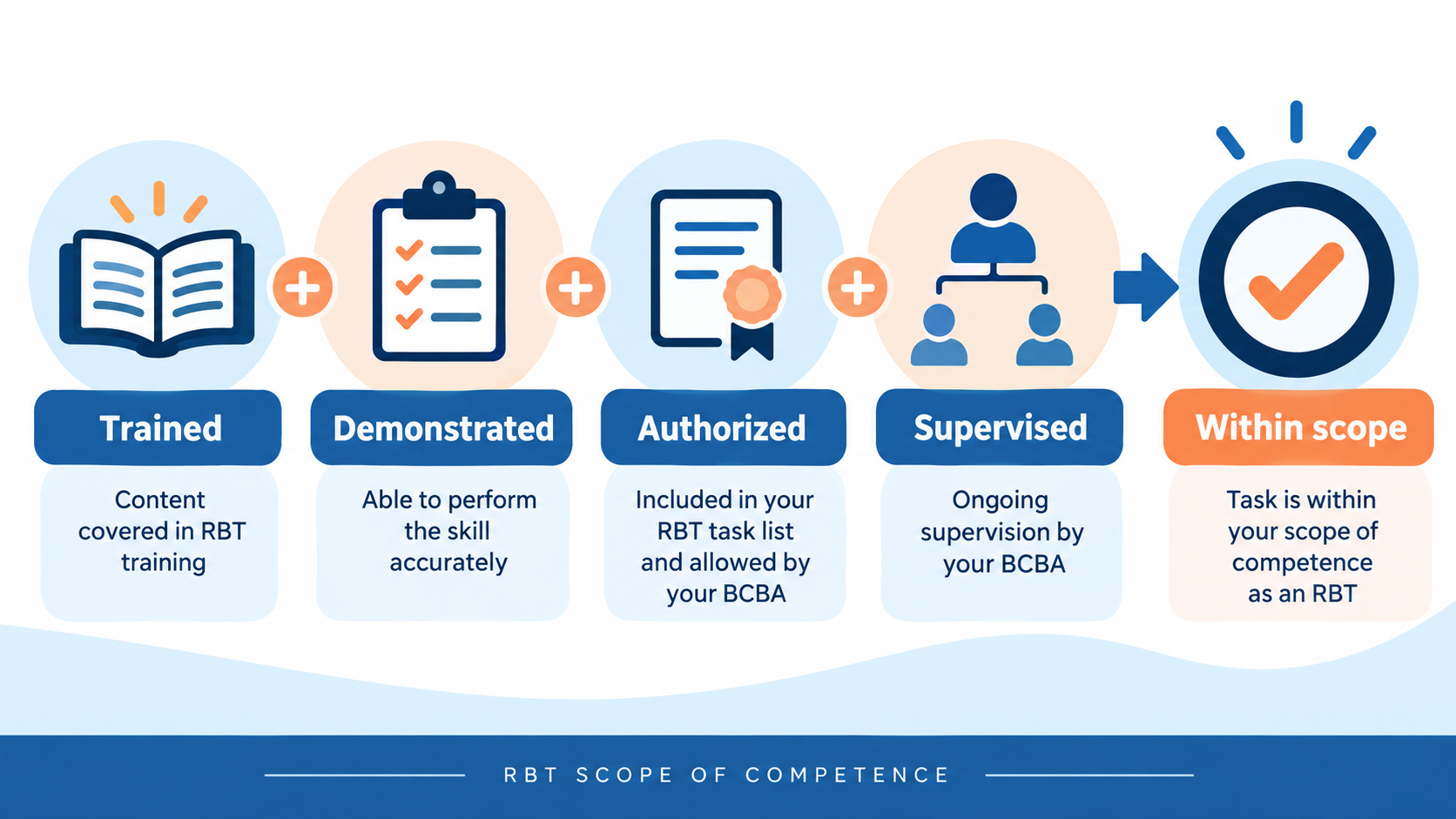
A simple scope check separates four ideas that are often mistakenly treated as one:
- Trained: You received instruction on the procedure, its important steps, the measurement or documentation requirements, and the situations that require help.
- Demonstrated: You showed the skill through the method selected by the supervisor, such as observation, role-play, record review, or another task-appropriate check.
- Authorized: The current plan, workplace direction, and applicable requirements allow you to implement the task in your role. Training alone does not create authorization.
- Supervised: The task fits the current supervision arrangement, including the direction, availability, observation, feedback, and escalation route required for the service.
All four layers should line up before a task is treated as ready for routine implementation. If one layer is missing, pause and ask the appropriate supervisor or workplace contact what must happen next.
How to build a task scope inventory
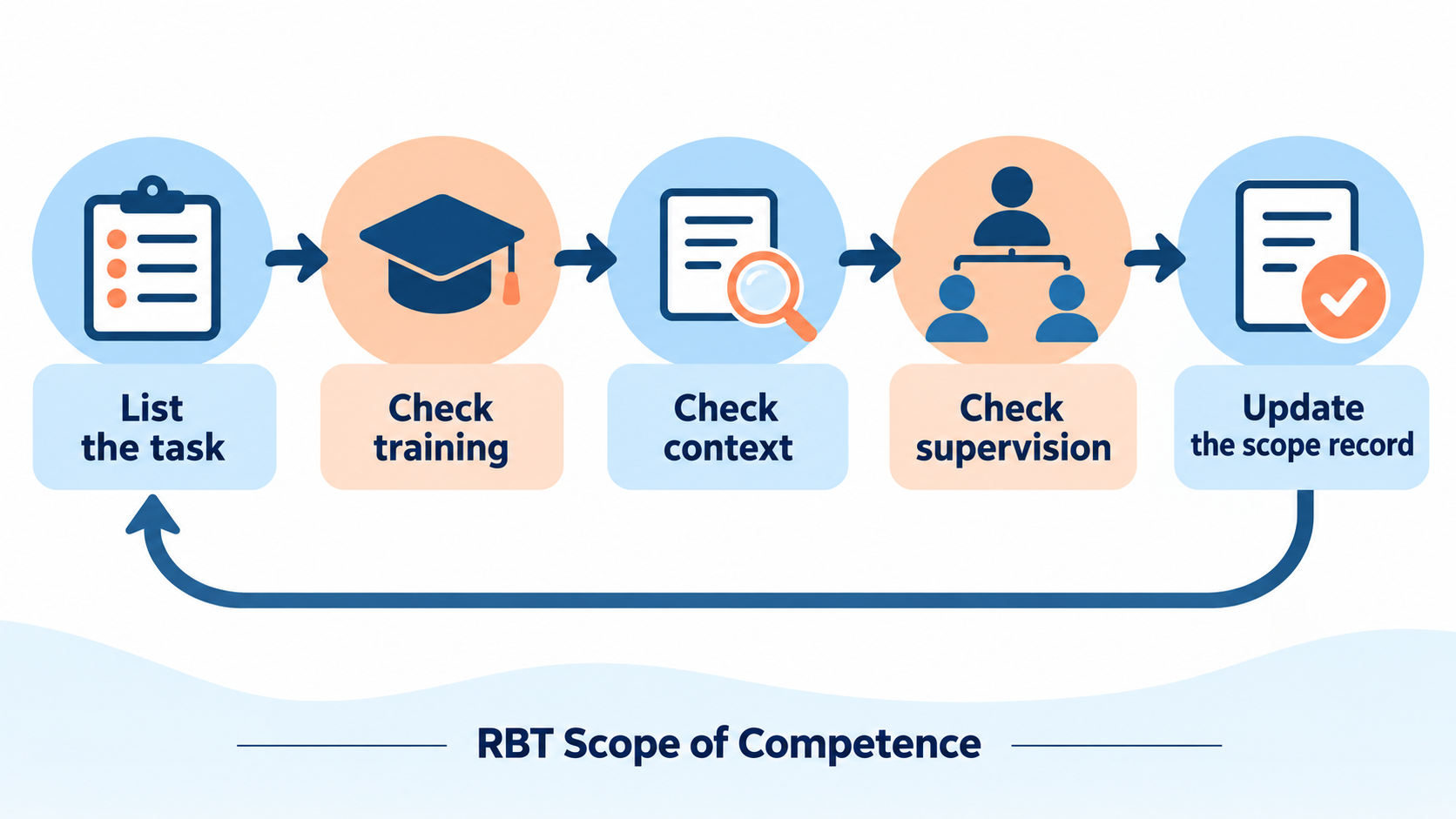
Start with the tasks you are actually expected to perform, not with a general list of everything an RBT might do. For each task, write a short entry with five parts:
- Task: Name the observable action, such as recording duration, delivering a trained prompt, preparing an approved teaching material, or completing an objective session record.
- Current procedure: Identify the plan, form, written instruction, or workflow that governs the task. Note its version or date when the workplace uses one.
- Evidence: Record how training and demonstrated performance were checked. Avoid relying only on memory or confidence.
- Context: Describe the client, setting, communication method, materials, and safety conditions that were included in the verification.
- Support route: Note who to contact, what to document, and what to do if the procedure is unclear or an unexpected event occurs.
This inventory helps reveal hidden assumptions. You may be trained to collect a measure on paper but not yet verified on the electronic system used at a new site. You may know a prompting procedure but need review when the learner uses a new communication device. You may have demonstrated a routine skill but not the same skill under a changed safety protocol.
When the scope needs a new review
Ask for a scope review whenever a meaningful variable changes. Common triggers include a new client or target, a revised behavior-change plan, a new data system, different materials, a new communication modality, a different service setting, a long break from the task, or a new safety concern.
Review is also appropriate when the data do not make sense, the written direction conflicts with what you were taught, the task requires a decision outside your role, or you are being asked to do something beyond your certification or competence. The RBT Ethics Code directs the RBT to promptly inform the supervisor or another appropriate workplace person in that situation and document the communication.
A change does not automatically mean you cannot help. It means the evidence and support need to match the new condition. The supervisor may provide instruction, observe performance, clarify the workflow, assign a different task, or define an interim safety step.
Examples of tasks within scope
A task may be within the working scope when the current procedure is clear, the supervisor has confirmed the required competence, the assignment is authorized, and the supervision route is active. Examples might include:
- recording an assigned measure according to the operational definition and approved data system;
- implementing a taught prompt or reinforcement procedure as written;
- preparing approved materials and following the session setup workflow;
- writing an objective session note that matches observed events and required documentation standards;
- reporting a missed opportunity, uncertain step, safety concern, or data problem to the supervisor.
These examples are not automatic permissions. The relevant question is whether the specific task has been trained, demonstrated, authorized, and placed within the current supervision plan.
Signs a task may be outside scope
Pause and seek direction when you are being asked to design or revise a treatment plan, interpret data beyond your assigned role, select an unapproved intervention, make a clinical decision that belongs to the authorized team, or use a procedure you have not been trained and verified to implement.
Other warning signs are more subtle: the form is missing, the definition is ambiguous, the required equipment is unavailable, the learner’s communication system has changed, the task introduces a new safety risk, or the instruction conflicts with the current written plan. Do not silently fill the gap with a personal workaround.
Protect immediate safety when needed, communicate the problem through the designated route, preserve accurate records, and follow the supervisor’s direction. Being willing to say “I need clarification before I continue” is a professional boundary, not a failure.
How to discuss scope with your supervisor
Bring a specific task rather than a general concern. You can ask:
- What is the current written procedure and which steps are most important?
- What evidence will you use to confirm demonstrated competence?
- What client, setting, equipment, or communication conditions are included?
- What should I do if the procedure is unclear or a safety issue appears?
- Where should I document training, feedback, reassessment, and any limits?
After the conversation, summarize the agreed next step using the workplace’s approved method. If the supervisor says more training or observation is needed, treat that as useful information about the task boundary. If the task is confirmed, keep the conditions and support route visible so that a later change triggers another review.
Frequently asked questions
Does an RBT certificate define the entire scope of competence?
No. Certification and competence are related but different. The task, context, authorization, demonstrated performance, and supervision arrangement still matter.
Can a task be within scope for one employer but not another?
Yes. Workflows, plans, settings, equipment, local requirements, and supervision arrangements can differ. A previous experience does not automatically verify the current task.
What should I do if I am asked to work beyond my competence?
Tell the supervisor or another appropriate workplace person promptly, explain the specific task or condition, follow immediate safety directions, and document the communication through the required process.
Does a supervisor’s absence expand my scope?
No. A supervisor being temporarily unavailable does not authorize independent clinical decisions or a new procedure. Use the designated escalation route and wait for direction when the task is unclear or outside the verified boundary.
Sources and scope note
This guide is based on the BACB RBT Ethics Code (2.0), the BACB Registered Behavior Technician Handbook, and the RBT Test Content Outline (3rd ed.). Requirements can change, and employer, payer, school, state, and legal rules may add obligations. Use current official sources and ask the appropriate supervisor about your situation.
Ready to practice the RBT concepts you just reviewed?
Try an independent, original RBT practice resource with exam-style questions, scoring, and answer explanations.
References
- Behavior Analyst Certification Board. RBT Test Content Outline, 3rd edition.
- Behavior Analyst Certification Board. RBT Handbook.
- Behavior Analyst Certification Board. RBT Ethics Code.