
Ongoing supervision RBT guidance connects day-to-day service delivery with demonstrated competence, direct observation, feedback, and documented follow-up. It continues after initial training because tasks, clients, plans, and settings can change.
Table of Contents
- Ongoing supervision RBT: what it means
- Why supervision continues after training
- What a strong supervision cycle includes
- How the monthly requirement fits the process
- Where group supervision fits
- Records and follow-up
- What to do when supervision is missed or unclear
- Frequently asked questions
- Sources and scope note
RBT SUPERVISION GUIDE · CONTINUOUS SUPPORT
Ongoing Supervision RBT: What It Covers and Why It Matters
How observation, feedback, participation, and records connect daily RBT work with safe and competent service.
Ongoing supervision RBT guidance is the continuing process that connects service delivery with direction, direct observation, feedback, competence review, and follow-up. It is not only an orientation meeting, a signature, or a calendar entry.
The BACB describes RBTs as paraprofessionals who assist with behavior-analytic services under the direction and close ongoing supervision of an RBT Supervisor and/or RBT Requirements Coordinator. The current Handbook and Ethics Code should be the first references for exact requirements. Employers, payers, schools, states, and treatment teams may also add rules.
This guide explains the structure of the process so an RBT can prepare useful questions and records. It cannot decide whether a specific employer or supervision arrangement is compliant.
Ongoing supervision RBT: what it means
Ongoing supervision is a continuing relationship around actual service work. The supervisor helps establish what the RBT is expected to implement, observes enough of the work to evaluate performance, gives feedback, and follows up on skills or concerns. The RBT participates honestly, implements authorized procedures, asks for clarification, and reports limits or errors.
The word “ongoing” matters. A person may complete initial training and still need support when a treatment plan changes, a new client enters service, a data system is replaced, or a familiar procedure is used in a different setting. Supervision keeps the evidence current instead of assuming that an old observation applies forever.
Ongoing supervision is also different from professional development. A general course may help learning, but attendance alone does not show that the RBT can implement a client-specific procedure accurately under the assigned supervision arrangement.
Why supervision continues after training
Initial training introduces concepts and skills. Ongoing supervision checks how those skills operate in real service conditions. It can reveal a measurement error, an unclear prompt step, a documentation gap, a change in learner communication, or a safety issue that was not visible during orientation.
Supervision also protects role boundaries. The RBT implements procedures within the defined role; the authorized supervisor or treatment team makes decisions that belong above that role. If the RBT is asked to work beyond certification or competence, the Ethics Code directs the RBT to promptly inform the supervisor or another appropriate workplace person and document the communication.
A useful supervision process is not designed to make the RBT guess what the supervisor wants. It should make expectations, evidence, feedback, and escalation routes more visible.
What a strong supervision cycle includes
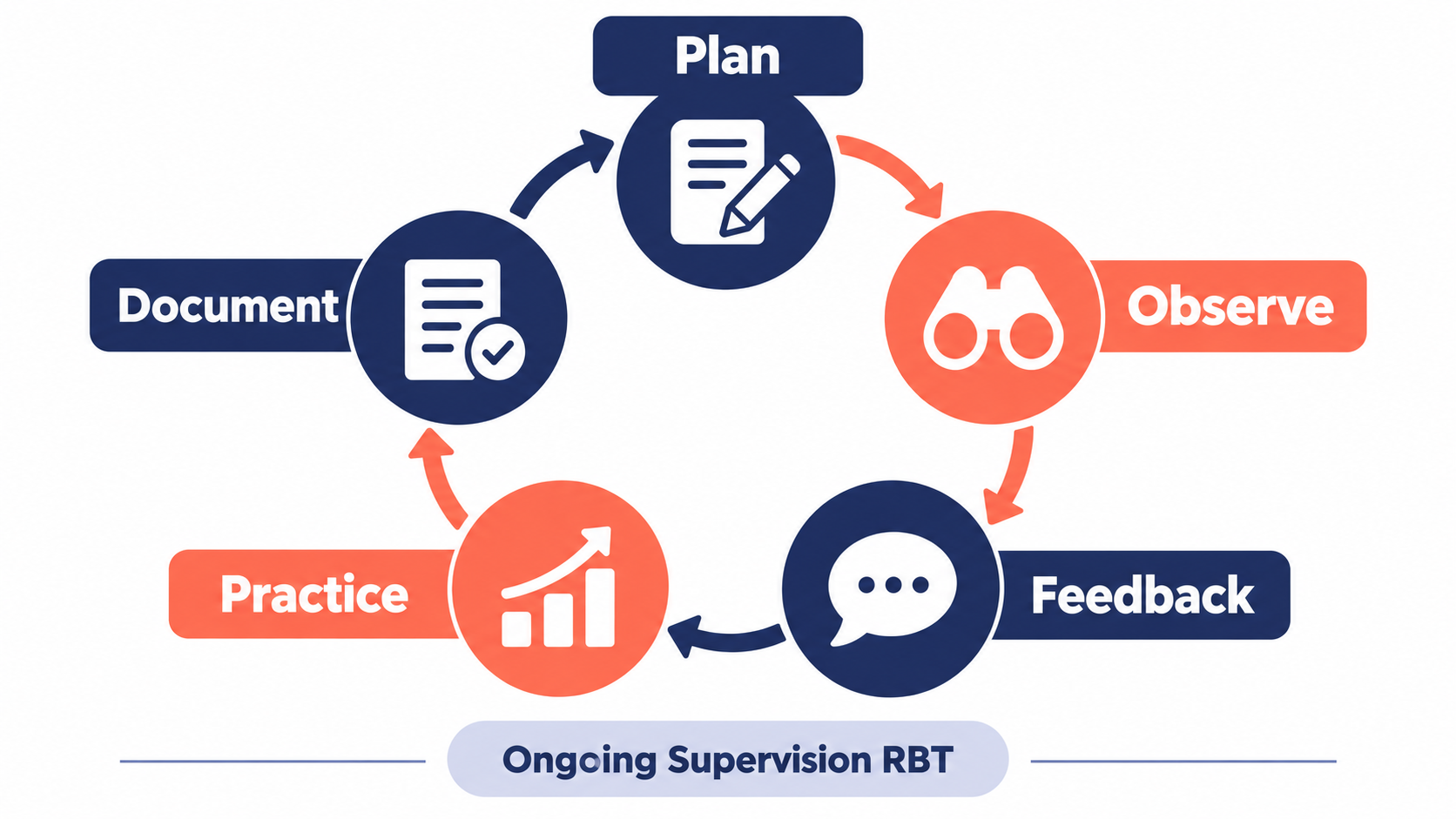
Specific activities vary, but a practical cycle usually includes five connected parts:
- Plan: Identify the current client goals, procedures, data requirements, risk or safety considerations, and the skill the supervisor will review.
- Observe: Watch the RBT implement the work directly or use another task-appropriate method that gives the supervisor meaningful evidence. Direct observation is especially important for performance that cannot be evaluated from a note alone.
- Give feedback: Describe the expected step, the observed step, what went well, and what should change. Feedback should be specific enough to practice.
- Practice and participate: The RBT asks questions, rehearses or repeats the relevant skill, and demonstrates that the feedback is understood. Passive attendance is not the same as active participation.
- Document and follow up: Record the date, type of contact, relevant client-focused activity, feedback, next action, and any reassessment needed through the approved system.
These parts form a loop rather than a one-time checklist. A new observation may lead to a practice plan; the next contact checks whether the change was implemented and whether the context has changed again.
How the monthly requirement fits the process
Current BACB RBT requirements describe ongoing supervision of at least 5% of behavior-analytic service hours each calendar month. Treat that percentage as one requirement within a broader process, not as a quality score. The current Handbook controls if wording, calculations, exceptions, or documentation rules change.
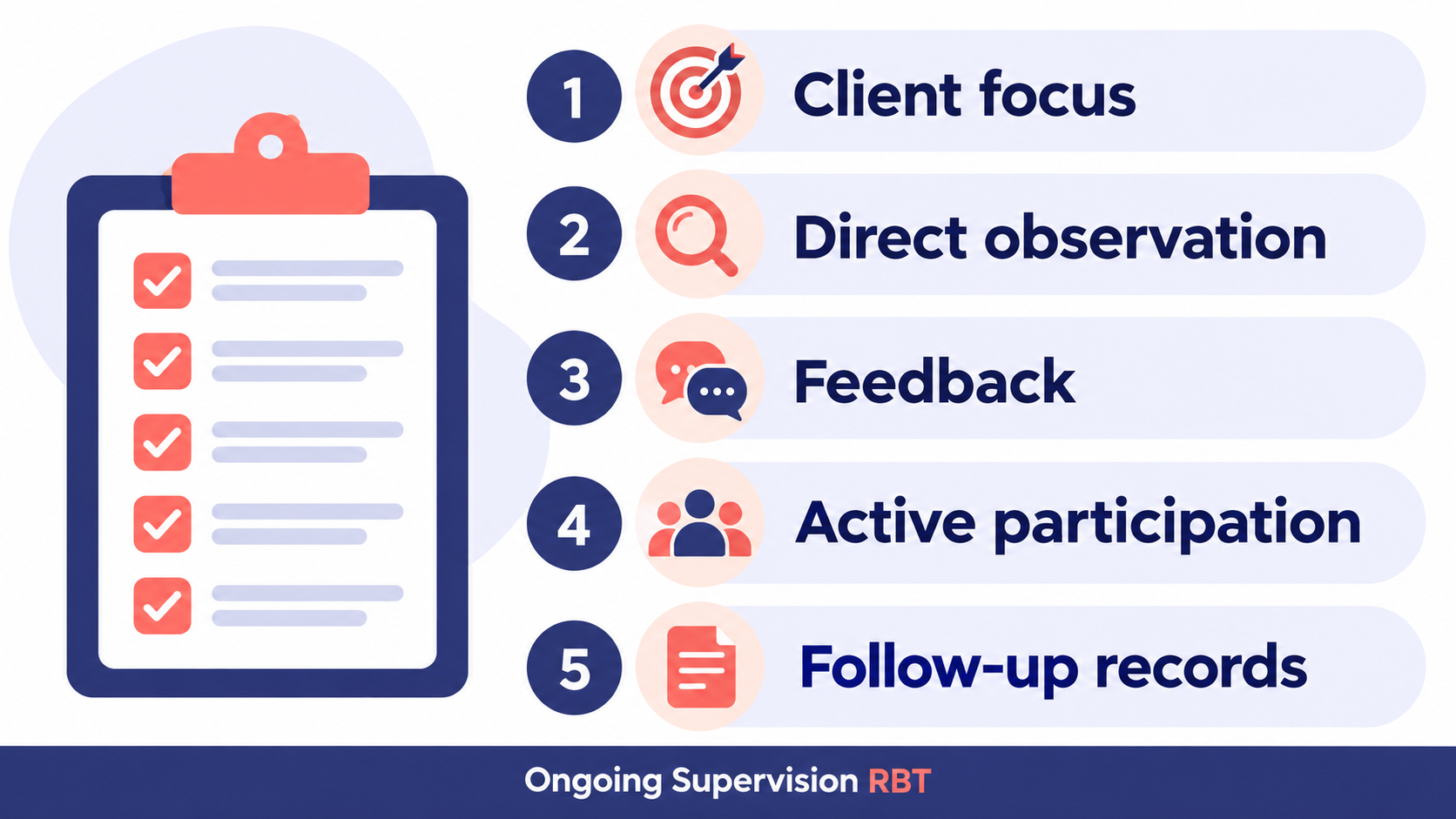
The percentage does not mean that any five out of one hundred hours automatically creates effective supervision. The contacts still need to meet the applicable expectations for client focus, participation, observation, feedback, and records. A tracker can help calculate hours, but a tracker by itself cannot demonstrate the quality or content of supervision.
RBTs can prepare by keeping an accurate service-hours record, checking which activities count under the current rules, and asking how the supervisor wants observation and follow-up documented. Do not fill a gap with guessed hours or a retroactive description.
Where group supervision fits
Group supervision can be useful when the activity is relevant, structured, and consistent with the current requirements. It may allow RBTs to discuss implementation questions, practice communication, or learn from common errors. But group attendance does not automatically replace every required individual element.
Ask how the arrangement handles individual performance, direct observation, active participation, client-specific information, and feedback that should not be shared broadly. A group meeting that covers general policy may be valuable staff training without being the same thing as client-focused supervision.
Protect confidentiality during group activities. Use the approved level of detail, avoid unnecessary identifying information, and follow workplace rules for records and case discussion.
Records and follow-up
Good records let the RBT and supervisor reconstruct what happened without relying on a vague memory. Depending on the approved system, useful fields may include:
- date, participants, and type of supervision contact;
- service hours or other information used for the current calculation;
- client-focused topic or skill observed;
- feedback given, practice completed, and the agreed next step;
- any concern, limit, missed observation, or reassessment date.
Records should be objective, timely, confidential, and consistent with the workplace process. Do not backdate supervision, describe an observation that did not occur, or copy a generic note that hides the actual activity. If a correction is needed, use the approved correction route.
What to do when supervision is missed or unclear
Raise the issue promptly. Tell the supervisor or designated workplace contact what was scheduled, what did not happen, which service hours or task may be affected, and what direction you need. Keep the message factual and use the required documentation channel.
Until you receive direction, do not independently create a replacement supervision plan, sign for a contact that did not occur, or continue a procedure that is unclear or unsafe. Follow immediate safety instructions and the organization’s escalation route. If the issue cannot be resolved through the normal route, ask which appropriate workplace person should be informed.
A missed contact can require a different plan, but it does not automatically mean that every service decision belongs to the RBT. The supervisor or authorized organization determines the corrective action.
Frequently asked questions
Is ongoing supervision the same as the initial RBT training course?
No. Initial training prepares a person for the certification pathway. Ongoing supervision continues during service delivery and checks current implementation, competence, feedback, and follow-up.
Does a staff meeting count as ongoing supervision?
Not automatically. Ask whether the activity meets the current BACB and workplace requirements for client focus, participation, observation, feedback, and documentation.
Does the 5% number prove that supervision is effective?
No. It is a current quantitative requirement described by the BACB, not a complete quality score. The content and evidence of the supervision contacts still matter.
What if I need help between scheduled contacts?
Use the designated communication and escalation route. A scheduled contact does not require you to wait silently when a procedure is unclear, a safety concern appears, or you are asked to work beyond your verified competence.
Sources and scope note
This guide is based on the BACB Registered Behavior Technician Handbook, the BACB RBT Ethics Code (2.0), and the RBT Test Content Outline (3rd ed.). Requirements can change, and employer, payer, school, state, and legal rules may add obligations. Check current official sources and ask the appropriate supervisor about your situation.
Ready to practice the RBT concepts you just reviewed?
Try an independent, original RBT practice resource with exam-style questions, scoring, and answer explanations.
References
- Behavior Analyst Certification Board. RBT Test Content Outline, 3rd edition.
- Behavior Analyst Certification Board. RBT Handbook.
- Behavior Analyst Certification Board. RBT Ethics Code.