

When someone searches for the RBT test, they may mean the certification examination, a practice test, an eligibility question, or a test-day planning problem. A useful study guide should separate those meanings before it offers advice. The official source defines the certification exam; independent practice resources help you rehearse decisions.
Table of Contents
- What the RBT test can mean
- Know the current exam boundary
- Understand the six study domains
- Study for applied decisions
- Use practice tests without overreading scores
- Make a test-day review plan
- Practice RBT test decisions
- Avoid these RBT test study mistakes
- Frequently Asked Questions
- References
This guide explains the current RBT test structure, the 3rd-edition academic boundary, how to study across six domains, and how to use practice questions without confusing a practice score with an official result.
RBT Training is independent and is not affiliated with, operated by, or endorsed by the Behavior Analyst Certification Board (BACB). The examples and practice prompts below are newly written for independent study. They are not official, recalled, leaked, or BACB-endorsed questions. No study guide or practice score guarantees certification.
What the RBT test can mean
Search intent changes the right answer. If you are asking “What is the RBT test?” you need an official overview. If you are asking “How do I practice?” you need original questions and explanations. If you are asking “Why did I miss a practice test?” you need an error analysis, not another download.
| Meaning | Useful evidence | Do not confuse it with |
|---|---|---|
| Certification examination | Current BACB RBT page, handbook, and TCO. | A provider’s mock test. |
| Practice test | Independent questions, rationales, and domain map. | Official exam content. |
| Competency assessment | Current assessment requirements and supervisor process. | A multiple-choice exam score. |
| Study plan | Correction log, source review, and fresh scenario practice. | A promise that a certain number of hours guarantees a pass. |
This distinction prevents two common errors. First, a practice page may describe its own format as “like the real exam,” but that does not make it official. Second, a certification examination is not the same as a clinical training session. Keep exam preparation, workplace supervision, and clinical decision-making in their proper lanes.
Know the current exam boundary
The current academic source is the RBT Test Content Outline, 3rd edition. It describes 43 tasks across six domains. Current exam context includes 75 scored questions and 10 unscored pilot questions. The total administered set is therefore discussed differently from the scored result; a study resource should state which number it uses.
| Boundary check | Study implication | Red flag |
|---|---|---|
| Current edition | Use the 3rd-edition task and domain language. | Old task-list language presented as current with no note. |
| Question status | Keep scored and unscored pilot context distinct. | Calling all practice or administered items scored. |
| Official versus independent | Use BACB sources for scope and independent resources for rehearsal. | “Official,” “real,” or “leaked” practice claims. |
| Role and ethics | Study implementation under supervision, privacy, and reporting. | Answers that ask an RBT to diagnose or rewrite a plan. |
Exam facts and eligibility requirements can change, so use the live BACB page and current handbook when making a registration or application decision. This article’s study guidance should not replace those official requirements.
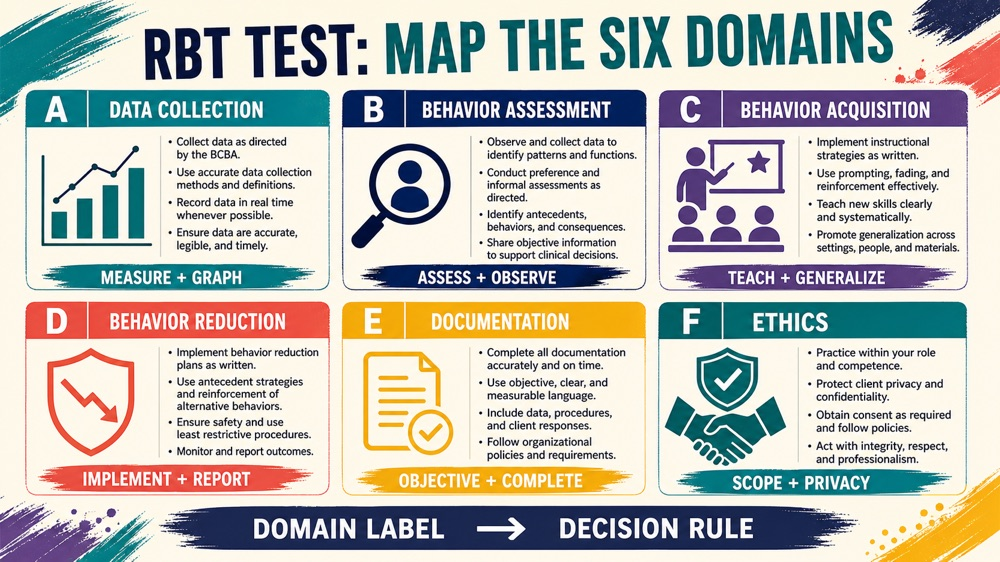
Understand the six study domains
Use the six-domain map as a study organizer, not as a substitute for the task wording:
| Domain | Core study questions |
|---|---|
| A. Data Collection and Graphing | What is observable? Which measure fits? How are data recorded and displayed? |
| B. Behavior Assessment | What does the assessment identify? What procedure is assigned? What does the result not prove? |
| C. Behavior Acquisition | How are teaching steps, prompts, reinforcement, shaping, chaining, and generalization implemented? |
| D. Behavior Reduction | How is the target defined, the written plan implemented, and safety or uncertainty reported? |
| E. Documentation and Reporting | How are notes objective, complete, timely, and useful to the team? |
| F. Ethics | How are privacy, scope, supervision, conflicts, and professional conduct protected? |
A domain label is only the beginning. Convert it into contrasts. For measurement, compare latency with duration and count with rate. For assessment, compare preference information with a functional conclusion. For acquisition, compare prompting with reinforcement and task analysis with chaining. For ethics, compare helpful disclosure with authorized communication.
These contrasts are what make a scenario answerable. Memorizing six headings without the decision points leaves you vulnerable to plausible distractors.
Study for applied decisions
Use a three-layer study block:
- Define: write the concept in observable, plain language.
- Distinguish: write the nearest competing concept and the clue that separates them.
- Apply: solve a fresh scenario and explain why the distractors fail.
For example, “latency” is not just “time.” The decision rule is the time between a specified event, such as an instruction, and response onset. “Duration” begins when the response starts and measures how long it continues. A scenario can include both time points, so the task is to identify the starting event.
Use the written plan as a controlling condition. If the plan specifies a data system, prompt sequence, reinforcement schedule, or reporting route, the RBT implements it and reports uncertainty. The most creative answer is not necessarily the most appropriate answer.
Ethical study also means protecting examples. Do not use real client names, identifying details, or screenshots in public practice logs. Keep independent examples newly written and separate from workplace documentation.
Use practice tests without overreading scores
A practice test is useful when you know its conditions. Record the number of items, time limit, feedback timing, domain mix, and whether the questions were fresh.
| Condition | What it measures | How to interpret it |
|---|---|---|
| Immediate feedback | Learning and explanation response. | Good for instruction; not a clean readiness baseline. |
| Untimed fresh set | Concept application without pacing pressure. | Useful for identifying knowledge and reasoning gaps. |
| Timed full set | Pacing, endurance, and decision-making under time. | Review wrong and low-confidence answers afterward. |
| Repeated identical set | Recall of familiar items. | Do not treat improvement as full transfer. |
Use correct-but-guessed answers as review items. A score can look strong while confidence is fragile. The correction log should record the clue, not just the letter.
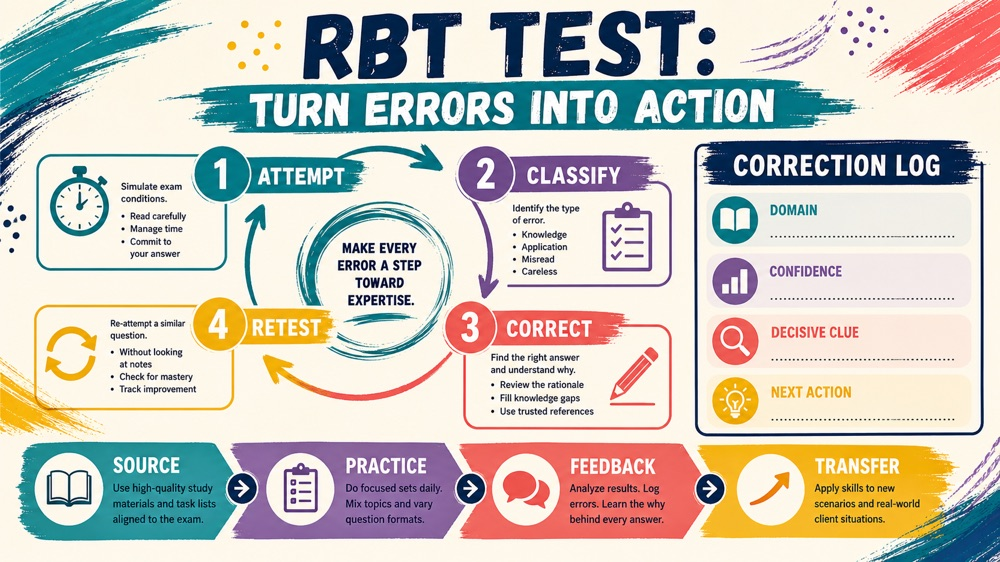
Make a test-day review plan
In the final review window, protect retrieval and decision clarity:
- Review current scope and your own correction rules rather than downloading many new resources.
- Complete a small mixed set to warm up, then stop before fatigue turns into guessing.
- Practice reading the condition first: unit, timeline, plan, privacy, or supervision.
- Prepare practical logistics from the current official instructions, including identification, appointment, and accommodation information if relevant.
- Do not treat a practice score or a marketing threshold as an official pass standard.
For any live registration or eligibility question, return to the current BACB page and handbook. For any workplace procedure question, use supervision. An exam-prep article cannot resolve a client-specific clinical decision.
Practice RBT test decisions
These original prompts help you rehearse the way a current RBT test scenario may require you to think:
- The stem asks how long it takes a learner to start after an instruction. Which measurement term controls the answer, and what event starts the clock?
- A preferred item is selected during an assessment. What can the observation identify, and what would require evidence about future behavior?
- The written plan specifies whole-interval recording, but a brief response occurs during the interval. What does the scoring rule require?
- A caregiver asks the RBT to change the intervention immediately. What role-safe action follows the written plan and supervision route?
- You are correct on a practice item but cannot explain the distractors. How should the correction log classify your confidence?
- A practice site uses 85 items. Which official current numbers should you keep separate when describing scored and unscored exam context?
After each answer, write the decisive clue in one sentence. That sentence is more portable than memorizing a page of answer letters.
Avoid these RBT test study mistakes
- Using an outdated source: confirm the current 3rd-edition outline and handbook.
- Confusing test types: separate certification exam, competency assessment, and practice test.
- Memorizing only definitions: add contrasts and fresh scenarios.
- Overreading a score: record timing, feedback, domain mix, and confidence.
- Ignoring role boundaries: follow the plan and supervision route.
- Sharing protected information: keep public practice examples independent and de-identified.
- Studying until exhausted: protect accurate retrieval and test-day logistics.
Bottom line: the RBT test is not one interchangeable thing. Use the official current source for certification scope, independent questions for applied practice, and a correction log to turn errors into next actions.
Ready to study by decision rule?
Use independent RBT practice questions, log the controlling clue, and retest the concept with a fresh scenario.
Try Free RBT Practice Questions →
Frequently Asked Questions
What is the RBT test?
It commonly refers to the RBT certification examination, but people also use the phrase for practice tests or competency assessment. Check the context and source.
What is the current RBT exam outline?
The current academic source is the RBT Test Content Outline, 3rd edition, which describes 43 tasks across six domains.
How many questions are scored?
Current exam context distinguishes 75 scored questions from 10 unscored pilot questions. Keep that distinction separate from a provider’s practice-item count.
Are practice questions official?
Independent practice questions are not official BACB exam content. Use the BACB outline and handbook for official scope and requirements.
How should I use a low practice score?
Classify errors by domain, confidence, and decisive clue, then choose a targeted review and a fresh retest.
References
- Behavior Analyst Certification Board. Registered Behavior Technician examination resources.
- Behavior Analyst Certification Board. RBT Test Content Outline, 3rd edition.
- Behavior Analyst Certification Board. RBT Handbook, updated June 2026.
- Behavior Analyst Certification Board. RBT Ethics Code.